Choose Accurate Adjectives for War
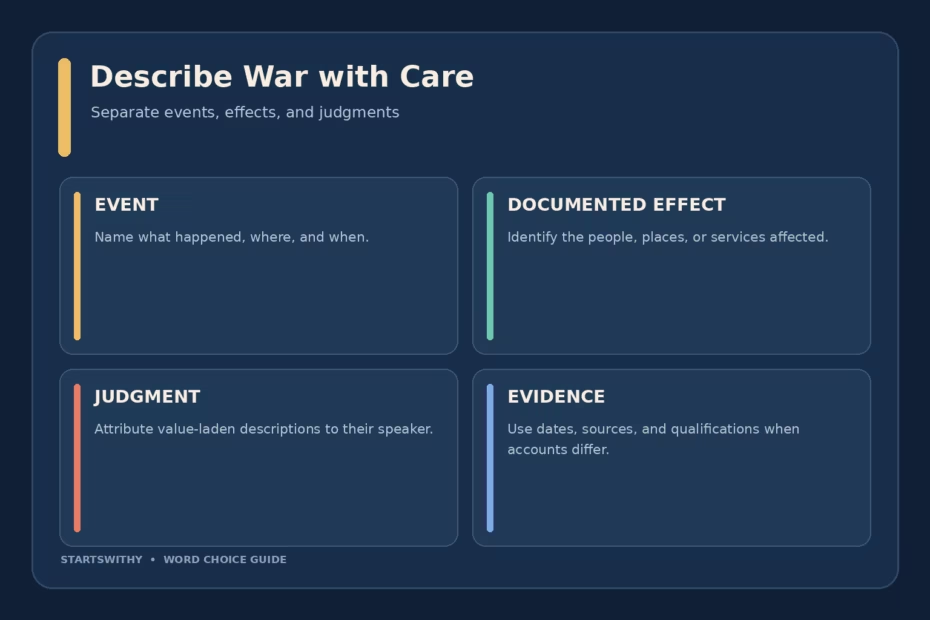
War is a subject where word choice carries real weight. An adjective can describe the scale of fighting, the experience of people caught in it, or a writer’s judgment about what happened. Those are different jobs. Prolonged describes duration; destructive describes an effect; unjust makes a moral judgment. Clear writing identifies which kind of claim it is making and supports factual claims with evidence.
Use the lists below as a vocabulary guide, not as a ranking of suffering or a way to make violence sound exciting. When details are uncertain, qualify the description and identify who supplied the information. The International Committee of the Red Cross explains that international humanitarian law distinguishes civilians from combatants and requires precautions to protect civilians during attacks. That is also a useful writing principle: keep civilians visible as people, not as background scenery. ICRC: Conduct of hostilities and protection of civilians.
Adjectives for the Course and Scale of a War
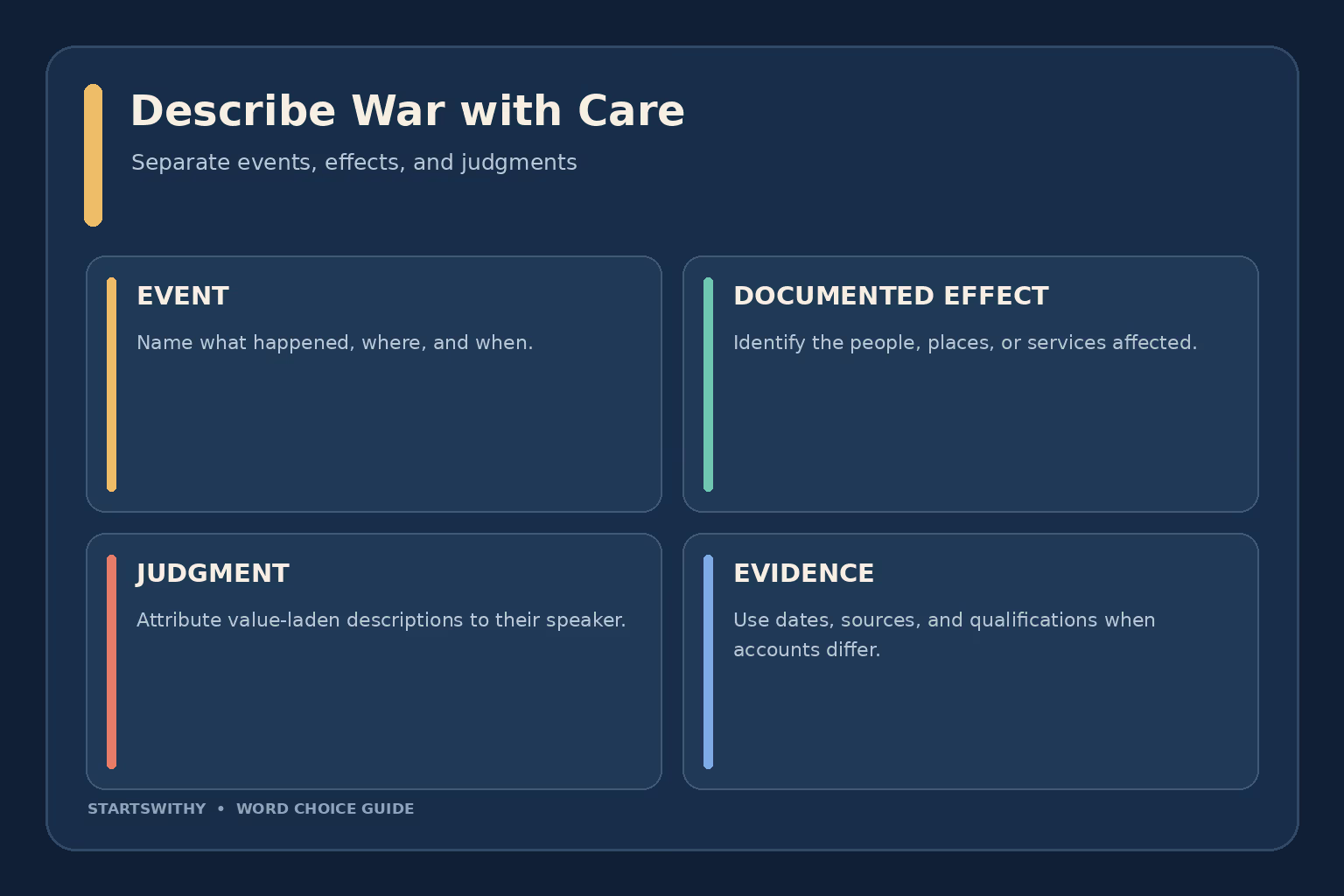
These words describe a conflict’s pattern or reach. Use them only when the underlying facts support them. A war may change over time, and one label rarely explains every front, community, or phase.
- Prolonged: continuing for a long time. “The prolonged conflict disrupted schooling across several generations.” Give dates or a defined period where possible.
- Widespread: affecting many places or people. “Widespread displacement was reported across the region.” State the area and source instead of using the word as a substitute for numbers.
- Regional: involving or affecting a particular region. It does not necessarily mean that every neighboring country is a belligerent.
- Interstate: involving two or more states. This is a specific political description, not a synonym for every armed conflict.
- Internal: occurring within a state. In legal and historical writing, use the relevant classification carefully; an internal conflict can involve outside forces too.
- Escalating: becoming more intense or serious. Say what is increasing—fighting, weapons use, casualties, or the number of areas affected.
- Stalemated: showing little movement toward a decisive military outcome. Avoid implying that political negotiations or civilian conditions are also unchanged.
- Unresolved: not settled or brought to an agreed conclusion. This can describe a conflict after active fighting has declined.
Words for Fighting and Conditions
When writing about operations or battles, choose concrete terms that describe observable conditions. A battle can be intense or chaotic for people experiencing it, but those impressions need a clear point of view. Urban identifies a setting; it does not automatically describe the people who live there or the legality of an attack.
- Intense: involving concentrated effort or activity. Explain whether you mean heavy fire, a high tempo, or severe strain on those involved.
- Protracted: drawn out over an extended period, often despite attempts to bring it to an end. It is more formal than “long.”
- Destructive: causing substantial damage. Name what was damaged—homes, roads, hospitals, farmland, or cultural sites—when this is known.
- Disruptive: interrupting ordinary systems or routines. This may fit a description of closed schools, interrupted utilities, or inaccessible services.
- Urban: occurring in a town or city. Pair it with specific information about the location and civilian surroundings.
- Unpredictable: difficult to anticipate. Attribute this to the people or reports describing the conditions rather than making it an all-purpose label.
- Contested: disputed or not securely controlled. This can be more accurate than confidently naming control when accounts differ.
- Ceasefire-bound: subject to a declared pause in fighting. A ceasefire announcement does not by itself establish that every party has stopped all hostilities.
Adjectives for Human and Community Effects
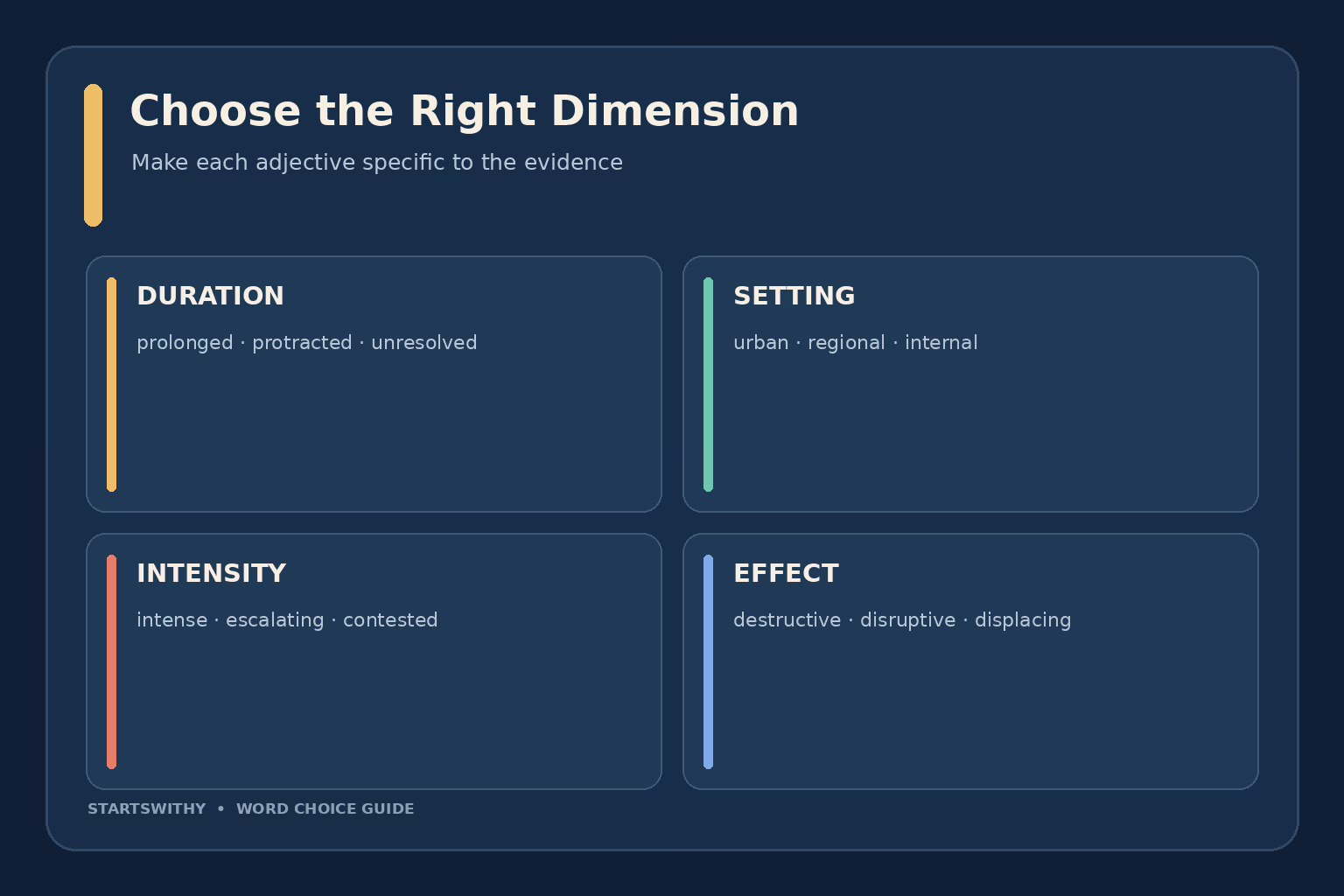
People affected by war have different experiences. Avoid turning a population into one emotional character or suggesting that trauma looks the same for everyone. Use a word that fits the detail being reported, and name whose experience it describes.
- Displacing: forcing people to leave their homes or usual places of residence. Say whether people crossed a border or moved within their country if that is established.
- Traumatic: causing or connected with severe distress. Use it with care, especially when describing an individual without their account or a qualified assessment.
- Grief-stricken: experiencing grief after loss. Attribute this description to people’s words or observed circumstances; do not assume every survivor responds the same way.
- Precarious: insecure or likely to worsen. It can describe access to shelter, food, medical care, or legal protection when evidence supports the risk.
- Resilient: able to recover or continue despite difficulty. Avoid using it to imply that people should simply endure deprivation or that support is unnecessary.
- Disrupted: interrupted or thrown out of normal operation. This is often useful for services, education, livelihoods, and family routines.
- Devastating: causing severe damage, loss, or distress. Make the impact concrete, and avoid applying it as dramatic decoration.
- Humanitarian: concerned with human welfare and relief. “A humanitarian crisis” should be connected to evidence about need, access, and conditions.
Positive-Sounding Words Need Context, Too
Words such as brave, heroic, victorious, and liberating often express a viewpoint. They may be appropriate in a quotation, memoir, or clearly identified account, but they should not silently turn an article into a celebration of violence. Describe the action and identify the speaker: “Residents called the rescue team’s work heroic” is more transparent than presenting “heroic” as a neutral fact.
- Brave: showing courage in danger. It is an evaluative description; explain whose action is being praised and why.
- Heroic: showing exceptional courage or self-sacrifice. Attribute the judgment when it comes from a particular community, witness, or source.
- Victorious: having won a contest or achieved a military objective. Clarify which objective and the time frame; a battlefield success does not settle the human or political consequences.
- Defensive: intended to protect against an attack. The label may reflect a party’s stated purpose, so distinguish that account from independently established facts.
- Liberated: freed from control or occupation. This can be a politically loaded description; specify who uses the term and how affected residents describe the change.
- Patriotic: expressing devotion to one’s country. It can describe a belief or message, but does not establish that a policy or military action is justified.
The distinction between observation and evaluation helps readers understand both the event and the viewpoint. A sentence such as “The army’s victorious advance was heroic” combines a claim about the outcome with two judgments. A more accountable version might say: “The government described the advance as a victory; independent reporting confirmed that its forces entered the town, while the longer-term effects remained unclear.”
How to Describe War Without Overstating the Evidence
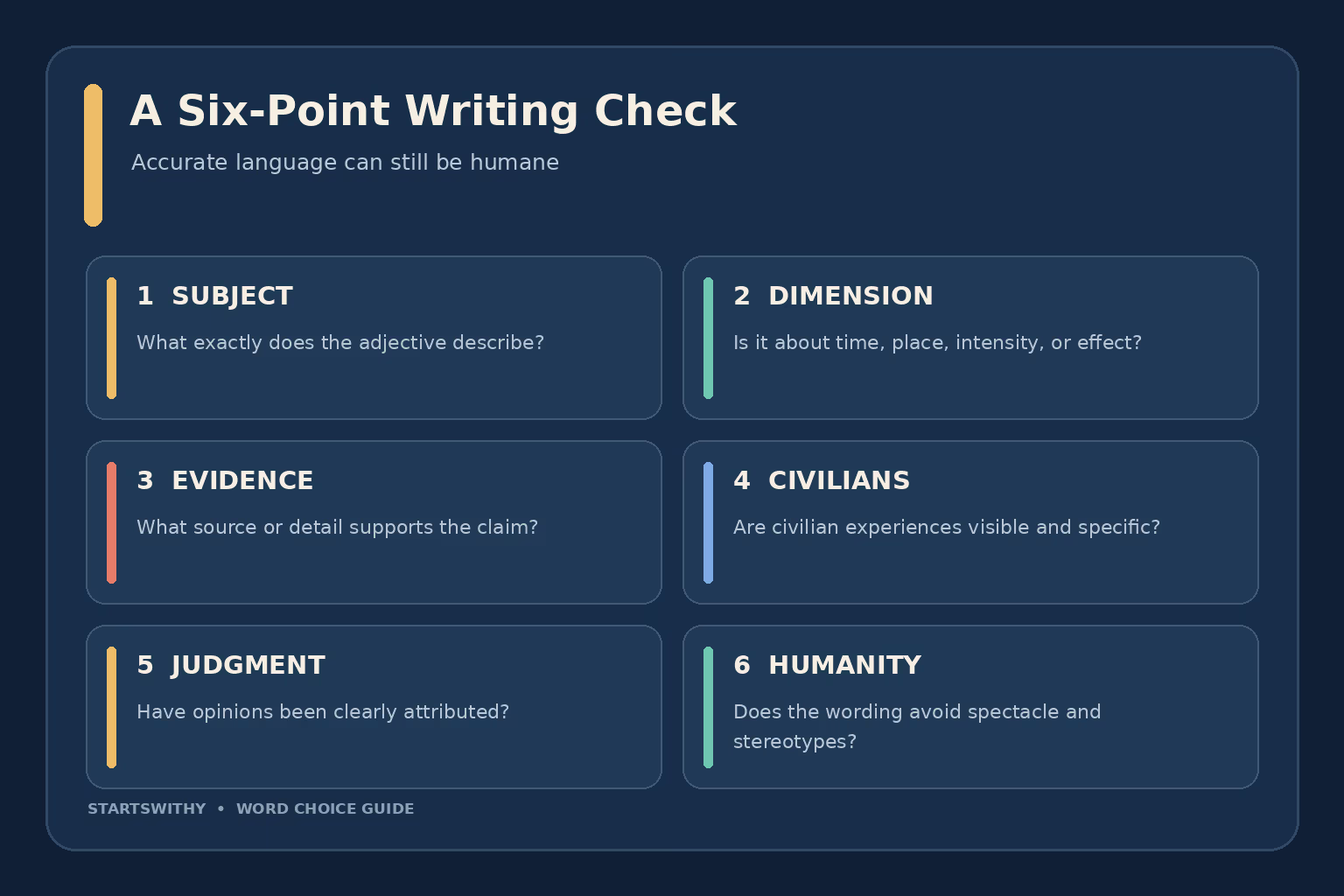
- Identify the subject. Is the adjective describing a battle, a policy, damage to infrastructure, a person’s account, or a community’s circumstances?
- Choose one dimension. Prefer “prolonged fighting” for duration or “destructive shelling” for a documented effect instead of stacking several dramatic adjectives.
- Give the basis. Name the source, date, location, or measurable detail that supports the description. If accounts disagree, say so.
- Keep civilians in view. Describe effects on homes, safety, family life, medical care, and access to essentials when reliable information exists.
- Separate fact from judgment. Mark a quoted or political characterization as someone’s view; do not let a value-laden adjective masquerade as a verified fact.
- Use humane language. Avoid language that treats people as scenery, uses suffering as spectacle, or implies that an entire population shares one trait.
Examples: More Precise Sentences About War
- Less precise: “The terrible war changed everything.” More specific: “After months of fighting, the closure of the main road limited access to the town’s hospital.”
- Less precise: “The brave civilians stayed strong.” More specific: “Several residents described how they organized shared transport to reach the clinic.”
- Less precise: “A heroic victory freed the city.” More specific: “The armed group withdrew from the city on Tuesday; residents and officials used different terms to describe what followed.”
- Less precise: “The attack was barbaric.” More specific: “The strike damaged three apartment buildings, according to the local emergency service; responsibility had not been independently confirmed.”
- Less precise: “The population was resilient.” More specific: “Community volunteers reopened a temporary classroom while families continued to request safe housing.”
These revisions do not remove emotion from the subject. They show readers what is known, who is speaking, and where a judgment begins. When a witness uses a vivid adjective, preserve it accurately as a quotation and provide enough context to understand their perspective.
Common Questions About War Adjectives
What are neutral adjectives for war?
Prolonged, regional, internal, urban, contested, and unresolved can be relatively descriptive when they are factually accurate. Even a seemingly neutral word needs context: “contested” should tell readers what control is disputed, and “regional” should identify the region.
What is a strong adjective for a war?
Destructive or protracted may be effective when evidence supports the description. The strongest choice is usually the most specific accurate word, not the most dramatic one.
Can “heroic” describe a soldier?
Yes, when the writer is intentionally expressing praise or reporting another person’s view. For neutral reporting, describe the action and attribute the judgment: “Her fellow medics called the evacuation heroic.”
How can I describe civilians affected by war respectfully?
Name the reported circumstances—such as displacement, interrupted schooling, or limited access to medical care—and avoid generalizing about an entire community’s feelings or character. Attribute personal experiences to the people who shared them.
Sources and Further Reading
- Cambridge Dictionary: “war” — meaning and usage.
- International Committee of the Red Cross: Conduct of hostilities and protection of civilians — distinction, proportionality, and precautions under international humanitarian law.
- International Committee of the Red Cross: Frequently asked questions about the rules of war — overview of international humanitarian law.
- United Nations Sustainable Development Goal 16 — peace, justice, and strong institutions.

War is a complex and multifaceted phenomenon that has shaped human history for centuries. As a writer, I find myself constantly searching for the right words to capture the essence of this intense and often devastating experience. In this article, I will delve into the world of adjectives for war, exploring the various ways we can describe the tumultuous nature of conflict. From words that evoke power and destruction to those that convey resilience and heroism, I will provide a comprehensive list of descriptive words and examples to help paint a vivid picture of the battlefield. So, join me as we embark on a linguistic journey through the trenches of war.
War is a realm where emotions run high and the stakes are unimaginably high. It is a crucible that tests the limits of human endurance and reveals both the darkest and noblest aspects of our nature. In this article, I’ll be sharing a collection of adjectives that can aptly describe the chaos, bravery, devastation, and triumph that war encompasses. Whether it’s the thunderous roar of artillery or the quiet determination of soldiers on the front lines, these words will help us better understand and articulate the profound impact of war. So, let’s dive into the rich tapestry of adjectives that illuminate the complex reality of warfare.
How to Describe war? – Different Scenarios
When it comes to describing war, there are countless scenarios we can explore. Each scenario presents a unique perspective on the intensity and devastation of conflict. Let’s dive into a few different scenarios and the adjectives that best capture their essence.
- Battles on the Frontline
- Aerial Bombardment
- Sieges and Blockades
- Guerrilla Warfare
- Post-War Devastation
Each scenario presents a different facet of the complex nature of war. Describing these scenarios allows us to capture the emotions, impacts, and consequences of conflict. It is through our words that we can shine a light on the realities of war and perhaps inspire a collective determination to pursue peace.
Describing Words for war in English
When it comes to describing the intensity and impact of war, using the right adjectives is crucial. These words help us paint a vivid picture of the emotions, actions, and consequences associated with armed conflict. In this section, I’ll provide you with a variety of adjectives that can be used to describe war. Let’s dive in:
- Brutal: War can be brutal, with acts of extreme violence and cruelty taking place on the battlefield. It’s important to remember that the brutality of war affects not only soldiers but also innocent civilians caught in the crossfire.
- Devastating: War leaves a trail of devastation in its wake. Buildings destroyed, lives lost, and communities torn apart. The impact of war is often long-lasting and can take years, or even generations, to recover from.
- Chaotic: The chaos of war is overwhelming. It’s a situation where order breaks down, and uncertainty and confusion reign. Battles are fought on multiple fronts, making it hard to predict what will happen next.
- Terrifying: War instills fear in the hearts of those involved. The constant threat of violence and death can create a climate of terror that permeates every aspect of life.
- Relentless: War is an unending struggle. The fighting seems to go on without respite, with no clear end in sight. It’s a relentless battle that drains the strength and resources of all those involved.
- Heartbreaking: In war, there are countless stories of heartbreak. Families torn apart, children orphaned, and dreams shattered. The emotional toll of war is profound and leaves scars that may never fully heal.
- Heroic: Despite the horrors of war, there are acts of heroism and bravery. Soldiers who put their lives on the line for their comrades and civilians who risk their own safety to help others. These acts of heroism are a glimmer of hope in an otherwise dark landscape.
- Senseless: War is often described as senseless because of the unnecessary suffering it brings. Lives are lost, resources are wasted, and conflicts arise that could have been resolved through diplomacy and dialogue.
It’s important to remember that war is a complex and multifaceted phenomenon, and these adjectives only scratch the surface of its impact.
Adjectives for war
When it comes to describing war, finding the right words can be a challenge. As an expert blogger with years of experience, I understand the importance of using descriptive adjectives to paint a vivid picture of the intensity and impact of armed conflict. In this section, I will provide you with a range of adjectives that can be used to describe war, both positive and negative. Let’s explore!
Positive Adjectives for War
While war is often associated with destruction and suffering, there are occasions when it is important to highlight positive aspects of wartime experiences. Here are some examples of positive adjectives that can be used to describe war, along with example sentences:
| Adjective | Example Sentence |
|---|---|
| Courageous | The soldiers showed courageous determination. |
| Triumphant | The nation celebrated a triumphant victory. |
| Resilient | Despite challenges, the war effort remained resilient. |
| United | The community came together in united support. |
| Noble | Many acts of noble sacrifice were witnessed during the war. |
Negative Adjectives for War
It is important to recognize the negative aspects of war as well, as it can bring devastation and tragedy. Here are some examples of negative adjectives that can be used to describe war, along with example sentences:
| Adjective | Example Sentence |
|---|---|
| Brutal | The war resulted in brutal loss of life. |
| Devastating | The impact of the war was devastating for the country. |
| Chaotic | The battlefield was chaotic and unpredictable. |
| Terrifying | The sounds of explosions were terrifying. |
| Relentless | The war’s relentless advance left no refuge. |
As you can see, war is a complex and multifaceted subject. Using the right adjectives can help to convey the range of emotions, actions, and consequences associated with armed conflict. Whether highlighting the bravery of soldiers or the devastation caused by war, it is crucial to choose words that accurately capture the essence of the experience.
Synonyms and Antonyms with Example Sentences
Synonyms for war
When it comes to describing war, there are various synonyms that can paint a vivid picture of the experience. Here are some synonyms to help you accurately convey the emotions, actions, and consequences associated with armed conflict:
- Battle: The fierce battle raged on, with soldiers fighting bravely for their beliefs.
- Conflict: The conflict between the two nations escalated, leading to devastating consequences.
- Warfare: The history books are filled with tales of warfare and its impact on societies.
- Struggle: The struggle for power and control has resulted in countless lives lost.
- Combat: The soldiers were prepared for combat, ready to face any challenges that lay ahead.
Antonyms for war
In contrast to the synonyms, antonyms provide the opposite meaning, giving us a perspective on peace and the absence of war. Here are some antonyms for war:
- Peace: After years of turmoil, the agreement brought an end to the war and ushered in an era of peace.
- Harmony: The nations worked together in harmony, resolving their differences without resorting to war.
- Tranquility: The serene landscape offered a glimpse of tranquility amidst the chaos of war.
- Reconciliation: The nations sought reconciliation to heal the wounds of war and build a brighter future.
- Diplomacy: Through careful diplomacy, conflicts were resolved peacefully, averting the need for war.
Importantly, these synonyms and antonyms provide a comprehensive range of words to describe war and its contrasting counterpart, peace. Using the right words allows us to capture the essence of these experiences accurately.
Conclusion
In this article, I have delved into the intricate world of war and provided a comprehensive list of adjectives that can be used to accurately describe the various aspects of armed conflict. By exploring synonyms such as battle, conflict, warfare, struggle, and combat, we can paint a vivid picture of the intensity and chaos that war entails. On the other hand, antonyms like peace, harmony, tranquility, reconciliation, and diplomacy allow us to contrast the destructive nature of war with the hope and serenity that comes with peace.
Choosing the right words to describe war is crucial in conveying its true essence. By using these adjectives, we can evoke powerful emotions and create a deeper understanding of the impact that war has on individuals and societies. Whether it’s capturing the bravery and determination of soldiers or the devastating consequences of conflict, these adjectives provide a rich vocabulary to articulate the complexities of war.
Remember, words have the power to shape perceptions and influence understanding. So, the next time you find yourself writing about war, choose your adjectives wisely to accurately convey the multifaceted nature of this human experience.


