Choose words that show what the wave is doing
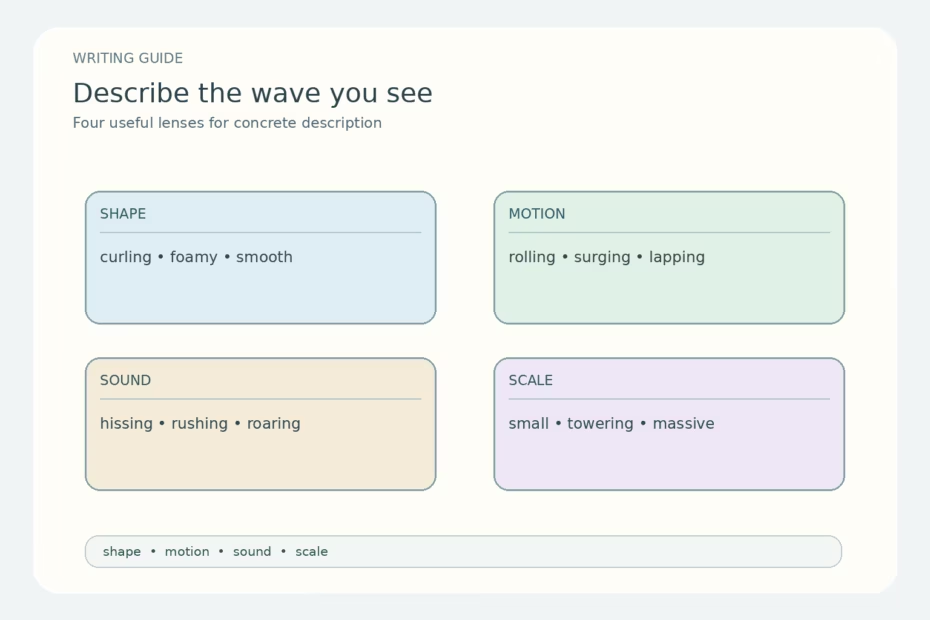
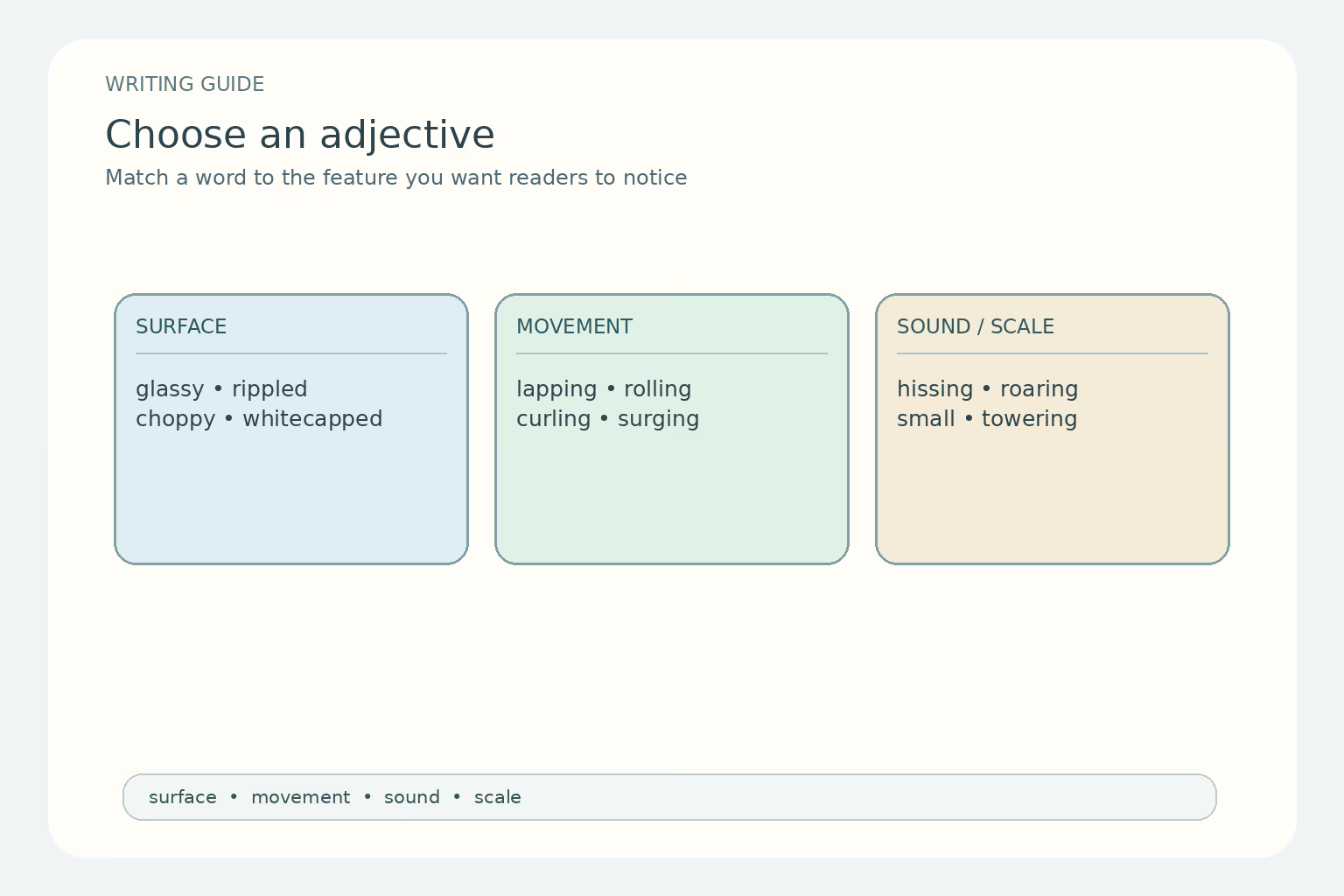
“Beautiful” can express a reaction, but a precise adjective lets the reader picture the water. Notice whether the surface is smooth or broken, whether the wave rises slowly or pitches forward, and what sound it makes at the shore. Then choose one or two words that fit: glassy for a smooth surface, rippling for small moving ridges, curling for a crest turning over, or thundering for loud surf. Naming what you observe makes the description more vivid than piling on synonyms.
Use technical terms when measurements matter
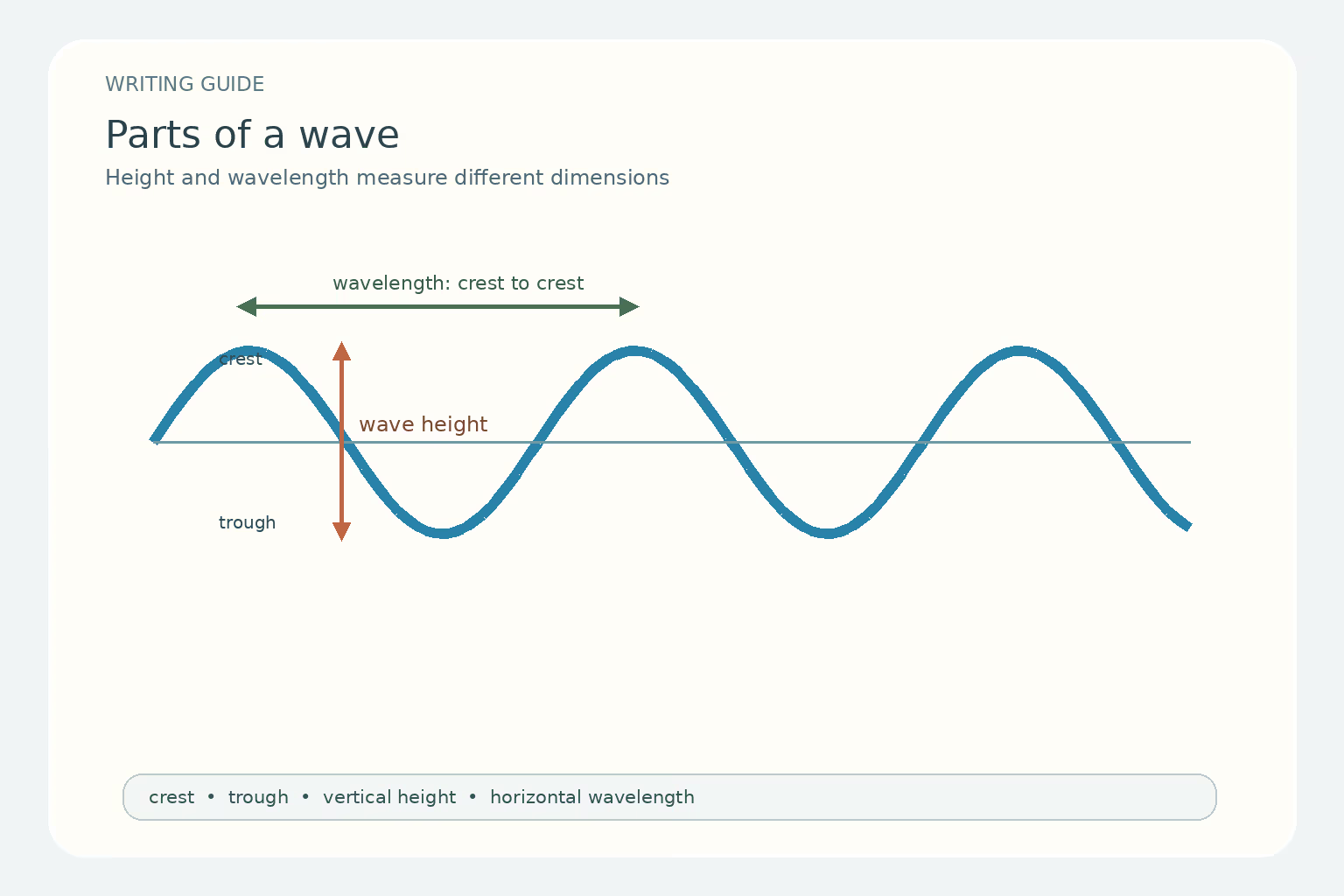
A wave’s crest is its highest point, and its trough is the lowest point between crests. NOAA defines wave height as the vertical distance from trough to crest and wavelength as the horizontal distance between successive crests or troughs. NOAA’s National Data Buoy Center uses these terms when explaining how ocean waves are described. In a scientific or boating context, “high” should refer to height and “long” can refer to wavelength; they are not interchangeable.
Wave period is the time between successive crests passing a fixed point. A long-period swell has more time between crests than short, locally generated wind waves. That is why a sentence such as “Long, widely spaced swells rolled toward shore” gives both an impression and useful information about timing and spacing. For literary writing, you usually do not need numbers, but the distinctions help you choose words accurately.
Wind waves and swell can look different
Waves generated by nearby wind may look steep, irregular, or choppy, especially when wind conditions change. Swell is wave energy that has traveled away from its generating wind area; the crests are often more organized and spaced farther apart. NOAA’s wave-observation glossary distinguishes swell from locally produced wind waves and notes its typically longer period. These are useful tendencies, not guarantees that every swell is gentle or every wind wave is rough.
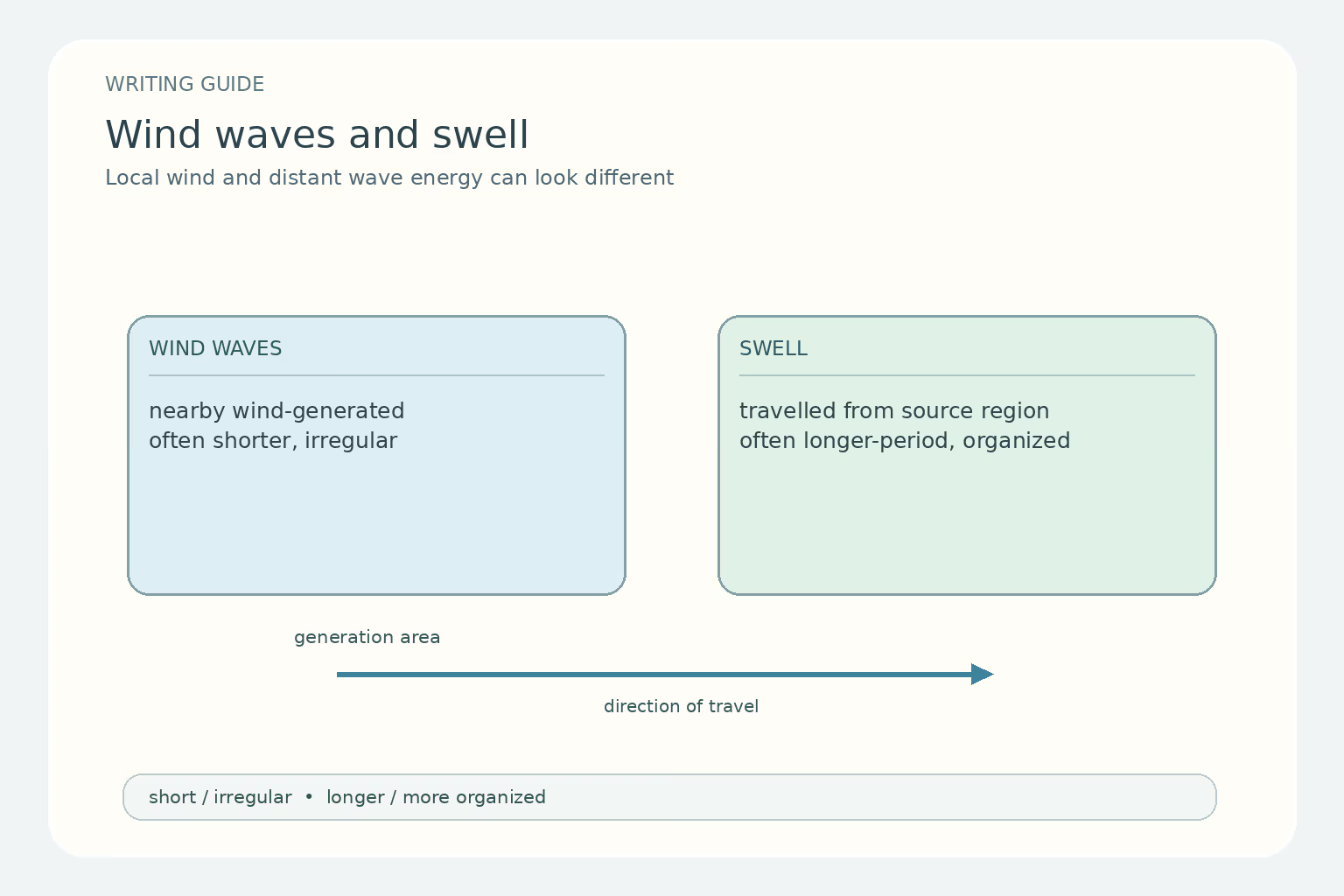
For a lively nearshore scene, words such as choppy, wind-stirred, short-crested, or whitecapped may fit. For a more ordered swell, try rolling, long-period, evenly spaced, or slow-moving. Use barreling or hollow only when the crest actually curls over to form a tube, a shape surfers may seek. “Clean” in surf language usually describes a wave face without much surface chop; it does not simply mean that the water is unpolluted.
Describe sound, texture, and scale
Adjectives can focus on different senses. Hissing, rushing, roaring, and thundering describe sound, from soft surf to a powerful break. Foamy, frothy, and whitecapped describe visible water at the crest or after a wave breaks. Gentle, rolling, and surging suggest movement, while towering and massive emphasize scale. Keep perspective in mind: “towering” may describe a wave from a small boat or a child’s viewpoint, while a measurement belongs in a forecast or report.
Make the description fit the setting
At a beach, describe how the water meets the land: breaking waves slapped the pebbled shore, or small ripples lapped against the sand. On a lake, a light breeze may make the surface shimmering or rippled without creating surf. In a storm scene, pair stronger words with evidence: steep, wind-driven waves threw spray over the seawall. The detail supports the adjective and helps readers understand why the water seems forceful.
- Quiet lake: “Gentle ripples traced silver lines across the cove.”
- Open coast: “Long swells rose and fell in an even rhythm beyond the break.”
- Windy afternoon: “Short, choppy waves slapped against the pier.”
- Surf break: “A hollow wave curled over, leaving a brief barrel of spray.”
When selecting an adjective, ask which feature matters most: shape, motion, sound, scale, or setting. One concrete detail and a well-matched word can make a sentence more memorable while keeping it accurate.
Hey there! Have you ever stood at the beach, mesmerized by the rhythmic crashing of waves against the shore? Waves are truly a force of nature that captivate our senses and evoke a sense of awe. But have you ever wondered how to describe these magnificent waves using the right adjectives? Well, you’re in luck! In this article, I’ll be sharing a collection of descriptive words that will help you paint a vivid picture of waves in all their glory.
How to Describe waves? – Different Scenarios
When it comes to describing waves, there are various scenarios that can help us understand different aspects of these natural wonders. Let’s explore a few of these scenarios to gain a better understanding of how to effectively describe waves.
Scenario 1: The Ocean Waves
- Swift: Ocean waves crash against the shore with a swift and powerful force.
- Majestic: The towering ocean waves create a majestic sight as they rise and fall.
- Rhythmic: The rhythmic pattern of the ocean waves can be mesmerizing to watch.
- Cresting: The waves form beautiful crests as they roll towards the beach.
- Foamy: As the waves break, they turn into foamy white water, creating a stunning visual display.
Scenario 2: Surfer’s Paradise
- Hollow: Surfers look for hollow waves, which provide a thrilling ride.
- Barrel: When the wave curls over and forms a hollow tube, it’s known as a barrel.
- Powerful: Surfers seek out powerful waves that offer the perfect combination of speed and intensity.
- Clean: A clean wave is one that is free from any choppiness or turbulence, making it ideal for surfing.
- Stoked: Surfers get stoked when they catch a great wave and have an exhilarating ride.
- Gentle: Lake waves are often gentle and soothing, creating a calming effect.
- Rippling: These waves have a gentle rippling motion, like a sheet of glass being disturbed.
- Calm: Lake waves are tranquil and create a serene atmosphere.
- Reflection: Sometimes, lake waves reflect the shimmering sunlight, adding a touch of magic.
- Serenade: The quiet lapping of lake waves can be likened to a gentle serenade.
Describing waves in different scenarios allows us to capture their beauty and power in various contexts. Whether it’s the majesty of ocean waves, the thrill of surfing, or the tranquility of lake waves, there’s no shortage of words to accurately describe and appreciate these incredible natural phenomena.
Describing Words for waves in English
When it comes to describing waves, there is a wide range of words that can capture their beauty and power. As a writer, it’s important to have a diverse vocabulary to effectively convey the unique characteristics of waves. Let’s explore some adjectives that can be used to describe different types of waves:
- Ocean Waves
Ocean waves are known for their sheer force and immense power. Here are some words that can help you describe the majestic nature of ocean waves: - Surfer’s Paradise
For surfers, waves take on a whole new meaning. They provide an exhilarating experience and a thrilling ride. Here are some words that can capture the excitement of waves for surfers: - Lake Waves
Unlike ocean waves, lake waves tend to be more gentle and soothing. They create a peaceful ambiance by gently lapping against the shoreline. Here are some words that can describe the tranquility of lake waves:
As you can see, these adjectives provide a glimpse into the diverse nature of waves. Whether it’s the powerful and towering ocean waves, the thrilling and hollow waves of a surfer’s paradise, or the calm and gentle ripples of lake waves, each type of wave has its own unique qualities.
Adjectives for waves
Positive Adjectives for Waves with Example Sentences
When it comes to describing waves, there are many positive adjectives that can capture their beauty and power. Here are some examples to help you paint a vivid picture:
| Adjective | Example Sentence |
|---|---|
| Majestic | The majestic waves crashed against the rocky shore. |
| Breathtaking | It was a breathtaking sight to see the waves towering over us. |
| Graceful | The graceful waves rolled gently towards the beach. |
| Mesmerizing | I couldn’t take my eyes off the mesmerizing waves as they curled and crashed. |
| Vibrant | The vibrant blue waves sparkled in the sunlight. |
| Exhilarating | Riding the exhilarating waves made me feel alive. |
| Hypnotic | The hypnotic rhythm of the waves lulled me into a peaceful state. |
| Dynamic | The dynamic waves created an ever-changing seascape. |
| Resplendent | The resplendent waves glistened with golden hues at sunset. |
| Serene | Standing on the beach, I was captivated by the serene waves lapping against the shore. |
| Invigorating | The invigorating waves crashed against my body, filling me with energy. |
| Spellbinding | The spellbinding waves drew me in with their beauty and power. |
Negative Adjectives for Waves with Example Sentences
While waves can be majestic and beautiful, there are also negative aspects to consider. Here are some examples of negative adjectives that can describe waves:
| Adjective | Example Sentence |
|---|---|
| Treacherous | The treacherous waves made it dangerous to swim in the ocean. |
| Destructive | The destructive waves battered the coastline, causing erosion. |
| Unpredictable | You should always be cautious when dealing with unpredictable waves. |
| Ferocious | The ferocious waves crashed against the boat, threatening to capsize it. |
| Overwhelming | The overwhelming waves crashed over me, making it hard to catch my breath. |
Remember, it’s important to have a diverse vocabulary when describing waves to accurately convey their unique qualities. Whether they are gentle and serene or powerful and mighty, choosing the right adjectives can help bring your writing to life.
Synonyms and Antonyms with Example Sentences
Synonyms for waves
Waves are an awe-inspiring force of nature, and choosing the right words to describe them can capture their beauty and power. Here are some synonyms, alternative words, that can help you convey the unique characteristics of waves:
| Synonym | Meaning | Example Sentence |
|---|---|---|
| Ripple | A small or gentle wave, usually caused by a disturbance | The calm lake was adorned with gentle ripples. |
| Surge | A strong, sudden forward movement of water | The surging waves crashed against the shoreline. |
| Swell | A gradual increase in the height and intensity of a wave | The swell of the ocean was incredible, rising higher with each passing moment. |
| Breaker | A wave that breaks or collapses into foam as it reaches the shore | Surfers were riding the massive breakers, enjoying the thrill of the waves. |
| Tsunami | A series of large ocean waves caused by an underwater disturbance | The devastating tsunami swallowed everything in its path. |
Antonyms for waves
While waves are often seen as magnificent and awe-inspiring, there are also times when they can be seen as calm and peaceful. Here are some antonyms, opposite words, to describe the different aspects of waves:
| Antonym | Meaning | Example Sentence |
|---|---|---|
| Stillness | The absence of movement or activity | The lake was calm and still, without a single wave in sight. |
| Tranquility | The state of being calm, peaceful, and quiet | The tranquil sea reflected the golden hues of the setting sun. |
| Serenity | A feeling of calmness and peacefulness | The gentle waves lapping the shore created a sense of serenity. |
| Silence | Complete absence of sound | As the sun set, the crashing waves were replaced by a peaceful silence. |
| Flatness | Lack of waves or surface irregularities | The glassy surface of the lake extended for miles, its flatness undisturbed. |
Note: It’s important to select the most appropriate synonym or antonym based on the context you are describing. Adjectives can greatly impact the overall image and mood you want to convey in your writing.
As we continue to explore the beauty and power of waves, let’s delve deeper into some specific scenarios where waves take on unique qualities and characteristics.
Conclusion
Describing waves can be a challenging task, as their beauty and power are difficult to capture in words. However, by using the right adjectives, we can paint a vivid picture and convey the desired image and mood in our writing.
In this article, we explored a wide range of adjectives to describe waves in various contexts. From gentle ripples to powerful surges and breathtaking tsunamis, we discovered a plethora of words to accurately depict the different aspects of waves.
We also learned about antonyms that can be used to describe the calmness and stillness of waves, such as tranquility, serenity, and silence. These contrasting words provide a balanced perspective and add depth to our descriptions.
Remember, selecting the most appropriate synonym or antonym based on the context is crucial in capturing the essence of waves. By choosing the right words, we can transport our readers to the mesmerizing world of crashing breakers or the tranquil embrace of a flat sea.
So, the next time you find yourself in awe of the ocean’s majestic waves, let your words flow and paint a picture that does justice to their magnificence.


