Adjectives for Weakness: Words and Examples
Adjectives for weakness describe a specific limitation, skill gap, or response in context. Words such as inexperienced, inconsistent, and hesitant point to different patterns; choosing the observable behavior makes feedback clearer than labeling a whole person as weak.
- Choose the category first: skill, confidence, consistency, judgment, or physical strength.
- Prefer a specific description: “hesitant to ask for clarification” gives more information than “weak.”
- Words are not interchangeable: “inexperienced” describes practice, while “inconsistent” describes variation over time.
- For interviews, pair a real area to improve with a relevant action and evidence of progress.
- Use physical or medical descriptions carefully: a word list cannot diagnose the cause of weakness or fatigue.
How should you choose an adjective for weakness?
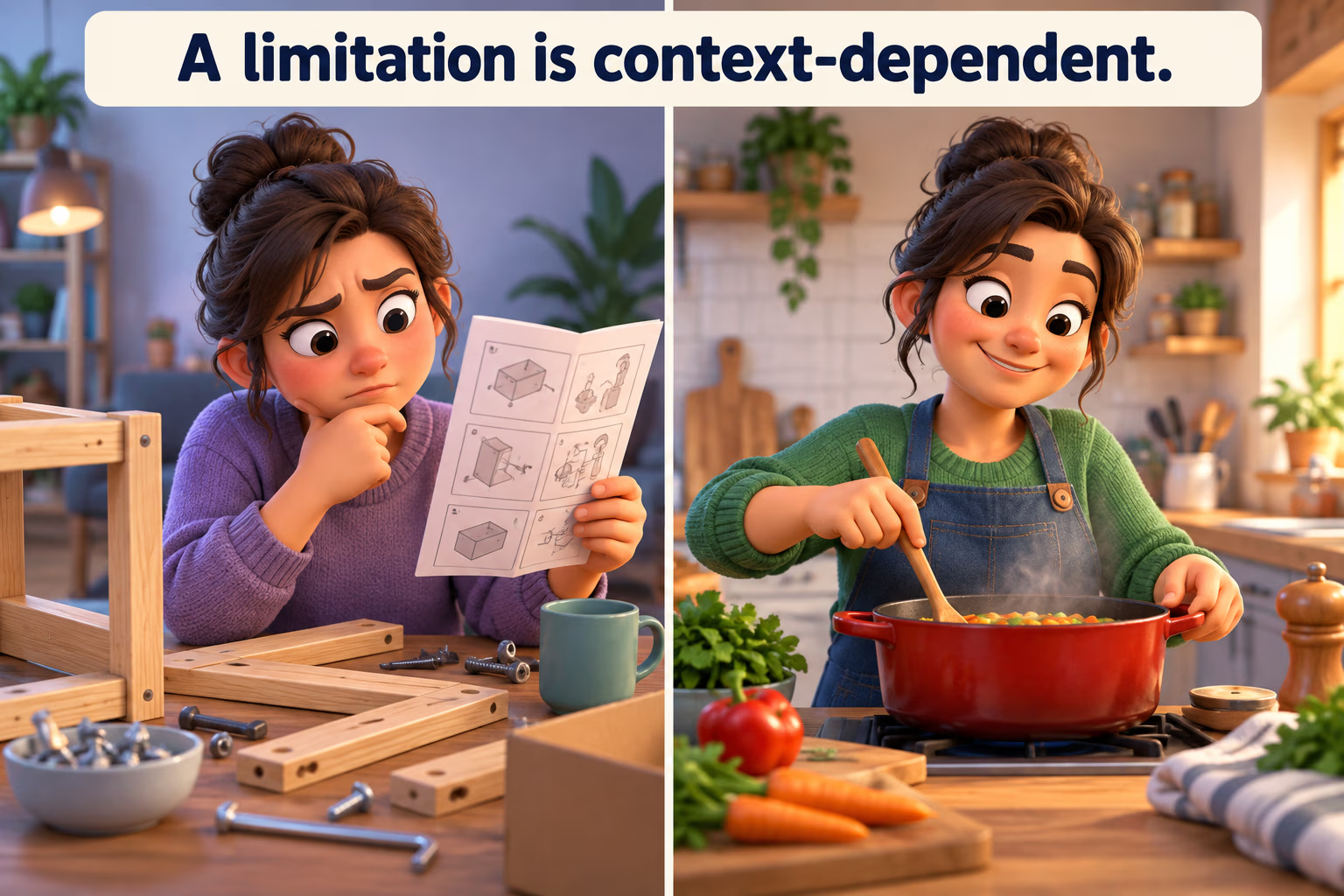
Choose an adjective by naming the situation and the behavior or capability you observed. Repeated missed deadlines may indicate inconsistent planning; limited practice with a new task means you are inexperienced with that task; and a delayed decision may be described as hesitant when it reflects uncertainty, though caution can also be appropriate.
“Weakness” has several meanings. The Cambridge Dictionary entry for weakness includes both a particular quality that is not effective and a lack of strength or power. In this article, most examples concern skills and behavior; physical weakness is a separate meaning and should not be inferred from a personality adjective.
| What you mean | More precise adjectives | Example |
|---|---|---|
| Limited practice | inexperienced, unpracticed, unfamiliar | “I am inexperienced with this reporting tool, so I am practicing on sample data.” |
| Uneven follow-through | inconsistent, unreliable, sporadic | “My follow-up has been inconsistent when several deadlines overlap.” |
| Slow decision or action | hesitant, cautious, indecisive | “I can be hesitant to raise a concern before I have checked the details.” |
| Planning or organization | disorganized, unstructured, forgetful | “My planning was disorganized, so I now break projects into dated checkpoints.” |
| Physical capability or energy | frail, feeble, weak | Use only when physical condition is actually what you mean, not as shorthand for a character judgment. |
What is the difference between a weakness adjective and a personal label?
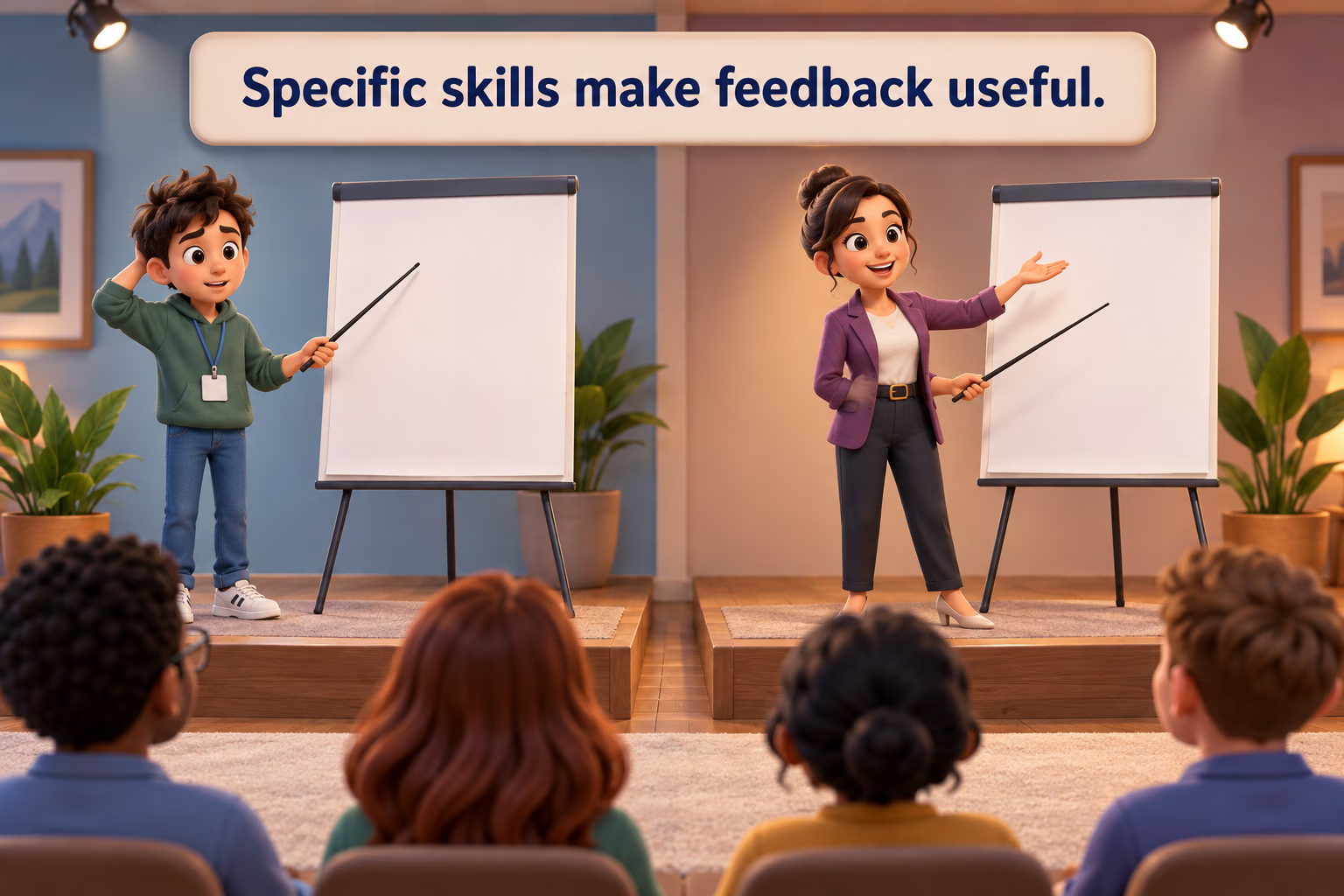
A useful weakness adjective describes an action or capability in a defined setting; a personal label treats one example as a permanent judgment about someone. “She was hesitant during the first client presentation” is bounded and observable, while “she is weak” is vague and can imply more than the evidence shows.
When describing yourself, connect the word to a real example and a practical next step. For example: “I was inexperienced with budget forecasting last quarter, so I paired with a colleague and now review each estimate against actual costs.” This wording names a current skill gap without claiming that the gap defines the person.
How can you describe a weakness in a job interview?
Describe an authentic, manageable area for improvement, give a brief example, and explain what you are doing about it. Harvard FAS career guidance advises candidates to be honest, take responsibility, and prepare examples. The U.S. Office of Personnel Management explains that structured interviews assess job-related competencies through questions about past behavior or proposed behavior.
- Name a relevant behavior: “I sometimes wait too long before asking for clarification.”
- Give a concise example: describe a situation and its concrete effect, without blaming teammates.
- Explain the adjustment: “I now confirm scope and deadlines at kickoff.”
- Show evidence: give a recent example of asking early and preventing rework.
Choose a real growth area that does not contradict a core requirement of the specific role. Avoid a disguised strength (“I care too much”) or an unsupported promise (“I fixed it completely”); a measured account is more credible and gives the interviewer something concrete to evaluate.

Which words for weakness fit different situations?
The best choice depends on whether you are discussing skill, pace, accuracy, confidence, or physical strength. Check the adjective’s meaning before using it: several words that sound negative describe different causes and lead to different remedies.
- Inexperienced: limited exposure or practice; it does not necessarily mean low ability.
- Inconsistent: results or behavior vary; identify when the variation occurs.
- Hesitant: slow or uncertain to act; explain what information or support would help.
- Disorganized: planning or materials lack structure; name the missed system or checkpoint.
- Indecisive: difficulty selecting among options; distinguish careful evaluation from avoidable delay.
- Vulnerable: open to harm or criticism in a particular situation; it is not automatically a defect or a synonym for incompetence.
- Frailty / feebleness: terms about physical weakness that can sound severe or stigmatizing; use only when that meaning is accurate and relevant.
A practical rule is to replace global judgments with a behavior, condition, and time frame: “I am bad at planning” becomes “When priorities change midweek, I sometimes miss a handoff; I now review dependencies every morning.” The second version helps the reader understand both the limitation and its scope.
Frequently asked questions about adjectives for weakness
What is a positive adjective for a weakness?
Teachable, reflective, and adaptable can describe a constructive response to a limitation, but they do not name the limitation itself. Use the adjective only when behavior supports it—for example, someone who seeks feedback, applies it, and changes a repeated work habit may be described as teachable.
Is “weak” the same as “inexperienced”?
No. Weak can refer broadly to low strength, effectiveness, or ability; inexperienced specifically means having limited experience. Someone can be inexperienced with a tool and still learn quickly, while an experienced person may have a separate weakness in a particular task.
How do I describe a weakness without sounding negative?
Be direct and specific, then explain the context and action. “I sometimes hesitate to delegate when deadlines are tight, so I now agree on ownership and check-in points at the start” is candid without turning one behavior into a judgment of someone’s overall character.
Can “weakness” refer to health or physical strength?
Yes. Dictionaries also define weakness as a lack of physical strength or power. A vocabulary list cannot establish why someone feels weak; if the concern is a real or new physical symptom, describe what is happening plainly and seek appropriate professional advice rather than choosing a personality adjective.
Conclusion: describe the specific weakness
Adjectives for weakness are clearest when they identify the exact capability or behavior and its context. Use inexperienced for limited practice, inconsistent for variable follow-through, and hesitant for delayed action; then add an example or next step so the description remains accurate and useful.
Context for the preserved original below: It is included unchanged, and its lists are examples of wording rather than endorsements or descriptions that fit everyone. They sometimes equate behaviors with labels such as lazy, shy, controlling, or quitter; these are not interchangeable and may misrepresent a person or situation. The “positive adjectives for weakness” mainly describe responses to a limitation, not the limitation itself. Frailty and feebleness often refer to physical weakness and can sound stigmatizing; use such words only when that meaning is accurate and relevant. Some limitations may persist or call for support, so do not imply that every weakness can be fully overcome.
How to Describe weakness? – Different Scenarios
Describing weakness can be an effective way to communicate a person’s limitations or shortcomings. There are various scenarios where we might need to describe weaknesses, whether it’s in a personal or professional context. In this section, I will explore different scenarios and share examples of how to effectively describe weakness.
1. Personal Weaknesses
When it comes to describing personal weaknesses, it’s important to be honest and self-aware. By acknowledging our weaknesses, we demonstrate a willingness to grow and improve. Here are some examples of how to describe personal weaknesses:
- “One of my weaknesses is procrastination. I tend to put off tasks until the last minute, which can lead to added stress and decreased productivity.”
- “I sometimes have difficulty speaking in public. I get nervous and find it challenging to articulate my thoughts clearly.”
2. Professional Weaknesses
In a professional setting, it is common to come across situations where we need to discuss our weaknesses with potential employers or colleagues. Here are a few examples of how to describe professional weaknesses:
- “I occasionally struggle with time management. I’m working on improving my organization skills to ensure I meet deadlines effectively.”
- “I find it challenging to delegate tasks as I tend to take on too much responsibility. However, I’m learning to trust my team members and distribute workload more efficiently.”
3. Overcoming Weaknesses
It’s not just about identifying weaknesses, but also about taking steps to overcome them. Here are a few examples of how to describe the process of overcoming weaknesses:
- “I have been taking public speaking courses to improve my communication skills and build my confidence in presenting to large audiences.”
- “To overcome my tendency to procrastinate, I have started using time management techniques such as creating a schedule and setting realistic goals for each task.”
Remember, describing weaknesses should be done in a constructive manner, focusing on growth potential rather than dwelling on limitations. By effectively communicating our weaknesses and the steps we’re taking to address them, we demonstrate our commitment to personal and professional development.
Describing Words for weakness in English
When it comes to describing weaknesses, using the right adjectives can help us communicate effectively. Here are some helpful words that can be used to describe different weaknesses:
- Procrastination: Procrastination is the tendency to delay or put off tasks. When describing this weakness, you can use adjectives such as “lazy” or “indecisive”.
- Difficulty Speaking in Public: Some people struggle with speaking in front of a large audience. Adjectives like “nervous”, “shy”, or “anxious” can be used to describe this weakness.
- Lack of Organization: If you have trouble keeping things in order, you can describe it as being “disorganized” or “messy”.
- Poor Time Management: When describing a weakness in managing time effectively, you can use adjectives like “unorganized”, “procrastinating”, or “inefficient”.
- Difficulty Delegating: For individuals who struggle with assigning tasks to others, you can use adjectives such as “controlling”, “micromanaging”, or “independent”.
- Lack of Confidence: Some people may have a weakness in self-assurance. Adjectives such as “insecure”, “shy”, or “timid” can be used to describe this weakness.
- Trouble Taking Initiative: If you struggle with taking charge and being proactive, you can describe it as being “passive”, “hesitant”, or “indecisive”.
- Lack of Persistence: When someone gives up easily, you can use adjectives like “quitter”, “easily discouraged”, or “giving up too soon”.
It’s important to remember that weaknesses can be improved upon. By acknowledging and understanding our weaknesses, we can take steps towards personal and professional growth.
Adjectives for weakness
Positive Adjectives for Weakness
When it comes to describing weaknesses, there are some positive adjectives that can help us understand and address them. Here are twelve examples with sentences to illustrate their usage:
| Adjective | Example Sentence |
|---|---|
| Teachable | I am always open to feedback and willing to learn from my mistakes. |
| Adaptable | I can quickly adjust to changes and find alternative solutions when faced with challenges. |
| Reflective | I take time to analyze my actions and learn from my experiences. |
| Resilient | Despite setbacks, I bounce back and continue to strive for improvement. |
| Resourceful | I am creative in finding solutions and make the most of the resources available to me. |
| Patient | I understand that progress takes time and am willing to put in the effort required. |
| Perceptive | I have a keen eye for detail, which helps me identify areas where I can make improvements. |
| Empathetic | I am sensitive to the needs and feelings of others, which allows me to build strong relationships. |
| Cooperative | I work well in a team, recognizing the strengths of others and collaborating to achieve our goals. |
| Flexible | I am open to new ideas and can adapt my approach to different situations. |
| Analytical | I excel at breaking down complex problems and finding practical solutions. |
| Persistent | I never give up easily and am dedicated to overcoming obstacles. |
Negative Adjectives for Weakness
Acknowledging and understanding our weaknesses also means being aware of negative adjectives that may describe them. Here are five examples, along with sentences to provide context:
| Adjective | Example Sentence |
|---|---|
| Procrastinative | Sometimes, I find myself putting off tasks until the last minute. |
| Insecure | I often doubt myself and my abilities, which can hold me back from taking risks. |
| Indecisive | I struggle to make decisions and may spend too much time weighing the options. |
| Impatient | I sometimes struggle with waiting for results and can become frustrated easily. |
| Disorganized | My lack of organization can lead to missed deadlines or inefficiency in my work. |
By identifying and acknowledging these negative aspects, I can work towards improving myself and turning these weaknesses into strengths. Understanding the adjectives that describe weaknesses allows us to grow both personally and professionally. It’s important to remember that weaknesses are not permanent, and with effort and self-awareness, we can overcome them and thrive.
Synonyms and Antonyms with Example Sentences
Synonyms for weakness
When it comes to describing weaknesses, there are several synonyms that can be used. These words can help us express our areas of improvement in a more nuanced way. Here are some synonyms for weakness:
- Limitation: Despite my limitation in public speaking, I always find a way to contribute to the team.
- Shortcoming: Recognizing my shortcomings allows me to work on them and become a better version of myself.
- Flaw: Everyone has flaws, and acknowledging them is the first step towards personal growth.
- Deficiency: My deficiency in organization skills doesn’t stop me from achieving my goals; it just means I need to put in extra effort.
- Imperfection: Embracing my imperfections helps me learn and grow.
- Vulnerability: Showing vulnerability is not a weakness, but rather a sign of strength and self-awareness.
- Frailty: My frailty lies in handling criticism, but I’m working on building resilience.
Antonyms for weakness
On the other hand, we also have antonyms for weakness, which highlight strengths or attributes that are the opposite of weakness. Here are some antonyms for weakness:
- Strength: Recognizing my strengths allows me to leverage them and overcome any weaknesses I may have.
- Ability: Focusing on my abilities rather than my weaknesses helps me build confidence and achieve success.
- Skill: Developing new skills allows me to compensate for any areas where I may feel weak.
- Talent: Embracing my talents helps me excel in certain areas and compensate for any perceived weaknesses.
- Competence: Building competence in different areas helps me overcome any feelings of weakness.
- Expertise: Developing expertise in a particular field boosts my confidence and minimizes any perceived weaknesses.
- Proficiency: Striving for proficiency in various areas helps me overcome my weaknesses.
Remember, it’s important to acknowledge and embrace our weaknesses, as they provide opportunities for growth and improvement. Recognizing synonyms and antonyms for weakness can help us better understand and express our areas of improvement.
Conclusion
In this article, I have provided a comprehensive list of adjectives that can be used to describe weaknesses. By using these adjectives, individuals can effectively communicate their areas of improvement in a more nuanced way. Additionally, I have introduced synonyms and antonyms for weakness, which can further enhance the ability to express weaknesses in a more precise manner.
It is crucial to acknowledge and understand our weaknesses in order to grow and develop both personally and professionally. By recognizing our weaknesses, we can take the necessary steps to improve and overcome them. This self-awareness is a key component of personal growth and can lead to greater success in various aspects of life.
Remember, weaknesses are not something to be ashamed of, but rather opportunities for improvement. By using these adjectives and understanding the importance of self-reflection, we can embrace our weaknesses and turn them into strengths.
So, the next time you want to discuss your areas of improvement, remember to use these descriptive adjectives to express yourself with clarity and confidence. Embrace your weaknesses, and watch yourself grow and thrive.


