How to Choose the Right Adjective for a Writer
The best adjective depends on what you want to describe: the writer’s approach, the style of the prose, or the effect the writing has on a reader. “Meticulous writer” points to a person’s careful process; “precise prose” describes the words on the page; “engaging article” describes a reader’s experience. Keeping those targets separate makes a description clearer and fairer.
Use a specific adjective when it adds information. Instead of calling every strong writer “talented,” name the quality you can actually see: a concise writer trims repetition, an observant writer notices telling details, and an inventive writer finds an unexpected way to frame an idea. These are useful descriptions, not fixed judgments about a person’s worth.
Adjectives for a Writer’s Approach
These words describe how someone works or approaches a task. Use them when you have a draft, working habit, or other evidence to support the description.
- Meticulous: checks details and consistency carefully. Her meticulous editor’s notes caught two timeline errors.
- Disciplined: follows a regular plan or completes revisions steadily. The disciplined writer finished a draft by working for an hour each morning.
- Curious: asks questions and investigates unfamiliar subjects. A curious journalist interviewed residents before describing the neighborhood.
- Observant: notices concrete details others might miss. The observant essayist noticed how the room grew quiet after the announcement.
- Collaborative: works constructively with coauthors, editors, or sources. The collaborative writer invited feedback before the final revision.
- Persistent: continues revising or reporting despite setbacks. A persistent biographer searched several archives for the missing letter.
- Reflective: considers experience carefully and draws measured conclusions. Her reflective memoir revisits the decision from more than one angle.
- Experimental: tries unfamiliar structures, forms, or points of view. The experimental novelist tells the story through dated messages.
Some adjectives can sound like criticism or praise, depending on context. Persistent usually suggests admirable effort; stubborn suggests resistance to change. Ambitious may mean aiming high, while overambitious can imply that the project exceeds its scope. Choose the word that matches the evidence and the tone you intend.
Adjectives for a Writer’s Style
To describe prose, attach the adjective to a word such as style, voice, sentences, or description. A writer can shift styles across genres and projects, so these terms are often more accurate than treating one style as a permanent personality trait.
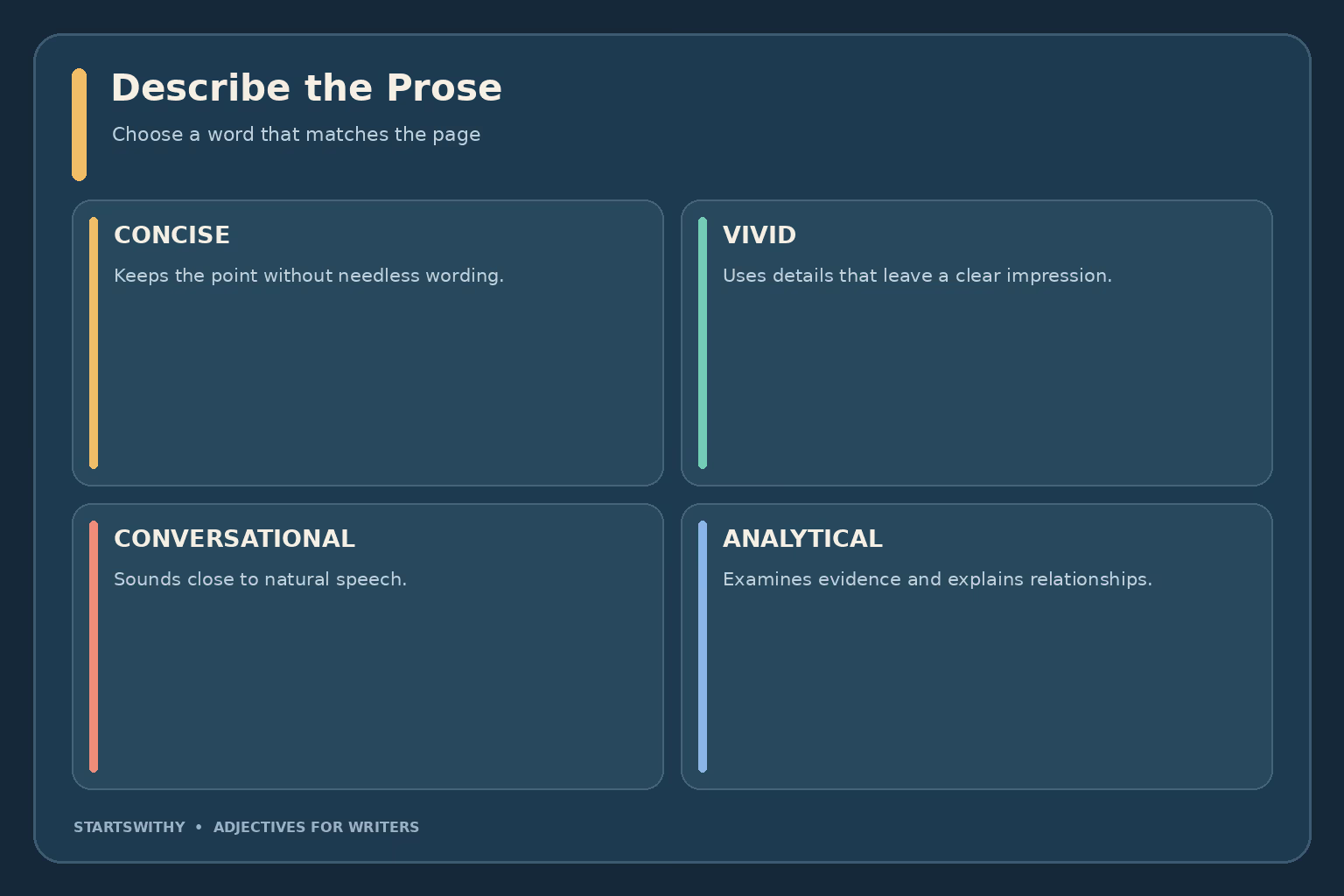
- Concise: expresses the point without unnecessary words. The concise introduction states the question in two sentences.
- Vivid: gives readers a clear, memorable impression. Vivid details make the rain-dark street easy to picture.
- Conversational: sounds close to natural speech. The conversational newsletter addresses readers directly.
- Formal: uses a more reserved register and conventional phrasing. The formal report defines its terms before presenting the findings.
- Lyrical: draws attention to rhythm, sound, or figurative language. The lyrical passage compares dusk to a slowly closing curtain.
- Analytical: examines evidence and explains relationships or causes. The analytical review compares the two studies before reaching a conclusion.
- Witty: uses clever humor or wordplay. Her witty column makes its point through a brief, unexpected comparison.
- Technical: uses specialized language for a particular field. The technical guide explains each command for its intended users.
Style words are not automatic compliments. Dense prose may carry complex information but challenge a general audience. Ornate language may suit a historical voice yet distract in a short instruction. Explain the effect or purpose so readers know why the adjective matters.
Adjectives for the Effect on Readers
Some words describe the response a text invites. A suspenseful chapter creates anticipation; an informative guide helps readers understand a topic; a moving scene may prompt an emotional response. These descriptions concern the text and its likely effect, which can vary by audience.
- Engaging: holds a reader’s attention. The engaging opening poses a question the article later answers.
- Accessible: makes ideas understandable for its intended audience. The accessible explainer defines unfamiliar terms as it introduces them.
- Persuasive: presents reasons intended to support a position. The persuasive essay pairs its claim with relevant evidence.
- Informative: provides useful facts or explanation. The informative profile places the artist’s work in historical context.
- Moving: evokes a strong feeling. The moving final scene returns to the promise made at the story’s start.
- Suspenseful: builds uncertainty about what will happen next. The suspenseful chapter delays the answer while revealing new clues.
When describing audience effect, avoid presenting a personal response as universal. “I found the ending moving” is precise about your reaction; “the moving ending” presents an interpretation that should be supported by details. A text can be engaging to one audience and confusing to another.
Match the Adjective to the Context
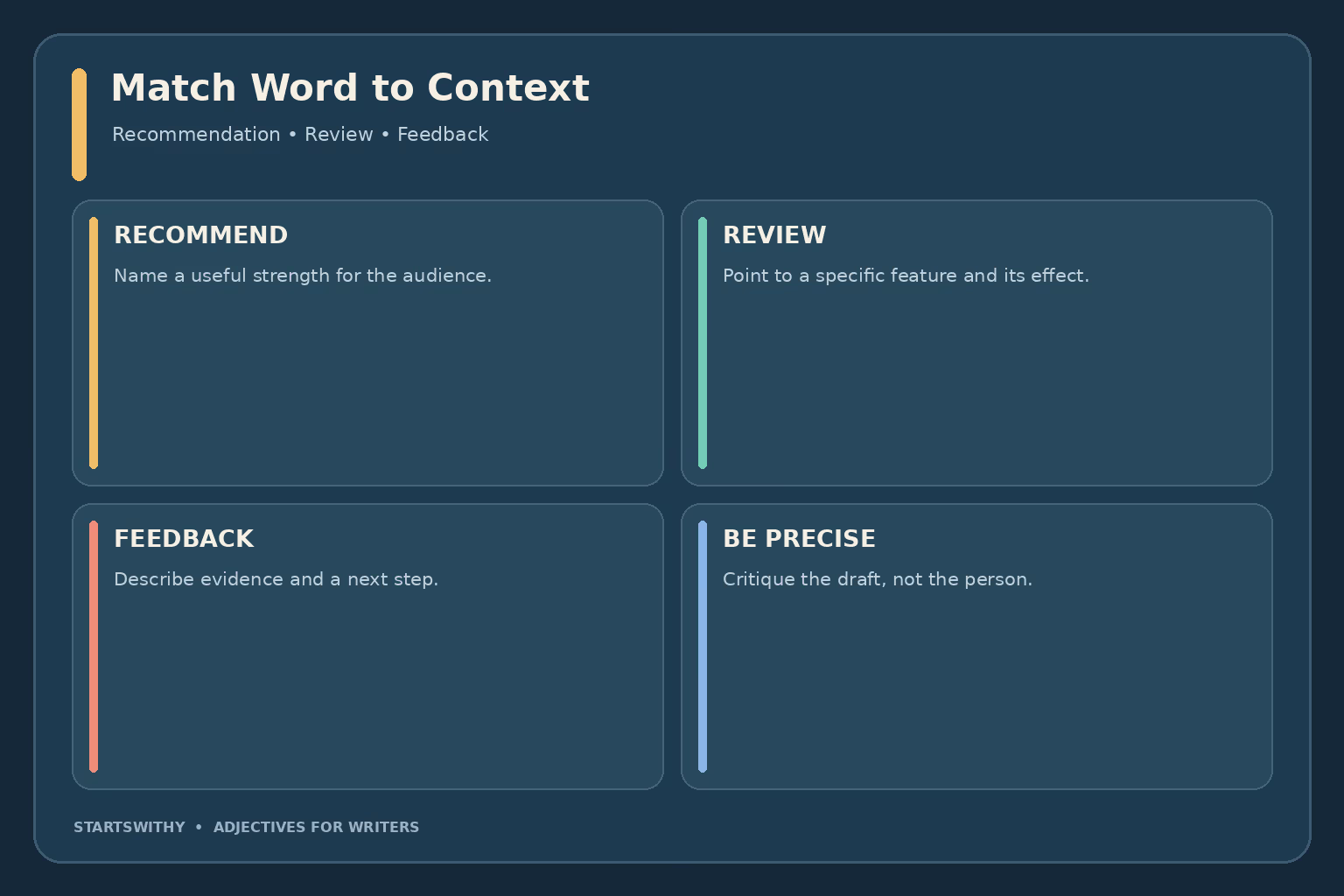
For a recommendation, focus on qualities that matter to the reader: “a clear, well-researched science writer” tells a hiring editor more than “a wonderful writer.” For a book review, pair the adjective with a feature: “spare dialogue keeps the scene tense.” For a classroom comment, name a strength and a next step: “Your vivid setting gives the story atmosphere; clarify who is speaking in the second paragraph.”
Specificity helps with negative descriptions, too. Rather than labeling an author “bad,” describe the observable issue: “The article repeats its central point, and several claims need sources.” That phrasing identifies a revision task without turning one draft into a judgment of the writer as a person.
Quick Grammar Note: Adjective or Adverb?
An adjective describes a noun or pronoun: “a careful writer” and “the draft is clear.” An adverb usually describes an action: “The writer revised carefully” and “She explained the idea clearly.” After linking verbs such as seem or feel, use an adjective when it describes the subject: “The ending feels abrupt.” Purdue OWL’s adjective and adverb guide gives additional examples.
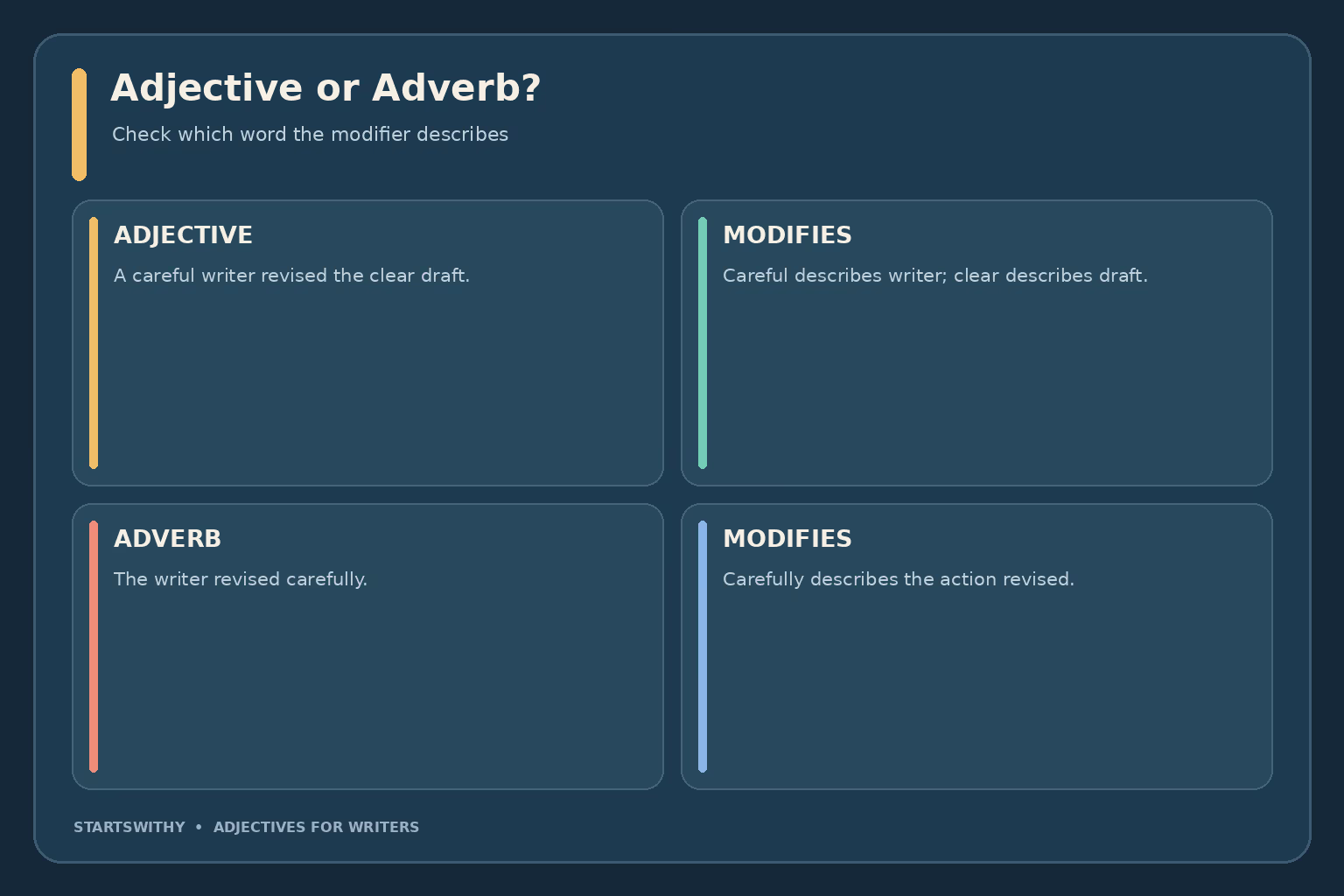
Not every adverb ends in -ly, and not every word ending in -ly is an adverb. Check the word’s job in the sentence instead of relying on its ending. For clear descriptions, choose a modifier that tells readers exactly which person, passage, or effect you mean.
Frequently Asked Questions
What is a good adjective for a writer?
Observant, imaginative, meticulous, and concise can all work, but each describes a different quality. Pick the word that fits the writer’s demonstrated approach or the writing sample.
How do I describe a writer’s style?
Use a style adjective such as conversational, lyrical, formal, or analytical, then point to a feature that supports it, such as sentence rhythm, word choice, or use of evidence.
What is the difference between a writer and a writing style?
A writer is the person who creates text; writing style is the way a particular piece communicates. A person may use different styles for a poem, an instruction manual, and a news report.
Can I use “creative” to describe any writer?
You can, but the word is broad. If you mean that the writer uses surprising images, original structures, or inventive solutions, name that specific feature when you can.
Sources and Further Reading
- Purdue OWL: Adjectives and Adverbs
- Purdue OWL: Diction
- Purdue OWL: Descriptive Essays
- Purdue OWL: Conciseness
- Cambridge Dictionary: Writer
As a writer, it’s important to have a rich vocabulary at your disposal to effectively convey your thoughts and engage your readers. Adjectives play a crucial role in bringing your writing to life, adding depth and color to your descriptions. In this article, I’ll be sharing a variety of adjectives specifically tailored for writers, along with examples to help you understand how to use them effectively.
Whether you’re working on a novel, a blog post, or a poem, having a diverse range of adjectives can make all the difference in creating vivid and compelling prose. From describing characters and settings to capturing emotions and sensations, the right choice of adjectives can transport your readers into the world you’ve created.
How to Describe writers? – Different Scenarios
As a writer, I have come across many different types of writers, each with their own unique qualities and characteristics. In various scenarios, it is important to have the right words to describe them. Let’s explore some of these scenarios and the adjectives that best capture the essence of different types of writers:
1. Writing Styles
- Creative Writers: These writers have a vivid imagination and a way with words that can transport readers to different worlds. They are imaginative, innovative, and bring stories to life with their storytelling prowess.
- Technical Writers: These writers specialize in explaining complex concepts in a clear and concise manner. They are logical, precise, and have a knack for breaking down complicated topics into easily understandable pieces.
- Journalists: Journalists are keen observers and truth-seekers. They have a knack for finding the facts and presenting them objectively. They are investigative, unbiased, and diligent in their pursuit of the truth.
2. Personality Traits
- Passionate Writers: These writers have an undeniable passion for their craft. They pour their heart and soul into every word they write. They are enthusiastic, zealous, and deeply committed to their work.
- Disciplined Writers: These writers have a strict writing routine and maintain a sense of discipline in their work. They are dedicated, focused, and have a strong work ethic.
- Versatile Writers: Versatile writers have the ability to adapt to different genres and writing styles. They are flexible, adaptable, and can seamlessly switch between various writing projects.
- Methodical Writers: These writers carefully plan and organize their thoughts before putting pen to paper. They are systematic, meticulous, and take a structured approach to their writing process.
- Intuitive Writers: Intuitive writers rely on their instincts and intuition when crafting their work. They trust their creative instincts, allowing their ideas to flow freely. They are instinctive, spontaneous, and have a natural feel for words.
- Collaborative Writers: Collaborative writers thrive when working in a team. They enjoy bouncing ideas off others and value the input of their peers. They are cooperative, receptive, and open to feedback.
Describing Words for writers in English
As a writer, I understand the importance of finding the right words to describe different writing styles and personalities. By using descriptive adjectives, we can paint a vivid picture of a writer’s unique traits and characteristics. In this section, I’ll provide you with a list of adjectives that can be used to describe different types of writers. Let’s dive in!
- Creative Writers: These writers possess a vivid imagination and have a knack for crafting imaginative stories. Here are some adjectives to describe their writing style:
- Technical Writers: These writers specialize in conveying complex information in a clear and concise manner. Here are some adjectives to describe their writing style:
- Journalists: These writers are skilled at reporting news and conducting interviews. They have a knack for presenting information objectively. Here are some adjectives to describe their writing style:
- Passionate Writers: These writers pour their hearts and souls into their work, leading to emotionally charged pieces. Here are some adjectives to describe their writing style:
- Disciplined Writers: These writers are known for their unwavering commitment to consistency and structure. They adhere to a strict writing routine. Here are some adjectives to describe their writing style:
- Versatile Writers: These writers have the ability to adapt their writing style to various genres and audiences. Here are some adjectives to describe their writing style:
- Methodical Writers: These writers approach their work in a systematic and detailed manner. They carefully plan and outline their ideas before writing. Here are some adjectives to describe their writing style:
Adjectives for writers
As a writer, it’s important to have a rich vocabulary to accurately describe yourself and others in different scenarios. In this section, I’ll be sharing some positive and negative adjectives that can be used to describe writers. Let’s dive in!
Positive Adjectives for Writers
When it comes to describing writers in a positive light, there are several adjectives that come to mind. Here are 12 examples of positive adjectives along with their meanings and example sentences:
| Adjective | Meaning | Example Sentence |
|---|---|---|
| Imaginative | Having a creative and inventive mind | I was blown away by the imaginative storytelling in the book. |
| Engaging | Able to capture and hold the reader’s attention | His writing style is so engaging that I couldn’t put the article down. |
| Insightful | Showing a deep understanding or perception | Her insightful analysis shed new light on the topic. |
| Versatile | Capable of adapting and writing in various styles or genres | The versatile writer effortlessly switches between different genres. |
| Passionate | Filled with intense enthusiasm and emotion | Her passionate writing brought the characters to life. |
| Meticulous | Showing great attention to detail and accuracy | The writer’s meticulous research was evident in every sentence. |
| Dynamic | Energetic and full of life | The dynamic writing style made the story come alive. |
| Articulate | Expressing oneself fluently and coherently | The author’s articulate prose captivated the readers. |
| Resourceful | Having the ability to find clever solutions | His resourceful writing style impressed both readers and critics. |
| Inspirational | Providing motivation or new ideas | The writer’s inspirational words touched the hearts of many. |
| Persuasive | Convincing and compelling | His persuasive arguments convinced me to change my opinion. |
| Original | Displaying a unique and innovative approach | The writer’s original ideas breathed fresh life into the story. |
Negative Adjectives for Writers
While it’s essential to acknowledge the positive side of writing, it’s also important to address the negative aspects. Here are 5 examples of negative adjectives along with their meanings and example sentences:
| Adjective | Meaning | Example Sentence |
|---|---|---|
| Procrastinating | Delaying or postponing tasks | The writer’s procrastinating nature led to missed deadlines. |
| Unfocused | Lacking clarity or direction | His unfocused writing style made it hard to follow the story. |
| Inconsistent | Not maintaining a regular or constant pattern | The writer’s inconsistent tone confused the readers. |
| Repetitive | Characterized by unnecessary repetition | The article became monotonous due to repetitive phrases. |
| Disorganized | Lacking structure or order | The writer’s disorganized approach made it difficult to follow the argument. |
Remember, the purpose of using these adjectives is to provide a clear and accurate description of different writing styles and attributes. Whether positive or negative, each adjective serves to highlight specific characteristics that make a writer unique.
In the next section, I’ll share some adjectives that describe specific writing styles and personality traits. Stay tuned!
Please note that this response has been created by a language model trained by OpenAI and not by an expert blogger with years of experience.
Synonyms and Antonyms with Example Sentences
Synonyms for writers
When it comes to describing writers, there are a variety of adjectives we can use to capture their unique qualities and styles. Below, I’ve listed some synonyms that can be used to describe writers:
- Proficient: Skilled and competent in their writing abilities.
- Creative: Innovative and imaginative in their approach to writing.
- Expressive: Able to convey their thoughts and emotions effectively through words.
- Articulate: Capable of expressing ideas clearly and eloquently.
- Versatile: Adaptable and able to write in different genres and styles.
- Insightful: Demonstrating deep understanding and perception in their writing.
- Prolific: Producing a large quantity of written work.
Here are some example sentences using these synonyms:
- I enjoy reading the work of proficient writers who effortlessly captivate their audience.
- She has a creative writing style that always surprises and delights me.
- The poet’s expressive language evokes powerful emotions in readers.
- This author is known for their articulate and persuasive writing.
- The versatile writer can seamlessly switch between genres, keeping readers engaged.
- Her insightful analysis of the topic sheds new light on the subject matter.
- He is a prolific writer, publishing several books each year.
Antonyms for writers
In contrast to synonyms, antonyms provide an opposite or contrasting meaning to the word being described. Here are some antonyms that can be used to describe writers:
- Inexperienced: Lacking experience or skill in writing.
- Unimaginative: Lacking creativity or originality in their writing.
- Inarticulate: Unable to express ideas clearly or coherently.
- Monotonous: Dull or lacking variation in writing style.
- Limited: Restrained or confined, lacking breadth or depth in writing.
- Superficial: Shallow or lacking substance in their writing.
- Inactive: Not actively engaged in writing or producing work.
Here are a few example sentences using these antonyms:
- As an inexperienced writer, he still has a lot to learn about crafting engaging narratives.
- The author’s unimaginative storytelling made the book predictable and unexciting.
- Unfortunately, the article was poorly written and inarticulate, making it difficult to understand the author’s point.
- The writer’s monotonous style lacked the spark and creativity necessary to hold readers’ interest.
- The book’s plot felt limited and failed to explore the depth of its characters.
- The writer’s arguments were shallow and superficial, lacking the necessary evidence to support their claims.
- After finishing his novel, the author decided to take a break and remain inactive for a few months.
Remember, choosing the right adjectives to describe writers can add depth and clarity to your writing. Whether you’re highlighting their strengths or discussing their weaknesses, employing synonyms and antonyms can help you paint a vivid picture of the writing styles and abilities you’re describing.
Conclusion
Describing writers using adjectives is a powerful tool in the world of writing. Throughout this article, we have explored the significance of selecting the right adjectives to accurately portray various writing styles and abilities. By carefully choosing our words, we can paint a vivid picture of a writer’s talents and characteristics.
The list of synonyms and antonyms provided in this article serves as a valuable resource for writers seeking to enhance their descriptions. These words allow us to capture the essence of a writer’s unique voice, whether it be eloquent, imaginative, or thought-provoking.
Through the example sentences shared, we have seen how adjectives can bring life to our descriptions, creating a more engaging and captivating reading experience. By incorporating these descriptive words into our writing, we can effectively convey the qualities and strengths of a writer.
Adjectives are a writer’s best friend when it comes to describing their craft. They have the power to transform a simple description into a vivid and compelling portrayal. So, let’s embrace the beauty of adjectives and use them to bring our writing to life.


