Adjectives for Young People: Choose Words That Fit
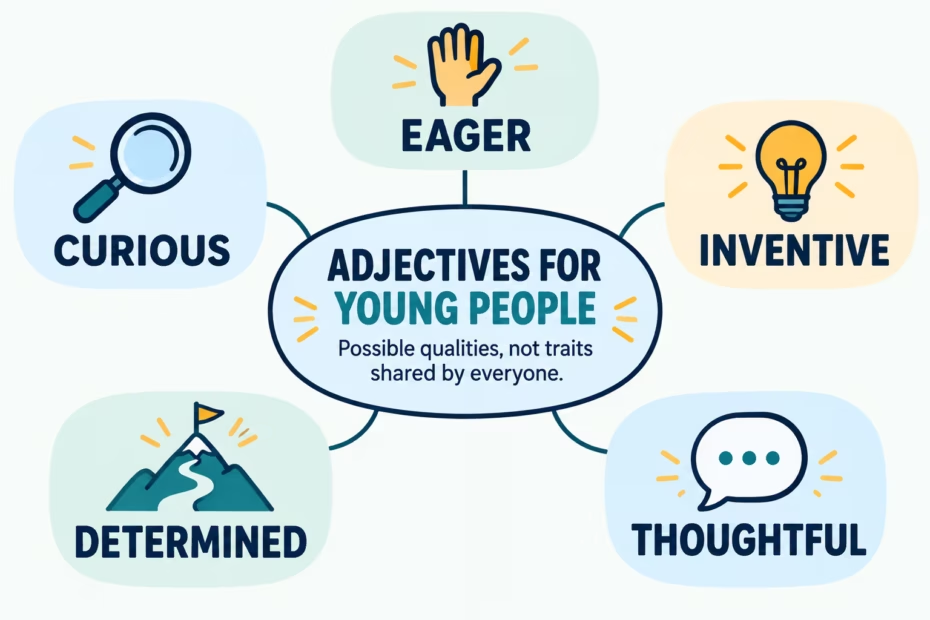
Young describes age or an early stage of development; it does not tell you what a person is like. When choosing adjectives for young people, name the quality or action you actually mean. A young person might be curious, inventive, reserved, determined, or tired—just like anyone else.
Positive adjectives for young people
Use these words when the context supports them. They describe qualities or behavior, not traits shared by every young person.
- Curious: interested in learning or finding out more. The curious student asked how the bridge could hold so much weight.
- Eager: ready and enthusiastic to do something. The eager volunteers arrived early to set up the garden.
- Imaginative: able to form original ideas or pictures in the mind. An imaginative storyteller turned a rainy afternoon into an adventure.
- Inventive: good at creating new ideas or ways to solve problems. The inventive team built a model from recycled materials.
- Determined: firmly committed to reaching a goal. She was determined to finish the course, practicing a little each day.
- Resilient: able to recover and continue after difficulty. After the first design failed, the resilient group tried a new approach.
- Thoughtful: considerate or careful in how one thinks. The thoughtful class made space for everyone to contribute.
- Playful: enjoying fun, lighthearted activity. The playful puppy chased the paper ball across the room.
For a specific person, support the adjective with a detail. Instead of saying that all young people are “ambitious,” describe the goal someone set or the steps they took toward it.
Words for energy, curiosity, and creativity
Choose a word according to the quality you want to convey. Lively suggests animation; energetic emphasizes vigor; curious describes a desire to learn; inquisitive often highlights asking questions; and inventive or imaginative focuses on original ideas. These terms overlap, but they are not interchangeable in every sentence.
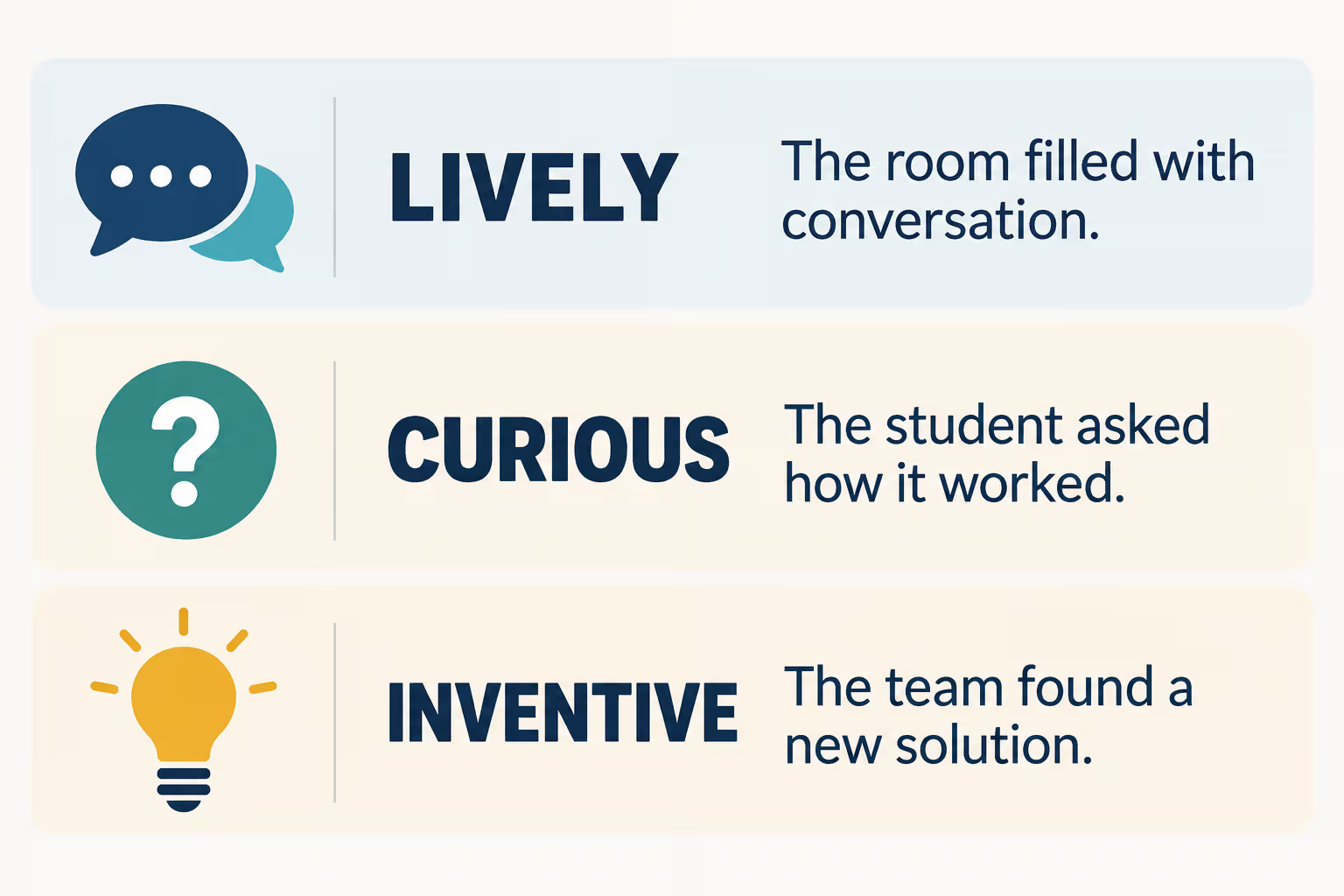
For example, “The lively group filled the room with conversation” describes atmosphere. “The inquisitive group asked how the experiment worked” gives a clearer, observable reason for the description.
Use behavior words carefully
Words such as impulsive, restless, and rebellious can sound judgmental when applied broadly to young people. If you mean a particular action, describe it directly: “Maya answered before hearing the full question” is more precise than labeling her impulsive. “The students shifted in their seats during the long wait” gives readers evidence for restless behavior without turning it into a claim about their age group.
Likewise, inexperienced means lacking experience in a particular area; it does not simply mean young. A person can be young and experienced, or older and new to a task.
Young, youthful, adolescent, juvenile, childlike, and childish
These related words have different uses:
- Young is the broad, ordinary word for someone or something at an early age or stage.
- Youthful can mean young in appearance or having qualities associated with youth, such as enthusiasm. It can also be approving when describing an older person’s energy.
- Adolescent refers to the developmental period between childhood and adulthood, or to someone in that period. It is more formal than teenager.
- Juvenile is used in specific legal, biological, or technical contexts; when describing behavior, it can be disapproving and mean childish or immature.
- Childlike often describes positive qualities associated with children, such as openness or wonder. Childish is often critical when it means immature or silly behavior.
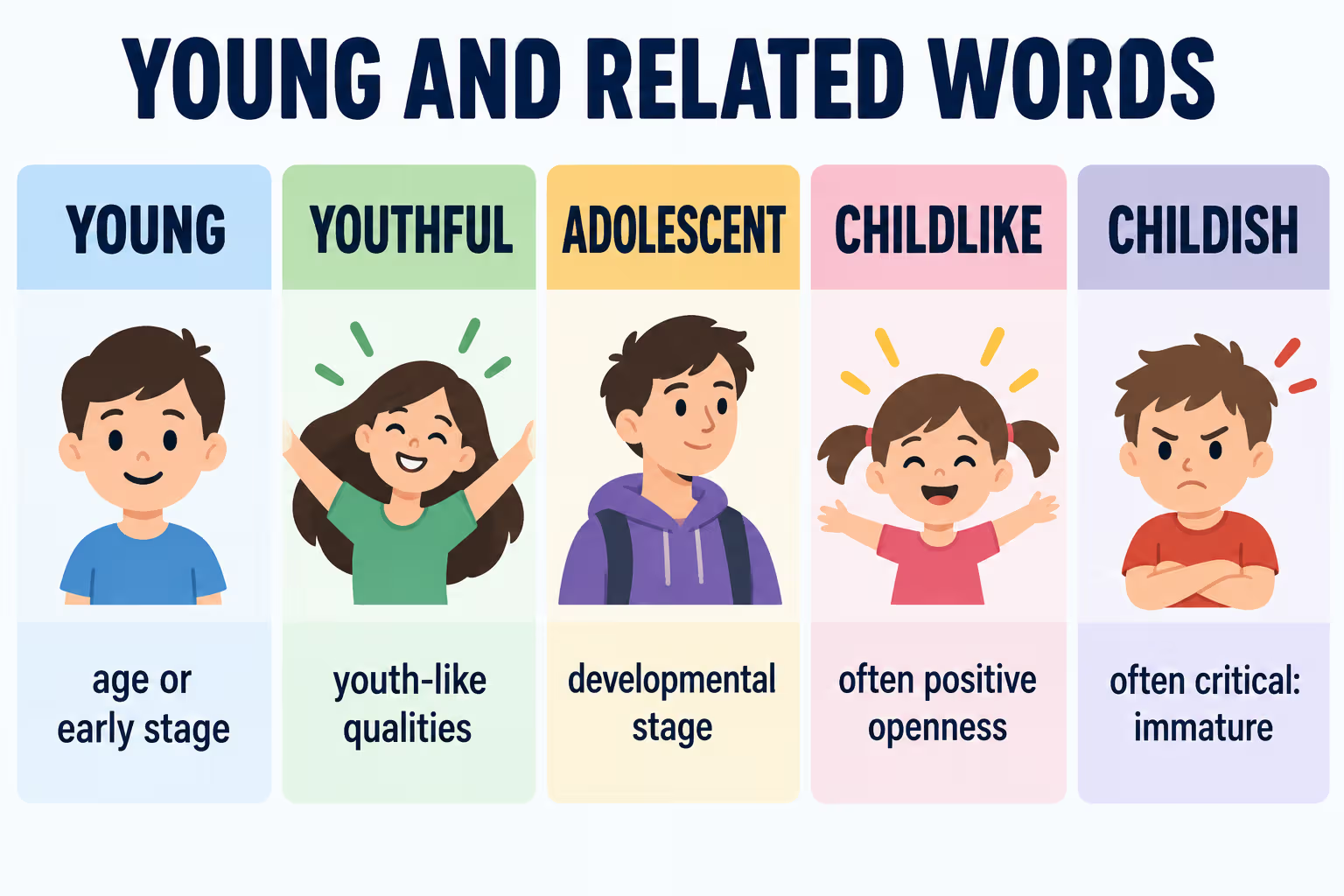
So “a youthful outlook” may be praise, while “a juvenile remark” may criticize the remark. Choose the term that matches your meaning and audience. Cambridge Dictionary’s usage notes distinguish youthful, juvenile, childlike, and childish.
Are “mature” and “old” opposites of young?
Not exactly. Mature usually describes development, judgment, or behavior, rather than chronological age: someone can be young and mature. Older is a relative age comparison, while adult names a life stage or legal status that depends on context. Aged can sound formal or impersonal when used for people, and senior may refer to age or rank. Pick the word that states the contrast you intend.
Quick examples
| What you mean | Useful adjective | Example |
|---|---|---|
| Interested in learning | Curious | The curious child examined each shell. |
| Full of activity | Lively | A lively discussion followed the story. |
| Creates original ideas | Inventive | The inventive students designed a simple water filter. |
| Continues after setbacks | Resilient | The resilient team revised its plan after testing. |
| At an early age or stage | Young | The young oak has begun to grow new leaves. |
Writing tip: describe the person or action you can observe, and use age words only when age is relevant. This keeps descriptions precise and avoids treating a diverse group as if everyone shared the same personality.
When it comes to describing the young, a wide range of adjectives can be used to capture their energy, curiosity, and potential. In this article, I’ll be sharing some powerful adjectives that perfectly encapsulate the vibrant spirit of youth. From “energetic” to “innovative” and everything in between, these words will help you paint a vivid picture of the young individuals in your life or in your writing. So, whether you’re a teacher, a parent, or simply someone who appreciates the zest of youth, read on to discover a collection of descriptive words that will bring your descriptions to life.
- Energetic: Young people are known for their boundless energy and enthusiasm. Whether they’re playing sports, exploring new hobbies, or simply going about their day, their vibrant energy is contagious.
- Curious: The young have an insatiable curiosity that drives them to explore and learn. They ask questions, seek out new experiences, and approach the world with a sense of wonder and awe.
- Ambitious: Young individuals are often driven by a strong desire to achieve their goals and make a difference in the world. They have big dreams and are willing to work hard to turn them into reality.
- Creative: The young possess a natural creativity that allows them to think outside the box and come up with innovative solutions. Their fresh perspective and imaginative ideas can inspire and transform the world around them.
- Resilient: Despite facing challenges and setbacks, the young have a remarkable ability to bounce back and persevere. Their resilience enables them to overcome obstacles and grow stronger in the process.
By using these adjectives and incorporating them into your descriptions, you’ll be able to vividly portray the energy, curiosity, ambition, creativity, and resilience that characterize the young. So go ahead, embrace the power of words and paint a picture that truly captures the essence of youth.
How to Describe young? – Different Scenarios
When it comes to describing young individuals, there are various scenarios where you may want to capture their unique qualities and characteristics. Whether you are writing a story, composing a poem, or creating a lesson plan for young students, it’s essential to choose adjectives that vividly portray the spirit of youth. Let’s explore some different scenarios and examples of how to describe young individuals:
- Stories and Literature:
When writing stories or describing characters, it’s crucial to bring them to life by choosing descriptive adjectives. Here are some examples of adjectives that paint a vibrant picture of youth:
- Energetic: The young boy bounded across the playground, full of energy and excitement.
- Curious: The young girl’s curious nature led her to explore every nook and cranny of the enchanted forest.
- Ambitious: The young entrepreneur set ambitious goals for his start-up business, determined to succeed.
- Poetry and Creative Writing:
Poetry provides a great platform to express the emotions and beauty of youth. Here are some adjectives that can add depth and evoke the essence of youth in your poems or creative writing:
- Creative: The young artist’s imaginative mind produced a kaleidoscope of colors on the canvas.
- Resilient: Despite facing challenges, the young dancer bounced back with resilience and grace.
- Adventurous: The young explorer ventured into the unknown, seeking new experiences and thrills.
- Teaching and Education:
When teaching young students, it’s important to use adjectives that engage their imagination and enthusiasm for learning. Here are some adjectives that can make your lessons more exciting and memorable for young minds:
- Inquisitive: The young learners asked an array of inquisitive questions, eager to expand their knowledge.
- Playful: The young children engaged in playful activities, fostering their cognitive and social development.
- Curious: The young scientists eagerly explored the mysteries of the natural world, driven by curiosity.
Remember, when describing young individuals, it’s important to choose adjectives that accurately reflect their unique qualities. By incorporating vibrant and descriptive adjectives, you can bring out the true essence of youth in your writing, storytelling, or teaching.
Describing Words for young in English
As a seasoned writer, I understand the importance of using the right adjectives to vividly describe young individuals. Choosing descriptive words that accurately capture their unique qualities can bring out the true essence of youth in writing, storytelling, or teaching. In this section, I will provide you with a comprehensive list of adjectives for young people in English, along with examples of how they can be used.
Energetic
Young individuals are brimming with energy, always ready to explore and take on new challenges. Here are some adjectives to describe their vibrant nature:
- Lively: The classroom was filled with lively young students, eager to participate in the activity.
- Dynamic: The young athletes displayed their dynamic skills on the field, impressing both the audience and their coaches.
Curious
Curiosity drives young minds to ask questions and seek knowledge. Here are some adjectives to capture their inquisitive nature:
- Curious: The young girl was curious about the world around her and asked her teacher a multitude of questions.
- Inquisitive: The inquisitive students eagerly delved into the topic, searching for answers to satisfy their curiosity.
Ambitious
Young individuals are filled with dreams and aspirations, always striving to achieve their goals. Here are some adjectives to reflect their ambitious nature:
- Driven: The young entrepreneur was driven to start her own business and worked tirelessly to turn her vision into reality.
- Motivated: The young musician was motivated to practice for hours every day, determined to become a world-class performer.
Creative
Young people possess immense imagination and artistic abilities that enable them to think outside the box. Here are some adjectives to describe their creative nature:
- Inventive: The young artist used inventive techniques to create unique and captivating masterpieces.
- Imaginative: The young writer had an imaginative mind, crafting enchanting stories that transported readers to magical realms.
Resilient
In the face of challenges, young individuals showcase their resilience and ability to bounce back. Here are some adjectives to capture their resilient nature:
- Tenacious: The young athlete displayed tenacious determination, never giving up even when faced with setbacks.
- Strong-willed: The young student was strong-willed, facing academic obstacles with unwavering determination.
Adjectives for young
Adjectives for Young
Positive Adjectives for Young with 12 Example Sentences
When it comes to describing young individuals, there are numerous positive adjectives that can capture their vibrant and energetic nature. As a writer or teacher, it’s important to choose the right adjectives in order to accurately portray the qualities of youth. Here are 12 positive adjectives for young people, along with example sentences to help you understand their usage:
- Energetic – The young boy ran around the playground with boundless energy.
- Curious – Young children are naturally curious about the world around them.
- Ambitious – The young entrepreneur started her own business at the age of 18.
- Creative – The young artist expressed herself through her beautiful paintings.
- Resilient – Despite facing challenges, young individuals have the ability to bounce back and persevere.
- Imaginative – The young girl had a vivid imagination and could create fantastical stories.
- Adventurous – The young explorer embarked on a journey to unknown lands.
- Intelligent – Young minds are capable of absorbing knowledge and learning quickly.
- Optimistic – Young people often have a positive outlook on life and believe in their dreams.
- Determined – The young athlete showed great determination to win the race.
- Empathetic – Young individuals can demonstrate a high level of empathy towards others.
- Confident – The young student presented her project to the class with confidence.
Negative Adjectives for Young with 5 Example Sentences
While it’s important to highlight the positive qualities of young people, it’s also necessary to acknowledge that they can exhibit negative traits at times. Here are 5 negative adjectives that can describe young individuals, along with example sentences:
- Impulsive – The young boy often acted without thinking about the consequences.
- Rebellious – Some teenagers go through a rebellious phase as they try to establish their identity.
- Insecure – Young individuals can struggle with feelings of insecurity and self-doubt.
- Naive – The young girl was naive and easily deceived by others.
- Restless – Young people may have difficulty staying still or focused for long periods of time.
Remember, when describing young individuals, it’s important to consider the context and use adjectives that accurately reflect their characteristics and experiences. By using the right adjectives, you can bring out the true essence of youth in your writing or teaching.
Synonyms and Antonyms with Example Sentences
Synonyms for young
When it comes to describing young individuals, there are several synonyms that can be used to convey the qualities of youth. Here are some common synonyms for young:
- Youthful: He has a youthful energy that is contagious.
- Juvenile: The juvenile kangaroo hopped across the field.
- Adolescent: The adolescent boy is starting to assert his independence.
- Youngster: The little girl is a talented young artist.
- Junior: She joined the junior tennis team when she was just ten years old.
- Childish: He still has some childish habits that he needs to outgrow.
- Inexperienced: The inexperienced driver needs more practice behind the wheel.
- Fresh: The fresh faces of the new students brought a sense of excitement to the classroom.
Example sentences:
- Youthful: The actress is known for her youthful appearance.
- Juvenile: The zoo has a dedicated section for juvenile animals.
- Adolescent: The adolescent girl is going through a growth spurt.
- Youngster: The playground is filled with happy youngsters playing on the swingset.
- Junior: She won the junior golf tournament with a fantastic score.
- Childish: His behavior during the meeting was quite childish.
- Inexperienced: The young doctor is still inexperienced, but eager to learn.
- Fresh: The college freshmen are excited for their first year of university.
Antonyms for young
On the other hand, there are also antonyms that can be used to describe individuals who are not young. Here are some common antonyms for young:
- Old: The elderly couple walked hand in hand.
- Mature: She has a mature outlook on life for her age.
- Aged: The aged dog slowly walked across the room.
- Grown-up: The grown-up man has a successful career.
- Senior: The senior citizen enjoys spending time with their grandchildren.
Example sentences:
- Old: The antique shop sells a variety of old items.
- Mature: The young boy showed a surprisingly mature attitude.
- Aged: The aged building has a rich history.
- Grown-up: As a grown-up, it’s important to take responsibility for your actions.
- Senior: The senior members of the community center organized a charity event.
Remember, choosing the right adjective is essential to accurately reflect the qualities of youth or describe individuals who are not young.
Conclusion
The right choice of adjectives is crucial when describing young individuals. Throughout this article, we have explored a comprehensive list of positive and negative adjectives that accurately reflect the qualities of youth. By using these adjectives, we can bring out the true essence of youth in our writing, storytelling, or teaching.
The importance of selecting the appropriate adjective cannot be overstated. It allows us to paint a vivid picture and create a more engaging experience for our readers or listeners. Whether we are describing someone who is young or capturing the spirit of youth, the right adjective can make all the difference.
By providing example sentences for each adjective, we have further enhanced our understanding of their usage. This practical approach enables us to apply these adjectives effectively in our own writing and communication.
In addition, we have explored synonyms and antonyms for the adjective “young,” showcasing the range of options available to us when describing individuals who are not young. This expands our vocabulary and allows for more nuanced descriptions.
By utilizing the adjectives discussed in this article, we can accurately and creatively describe young individuals, capturing the energy, vibrancy, and unique qualities that define youth.


