Question Mark Rules at a Glance
A question mark (?) closes a direct question, including a short fragment used as a question. It does not normally close an indirect question embedded in a statement. In English, put one question mark at the end of the whole question, and use quotation marks or parentheses to show which words the mark applies to.
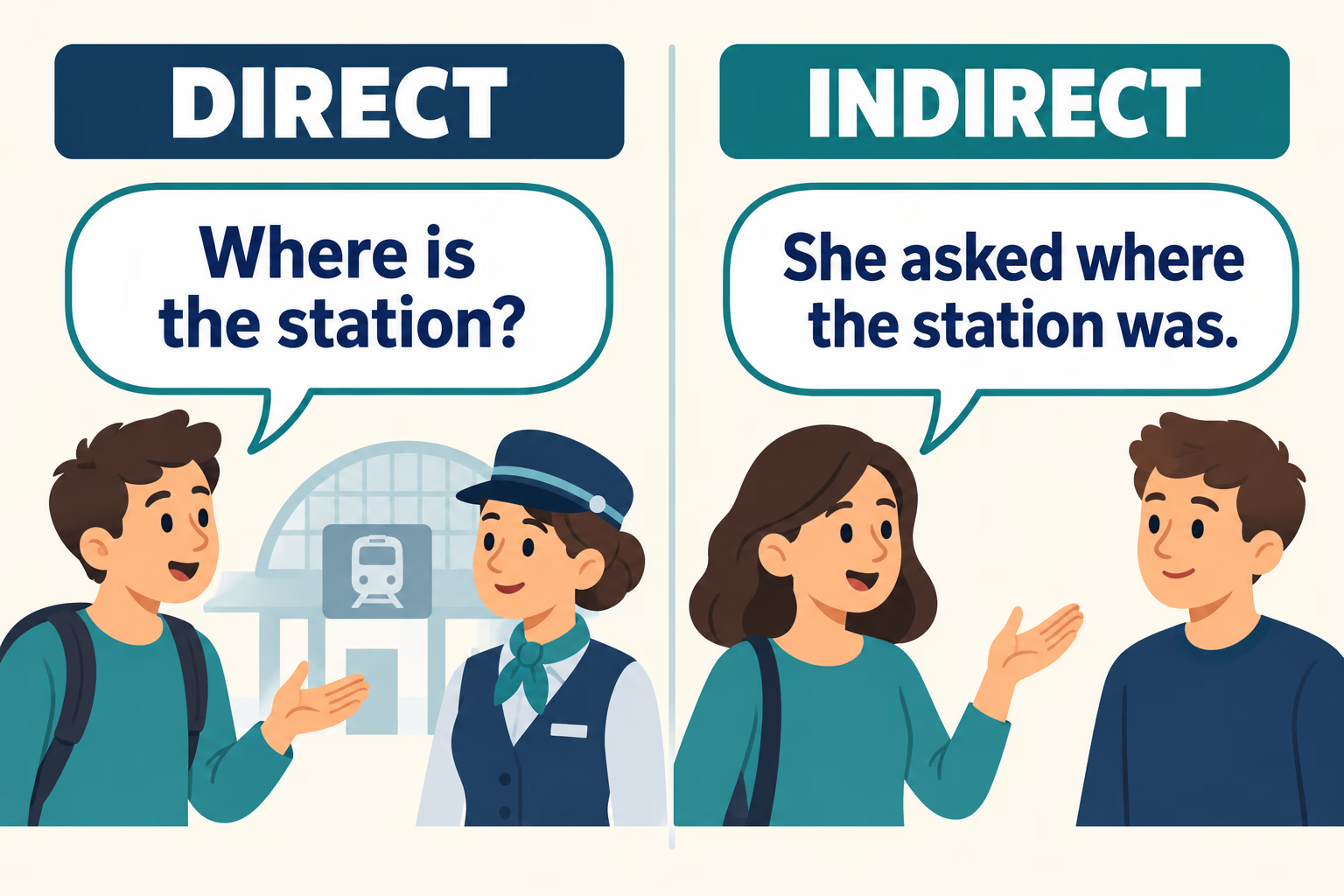
- Direct: Where did you put the key?
- Indirect: She asked where I put the key.
- Question inside a quotation: He asked, “Where is the key?”
- Question about a quoted word: Did he say “key”?
- Spanish direct question: ¿Dónde está la llave?
The fastest editing check is to identify the sentence’s main speech act: is the writer asking the reader something now, or reporting, describing, or quoting a question? Punctuate the sentence that is actually on the page, rather than adding a question mark merely because it contains a question word.
When Does a Question Need a Question Mark?
Use a question mark after a direct question, whether it asks for information, confirmation, a choice, or a response. The sentence does not need to begin with who, what, or why: Are you ready?, You have the tickets?, and Tea or coffee? can all function as direct questions. Cambridge Grammar notes that questions can take different forms, including statement-shaped questions in conversation.
A question can be a complete sentence or a short contextual fragment. In dialogue, Coming? and Why? are clear when the conversation supplies the missing context. In a formal explanation, use a complete construction when the fragment could be mistaken for a heading or note.
Rhetorical questions still take a question mark when they are deliberately phrased as questions: Who could forget that result? The mark records the sentence form; it does not promise that the writer expects a spoken answer. If the line is meant as a plain assertion instead, a period is often calmer and clearer.
Why Does an Indirect Question Usually End with a Period?
An indirect question reports or embeds a question inside a larger statement, so the larger sentence takes its end punctuation. Write I wonder where the museum is. and They asked whether the room was open. The embedded ideas request information, but neither complete sentence directly asks the reader for it.
Keep the statement word order in most embedded questions: Do you know where the exit is? is correct, while Do you know where is the exit? usually is not. The first example has a question mark because Do you know…? is itself a direct question; where the exit is is the embedded question. A period changes the first sentence into a statement: I know where the exit is.
Use if or whether when reporting a yes-or-no question: She asked if the shop was open. A period is standard after a declarative reporting clause. A question mark may be appropriate when the whole sentence itself asks the reader something, as in Could you tell me whether the shop is open?
Where Does the Question Mark Go with Quotation Marks?
Place the question mark according to meaning: inside the closing quotation mark when the quoted words are a question, and outside when the surrounding sentence is the question. American and British house styles differ on some commas and periods around quotes, but this meaning-based principle for question marks is widely used; follow the style guide required by your publisher.
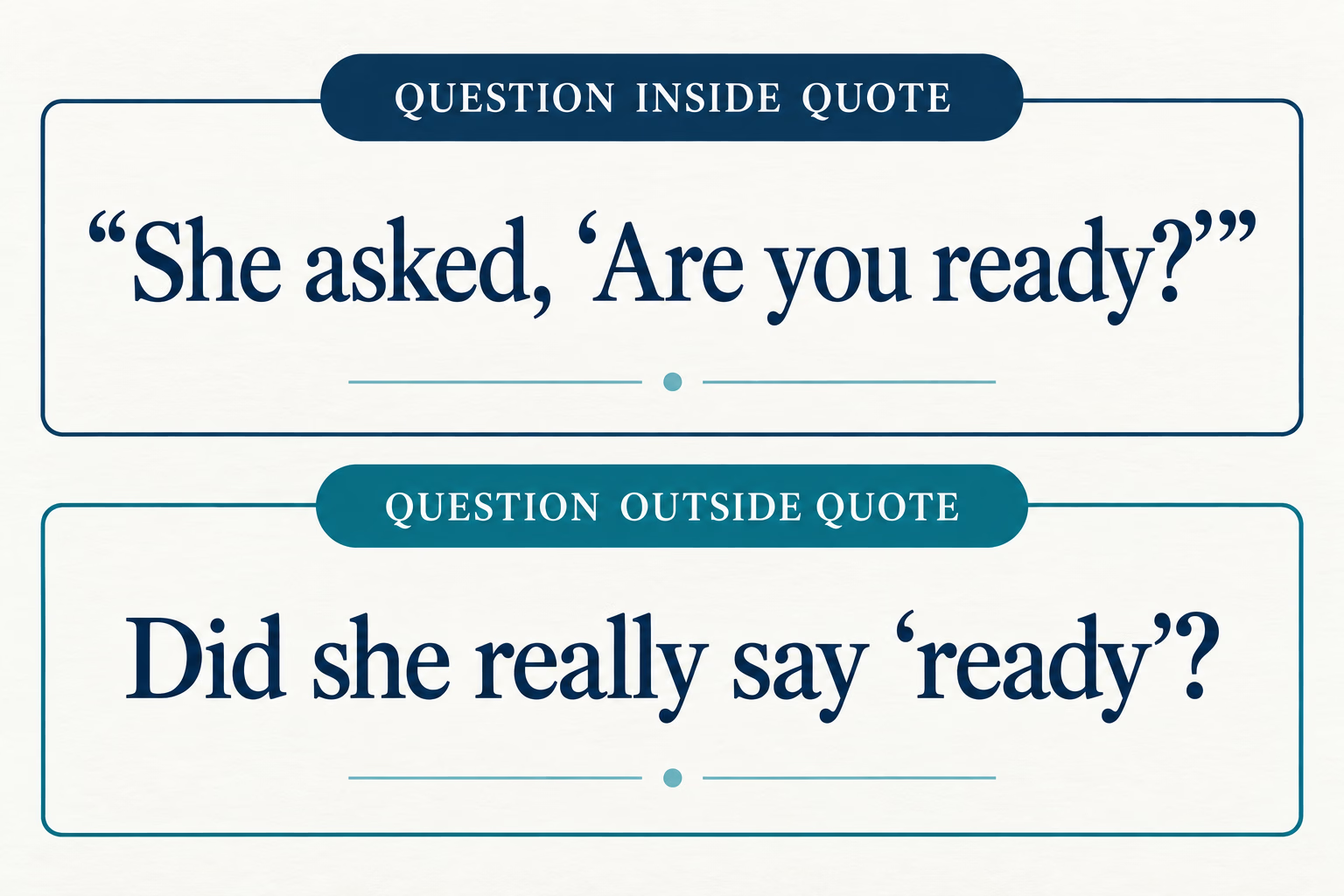
- The quotation is a question: Maya asked, “Are you ready?”
- The entire sentence asks about a word or phrase: Did Maya say “ready”?
- Both the quote and reporting sentence are questions: Did Maya ask, “Are you ready?”
In the third example, one mark serves both roles because the quotation ends at the end of the whole question. Do not add a second question mark after the closing quotation mark. Purdue OWL explains that question marks and exclamation points go inside quotes when they belong to the quoted material, and outside when they belong to the sentence around it.
How Do Parentheses Affect the Question Mark?
Put the question mark inside parentheses when only the parenthetical words form a question, and put it outside when the whole sentence is a question. For example: The note asked (who had the key?) before listing the names. Here the parenthetical aside is interrogative, but the full sentence is a statement. Compare: Did the note identify the keyholder (Mina)? The main sentence is a question, so its mark follows the closing parenthesis.
When a parenthetical question appears inside a statement, use an opening parenthesis and a question mark before the closing one: The report asks (and answers) whether the route is safe. This sentence itself is not a question, so it ends with a period. Avoid placing both a question mark inside the parentheses and another after them unless two distinct questions genuinely require punctuation.
Should You Capitalize the Next Word After a Question Mark?
Capitalize the next word when a new sentence begins; keep it lowercase when the same sentence continues. The punctuation mark alone does not decide capitalization. Write Where is the gate? We can wait beside it. because the second clause is a new sentence, but write Who knows?—perhaps the caretaker does. only if your punctuation and style make the continuation part of one sentence.
After a quoted question, capitalization depends on the grammar outside the quotation: “Where is the gate?” she asked. The reporting clause continues the same sentence, so she remains lowercase. By contrast, “Where is the gate?” She asked the attendant. begins a new sentence after the quotation and therefore capitalizes She.
How Should You Punctuate a Series of Questions?
Give each separately asked question its own question mark, including questions in a list or dialogue. A useful sequence is: Which room is booked? Who has the key? When does the tour start? Keep each item parallel where possible, and capitalize each one if it is written as a separate sentence.
- Mark where one complete direct question ends.
- Place one question mark there, before any closing quotation mark if it belongs to quoted words.
- Start the next independent question with a capital letter.
- Use a comma or semicolon instead only when questions are combined into a single grammatical sentence and the chosen structure reads clearly.
A string such as What? Why? How? can convey surprise or a rapid exchange in dialogue, but several marks after one question (What???) are informal emphasis. In edited prose, one mark is normally enough. The interrobang (‽) is a distinct Unicode character designed to combine question and exclamation, but it remains uncommon in everyday formal writing.
What Is Different About Spanish Question Marks?
Standard Spanish uses an opening inverted question mark (¿) at the beginning of a direct question and a closing question mark (?) at its end: ¿Cuándo sale el tren? The opening mark tells readers where the interrogative span begins, which is useful when a question starts after other words in the same sentence.
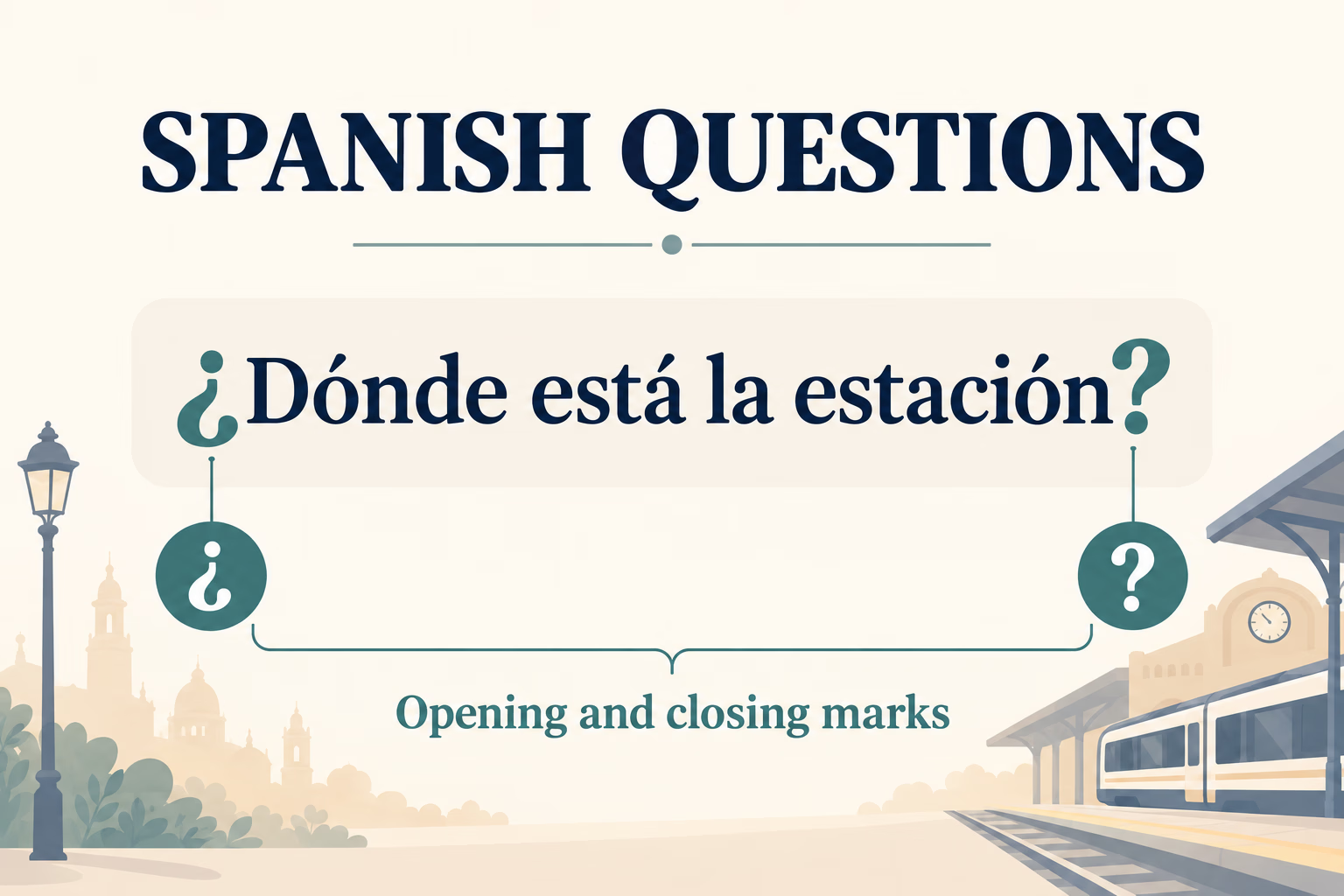
If only part of a sentence is a question, Spanish places the opening mark at the start of that part: Y tú, ¿qué piensas? It does not automatically begin at the start of the whole sentence. The Royal Spanish Academy treats the opening and closing marks as a paired set for questions; do not substitute a period, comma, or exclamation mark for the opening sign.
Where Did the Question Mark Come From?
The medieval question mark is associated with the Latin term punctus interrogativus, a mark used to signal an interrogative or a rising vocal pattern. Manuscript punctuation developed over time, and the shape of the modern question mark evolved gradually. Historians do not have firm evidence that the symbol came from an Egyptian cat’s tail or from the letters Q and O in quaestio; those are popular origin stories, not established facts.
Alcuin of York is often credited with inventing the question mark, but that claim should also be treated cautiously: a manuscript commissioned by Charlemagne in 781 reportedly used an interrogative mark before Alcuin joined Charlemagne’s court. The evidence supports a medieval development of question punctuation, not a securely identified single inventor or one proven moment of invention. Manuscript specialists distinguish the medieval punctus interrogativus from the familiar modern glyph.
For digital text, Unicode identifies the ordinary question mark as U+003F and separately encodes characters such as the inverted Spanish mark U+00BF. These are distinct characters, not merely fonts or decorative variants. That distinction matters when searching, proofreading, or entering Spanish text with a keyboard.
A Fast Proofreading Check
When a sentence looks uncertain, first locate the main clause and ask whether it directly asks the reader something. Then check whether a question is embedded, quoted, or parenthetical, and place the mark next to the words it governs. This two-pass check catches the most common punctuation error: using a question mark because a sentence contains who or where, even though the full sentence is a statement.
- Tell me where you parked. Statement; period.
- Can you tell me where you parked? Direct question; question mark at the end.
- “Where did you park?” he asked. Quoted question; mark inside the quote.
- Did he ask “Where did you park”? The reporting sentence asks the question; mark outside the quote.
Frequently Asked Questions About Question Marks
Does every sentence with “who” or “why” need a question mark?
No. A sentence needs a question mark when its main structure is a direct question. Why did the train stop? asks directly, but I know why the train stopped. reports information and ends with a period. The presence of an interrogative word does not determine the punctuation by itself.
Can a polite request end with a question mark?
Yes, when the request is phrased as a direct question: Could you open the window? A plain command such as Please open the window. is normally punctuated with a period. The writer’s tone may be polite in either construction, but the sentence form differs.
Can a rhetorical question end with a period?
It can when the writer recasts it as a statement, but a sentence phrased as a question normally takes a question mark. Compare Who could object? with No one could reasonably object. Choose the version that best matches the intended tone and avoids using a rhetorical question as filler.
Should I use more than one question mark for emphasis?
Usually not in formal or edited prose. A single question mark is the standard end mark; repeated marks signal informal surprise or disbelief and can distract from the sentence. Use wording, a separate exclamation, or dialogue context to convey emphasis more precisely.
What is the difference between a question mark and an interrobang?
A question mark ends a question, while an interrobang combines the question mark and exclamation point in one glyph (‽). The interrobang is available in Unicode but is relatively rare in ordinary prose. Most style guides and professional settings favor the familiar “?!” or a rewritten sentence.
Sources and Further Reading
- Cambridge Dictionary, English Grammar Today: Questions.
- Purdue OWL: Additional Punctuation Rules for Quotation Marks.
- Real Academia Española: Question and exclamation marks.
- Unicode Names List: ASCII punctuation, U+003F.
- Oxford Academic, The Latin New Testament: punctuation in manuscript traditions.

Have you ever wondered about the significance of that small, curvy punctuation mark at the end of a sentence? The question mark, often referred to as the “interrogation point,” plays a crucial role in our written communication. In this article, I’ll delve into the world of question marks, exploring their usage, rules, and the impact they have on our sentences.
When it comes to using a question mark, there are certain guidelines to follow. It’s not just about indicating a question; there are indirect questions, commands, and even rhetorical questions that require different punctuation. Understanding when and how to use a question mark correctly can enhance the clarity and effectiveness of your writing. So, let’s explore the various scenarios where a question mark comes into play and unravel the mysteries behind this seemingly simple punctuation mark.
Question marks often go hand in hand with quotation marks and parentheses. Knowing where to place the question mark in relation to these punctuation marks can be a bit tricky. But fear not, I’ll provide you with clear guidelines to ensure that your question marks are in the right place, whether they are part of the quoted text or the surrounding sentence. So, let’s dive into the intricate relationship between question marks and quotation marks, as well as question marks and parentheses.
What is a Question Mark?
A question mark is a punctuation mark that is used to end interrogative sentences or questions. It is represented by a symbol “?” and placed at the end of a sentence to indicate that it is a direct question. The question mark is one of the main three end marks for sentences, along with the period and the exclamation point.
Definition
The question mark serves as a visual cue to readers that a sentence should be read as an inquiry or a question. It represents something unknown, unknowable, uncertain, or doubtful. It is used when seeking information, clarification, or confirmation from someone. In writing and printing, the question mark is placed at the conclusion of a sentence to indicate that it is a direct question.
Purpose
The purpose of the question mark is to clearly indicate to readers that a sentence requires a response or an answer. It signals that the sentence is asking for information or seeking clarification. The placement of the question mark depends on the structure of the sentence and should be used to accurately convey the intended meaning.
Usage
Question marks are used in a variety of ways in written communication. Here are a few key points to keep in mind:
- Question marks are used at the end of direct questions or interrogative sentences.
- They are also used for indirect questions, rhetorical questions, and commands that are phrased as questions.
- Question marks should be placed before a closing bracket or quotation mark if the question is part of the text in the brackets or quotation marks. They should be placed after the closing bracket or quotation mark if the question is part of the surrounding text.
Remember, using question marks accurately and appropriately helps readers understand the intended meaning of your sentences and ensures effective communication.
The History of the Question Mark
Origins
The origins of the question mark are shrouded in mystery and speculation. One theory suggests that it may have originated from the ancient Egyptians, who were known for their worship of cats. They may have observed the curious shape of a cat’s tail and incorporated that shape into the punctuation mark. Another theory links the question mark to the Latin word “quaestio,” meaning “question.” Scholars in the Middle Ages would write “quaestio” at the end of a sentence to indicate that it was a question, which eventually morphed into the modern question mark.
Evolution
The question mark made its first appearance in Latin manuscripts around the eighth or ninth century, possibly with the works of Alcuin, an English scholar and poet. Alcuin, who joined the court of Charlemagne in 781, created the “punctus interrogativus” or the point of interrogation. This symbol resembled a tilde or lightning flash with a rising tone of voice, representing the intonation used when asking a question. The question mark was not introduced to the English language until 1587 with the publication of Sir Philip Sidney’s “Arcadia,” where it appeared nearly 140 times.
Variations
Over time, variations of the question mark have emerged. The traditional question mark (?) remains the most widely recognized and used form. However, in some languages, such as Spanish, there is an upside-down question mark (¿) that is used at the beginning of a sentence to indicate a question. In informal online communication, the addition of multiple question marks (???) is often used to convey emphasis or incredulity.
The question mark has evolved from its ancient origins to become an integral part of written communication. Its history is fascinating, and its usage continues to play a crucial role in sentence structure and conveying meaning. By understanding the origins, evolution, and variations of the question mark, we can better appreciate its significance in effective communication.
Punctuation Rules for Question Marks
When it comes to using question marks in written communication, there are specific rules to follow to ensure clear and effective writing. In this section, I will discuss the key punctuation rules for question marks, including their placement, capitalization, and punctuating multiple questions.
Placement
The placement of question marks depends on the structure of the sentence. Here are the general guidelines:
- For straightforward questions that require a direct response, the question mark goes at the very end of the sentence. For example, “Where are you going?”
- If the question mark applies to the sentence as a whole, rather than to a specific phrase or word, it should be placed at the very end. This is true even when a quotation contains a question. For example, “Did he ask, ‘Are you coming?'”
- If a question mark applies to both a quoted phrase and the rest of the sentence, use only one question mark. For example, “Did he say, ‘Where are you going?'”
Capitalization
The capitalization of words following a question mark depends on the context:
- When a question comes at the end of a statement and is separated by a comma, the word following the comma is usually not capitalized. For example, “He wondered if she was telling the truth, but he wasn’t sure.”
- Capitalization of the question after the comma is used for extreme emphasis, but it is rarely recommended. For example, “Was he really doing the best he could? That was the question.”
- When a sentence begins with a question, the word following the question mark is not capitalized. For example, “Are you ready for the challenge? Let’s get started!”
Punctuating Multiple Questions
When writing a series of questions, each question should be punctuated with a question mark, even if the items are not complete sentences. Capitalization of the question items is optional, so be consistent with your chosen style. For example:
- “What is your favorite color? How old are you? Have you ever been to Paris?”
By following these punctuation rules for question marks, you can ensure clear and effective communication. Remember to consider the structure of your sentence, the capitalization of words following the question mark, and how to punctuate multiple questions. With these guidelines in mind, your writing will always convey your intended meaning.
Common Mistakes with Question Marks
Overusing or Underusing
One common mistake when it comes to question marks is overusing or underusing them. It’s important to use question marks appropriately to achieve clear and effective communication. Using too many question marks can make your writing seem overly dramatic or unprofessional, especially in formal or professional settings. On the other hand, not using question marks when they are necessary can lead to confusion and misunderstanding.
To avoid overusing question marks, it’s essential to consider the context and tone of your writing. Ask yourself if a question mark is truly needed to convey your message or if a different punctuation mark, such as a period, would be more appropriate. Remember that question marks are primarily used to end interrogative sentences or direct questions. If your sentence is not a question, it’s best to use a different punctuation mark.
Incorrect Placement
Another common mistake is incorrect placement of question marks. The placement of a question mark depends on the structure of the sentence. It should always come at the end of the sentence, directly after the question being asked. However, some writers make the mistake of placing a question mark in the wrong location, either before or in the middle of the sentence.
To avoid incorrect placement, carefully review your sentence structure and ensure that the question mark is placed at the appropriate location. Remember that question marks should not be used in commands or instructions, as they are not framed as questions. Additionally, when reporting previously asked questions in indirect speech, a question mark should not be used.
Confusion with Other Punctuation Marks
Question marks can sometimes be confused with other punctuation marks, leading to incorrect usage. For example, there can be confusion between question marks and exclamation marks in rhetorical questions. Depending on the context, a rhetorical question can end in either a question mark or an exclamation mark. However, it’s important to understand that the use of an exclamation mark adds emphasis and can make a rhetorical question sound more blunt.
To avoid confusion, it’s important to understand the specific rules and guidelines for using different punctuation marks. Familiarize yourself with the rules regarding question marks, exclamation marks, periods, and other punctuation marks to ensure proper usage in your writing.
Remember, by avoiding overusing or underusing question marks, using correct placement, and understanding the differences between question marks and other punctuation marks, you can enhance the clarity and effectiveness of your written communication.
Fun Facts about Question Marks
Trivia
Did you know that the question mark has a fascinating history? It is believed to have been introduced by Alcuin of York, an English scholar and poet, in the 9th century. Alcuin, who was invited to join the court of Charlemagne, created the “punctus interrogativus” or “point of interrogation,” a symbol resembling a tilde or lightning flash. This symbol represented the rising tone of voice used when asking a question.
Symbolism
The question mark also holds symbolic meaning. In literature and art, it is often used to represent doubt, uncertainty, and mystery. It can add a layer of intrigue and suspense to a story, leaving readers pondering the unanswered questions. This punctuation mark is a powerful tool for engaging the audience and keeping them invested in the narrative.
Cultural Significance
The question mark has made its way into various cultural expressions. In the Southern United States, for example, the shape of a buzzard soaring in the sky is often likened to a question mark. This metaphorical comparison adds a touch of whimsy to the description of the bird and demonstrates the creative ways in which the question mark can be incorporated into language.
These examples highlight some interesting aspects of the question mark’s trivia, symbolism, and cultural significance. It’s fascinating to see how this simple punctuation mark has made its mark on history, literature, and everyday language.
Conclusion
In this article, I have explored the significance of question marks in written communication and provided guidelines for their usage. By highlighting common mistakes and addressing incorrect placement, I have emphasized the importance of using question marks appropriately for clear and effective communication. It is crucial to carefully review sentence structure and understand the specific rules for using different punctuation marks to avoid confusion.
Additionally, I have delved into the fun facts about question marks, including their history, symbolism, and cultural significance. From their introduction by Alcuin of York in the 9th century to their representation of doubt and mystery in literature and art, question marks have a rich and fascinating background. Furthermore, their metaphorical comparison to a soaring buzzard in the Southern United States adds to their cultural significance.
By understanding the proper usage of question marks and appreciating their trivia and symbolism, we can enhance our written communication and engage readers effectively. So next time you encounter a question, remember to use the question mark wisely and make your words soar with clarity and impact.