What Does “Abundant” Mean?
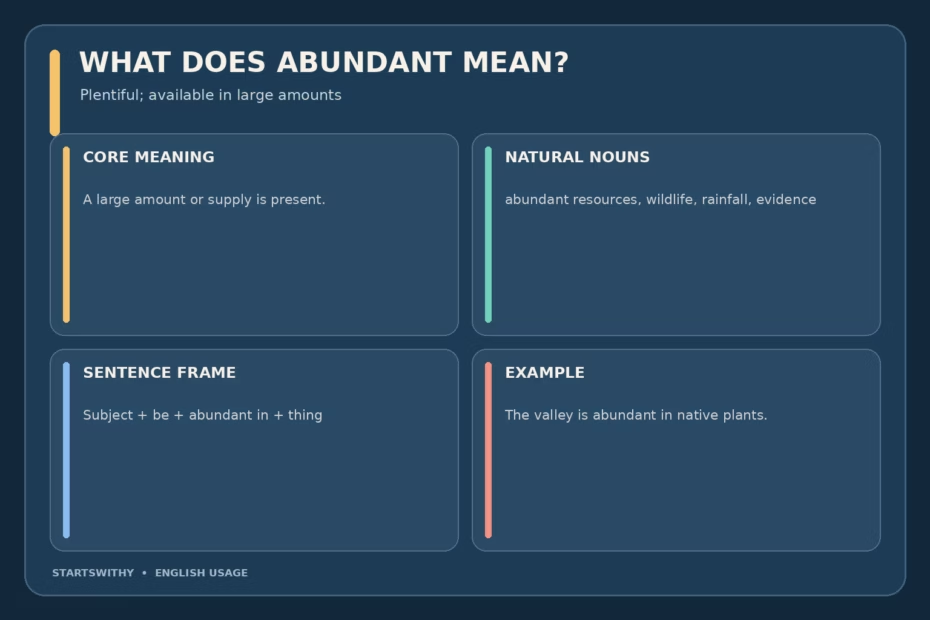
Abundant means present or available in large quantities; it describes something plentiful. You can use it for countable things, such as opportunities or examples, and for things treated as a mass, such as rainfall, food, or evidence. The sentence should make clear what is plentiful.
Quick answer: Put abundant before a noun (“abundant resources”), after a linking verb (“resources are abundant”), or in the phrase abundant in (“the area is abundant in birdlife”). For example: “The reserve is abundant in native plants, and its wetlands support abundant wildlife.”
How to Use “Abundant” in a Sentence
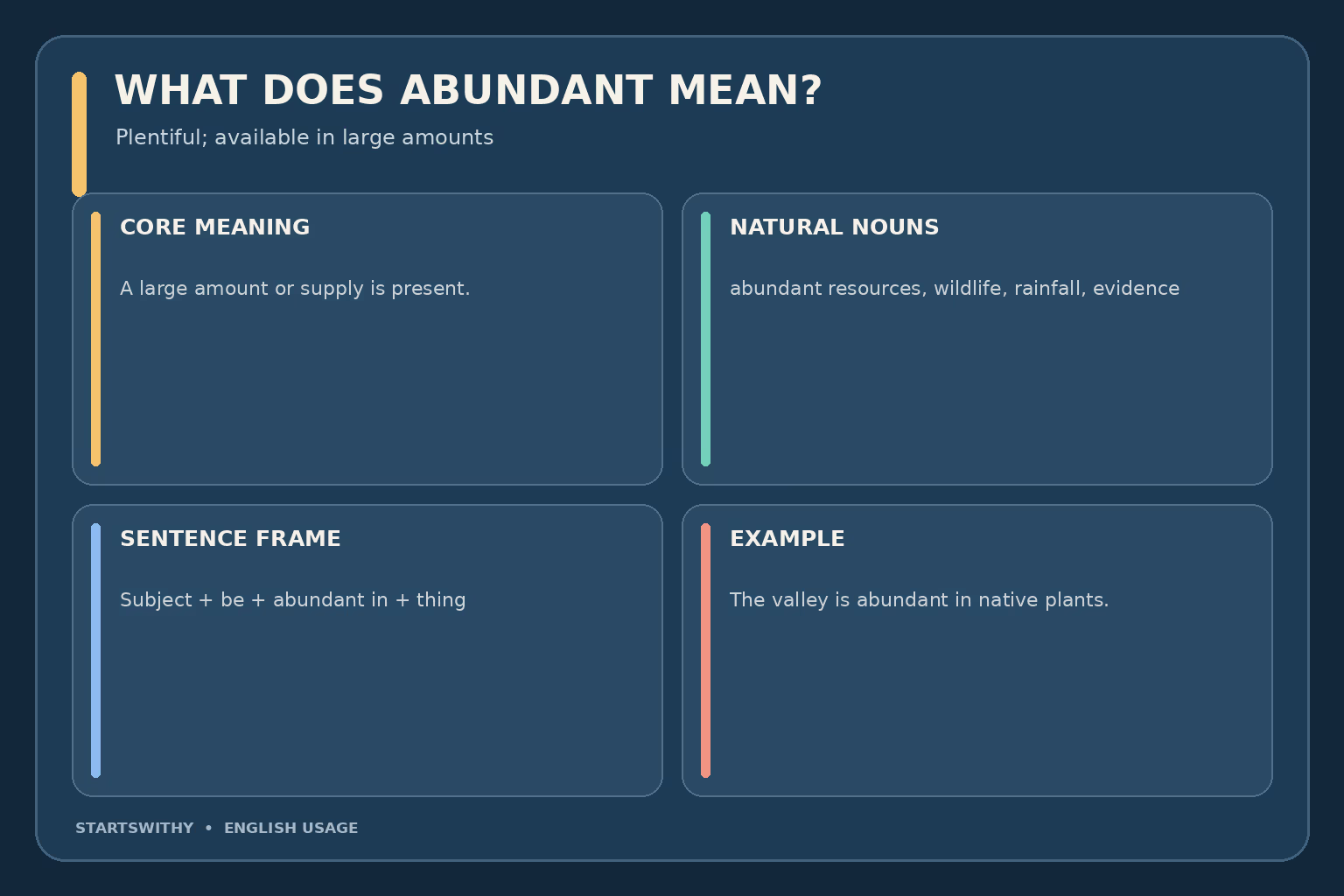
Because abundant is an adjective, it describes a noun or follows a linking verb such as be. The noun may be named immediately after it, or it may appear in an in-phrase. Each pattern keeps the focus on the item that exists in large quantity.
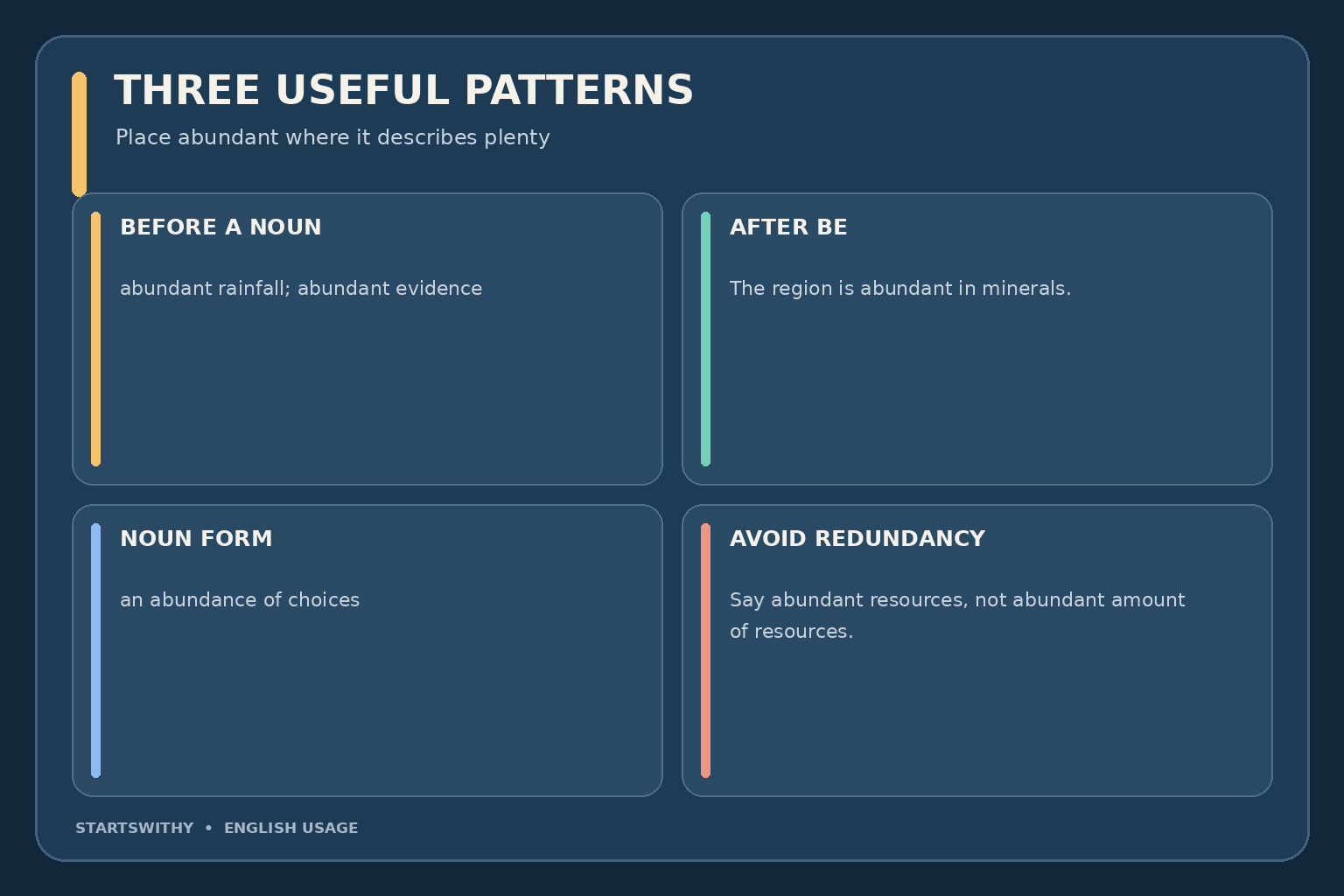
- Abundant + noun: “The archive contains abundant evidence of the town’s early history.”
- Be + abundant: “Fresh water is abundant during the rainy season.”
- Be abundant in + noun: “The hillside is abundant in wild herbs.”
- An abundance of + noun: “The garden produced an abundance of tomatoes.” Here, abundance is the noun form.
The related adverb abundantly describes an action or quality: “The instructions are abundantly clear.” It can also mean “in great quantity,” as in “The species grows abundantly along the river.” Use the form that matches the job in the sentence: abundant modifies a noun, while abundantly modifies an adjective or verb.
More Examples of “Abundant” in Context
- After the storm, the hillside was abundant with fresh mushrooms, so the foragers stayed on marked trails.
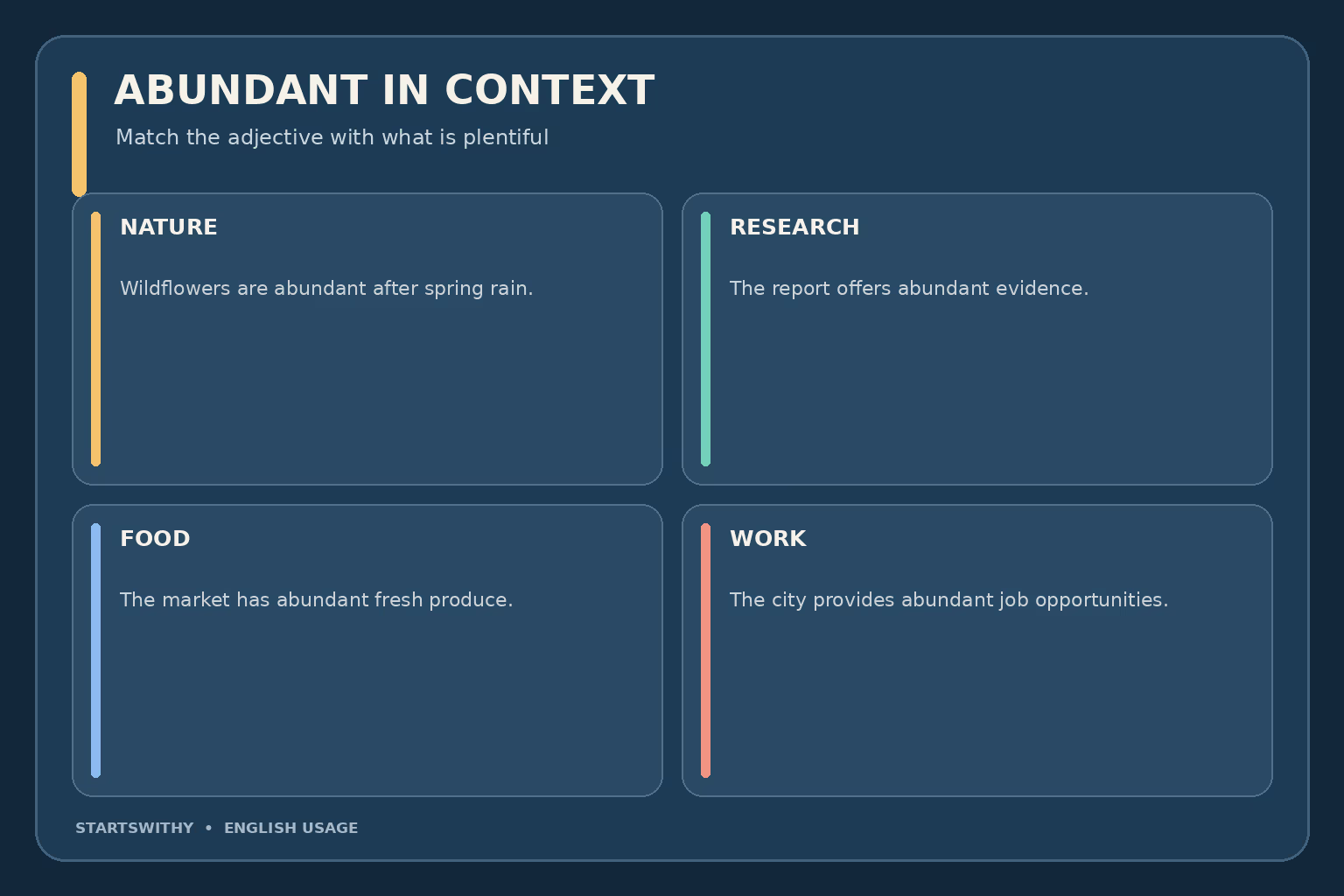
- The research team gathered abundant evidence, but it still checked each source before drawing a conclusion.
- Local farms provide abundant produce during the summer harvest.
- Because the library has abundant study space, students can usually find a quiet desk.
- Wildlife is abundant near the marsh, especially at dawn.
- The museum’s archive is abundant in letters from the period, although some years are poorly represented.
- Rainfall was abundant this spring, and several paths remained muddy.
- The guide offered abundant examples to help new volunteers learn the process.
- With abundant choices on the menu, the group asked the server about ingredients.
- Solar energy is abundant in sunny regions, though collecting and storing it requires equipment.
- The orchard produced an abundant crop of pears after several mild seasons.
- Though the article has abundant detail, its main point is easy to locate.
Abundant vs. Similar Words
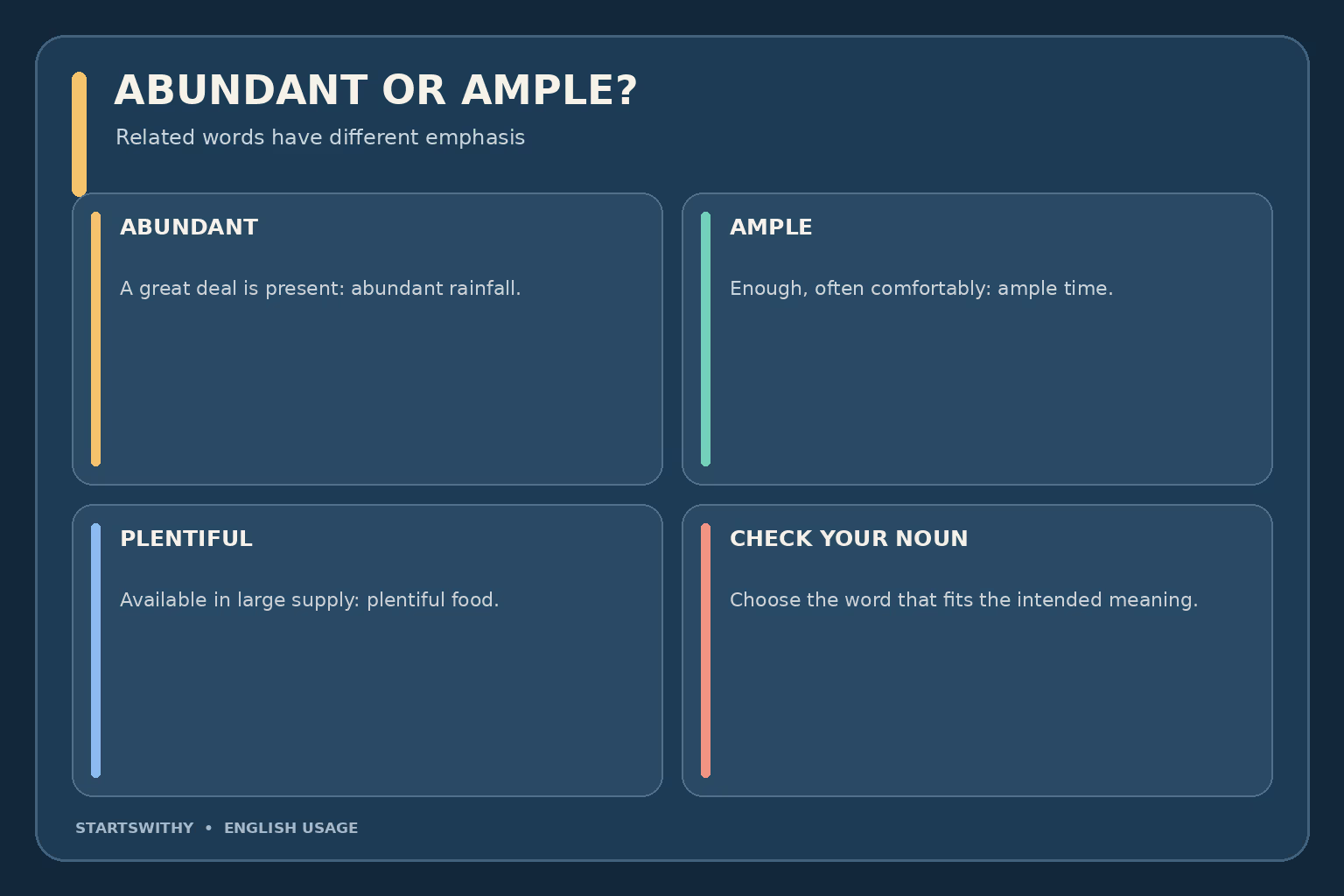
Abundant, ample, and plentiful overlap, but the emphasis differs. Abundant stresses a large quantity or presence. Ample often means enough, or more than enough, for a purpose: “We have ample time to finish.” Plentiful means available in a large supply: “Fresh berries are plentiful in July.” Select the word that says what you mean rather than rotating synonyms mechanically.
A frequent editing issue is using abundant amount or abundant number when the noun already names a quantity. Usually write abundant rainfall, abundant information, or abundant opportunities. Use a large amount of with an uncountable noun and a large number of with plural count nouns: “a large amount of rainfall” or “a large number of opportunities.” These versions are longer but grammatically clear.
Common Mistakes to Avoid
- Adding a redundant quantity word: Prefer “abundant resources” to “an abundant amount of resources.”
- Using a singular count noun without a determiner: Say “an abundant supply,” not “abundant supply,” unless the noun is plural or uncountable (“abundant supplies,” “abundant rainfall”).
- Confusing adjective and noun forms: Use “abundant choices” but “an abundance of choices.”
- Overstating a comparison: “Abundant” means plentiful; it does not automatically mean unlimited or inexhaustible.
- Choosing a vague noun: Name what is plentiful—evidence, rainfall, food, time, or options—so readers can picture the quantity.
Frequently Asked Questions
What is a simple sentence with “abundant”?
“The meadow is abundant in wildflowers.” The adjective tells us that many wildflowers grow there.
What is the difference between “abundant” and “an abundance of”?
Abundant is an adjective (“abundant choices”). Abundance is a noun, usually used in the phrase “an abundance of choices.”
Can “abundant” describe uncountable things?
Yes. It can describe uncountable nouns such as rainfall, evidence, food, or information, as well as plural count nouns such as examples and opportunities.
Is “abundant amount” correct?
It is understandable, but often redundant because both words express quantity. In most sentences, use “an abundant supply” or name the noun directly, such as “abundant rainfall.”
Sources and Further Reading
- Cambridge Dictionary: “abundant” (definition, examples, and pronunciation).
- Merriam-Webster: “abundant” (definition, word history, and example usage).
- Cambridge Grammar: Countable and uncountable nouns (how noun countability affects sentence patterns).

Have you ever struggled to find the right words to express the sheer abundance of something? The word “abundant” is commonly used to describe a plentiful or copious amount of something.
When we say something is abundant, we are indicating that there is a large quantity or supply of it available. This term is often used to convey a sense of profusion or overflowing presence in various contexts.
7 Examples Of Abundant Used In a Sentence For Kids
- Birds have abundant feathers to keep them warm.
- The tree is covered in abundant green leaves.
- In the garden, there are abundant flowers in different colors.
- The ocean is home to an abundant number of sea creatures.
- During the monsoon season, there is an abundant amount of rain.
- The farmer’s fields are filled with abundant crops ready for harvest.
- On a sunny day, there is an abundant amount of sunshine to enjoy.

14 Sentences with Abundant Examples
- Abundant opportunities for internships are available for college students in India.
- Many Indian universities offer abundant scholarships to help students with financial needs.
- College libraries in India are stocked with an abundant collection of books and study materials.
- Students pursuing higher education in India have access to abundant research resources.
- The campus cafeteria provides students with a variety of healthy food options in abundant quantities.
- The college campus is surrounded by abundant greenery, creating a peaceful environment for studying.
- Abundant extracurricular activities are organized by student clubs and associations on campus.
- Indian colleges hold abundant career fairs to help students explore job opportunities.
- Indian colleges often organize abundant cultural events and festivals to celebrate diversity.
- The city where the college is located has an abundant supply of affordable housing options for students.
- Indian colleges offer abundant facilities such as gyms, sports fields, and study areas for students.
- Students can find abundant part-time job opportunities in various sectors while studying in India.
- Indian colleges provide abundant support services, such as counseling and tutoring, to help students succeed.
- With such abundant resources and opportunities, college students in India have a promising future ahead.

How To Use Abundant in Sentences?
Abundant means having a large amount or quantity of something. When using it in a sentence, it is important to place it in a context that highlights its meaning clearly.
Here is an example to help you understand how to use abundant in a sentence: “The garden was filled with an abundant variety of colorful flowers.”
In this sentence, the word abundant is used to describe the large quantity of colorful flowers in the garden. It expresses the idea that the garden is full of many different types of flowers, emphasizing the sheer number and variety present.

When constructing your own sentences using abundant, think about what specific thing or things are being described as plentiful and use the word accordingly. For instance, “The market was overflowing with an abundant supply of fresh fruits and vegetables,” clearly conveys the idea that the market had a large quantity of fresh produce available.
Remember that the word abundant is used to emphasize the abundance or plentifulness of something, so be sure to choose your words carefully to convey this meaning accurately.
Conclusion
In summary, sentences with abundant clearly showcase the wealth or excess of something, whether it be rich in detail, resources, or quantity. These sentences are characterized by their plentiful content, providing ample information for the reader to grasp and comprehend the message being conveyed. The use of abundant in sentences adds depth and richness to the language, making the text more vivid and engaging to the audience.
Through sentences with abundant, writers can effectively communicate their ideas, evoke imagery, and emphasize the abundance of a particular subject matter. By incorporating this keyword into their writing, authors can create vivid descriptions, detailed explanations, and thorough narratives that captivate readers and leave a lasting impression.


