
Accordingly is an adverb with two common uses: it can introduce a result (“The office closed early; accordingly, the meeting moved online”) or mean “in a way that fits the situation” (“Check the forecast and pack accordingly”). Use a semicolon or a full stop before it when it connects independent clauses, then put a comma after it.
Key points
- Accordingly can mean “as a result” or “in a way that fits the situation.”
- For a result link between independent clauses, write “The road closed; accordingly, we took another route.”
- When it means “to fit the circumstances,” it often follows a verb: “Check the weather and dress accordingly.”
- Do not join two complete sentences with a comma alone before accordingly.
- The word is formal in tone; so or then may sound more conversational in some sentences.
What Does “Accordingly” Mean?
Accordingly is a formal adverb with two related but distinct uses. It can introduce a consequence that follows from information already given, or it can mean that an action is performed in a way that suits the circumstances. Use the surrounding clause and verb to decide which meaning fits.
| Use | Meaning | New example |
|---|---|---|
| Result connector | As a result; therefore | “The clinic lost power; accordingly, staff moved appointments to the next day.” |
| Suitable response | In a way that fits the situation | “The trail may be muddy, so pack accordingly.” |
Cambridge labels accordingly formal and defines it as acting in a way suitable for a situation, with common phrases such as act accordingly and plan accordingly. Collins also records the result or consequence sense. The two uses overlap in the idea of responding to information, but they do different jobs in a sentence.
How Do You Use “Accordingly” to Mean “Suitably”?
Use accordingly after an action verb when the action should match a known condition, instruction, or standard. “The outdoor forecast may change, so pack accordingly” names the condition and makes the intended response clear.

Common patterns include act accordingly, adjust accordingly, plan accordingly, and respond accordingly. The reader needs a reference point for the action. “The doors open at 8 a.m.; plan accordingly” supplies one, while “plan accordingly” with no known plan, deadline, or condition can feel incomplete.
In this use, accordingly often appears at the end of the sentence and modifies the verb. No comma is normally needed before a final adverb: “The route may be icy, so drive accordingly.” The comma in that example belongs before the coordinating conjunction so, not before accordingly.
When Does “Accordingly” Mean “As a Result”?
Use accordingly as a sentence connector when a second statement follows as a consequence of the first. The preceding sentence should contain the information that makes the result understandable.
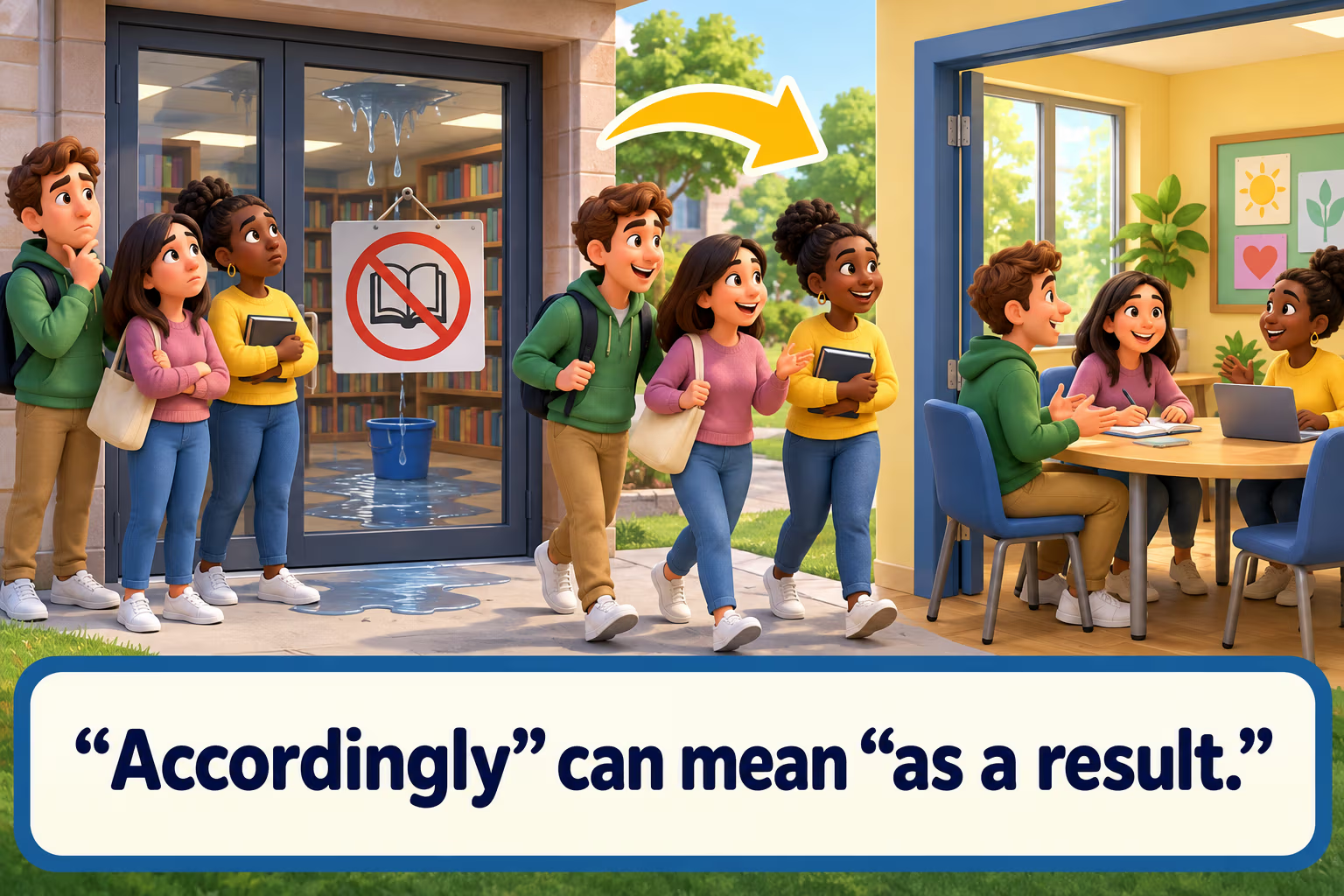
For example, “A water main broke near the school; accordingly, classes moved to the community center.” The first clause gives the event; the second names the consequence. At the start of a new sentence, use a full stop before the connector: “A water main broke near the school. Accordingly, classes moved to the community center.”
Do not use a comma alone to splice two independent clauses: “A water main broke, accordingly, classes moved” is not standard edited punctuation. Purdue OWL explains that a semicolon can join independent clauses with a conjunctive adverb such as therefore or consequently; a full stop is another clear option.
What Punctuation Follows “Accordingly”?
When accordingly begins a result clause after a semicolon, place a comma after it: “The ferry service stopped; accordingly, the tour was postponed.” The semicolon separates the two complete clauses, and the comma marks the transition after the connector.
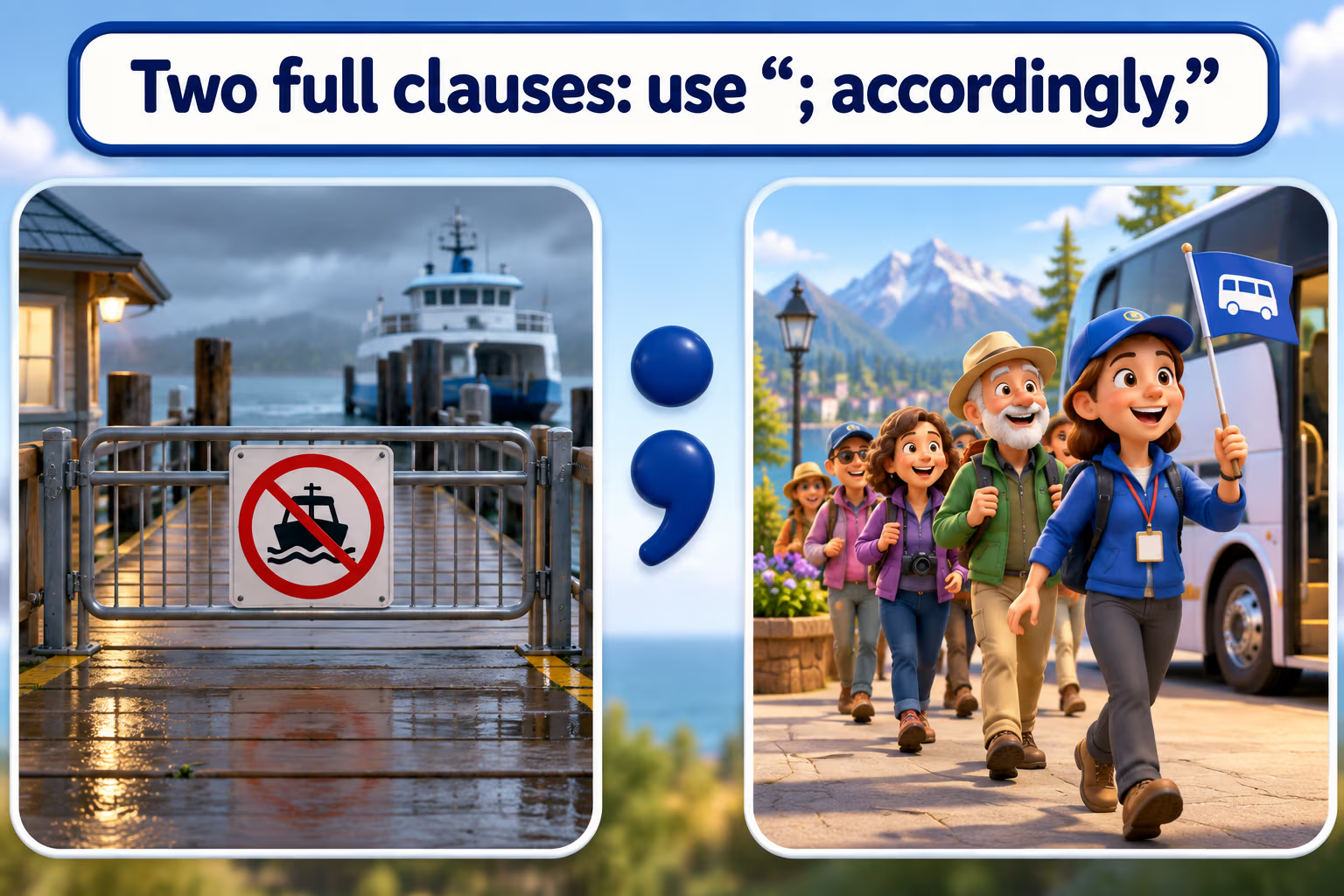
A period also works when accordingly begins a new sentence: “The ferry service stopped. Accordingly, the tour was postponed.” A comma alone cannot separate the independent clauses. When the adverb instead means “in a way that fits,” punctuation follows the sentence’s ordinary structure: “The ferry schedule may change, so check accordingly.”
Is “Accordingly” Formal?
Yes. Cambridge labels accordingly formal, so it can suit reports, instructions, and edited prose. In everyday conversation, a writer may prefer so, then, or a direct verb when that sounds more natural. Formality is a matter of tone, not a rule that makes the word incorrect in speech.
Choose the word for the relationship you intend. In “The figures were incomplete; accordingly, we delayed the report,” the connector marks a consequence. In “The figures may change, so update the chart accordingly,” it tells someone to make an adjustment that fits the new information.
The full source article, including all 21 original example items, is preserved below without edits. The new guide after that source block explains the two meanings and provides clearly marked replacement examples where the source wording needs context or punctuation clarification.

Confused about how to use the word “accordingly” in a sentence? Look no further! “Accordingly” is an adverb that is used to indicate a result or consequence based on the information provided.
By using “accordingly” in your sentences, you can seamlessly show the relationship between cause and effect, making your writing more structured and logical. Let’s explore the proper use of “accordingly” to enhance the clarity and coherence of your communication.
7 Examples Of Accordingly Used In a Sentence For Kids
- Accordingly, we will be having a fun art class today.
- Let’s clean up our toys and organize them accordingly.
- Please listen to the teacher’s instructions and follow them accordingly.
- Let’s line up accordingly for our outdoor playtime.
- Please share the toys accordingly with your friends.
- Make sure to eat your lunch accordingly and finish all your food.
- Let’s all sing the school anthem together accordingly.
14 Sentences with Accordingly Examples
- Accordingly, please make sure to submit your assignment before the deadline.
- It is important to attend classes regularly so you can understand the topics accordingly.
- Make sure to manage your time effectively to study for exams accordingly.
- Accordingly, revise the syllabus thoroughly before appearing for the final exam.
- Accordingly, participate in group discussions to improve your communication skills.
- Student organizations can help you build leadership skills, accordingly, consider joining one.
- Accordingly, make use of the library resources to enhance your research skills.
- Accordingly, set realistic goals for yourself and work towards achieving them.
- Being physically active can improve your concentration and focus accordingly.
- To excel in your academics, it is essential to prioritize your tasks accordingly.
- Accordingly, seek guidance from mentors and professors to excel in your chosen field.
- Developing a habit of reading regularly can enhance your knowledge accordingly.
- Accordingly, participate in extracurricular activities to broaden your horizons.
- Accordingly, create a study schedule that suits your learning style and preferences.
How To Use Accordingly in Sentences?
Accordingly is used to show a relationship between different pieces of information in a sentence. It is often used to indicate that one thing is a consequence or result of another.
To use accordingly in a sentence, first identify the cause-and-effect relationship between two ideas. For example, “The weather forecast predicted heavy rain; accordingly, I brought an umbrella.” In this example, the heavy rain is the cause, and bringing an umbrella is the effect.
Another way to use accordingly is to show alignment or agreement. For instance, “She completed her tasks on time; accordingly, she received praise from her boss.” Here, the completion of tasks aligns with the praise received.
It is important to place accordingly in the correct position in the sentence. It typically comes at the beginning or middle of a sentence to link the cause and effect or align the ideas. For example, “Due to the traffic jam, I arrived late to the meeting. Accordingly, I missed the first few minutes of the presentation.”
Remember that accordingly is a formal word, so it is more commonly used in written language than in spoken conversation. By understanding the function of accordingly and practicing using it in sentences, you can effectively communicate relationships between ideas and make your writing clearer and more cohesive.
Conclusion
In summary, using sentences that are structured accordingly ensures clarity and coherence in communication. By arranging information in a logical manner, readers can easily follow the flow of ideas and understand the message being conveyed. Whether it’s to provide explanations, give instructions, or present arguments, using sentences that are structured appropriately enhances the effectiveness of written and spoken communication.
Moreover, by crafting sentences that are arranged accordingly, individuals can effectively convey their thoughts and ideas in a way that is easy for others to comprehend. This skill is essential in various aspects of life, including academic, professional, and personal interactions. Therefore, it is important to pay attention to sentence structure to ensure that the intended message is delivered accurately and effectively.
How Can You Make an “Accordingly” Sentence Clear?
A clear sentence with accordingly names both the situation and the response or result. Use this quick editing sequence:
- Identify the meaning. Replace the word with “as a result” or “in a way that fits the situation.” If neither paraphrase works, choose a more precise word.
- Name the reference. State the forecast, rule, instruction, event, or prior fact that explains why the response fits.
- Check the sentence boundary. If it links two independent clauses, put a semicolon or period before it and a comma after it. If it modifies a verb, use ordinary sentence punctuation.
This check prevents a common problem in the source examples: several sentences ask the reader to act “accordingly” without saying what plan, instruction, or condition should guide the action. The examples below are new clarifications; the original examples remain unchanged in the source block.
How Can You Clarify the Source’s Examples?
| Source pattern | Why it can be unclear | New, clearer example |
|---|---|---|
| “Accordingly, we will have art class today.” | No earlier fact explains the consequence. | “The playground is closed for repairs; accordingly, art class will meet in Room 4.” |
| “Organize the toys accordingly.” | The reader is not told how to organize them. | “The picture guide shows where each toy belongs; put the toys away accordingly.” |
| “Listen to the instructions and follow them accordingly.” | Accordingly adds little after “follow the instructions.” | “The teacher assigned one station to each group; line up accordingly.” |
| “Eat your lunch accordingly.” | No condition or plan explains the expected way to eat. | “The field trip runs past noon, so pack a lunch accordingly.” |
| “Study for exams accordingly.” | The preparation method or schedule is unstated. | “The exam covers four units; plan your review time accordingly.” |
| “Student organizations help build leadership; accordingly, consider joining one.” | The original uses commas around a connector between full clauses. | “A weekly student group offers project roles; accordingly, joining one may give you practice coordinating a team.” |
| “Being active improves concentration accordingly.” | The placement suggests a result but does not identify what changes accordingly. | “If exercise helps you focus, schedule a short walk before studying.” |
Some source items can be made clear by adding the missing context; others are more natural when rewritten without accordingly. It is not necessary to keep the word in every example. A precise sentence matters more than including a target word where its meaning is vague.
What Is the Difference Between “Accordingly” and “So”?
Both words can introduce a result, but accordingly sounds more formal and often emphasizes that a response follows from a stated circumstance. So is shorter and more conversational. Compare “The meeting room is unavailable, so we moved online” with “The meeting room is unavailable; accordingly, we moved online.”
In a suitable-response sentence, accordingly can be replaced with appropriately, suitably, or “to fit the situation,” depending on context: “The instructions may change, so respond accordingly.” Avoid swapping words mechanically; check that the substitute preserves the intended sense.
New Sentence Examples for Both Meanings
These additional examples are written to make the reference point explicit:
- Result: “The train was canceled; accordingly, we booked a bus.”
- Result: “The survey closed yesterday. Accordingly, no new responses were added.”
- Suitable response: “The dress code is business casual, so choose your clothes accordingly.”
- Suitable response: “The recipe serves eight; adjust the ingredient amounts accordingly.”
- Suitable response: “The map marks a steep section, so pace yourself accordingly.”
In every case, the preceding circumstance explains either the consequence or the action that fits. The word does not itself supply a missing reason, instruction, or comparison.
Sources and Further Reading
Cambridge Dictionary’s accordingly entry labels the adverb formal and gives the suitable-response meaning, including act accordingly and plan accordingly. Collins Dictionary’s accordingly entry distinguishes the result sense from acting in a way that depends on the situation. Purdue OWL’s commas-versus-semicolons guide explains that a semicolon can join independent clauses linked by a conjunctive adverb.
Frequently Asked Questions About “Accordingly”
What are two meanings of accordingly?
Accordingly can introduce a result, meaning “as a result” or “therefore,” as in “The road closed; accordingly, we took another route.” It can also mean “in a way that fits the situation,” as in “Check the forecast and pack accordingly.” The surrounding sentence shows which sense is intended.
Does accordingly need a comma after it?
When accordingly begins a result clause, a comma usually follows it: “Accordingly, the meeting moved online.” The same comma follows it after a semicolon: “The room was unavailable; accordingly, the meeting moved online.” When it modifies a verb at the sentence end, such as “plan accordingly,” no preceding comma is normally needed.
Can accordingly start a sentence?
Yes. At the beginning of a sentence, accordingly can connect the statement to a result already explained: “The forecast changed overnight. Accordingly, the organizers moved the event indoors.” A comma follows the introductory connector. Make sure the earlier context supports the result rather than leaving the reader to guess.
Is accordingly too formal for everyday writing?
Not necessarily, but Cambridge labels it formal, and it can sound more formal than so or then. Use it when the tone and meaning fit, especially in instructions or edited prose. In a casual sentence, a direct phrase such as “so we changed the plan” may sound clearer and more natural.
What punctuation is wrong with “The office closed, accordingly, we left”?
That sentence uses a comma alone between two independent clauses, creating a comma splice. Write “The office closed; accordingly, we left” or “The office closed. Accordingly, we left.” The comma after accordingly marks the connector; it does not replace the semicolon or period needed before it.


