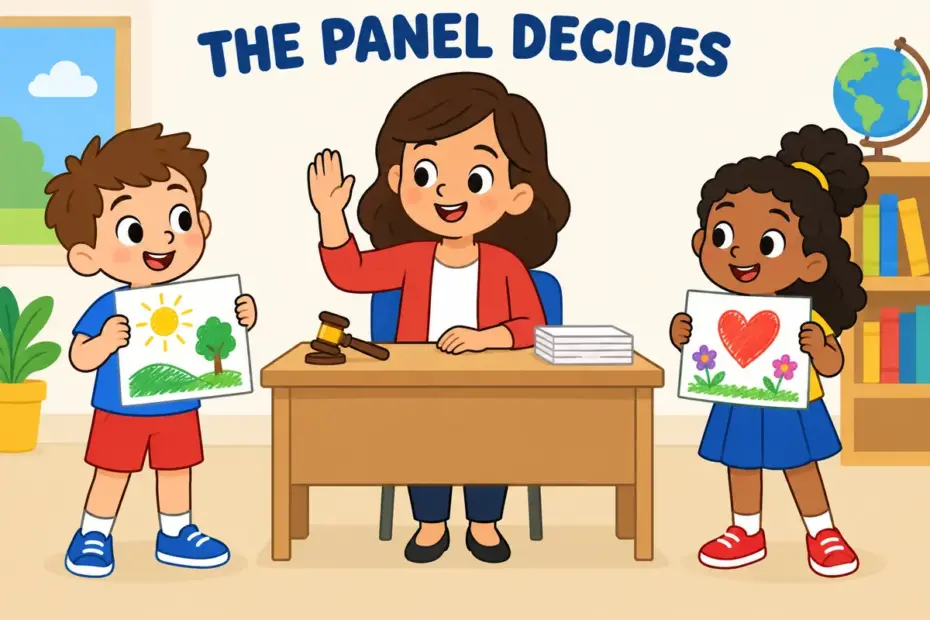
Adjudicate means to act as a judge and decide a disputed case, claim or competition with authority. To use adjudicate in a sentence, name the deciding body and the matter in dispute: “The tribunal adjudicated the rent claim.” The verb usually takes a direct object, and British writing often adds on before the issue.
Adjudicate at a glance
- Adjudicate is a verb; its forms are adjudicates, adjudicated, adjudicating and adjudication.
- The core sense is to decide a disputed matter formally, as a court, panel or appointed official does.
- It takes a direct object, and British use also allows adjudicate on or upon an issue.
- Typical subjects are a tribunal, a licensing committee, an umpire, an examiner or a review board.
- The word belongs to legal, administrative and competition writing rather than casual talk.
- The commonest error is choosing it when a private mediator, not a deciding authority, is at work.
What does adjudicate mean?
Adjudicate is a verb meaning to act as a judge and make a formal decision about a disputed matter. The Cambridge entry for adjudicate separates two settings: a court or tribunal deciding a case, and an official judging a competition or claim. Both keep one core idea, that somebody with authority hears the facts and rules. Where two neighbours simply want the argument over, settle the matter is the plainer choice, because adjudicate implies a deciding authority standing above the parties.
| Sense | Plain meaning | Example sentence |
|---|---|---|
| Judicial | A court or tribunal decides a case | The tribunal adjudicated the employment claim in June. |
| Official ruling | An appointed person decides a claim or application | An examiner adjudicated the scholarship applications. |
| Competition | An official settles the result of an event | A former champion adjudicated the final round. |
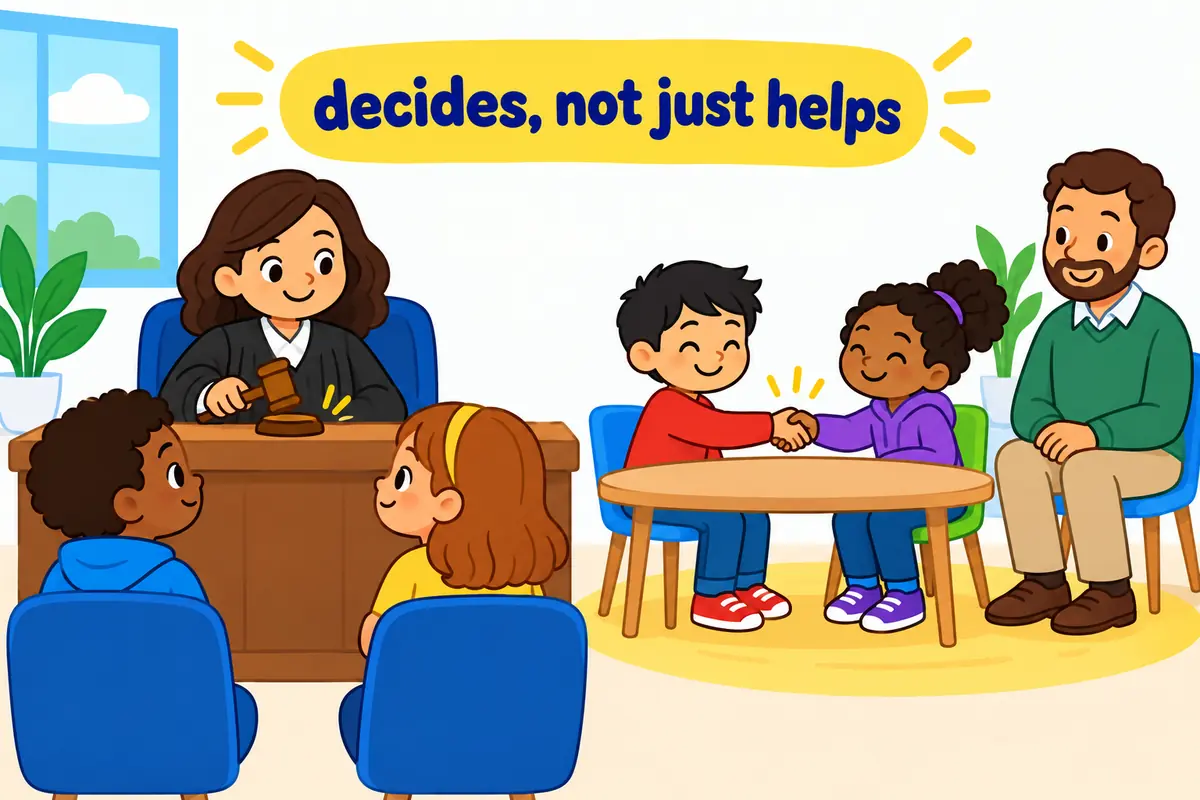
One limitation is worth stating plainly. Adjudicate does not mean to mediate or to negotiate. A mediator helps two sides reach their own agreement, while an adjudicator imposes a ruling the parties must accept. If nobody holds authority to decide, the word is the wrong one.
How do you use adjudicate in a sentence?
Adjudicate follows one of three shapes: it takes the disputed thing as a direct object, it takes on or upon before the issue, or it appears in the passive when the process matters more than the decider. The table below separates these patterns.
| Pattern | Example | What it signals |
|---|---|---|
| adjudicate + dispute or claim | The panel adjudicated the boundary dispute. | Direct object, standard in business and legal writing. |
| adjudicate on or upon + issue | The court adjudicated on the planning appeal. | Chiefly British; the matter is introduced with on. |
| adjudicate + case | The umpire adjudicated the match. | Competition sense, common in sports reporting. |
| be adjudicated | The claim was adjudicated within a month. | Passive voice, keeping attention on the process. |
| adjudicate a person’s claim | The referee adjudicated her protest. | The object is the claim itself, never the person. |
Adjudicate in a sentence: examples across contexts
Adjudicate changes register more than it changes meaning. The nine sentences below keep the same verb while moving from a classroom to a courtroom, and each one names the deciding body and the matter it rules on.
| Context | Example sentence | Why this works |
|---|---|---|
| Classroom | The teacher adjudicated the class debate on screen time. | Puts a neutral adult in the deciding role children recognise. |
| Workplace email | The review board adjudicated the pay dispute before the deadline. | Names the body and the matter it settled, which a memo needs. |
| News report | A tribunal adjudicated three hundred cases in its first year. | The number shows scale, which reporting requires. |
| Legal writing | The court adjudicated the claim under section twelve. | Names the statute, the register that fits the verb. |
| Sports report | A retired referee adjudicated the disputed try. | Competition sense, with the official as subject. |
| Academic writing | Two markers adjudicated the borderline dissertation. | Shows independent human judgement rather than a machine score. |
| Local government | The licensing committee adjudicated the noise complaint. | A public body plus a citizen complaint is the typical pairing. |
| Immigration | An officer adjudicated the visa application in forty days. | Administrative sense, extremely common in official usage. |
| Conversation | A neighbour adjudicated our fence argument. | Everyday use, but only when the neighbour really decides it. |
Only the last sentence drops the formal setting, and even there the neighbour must have authority to rule. That requirement is the clearest test of whether adjudicate belongs in the sentence.
Adjudicate vs judge, arbitrate and settle
Adjudicate overlaps with three verbs and replaces none of them cleanly. A judge forms an opinion or gives a verdict; arbitrate means deciding as a neutral the two parties chose themselves; determine the outcome is the plain phrase for fixing a result.
| Attribute | adjudicate | judge | arbitrate |
|---|---|---|---|
| Core job | Decide a dispute or claim with authority | Form an opinion or give a verdict | Decide a dispute between two willing parties |
| Who appoints the decider | A court, state or rulebook | Anyone, or a court | The two parties themselves |
| Typical subject | Tribunal, panel, referee, examiner | Person, court, critic | Arbitrator, neutral |
| Typical object | A case, claim, dispute or application | A person, action or work | A dispute, difference or wage claim |
| Register | Formal, legal and administrative | Neutral and extremely common | Formal, commercial and labour |
Verdict: use judge for everyday opinions, arbitrate when the parties picked the neutral themselves, and adjudicate when an authority with the power to rule decides the matter.
Word forms and grammar of adjudicate
Adjudicate inflects regularly, and the noun adjudication is the form that appears most often in business and legal writing because it names the whole process in one word.
| Form | Part of speech | Example |
|---|---|---|
| adjudicate | verb, base form | The board will adjudicate the appeal. |
| adjudicates | verb, third person singular | She adjudicates the national debating final. |
| adjudicated | verb, past and past participle | The umpire adjudicated the tie-break. |
| adjudicating | verb, present participle | A panel is adjudicating the flood claims. |
| adjudication | noun | The adjudication took three weeks. |
| adjudicator | noun, a person | The adjudicator’s written reasons ran to five pages. |
| adjudicative | adjective, rare | The body’s adjudicative role is set out in the statute. |
Learners sometimes invent the adjective adjudicatory and use it in place of adjudicative. The legal register does use adjudicatory, but adjudicative is the safer choice in general writing.
Common mistakes with adjudicate
- Incorrect:
The court adjudicated about the contract.Correct: The court adjudicated the contract. Rule: Adjudicate takes a direct object or on, never about. - Incorrect:
The referee adjudicated the player.Correct: The referee adjudicated the player’s appeal. Rule: The object is the disputed matter, not the person involved. - Incorrect:
They adjudicated that the fee was unfair.Correct: They adjudicated the fee dispute. Rule: Adjudicate never takes a that-clause; use decide that instead. - Incorrect:
A mediator adjudicated their quarrel before they signed.Correct: A mediator helped them settle their quarrel. Rule: Adjudicate needs a decider with authority, not a go-between.
Practice using adjudicate
Work through the six items, then read the reasoning rather than only the answer.
- Fill the gap: The appeals panel ______ the dismissed worker’s claim in a single morning.
- Choose the better word: Because the two firms chose him themselves, the neutral (adjudicated / arbitrated) the wage dispute.
- Correct the error: The judge adjudicated that the clause was void.
- Build a sentence: use adjudicate on about a council deciding a planning appeal.
- Spot the register: which belongs in a formal letter, the committee adjudicated the complaint, or the committee sorted out the complaint?
- Rewrite with the noun: The examiner adjudicated the entries. Use adjudication instead.
Answers
- adjudicated — a panel with authority is the deciding subject, and the claim is the object.
- arbitrated — the parties chose the neutral, so arbitrate is the precise verb.
- The judge decided that the clause was void — adjudicate cannot introduce a that-clause.
- Model answer: The committee adjudicated on the planning appeal at its March meeting.
- The committee adjudicated the complaint — a formal letter keeps the precise legal verb.
- The examiner’s adjudication of the entries took two days — the noun needs an article or possessive.
The bottom line
Use adjudicate in a sentence when someone with authority decides a disputed case, claim or competition, and name that deciding body as the subject. Two details settle most choices: the verb takes a direct object or on, never a that-clause, and it demands a decider above the parties rather than a mediator between them. Where two sides simply reach their own agreement, pronounce a verdict and settle are the more precise words to weigh.
Frequently asked questions about adjudicate
Can one person adjudicate a dispute?
Yes, provided that person holds authority to decide. A single examiner can adjudicate a scholarship competition, and a lone umpire can adjudicate a match. What matters is not the number of deciders but their power to impose a ruling the parties must accept, which is the idea the verb carries.
What is the past tense of adjudicate?
The past tense is adjudicated, and it doubles as the past participle, so both the simple past and the passive use the same form. A tribunal adjudicated the claim last week, and the claim was adjudicated last week. The present participle is adjudicating, and the noun is adjudication.
Which preposition follows adjudicate?
British and American usage differ. When the matter is not a direct object, British writing commonly adds on or upon, as in the court adjudicated on the appeal. American writing usually keeps the direct object. No standard version uses about, which is the commonest learner error with this verb.
Is adjudicate used in sports?
Yes. An umpire, referee or judging panel adjudicates a match, a race or a disputed score, and sports reporting uses the verb freely. The competition sense is slightly looser than the legal one, since the official settles a result rather than interpreting a statute, but the core meaning holds.
Have you ever wondered what it means to adjudicate? Adjudicate simply refers to the formal process of settling a dispute or making a decision, especially by a legal authority or judge.
In the legal realm, the term adjudicate is commonly used to describe the process of resolving a disagreement or conflict by examining and evaluating the evidence presented in a case. This can involve interpreting laws, regulations, and precedents to reach a fair and just conclusion.
7 Examples Of Adjudicate Used In a Sentence For Kids
- The teacher will adjudicate who gets to go first in the game.
- Let’s ask the teacher to adjudicate if the answer is correct.
- We should let the referee adjudicate on the winner of the race.
- The judge will adjudicate the best costume in the competition.
- The principal will adjudicate any disagreements between students.
- The umpire will adjudicate if the ball was in or out of bounds.
- We need someone fair to adjudicate the dispute between friends.
14 Sentences with Adjudicate Examples
- Adjudicate the debate competition fairly and impartially to determine the winner.
- It is crucial to adjudicate any plagiarism cases promptly and with transparency.
- The panel will adjudicate the student council election to ensure it is conducted smoothly.
- The committee was formed to adjudicate on the issues related to academic misconduct.
- As future lawyers, college students must understand how to adjudicate legal disputes effectively.
- The professor will adjudicate on the validity of each research paper submitted by the students.
- The disciplinary committee will adjudicate on the cases of rule violations on campus.
- The college administration will adjudicate on the allocation of student funds for various projects.
- A neutral third party will be brought in to adjudicate on the disagreement between the student groups.
- It is important for student leaders to be trained on how to adjudicate conflicts within their organizations.
- The adjudication of the academic integrity policy will be implemented by the college’s integrity council.
- The faculty members are responsible for adjudicating on matters related to student performance and grading.
- The college moot court competition requires students to adjudicate on legal cases as part of the competition.
- The student council elections committee will adjudicate on any disputes regarding the election process.
How To Use Adjudicate in Sentences?
To adjudicate means to make a formal judgement or decision about a disputed matter. When using this word in a sentence, it is important to ensure that the context is clear and the meaning is accurately conveyed. Here’s a guide on how to use adjudicate in a sentence:
-
Identify the issue or conflict that needs to be resolved.
Example: “The judge will adjudicate the case and determine the rightful owner of the property.” -
Use adjudicate in the appropriate tense based on the context.
Example: “The committee plans to adjudicate the scholarship applications next week.” -
Make sure to include the subject of the sentence that will be making the decision or judgement.
Example: “The arbitration panel will adjudicate the dispute between the two companies.” -
Ensure that the sentence flows smoothly and is grammatically correct.
Example: “The school board must adjudicate the student’s appeal before the end of the academic year.”
By following these guidelines, you can effectively incorporate adjudicate into your sentences to communicate the act of making a formal decision or judgement.
Conclusion
In conclusion, understanding the importance of adjudicating disputes is crucial for ensuring fairness and justice in legal proceedings. Adjudicating disputes involves examining evidence, listening to arguments, and making decisions based on the law and facts presented. The goal of adjudication is to resolve conflicts and uphold the rule of law in a transparent and impartial manner.
By adjudicating disputes fairly and impartially, the judicial system plays a vital role in upholding justice and maintaining social order. Whether in courtrooms or alternative dispute resolution forums, the process of adjudication is essential for ensuring that legal disputes are resolved in a just and equitable manner, benefiting both individuals and society as a whole.


