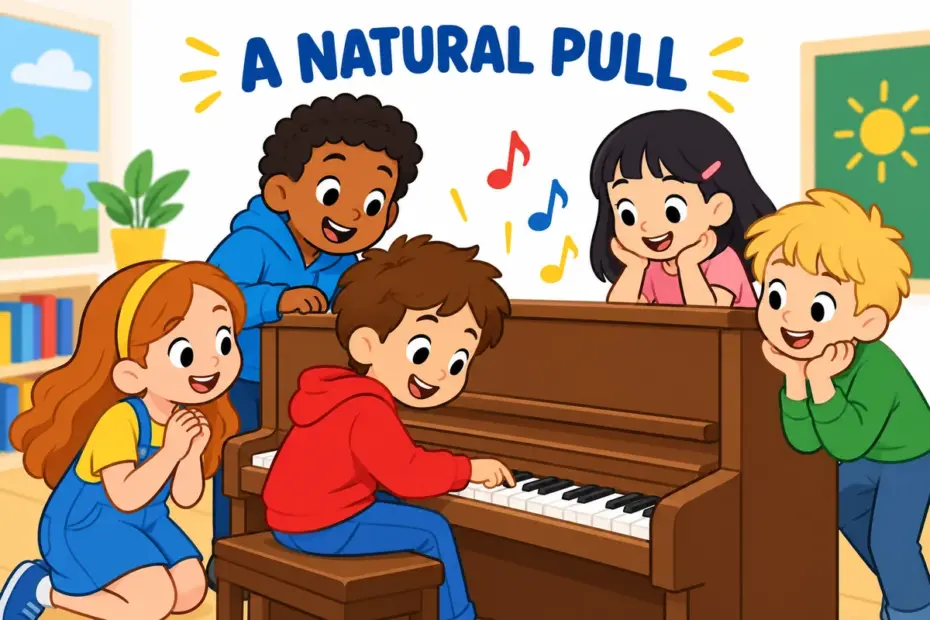
Affinity means a natural liking for something or a close similarity between things. To use affinity in a sentence, pick the right preposition: affinity for a person or activity, affinity with or between things that resemble each other. “She felt an immediate affinity for the village.”
Affinity at a glance
- Affinity is a countable noun; its plural is affinities.
- A liking takes for; a resemblance takes with or between.
- The word covers both an emotional pull and a structural similarity.
- Typical collocations are a natural affinity, a strong affinity and an affinity for.
- The commonest error is using the preposition to instead of for.
What does affinity mean?
Affinity is a noun meaning a natural liking for someone or something, or a close similarity between things. The Cambridge entry for affinity gives both the liking sense and the resemblance sense. The liking is a form of attraction, while the second sense rests on a measurable similarity.
| Sense | Plain meaning | Example sentence |
|---|---|---|
| Natural liking | A spontaneous attraction to a person or activity | He has an affinity for old films. |
| Close similarity | A resemblance between two things | There is an affinity between the two languages. |
| Scientific attraction | A natural bond between substances or cells | The drug binds with high affinity. |
How do you use affinity in a sentence?
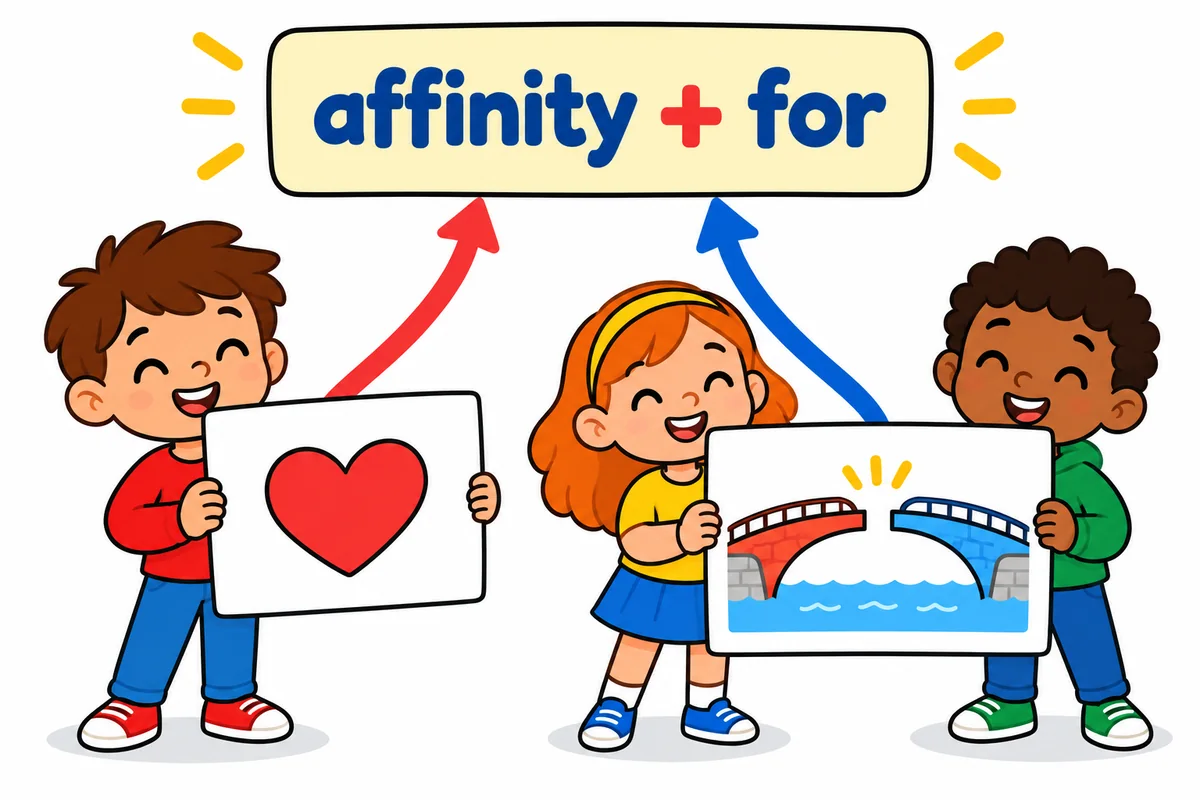
The preposition decides the sense. Use for when a person or thing is drawn to something, and with or between when two things resemble each other. The noun is countable, so a singular use normally needs an article. Where the meaning is only likeness and no pull is felt, similarity is the plainer word.
| Pattern | Example | What it signals |
|---|---|---|
| affinity + for | She has an affinity for watercolour painting. | a liking or talent |
| affinity + with | He shares an affinity with his grandfather. | a bond between people |
| affinity + between | The affinity between the dialects is clear. | a resemblance |
| an affinity + for | The team showed an affinity for risk. | a countable use with an article |
Affinity in a sentence: examples across contexts
| Context | Example sentence | Why this works |
|---|---|---|
| Classroom | Maya has a natural affinity for numbers and spots patterns quickly. | The for pattern names a school subject. |
| Workplace email | This role suits anyone with an affinity for careful detail. | A hiring note uses affinity as a neutral strength. |
| News report | The two regions share an affinity of language and custom. | Journalism uses the similarity sense. |
| Academic writing | The study measured the affinity between the receptors and the drug. | A scientific bond is the technical sense. |
| Conversation | We felt an instant affinity, as if we had known each other for years. | The emotional pull fits ordinary talk. |
| Travel writing | The writer describes an affinity with the desert and its silence. | With links a person to a place. |
| Sports report | The striker has an affinity for the left wing. | For marks where a player thrives. |
| Music review | Her voice has an affinity with early folk recordings. | With compares two sounds. |
| Business letter | We found a clear affinity between the two brands and merged them. | The similarity sense justifies a decision. |
| Personal letter | Reading brought him a quiet affinity with distant cousins. | A gentle bond suits a personal tone. |
Affinity vs sympathy
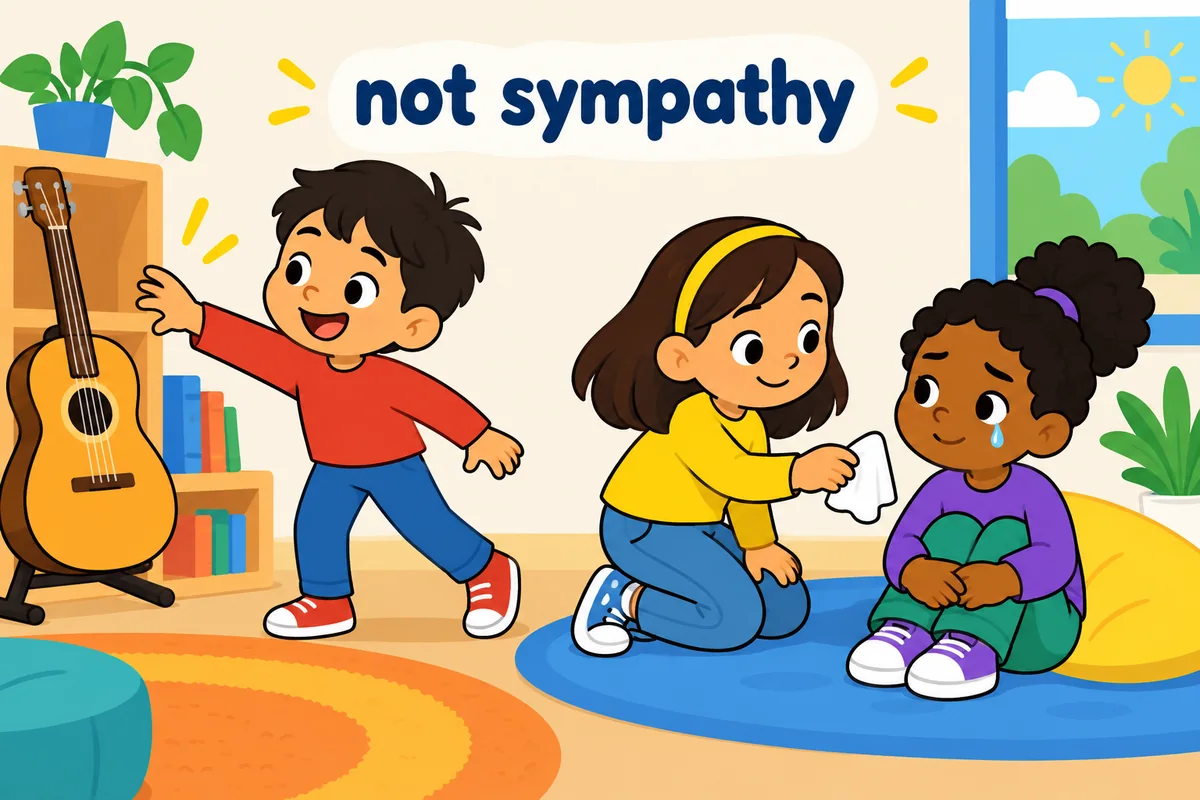
Both nouns describe a positive feeling, which is why they are mixed up. Affinity is the pull you feel toward something you like or resemble, whereas sympathy is the care you feel for someone in difficulty. The opposite of affinity is aversion, not sympathy.
| Attribute | Affinity | Sympathy |
|---|---|---|
| Core meaning | A natural liking or a close similarity | Compassion for someone in difficulty |
| Direction | Pulls you toward something | Reaches out toward someone who suffers |
| Typical object | Subjects, people, places, ideas | People and their misfortune |
| Shared ground | Both can describe a felt connection | Both can describe a felt connection |
| Register | Neutral to formal | Neutral to formal |
Use affinity for a liking or a likeness, and sympathy for shared sorrow.
Word forms and grammar of affinity
The plural is affinities, and the adjective affined is rare and mostly technical. The related noun rapport describes the warm connection two people build, which overlaps with one sense of affinity. A phrasal verb can also express a bond, as when people form a bond over shared work.
| Form | Part of speech | Example |
|---|---|---|
| affinity | noun, singular | She has an affinity for jazz. |
| affinities | noun, plural | The affinities between the two systems run deep. |
| affined | adjective, rare | The affined families traded together for years. |
| affinitys | non-standard plural | Do not write this; use affinities. |
Common mistakes with affinity
Using the wrong preposition. Incorrect: She has an affinity to horses. Correct: She has an affinity for horses. Rule: a liking takes for, while a resemblance takes with or between.
Dropping the article. Incorrect: He has affinity for maths. Correct: He has an affinity for maths. Rule: affinity is countable, so a singular use needs an article.
Confusing it with aversion. Incorrect: He has an affinity for loud noise, which he avoids. Correct: He has an aversion to loud noise. Rule: affinity attracts and aversion repels.
Using it as a verb. Incorrect: The two towns affinity each other. Correct: The two towns share an affinity. Rule: affinity is a noun; a verb such as share carries the action.
Practice using affinity
- She showed an early affinity ____ the violin.
- Choose better: The affinity ____ the two dialects is obvious. (between / to)
- Correct the error: They have affinity with each other.
- Write a sentence about a new colleague who loves puzzles, using affinity.
- Which word fits: He feels ____ for those who lost their homes? (affinity / sympathy)
- Complete the sentence in the similarity sense: The chemist found a strong affinity ____ the two molecules.
Answers
- for — a liking or talent takes for.
- between — a resemblance between two things uses between.
- They share an affinity — affinity is a noun and needs a verb.
- The new colleague has an affinity for puzzles — for marks the attraction and an is required.
- sympathy — the sense is care for people in trouble, not attraction.
- between — a scientific bond between two substances uses between.
The bottom line
Affinity in a sentence is controlled by its preposition: for signals a liking, and with or between signals a resemblance. Keep the noun countable, so a singular use takes an article. Where you mean only likeness, similarity is simpler, and where you mean care for someone, sympathy is the right word.
Frequently asked questions about affinity
Is it affinity to or affinity for?
Affinity for is the standard pairing when the sense is a liking or a talent, as in an affinity for languages. Affinity to appears occasionally but is not the usual choice. When the sense is a resemblance, use with or between instead.
Is affinity always countable?
In the liking and similarity senses, affinity is countable, so a singular use takes an article and the plural is affinities. The scientific sense is also countable, as in a high affinity for the receptor. Only rare technical writing leaves the article out.
What is the difference between affinity and attraction?
Attraction is the broader pull that can be physical or emotional, while affinity adds the idea of a natural fit or a resemblance. A person can feel attraction at first sight, but an affinity usually suggests a lasting match of temperament or interest.
Can affinity describe objects rather than people?
Yes. In chemistry the noun describes how strongly two substances bind, and in general writing it can describe a likeness between languages, styles or systems. The subject need not be a person, provided the connection is a genuine fit or resemblance.
Do you ever find yourself naturally drawn to something or someone? That’s your affinity speaking. Affinity, simply put, is a strong liking or connection you feel towards a particular thing, person, or group.
It’s that instant feeling of being in sync with something or someone, almost as if you were meant to be together. Affinity can be spontaneous and unexplainable, but it often involves a sense of belonging or attachment that goes beyond mere preference.
7 Examples Of Affinity Used In a Sentence For Kids
- I have an affinity for playing with colorful toys.
- My little sister has a strong affinity for dancing.
- We share a special affinity for drawing animals.
- Birds have a natural affinity for flying in the sky.
- Some people have a deep affinity for helping others.
- Flowers have a beautiful affinity for blooming in spring.
- My friend has a unique affinity for solving puzzles.

14 Sentences with Affinity Examples
- Many college students in India have a strong affinity for music and enjoy joining music clubs.
- It’s common to see college students with a natural affinity for sports participating in various tournaments.
- Some students have a special affinity for literature and often organize book clubs to discuss their favorite novels.
- Despite studying different subjects, a group of students discovered their shared affinity for cooking and started a cooking club.
- There’s a notable affinity among students for photography, with many joining photography clubs to improve their skills.
- College students often find affinity with certain professors who inspire them and help them excel in their studies.
- As part of a cultural exchange program, students were able to explore their affinity for different traditions and customs.
- The college library is a popular spot for students with an affinity for reading, where they can borrow books and study in peace.
- During festivals, students with an affinity for dance come together to perform and celebrate the occasion.
- Some students have a strong affinity for technology and often participate in coding competitions to showcase their skills.
- Students who share an affinity for environmental conservation often team up for tree-planting drives and clean-up campaigns.
- There’s a growing affinity among students for startups, with many participating in entrepreneurship workshops and competitions.
- For students with an affinity for art, college provides a platform to showcase their talents through exhibitions and events.
- College students who have an affinity for debate often participate in intercollegiate competitions to hone their skills and knowledge.

How To Use Affinity in Sentences?
Affinity is a term used to express a connection or similarity between two or more things. Affinity is often used when referring to a fondness or liking for something or someone. When constructing a sentence with affinity, it is important to ensure that the context is clear and the word is used correctly.
To use affinity in a sentence, start by identifying the two things that share a connection or similarity. For example, “I have a strong affinity for animals, especially dogs.” In this sentence, affinity is used to express a deep fondness for a specific type of animal.

Another example could be, “There is an affinity between the colors blue and green in this painting.” Here, affinity is used to describe a connection or harmony between the two colors.
When using affinity in a sentence, make sure it is placed in a way that clearly conveys the relationship or likeness between the things being discussed. With practice, you will become more comfortable incorporating affinity into your writing to accurately convey connections and preferences.
Conclusion
In conclusion, sentences with affinity refer to sentences that demonstrate a strong connection or likeness between one element or concept to another. These sentences are designed to highlight similarities, relationships, or shared characteristics, often to convey a sense of familiarity or closeness. By using sentences with affinity, writers can establish coherent and cohesive ideas, making the text more engaging and comprehensible for the reader.
In crafting sentences with affinity, authors can enhance the clarity and effectiveness of their writing by emphasizing the connections between different ideas or themes. By utilizing this technique, writers can create a sense of unity and coherence in their work, guiding readers towards a deeper understanding of the subject matter at hand.


