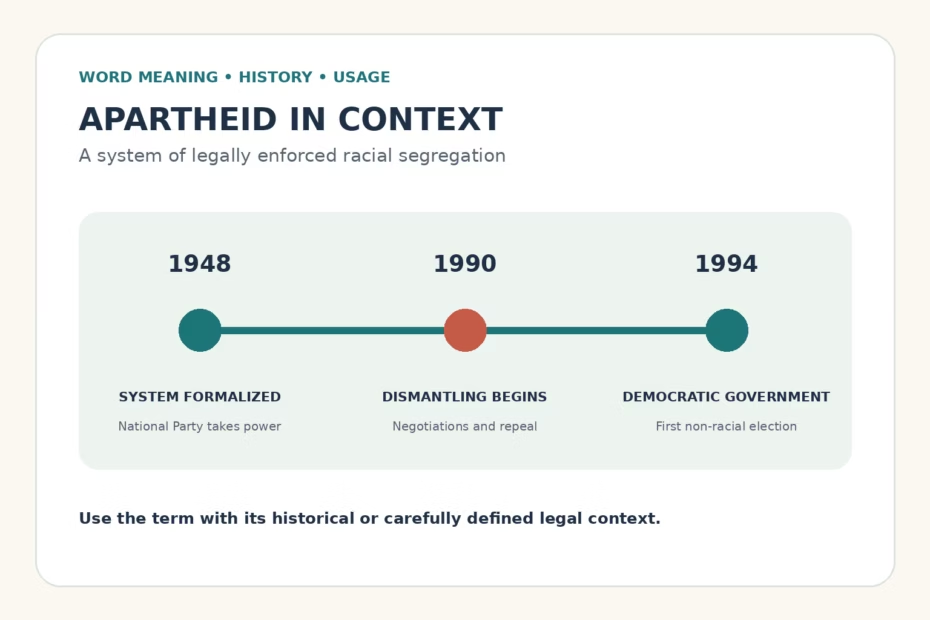
Apartheid in a sentence is best used for a precise historical or carefully defined legal context. The word most commonly names South Africa’s system of legalized racial discrimination and segregation, formalized after the National Party came to power in 1948 and dismantled through negotiations and legal changes beginning in 1990. South Africa’s first democratically elected government took office in 1994. The examples and notes below explain the noun’s meaning, grammar, and respectful use.
What does apartheid mean?
Apartheid is an uncountable noun. In ordinary historical usage, it refers to the former political system in South Africa that imposed racial classification, segregation, and unequal rights. The word comes from Afrikaans and is commonly glossed as “apartness” or “separateness.” In a sentence, it can be the subject (Apartheid shaped public policy), the object (They studied apartheid), or a noun modifier (apartheid laws).
The word also appears in international law, including the Rome Statute’s definition of the crime of apartheid. That legal usage has specific elements; it is not simply a synonym for unfairness, prejudice, or separation. When discussing a contemporary situation, explain the evidence and legal or scholarly framework instead of treating the label as self-explanatory. The UN’s legal history of the Apartheid Convention notes its origin in opposition to South Africa’s system and its later use in international legal instruments.
How to use apartheid in a sentence accurately
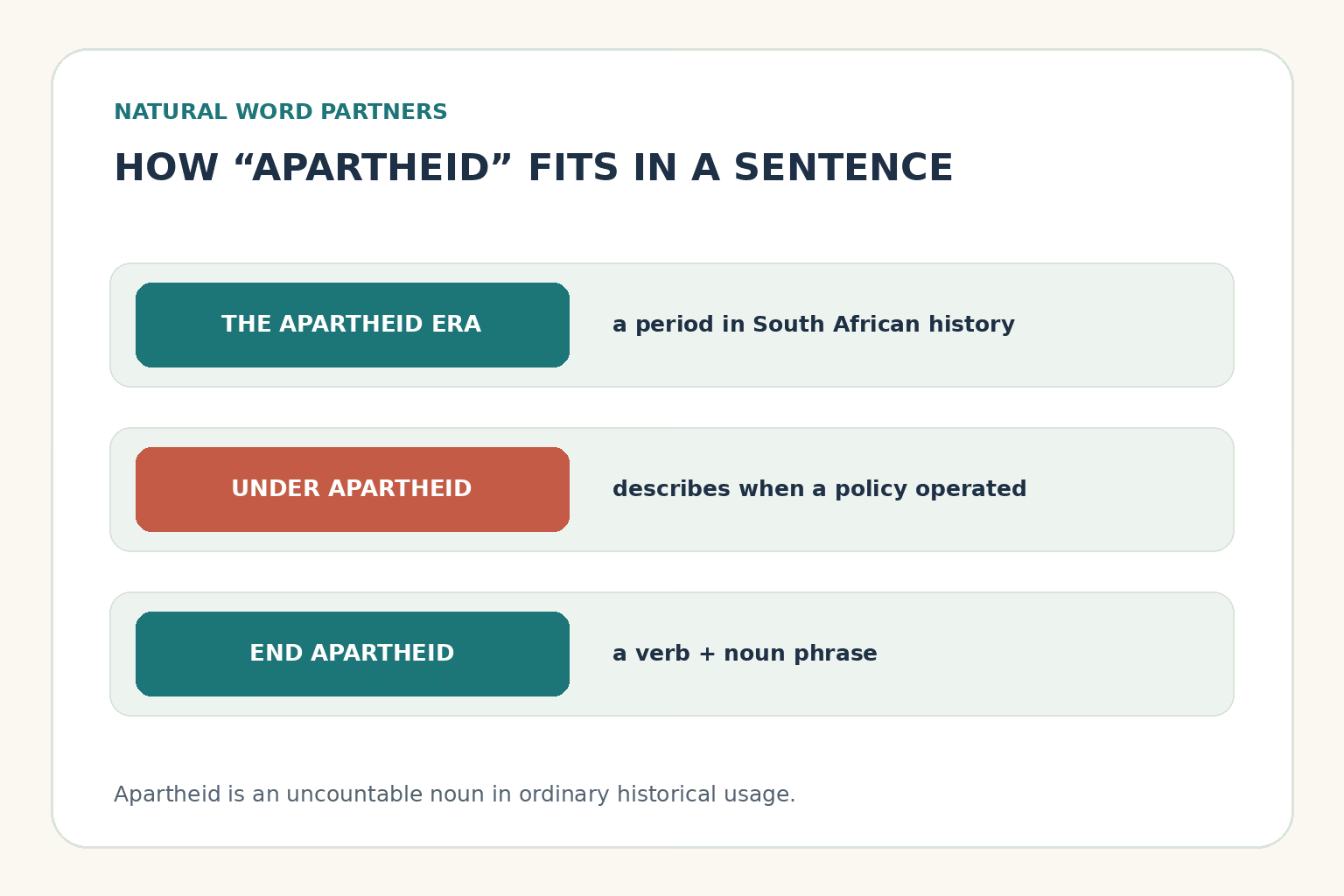
Use apartheid with a verb or phrase that fits the context: a government may enforce or maintain a system; activists may resist it; lawmakers may repeal laws; and a country may dismantle or end apartheid. Phrases such as under apartheid, the apartheid era, and apartheid legislation are also natural.
- Historical setting: “Under apartheid, South African law assigned people racial classifications that shaped where they could live and which public facilities they could use.”
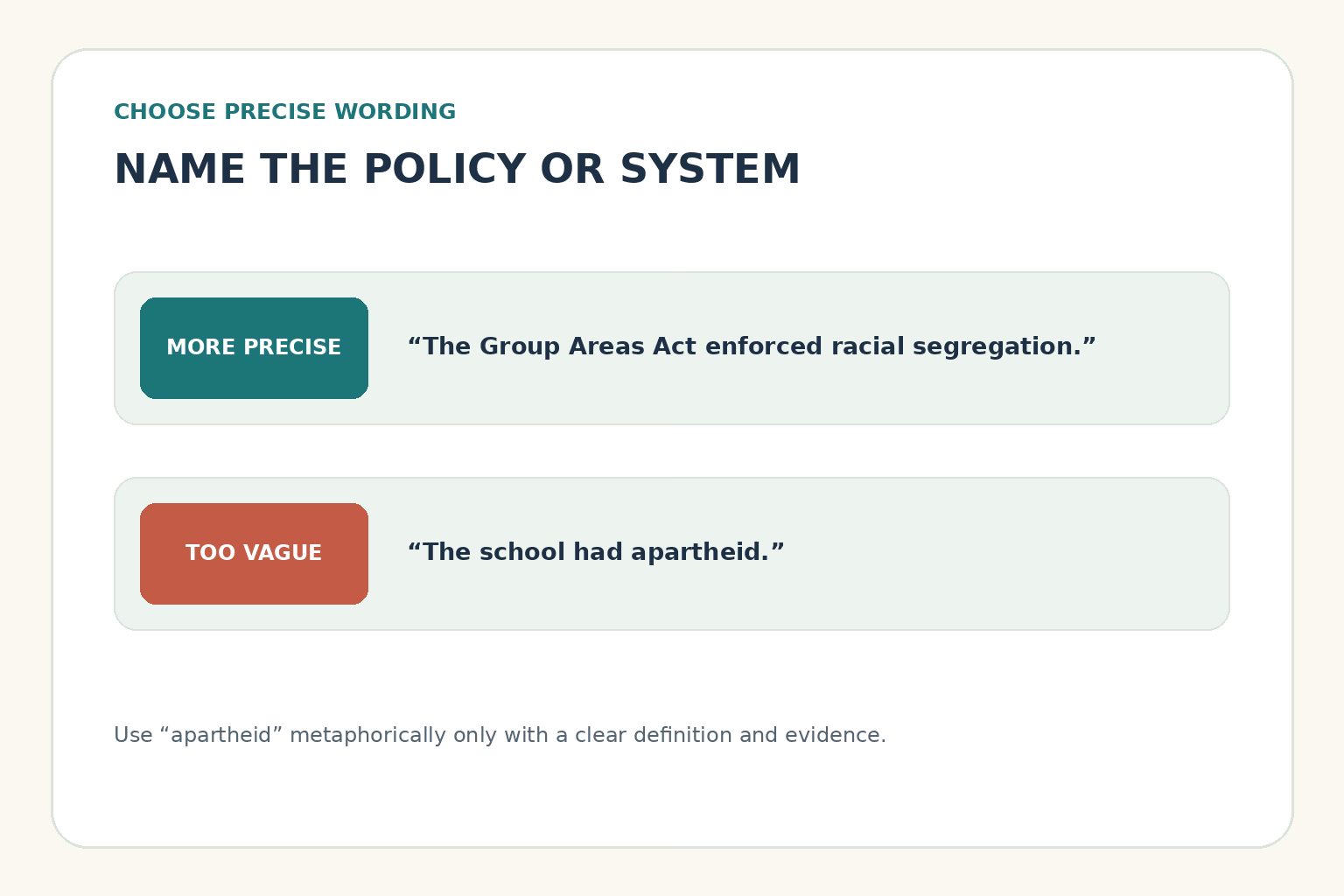
- Specific legislation: “The Group Areas Act enforced residential segregation as part of the apartheid system.”
- Resistance: “Anti-apartheid organizers built local and international campaigns against the government’s racial policies.”
- Negotiated transition: “Negotiations and legal reforms beginning in 1990 helped dismantle apartheid; the first democratic national election followed in 1994.”
- Historical research: “The archive compares pass laws from different periods with the records created under apartheid.”
- International response: “The United Nations repeatedly condemned apartheid and supported efforts to establish a non-racial democracy in South Africa.”
Timeline: use dates carefully
South Africa’s apartheid system was built on earlier racial discrimination and segregation. The National Party’s 1948 victory is commonly used as the point when apartheid became the government’s formal policy. The system was not switched off on a single day: negotiations, releases of political prisoners, unbanning of organizations, and repeal of apartheid laws unfolded during the early 1990s. The first non-racial democratic election was held in April 1994, and the new government took office in May. For that reason, write that apartheid was dismantled through a transition or that democratic government began in 1994; avoid implying that every discriminatory effect ended with the election.
The United Nations in South Africa timeline records the 1994 election and the new government’s inauguration, while the South African History Online account of pass laws traces restrictions on movement and their longer roots. These sources help distinguish a law’s date, the wider system, and the lasting effects of unequal access to land, housing, education, and work.
Word choice and respectful context
Because apartheid refers to a system of state-enforced racial domination and has a particular history in South Africa, avoid using it as a casual label for any separation, school rule, or interpersonal slight. If you mean discrimination, segregation, exclusion, or unequal treatment, name that practice directly. If you are making an analytical comparison, state the specific features being compared and cite reliable evidence; do not suggest that two situations are identical merely because both involve injustice.
When writing about people affected by apartheid, keep the people—not only the policy—visible. Name a community only when it is relevant and supported by the source. Prefer active, concrete descriptions such as “the law restricted Black South Africans’ movement” over vague wording such as “people had a hard time.” Avoid reducing a whole community to a single experience or portraying resistance as passive. For younger readers, explain that unfair laws were made and enforced by people and institutions, and that people also organized to oppose them.
Quick grammar guide
| Pattern | Example | Why it works |
|---|---|---|
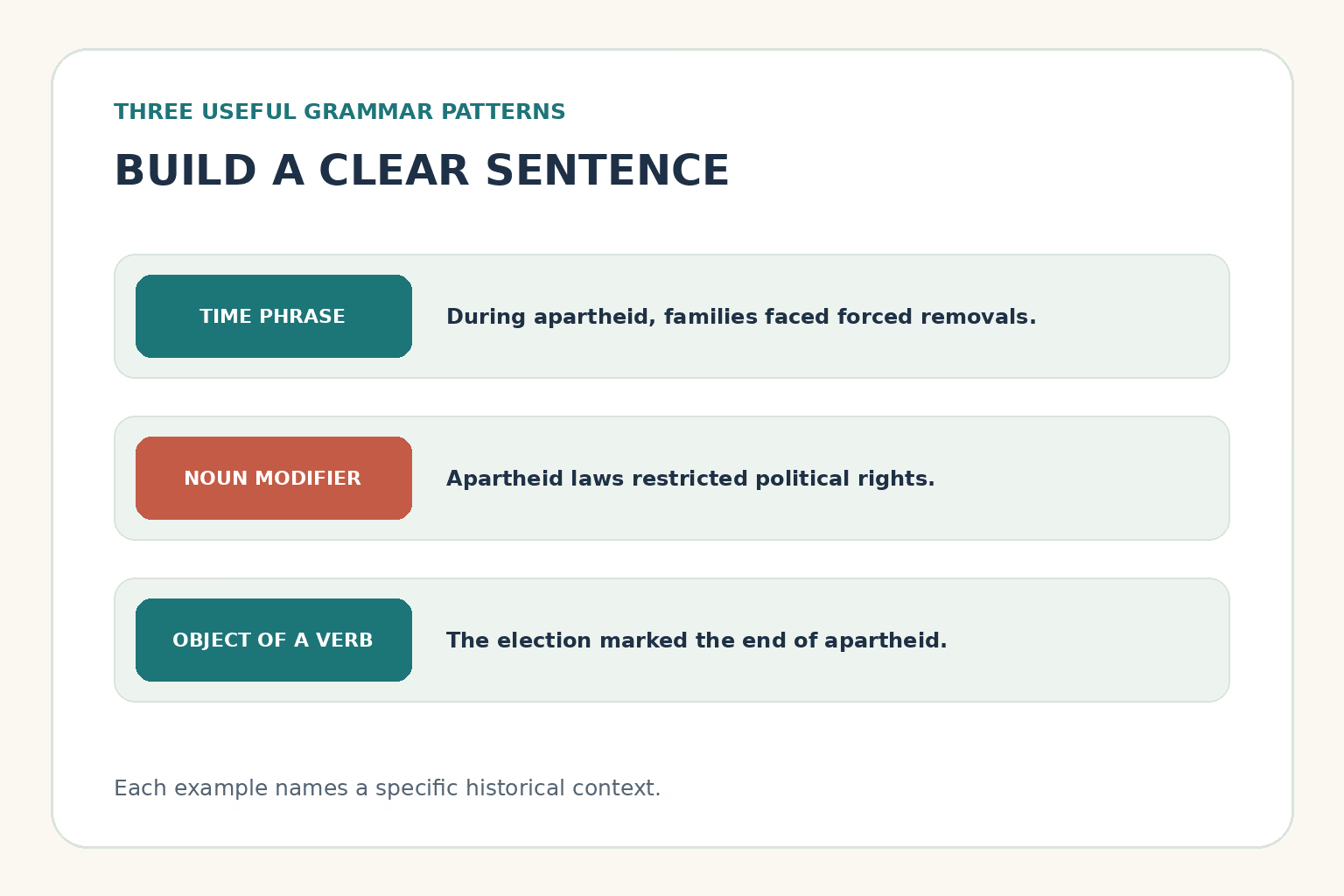
| under apartheid | “Under apartheid, residence was controlled by discriminatory laws.” | Sets a historical time or condition. |
| apartheid + noun | “Apartheid legislation restricted civil and political rights.” | Uses the noun to modify a related noun. |
| end / dismantle / resist + apartheid | “The movement worked to dismantle apartheid.” | Pairs the noun with a clear action. |
| anti-apartheid + noun | “She studied anti-apartheid organizing.” | Uses the hyphenated adjective before a noun. |
Apartheid is usually lowercase in running text. Capitalize it only when it begins a sentence or appears in a formal title. The related adjective anti-apartheid is normally hyphenated before a noun. The word is generally uncountable, so write apartheid rather than an apartheid when referring to South Africa’s system; a specific comparison may require a more carefully defined phrase.
21 apartheid sentence examples: source text
The original 21 examples and source paragraphs are retained below in full. Some use the word metaphorically or simplify the historical timeline; the updated examples and guidance above model more precise usage and provide the dates in context.

Have you ever heard of the term “apartheid”? Apartheid was a system of institutionalized racial segregation and discrimination that existed in South Africa from 1948 until the early 1990s. This system enforced a strict division between different racial groups, with the white minority holding power and privilege over the black majority.
During apartheid, laws were enacted to separate communities based on race, restricting the rights and freedoms of non-white individuals in all aspects of society, including education, employment, and housing. The legacy of apartheid continues to have a profound impact on South Africa, and the struggle against this oppressive system serves as a reminder of the importance of equality and justice for all.
7 Examples Of Apartheid Used In a Sentence For Kids
- Apartheid was a system of segregation in South Africa.
- People were treated unfairly because of apartheid.
- Apartheid separated people based on their skin color.
- We should all be treated equally, and not have apartheid.
- Apartheid is not fair because it makes some people feel bad.
- Let’s be friends and not have apartheid in our hearts.
- We must always stand up against apartheid and promote equality.
14 Sentences with Apartheid Examples
- Apartheid laws were enforced in South Africa for nearly 50 years, segregating people based on race.
- Many college students in India study the history of apartheid in South Africa as part of their curriculum.
- The effects of apartheid can still be seen in South Africa today, with lingering social and economic disparities.
- Understanding the impact of apartheid on society is crucial for students studying social sciences.
- Apartheid was officially abolished in South Africa in 1994, marking a significant moment in history.
- Students often discuss the concept of apartheid in their sociology classes to analyze systems of oppression.
- Learning about apartheid can help students reflect on the importance of equality and human rights.
- The legacy of apartheid serves as a reminder of the dangers of institutionalized discrimination.
- College campuses should be inclusive spaces that promote diversity and reject any form of apartheid.
- Examining the parallels between apartheid in South Africa and other forms of discrimination worldwide can provide valuable insights for students.
- Students are encouraged to engage in discussions about apartheid to foster a deeper understanding of social justice issues.
- The struggle against apartheid in South Africa was led by activists who fought for equality and justice.
- College students have a responsibility to challenge and dismantle systems of apartheid in their own communities.
- By educating themselves about the history of apartheid, students can work towards building a more inclusive and equitable society.
How To Use Apartheid in Sentences?
To use the word Apartheid in a sentence, you can say, “The policy of Apartheid in South Africa systematically segregated and discriminated against non-white inhabitants.”
Here are a few more examples showcasing how to use the term Apartheid in sentences:
-
“During the era of Apartheid, black South Africans were subjected to racial segregation in all aspects of society.”
-
“The United Nations General Assembly adopted a resolution condemning the Apartheid regime in South Africa.”
-
“The dismantling of Apartheid laws in South Africa marked a significant victory for human rights and equality.”
Remember, when using the term Apartheid, it is essential to understand its historical context and the impact it had on society. By incorporating the word Apartheid into sentences accurately, you can effectively communicate its significance and promote awareness about the injustices faced under such a system.
Conclusion
In conclusion, the sentences with the keyword “apartheid” showcased the historical segregation and discrimination system that was implemented in South Africa. These sentences illustrated the oppressive policies and practices that divided people along racial lines, leading to widespread inequality, violence, and injustice. They shed light on the challenges faced by individuals living under apartheid, and the resistance and struggles they endured to dismantle this unjust system.
By examining these sentences, we gain a deeper understanding of the impact of apartheid on society and recognize the importance of promoting equality, diversity, and inclusion to prevent such atrocities from happening again. The sentences with the keyword “apartheid” serve as a reminder of the importance of standing up against discrimination and oppressions in all forms to build a more just and equitable world for all.


