
Arrant is an adjective meaning complete, total or downright, and it almost always sits immediately before a noun to intensify a negative quality. To use arrant in a sentence, place it before the noun it condemns: “The committee dismissed the rumour as arrant nonsense.” It never appears after the verb, so the nonsense was arrant is not English.
Arrant at a glance
- Arrant is an attributive adjective: it comes before a noun and has no comparative form.
- The dominant pattern is arrant + a negative noun such as nonsense, folly, cowardice or hypocrisy.
- Typical subjects are claims, excuses, behaviour and people being judged harshly.
- The word is literary and slightly old-fashioned, at home in essays and reviews.
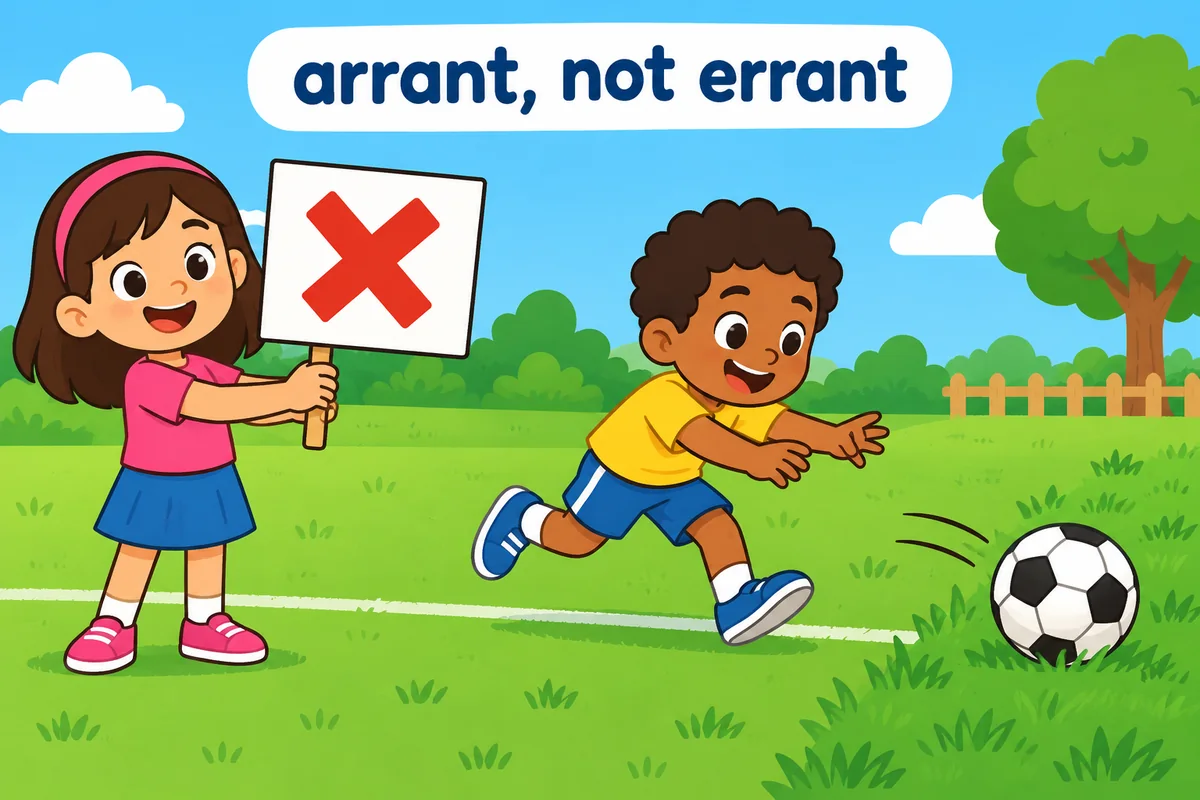
- The commonest error is confusing arrant with errant, which means wandering or straying.
What does arrant mean?
Arrant is an adjective meaning complete, thorough or downright, used before a noun to stress that a bad quality is present in full. The Cambridge entry for arrant records this emphatic, disapproving use. Where a writer wants the same force without the old-fashioned tone, utter or complete does the same work.
| Sense | Plain meaning | Example sentence |
|---|---|---|
| Complete, downright | Nothing but the bad quality named | He dismissed the claim as arrant nonsense. |
| Shameless, notorious | Open and unashamed in a bad way | The report exposed him as an arrant liar. |
| Mere, pure | Only the bad thing, with nothing good mixed in | Their excuse was arrant cowardice. |
One limitation is easy to miss. Arrant is not a neutral intensifier like very, because it carries built-in disapproval, so it cannot praise. An arrant success or an arrant talent sounds wrong, and a writer who wants positive emphasis needs a different word such as sheer, which can attach to good or bad things alike.
How do you use arrant in a sentence?
Place arrant directly before the noun and never grade it. The five patterns below show the nouns it usually condemns and the fixed predicative frame that keeps the adjective next to its noun even after the verb be.
| Pattern | Example | What it signals |
|---|---|---|
| arrant + negative noun | They published arrant nonsense about the trial. | Intensifies a judgement of the content. |
| an arrant + person noun | Only an arrant coward would abandon the team. | Labels a person harshly. |
| be + an arrant + noun | The promise was an arrant lie. | Keeps the adjective before the noun after be. |
| the arrant + noun | The arrant hypocrisy of the scheme appalled her. | Formal commentary in essays and reviews. |
| arrant + noun, ungraded | He was guilty of arrant folly. | Cannot be intensified: never very arrant. |
The adjective has no comparative or superlative, so more arrant and most arrant are both wrong. Intensity comes from the noun and the surrounding sentence, not from degree words.

Arrant in a sentence: examples across contexts
The nine sentences below keep arrant before a noun while moving from a classroom to a review, and each one attaches the word to something the writer clearly disapproves of. Where the disapproval needs a blunter, more modern adjective, blatant may fit better.
| Context | Example sentence | Why this works |
|---|---|---|
| Classroom | The pupils saw through his arrant excuse for missing homework. | A concrete excuse suits the word’s disapproval. |
| Workplace email | Calling the delay unavoidable was arrant nonsense. | Names the claim being dismissed. |
| News report | The inquiry found the allegation to be arrant fabrication. | Matches the formal, judicial tone. |
| Book review | The novel’s politics amount to arrant sentimentality. | Critical judgement of a quality. |
| History essay | Wartime propaganda traded in arrant deceptions. | Condemns a whole practice, not a person. |
| Sports column | Quitting at half time was arrant surrender. | Harsh verdict delivered with old-fashioned force. |
| Conversation | That is arrant rubbish, and you know it. | Spoken outrage, still before the noun. |
| Editorial | The minister’s denial was arrant hypocrisy. | Public accusation in formal prose. |
| Literary criticism | Arrant sentiment weakens the closing chapter. | Judges a quality within a work. |
Every example keeps arrant attached to its noun. The word never floats free, which is why it feels at home in judgements that name the fault precisely.
Arrant vs utter, sheer and errant
Arrant belongs to a small group of intensifying adjectives, and errant is the near spelling that trips writers most often. Arrant means complete and blameworthy, utter is a neutral intensifier, sheer leans towards thin or pure, and errant means wandering off course.
| Attribute | arrant | utter | sheer | errant |
|---|---|---|---|---|
| Core force | Complete and blameworthy | Complete, neutral | Nothing but, thin or pure | Wandering, off course |
| Attaches to | Bad qualities only | Any quality | Thin or bare things | People, animals, shots |
| Register | Literary and old-fashioned | Neutral and common | Slightly literary | Neutral, technical |
| Example | arrant nonsense | utter confusion | sheer luck | an errant golf shot |
| Can praise? | No | Yes | Sometimes | Not relevant |
Verdict: choose arrant when a bad quality is complete and the tone can carry an old-fashioned sting, utter for neutral emphasis, sheer when something is nothing but itself, and errant whenever the meaning is wandering rather than total.
Word forms and grammar of arrant
Arrant itself never changes form, and the table sets out the near-words that share its letters or its sound. Learners who build the derived adverb should treat aberrant and the other look-alikes as separate words with separate meanings.
| Form | Part of speech | Example |
|---|---|---|
| arrant | adjective, attributive | an arrant coward |
| arrantly | adverb, rare | He behaved arrantly towards the whole team. |
| arrant + noun | grammar note | an arrant lie, never the lie was arrant |
| errant | adjective, different word | an errant shot |
| aberrant | adjective, different word | aberrant behaviour |
| ardent | adjective, different word | an ardent supporter |
The adverb arrantly is rare enough to avoid in ordinary writing. If a sentence needs an adverb, the adjective is usually in the wrong place and the noun should be doing the work.
Common mistakes with arrant
- Incorrect:
The results were arrant.Correct: The results were complete nonsense. Rule: Arrant must sit before a noun and cannot stand alone after be. - Incorrect:
She gave an arrant performance.Correct: She gave a superb performance. Rule: Arrant carries disapproval, so it cannot praise. - Incorrect:
An arrant stranger wandered into the hall.Correct: An errant stranger wandered into the hall. Rule: Errant means wandering; arrant means complete. - Incorrect:
He is very arrant.Correct: He is an arrant coward. Rule: Arrant has no degrees and needs its noun. - Incorrect:
They showed arrant enthusiasm.Correct: They showed genuine enthusiasm. Rule: Arrant attaches only to qualities the writer condemns.
Practice using arrant
Work through the six items, then check the reasoning rather than only the answer.
- Fill the gap: The editor called the rumour ______ nonsense.
- Choose the better word: After the appeal, the verdict was (arrant / utter) confusion.
- Correct the error: His apology sounded arrant to everyone present.
- Build a sentence: use an arrant coward about a character in a story.
- Spot the register: which fits a formal review — arrant hypocrisy, or total rubbish, basically?
- Rewrite with sheer: The escape was complete luck. Use sheer for neutral emphasis.
Answers
- arrant — the adjective sits before nonsense and condemns it.
- utter — utter is the neutral intensifier, while arrant would imply blame.
- His apology sounded hollow to everyone present — arrant cannot stand alone after the verb.
- Model answer: In the fable, the boastful hare is an arrant coward when the race begins.
- Arrant hypocrisy — a review keeps the formal, disapproving adjective.
- Model answer: The escape was sheer luck, with no skill involved at all.
The bottom line
Use arrant in a sentence to intensify a bad quality, always placing it directly before the noun it condemns. The two points that decide most sentences are that arrant cannot stand alone or take degree words, and that it carries disapproval, so it never praises. When the tone needs to be modern rather than literary, utter, complete or blatant will usually serve better.
Frequently asked questions about arrant
What does arrant mean in modern English?
Arrant is an adjective meaning complete or downright, used almost only before a noun to emphasise a bad quality. Arrant nonsense and an arrant coward are typical. The word survives as a fixed intensifier rather than one you build freely into new phrases.
Is arrant a formal word?
Arrant belongs to literary and slightly old-fashioned writing. It appears in essays, reviews and fiction rather than in everyday speech. In a business email, plain complete or total would sound more natural than arrant, which readers may find affected outside fiction and commentary.
How does arrant differ from errant?
Errant means wandering or straying, as in an errant golf shot, while arrant means complete or downright, as in arrant nonsense. The two words differ by one letter and are often confused. Check whether the sense is roaming or utter, then choose accordingly.
Can arrant describe something good?
No. Arrant attaches to negative qualities such as nonsense, folly, cowardice or hypocrisy. Writing an arrant success or an arrant joy sounds wrong because the word carries built-in disapproval. For positive emphasis, a neutral word such as complete, thorough or sheer works instead.
Have you ever come across the word “arrant” while reading or conversing and wondered about its meaning? In English grammar, “arrant” is an adjective that describes something complete or absolute, typically with negative connotations.
It is often used to emphasize the extreme or glaring nature of a quality or action, highlighting it as unmistakably evident. Keep on reading to discover how this term can be employed in various contexts to emphasize the significance or severity of a situation.
7 Examples Of Arrant Used In a Sentence For Kids
- The arrant cat meowed loudly for food.
- The arrant sun shone brightly in the sky.
- The arrant puppy wagged its tail happily.
- The arrant elephant trumpeted loudly in the zoo.
- The arrant bird sang a beautiful song in the tree.
- The arrant monkey swung from branch to branch in the forest.
- The arrant flower bloomed beautifully in the garden.
14 Sentences with Arrant Examples
- The professor’s arrant claims about the upcoming exam left the students feeling anxious and uncertain.
- Despite his lack of preparation, he spoke with an arrant confidence during the group presentation.
- It was clear from her arrant demeanor that she had no intention of working together on the group project.
- The textbook’s arrant explanations made it difficult for students to fully grasp the complex concepts.
- The debate between the two students became increasingly heated as they both tried to prove their arrant points.
- The student’s arrant disregard for academic integrity led to serious consequences when caught plagiarizing.
- The student’s arrant belief that attendance was optional resulted in a failing grade for missing too many classes.
- The guest lecturer’s arrant attitude towards the students’ questions created a tense atmosphere in the classroom.
- The professor’s arrant dismissal of student concerns about the overwhelming workload added to their stress levels.
- The student’s arrant request for an extension on the assignment was met with skepticism by the professor.
- The university’s arrant policy on late submissions left many students struggling to meet deadlines.
- The dean’s arrant decision to increase tuition fees sparked protests among the students on campus.
- The student’s arrant insistence that they did not need to study for the exam because they knew the material well proved to be a mistake.
- The academic advisor’s arrant advice to take a heavy course load in the upcoming semester raised concerns among the student body.
How To Use Arrant in Sentences?
Arrant is used as an adjective to describe something complete and total. To use arrant in a sentence, insert it before the noun that you want to emphasize as being absolute or extreme. For example, “The man’s arrant disregard for traffic laws caused several accidents.” Here, arrant emphasizes the man’s complete disregard for traffic laws.
Another way to use arrant is in a sentence like this: “Her behavior was arrantly selfish.” In this case, arrantly is the adverb form of arrant, emphasizing the extreme and total nature of her selfishness.
Remember, arrant should be used to emphasize something as being complete, total, or extreme. Make sure that the word you are using arrant with is a noun that you want to describe in this way.
Practice using arrant in different sentences to become more comfortable with its usage. Reading examples of sentences containing arrant can also help you understand how to use it effectively in your own writing.
Conclusion
In conclusion, the arrant incompetence displayed by the new employee led to numerous errors in the project. These glaring mistakes were clear indications of their complete lack of skill and understanding of the task at hand. The arrant disregard for attention to detail resulted in significant setbacks for the team and highlighted the need for proper training and supervision.
Moving forward, it is crucial for organizations to provide adequate support and guidance to employees to prevent arrant mistakes from occurring. By offering training programs and setting clear expectations, companies can ensure that their employees are equipped to perform their duties competently. Addressing arrant errors promptly and effectively can improve overall efficiency and productivity in the workplace.


