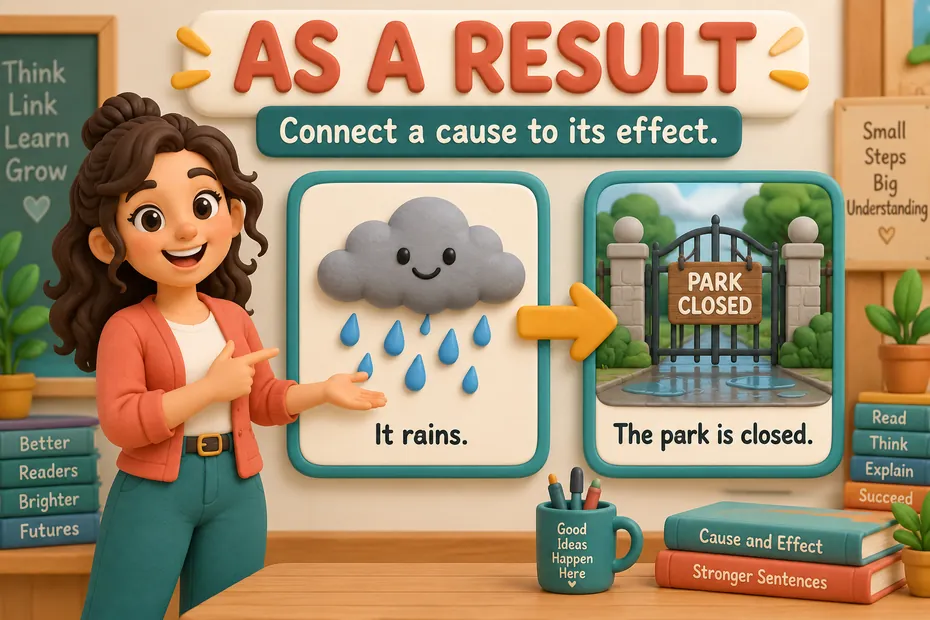
How to Use As a Result in a Sentence
As a result introduces an effect or consequence of something already mentioned. For example, “The bus was late. As a result, we missed the opening talk.” Use as a result of when naming the cause directly: “As a result of the delay, we missed the opening talk.”
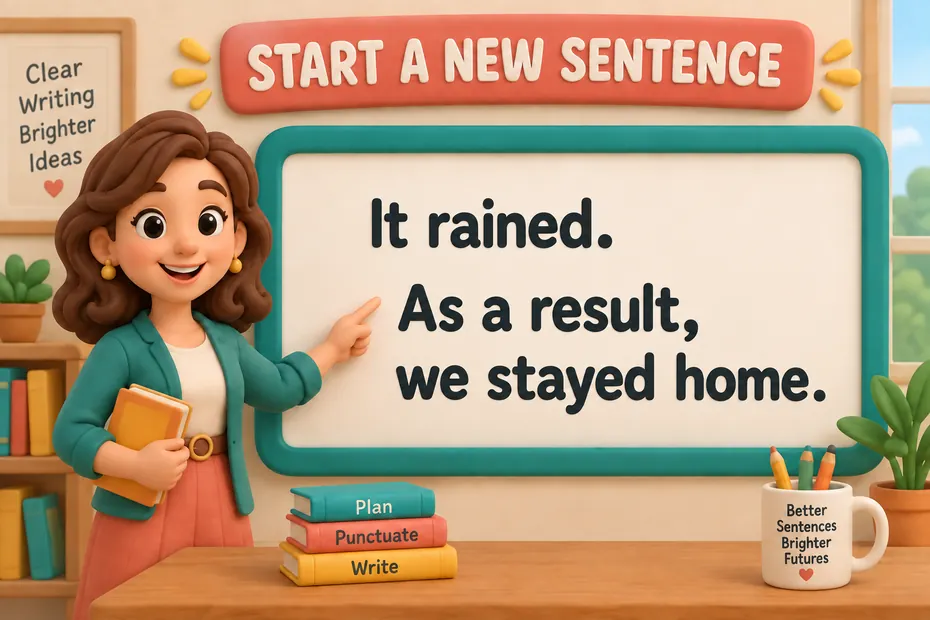
Cause First, Consequence Second
As a result points back to a cause. In “The lights failed. As a result, the show stopped,” the failure is the cause and the stopped show is the consequence. The phrase helps the reader follow that relationship. It should not merely connect two unrelated facts that happened near each other in time.
Compare “I wore a blue coat. As a result, the train arrived” with “The track was blocked. As a result, the train was delayed.” The first suggests a cause that the sentence has not established. The second gives a plausible relationship within the example. A transition signals reasoning; it does not supply missing evidence for that reasoning.
Three Clear Sentence Patterns
| Pattern | Original example | Structure |
|---|---|---|
| Two sentences | The shop closed early. As a result, we returned the next day. | A full stop separates the complete statements. |
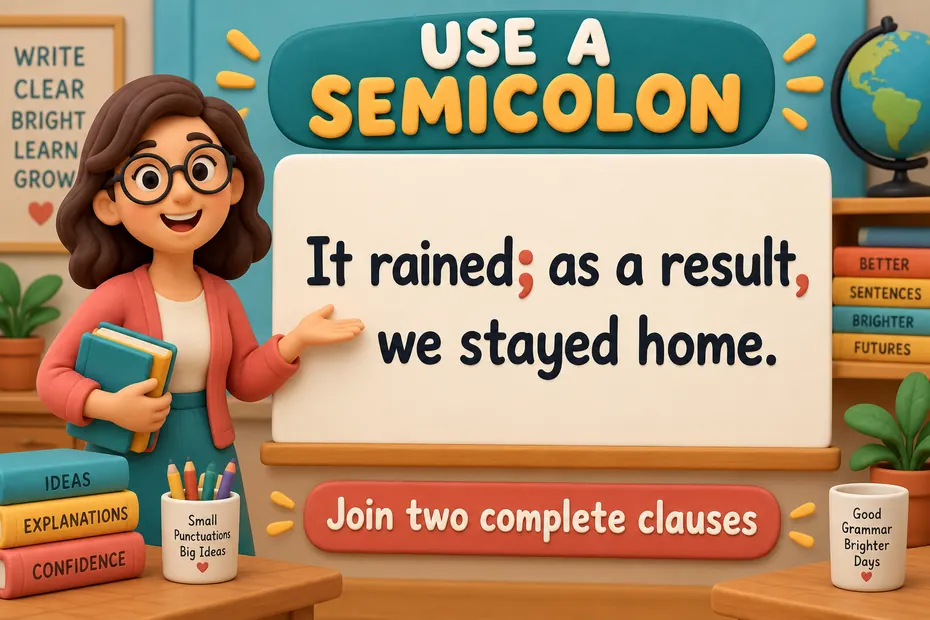
| One sentence with a semicolon | The shop closed early; as a result, we returned the next day. | A semicolon joins two complete clauses. |
| Cause named after of | As a result of the early closure, we returned the next day. | The introductory phrase names the cause. |
The two-sentence version is often the clearest choice for learners. It gives the cause its own sentence, then introduces the effect. The semicolon version keeps closely related clauses together. The of version compresses the cause into a noun phrase. Choose the pattern that matches the information rather than forcing every example into one long sentence.
As a Result and As a Result Of
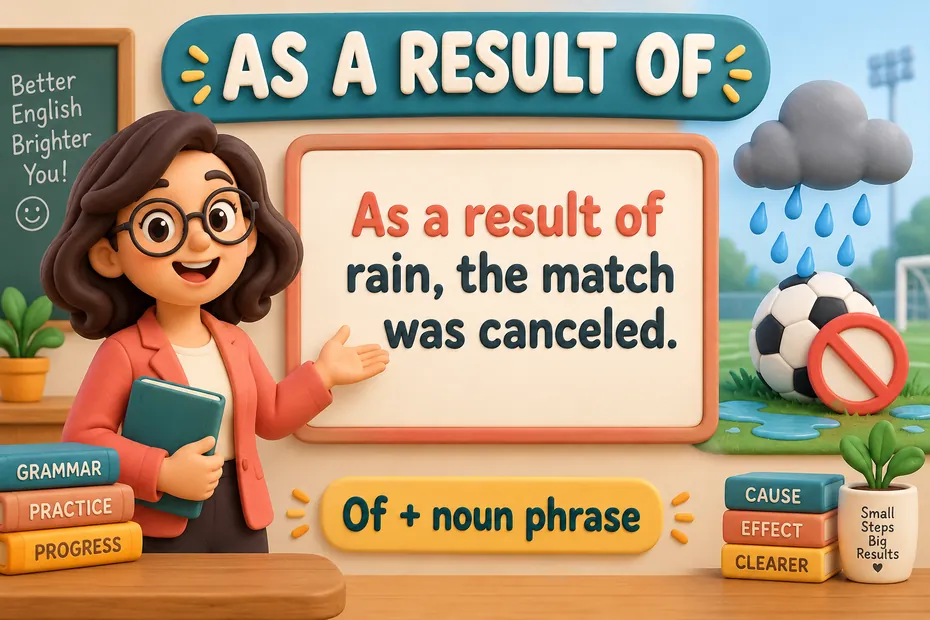
As a result can stand as a transition because the reader already knows the cause. “The ticket machine broke. As a result, a queue formed.” As a result of requires words naming the cause: “As a result of the broken machine, a queue formed.” Merriam-Webster records the phrase and its common of extension.
After of, use a noun phrase or an ing construction, not a bare complete clause. Write “As a result of missing the train, we arrived late,” or “As a result of the missed train, we arrived late.” Do not write “As a result of we missed the train.” A version with because can introduce that full clause: “Because we missed the train, we arrived late.”
Avoid a Comma Splice
When two clauses could each stand as a sentence, as a result does not let a comma alone join them. Repair “It rained, as a result, the match was canceled” with a full stop or semicolon: “It rained. As a result, the match was canceled.” Purdue OWL explains this general distinction between independent clauses and comma splices.
A comma normally follows the introductory transition in “As a result, we changed our plans.” If the phrase interrupts a clause, paired commas may help: “We changed our plans, as a result, before leaving.” That placement is less smooth than “As a result, we changed our plans before leaving,” so prefer the clearer arrangement.
As a Result Compared with Because and So
Because introduces a cause: “We stayed inside because it rained.” As a result introduces a consequence after the cause is known: “It rained. As a result, we stayed inside.” So can connect the consequence within one sentence: “It rained, so we stayed inside.” The meaning is related, but the grammar differs.
Do not mechanically replace one connector with another while leaving every punctuation mark unchanged. First identify the cause and effect, then build the appropriate structure. The so version is often conversational; the two-sentence as a result version can sound more explanatory. Neither is automatically more correct for every context.
Original Cause-and-Effect Practice Examples
- The instructions were unclear. As a result, several students asked for help.
- The team checked the figures twice. As a result, it found a missing entry.
- As a result of the road closure, the bus took a different route.
- The library added evening hours; as a result, more students could visit after class.
- The printer ran out of paper. As a result, we paused the job.
- As a result of practicing regularly, Maya felt more confident during the performance.
These examples are invented to demonstrate language, not reports of measured outcomes. In a real essay, distinguish a supported consequence from an assumption. If you only know that two things happened together, explain that limited relationship rather than inserting as a result and implying a proven cause.
Frequently Asked Questions
Can I start a sentence with as a result?
Yes. “As a result, we changed our plans” is a natural sentence when the cause is clear from the previous context. A comma normally follows the introductory phrase. If readers do not know the cause, name it in a preceding sentence or use an as a result of phrase.
What comes after as a result of?
Use a noun phrase or an ing construction naming the cause, such as “the delay” or “missing the train.” A complete bare clause such as “we missed the train” does not fit directly after of. Use because for that structure, or reshape the cause into a suitable phrase.
Is as a result the same as because?
They express related cause-and-effect ideas but introduce different parts of the relationship. Because introduces the cause; as a result introduces the consequence after the cause is known. Compare “We left because it was noisy” with “It was noisy. As a result, we left.” Their sentence structures differ.
Can a comma come before as a result?
It depends on the whole sentence. A comma alone cannot join two complete clauses merely because the second contains as a result. Use a full stop or semicolon in that pattern. Commas can mark an interrupting phrase within a clause, but the punctuation must match the structure.
Sources for Meaning and Punctuation
Looking to understand how to properly structure your sentences to show cause and effect? When you want to convey that one action leads to another, you can use the phrase “as a result.” This signals to the reader that the following sentence will explain the consequences of the initial action.
“As a result” is a useful tool in writing to clearly connect two events or actions and show the cause and effect relationship between them. By using this phrase, you can effectively explain the outcomes that arise from specific circumstances.
7 Examples Of As A Result Used In a Sentence For Kids
- The sun was shining brightly as a result we went outside to play.
- I watered the plants every day, as a result they grew tall and colorful.
- I studied hard for my test, as a result I got a good grade.
- I helped my friend clean up the classroom, as a result we finished quickly.
- I listened carefully to the teacher, as a result I understood the lesson better.
- I shared my toys with my friends, as a result we all had fun playing together.
- I ate all my vegetables, as a result I felt strong and healthy.

14 Sentences with As A Result Examples
- As a result, of poor time management, many students struggle to meet assignment deadlines.
- Students who attend lectures regularly tend to perform better in exams, as a result of increased understanding of the subject matter.
- As a result of joining study groups, students have reported improvements in their grades.
- Lack of communication with professors can lead to misunderstandings and confusion, as a result students may not perform as well in their courses.
- As a result of participating in extracurricular activities, students can develop valuable skills beyond the classroom.
- As a result of excessive social media use, students often face distractions and a decrease in productivity.
- As a result of effective note-taking during lectures, students are better able to recall information for exams.
- As a result of attending career fairs, students have opportunities to network with potential employers.
- As a result of taking breaks while studying, students can prevent burnout and maintain focus.
- Procrastination can lead to rushed work and lower quality assignments, as a result students may receive lower grades.
- As a result of presenting confidently during class presentations, students can showcase their knowledge and improve their communication skills.
- As a result of forming study groups, students can share resources and help each other with difficult concepts.
- As a result of seeking help from academic advisors, students can clarify their academic goals and plan their course schedules effectively.
- As a result of regularly revising coursework, students can retain information better and perform well in exams.

How To Use As A Result in Sentences?
As A Result is a transition phrase that shows a cause and effect relationship between two actions or events. It is used to explain the consequence of a previous action or situation.
For beginners, here’s how to use As A Result in a sentence:
- As A Result must always be followed by a comma to separate it from the rest of the sentence. For example: “Tom studied hard for his exams, as a result, he got straight A’s.”
- As A Result can also be used at the beginning of a sentence to clearly show the cause and effect relationship. For example: “As a result of the heavy rain, the game was canceled.”
- When using As A Result, make sure that the consequence you mention is directly related to the action or situation that came before it. This helps to maintain clarity and coherence in your writing.
- You can also use As A Result to summarize a series of events or ideas. For example: “She missed her train, as a result, she arrived late to the meeting and missed an important presentation.”
By following these simple guidelines, you can effectively use As A Result in your sentences to clearly express cause and effect relationships.

Conclusion
In conclusion, the use of “as a result” in sentences serves to clearly connect cause and effect, indicating the outcome of a previous action or event. This phrase helps to establish a logical flow in writing, making it easier for readers to understand the relationship between different parts of a text. For example, “She studied diligently, and as a result, she aced her exam,” effectively communicates the cause-effect relationship between studying and performing well on the exam.
By incorporating “as a result” in sentences, writers can effectively convey consequences and outcomes in a concise and straightforward manner. This phrase is a valuable tool for establishing clarity and coherence in writing, ensuring that the intended message is easily understood by the audience.