How to Choose the Right Adjective for Furniture
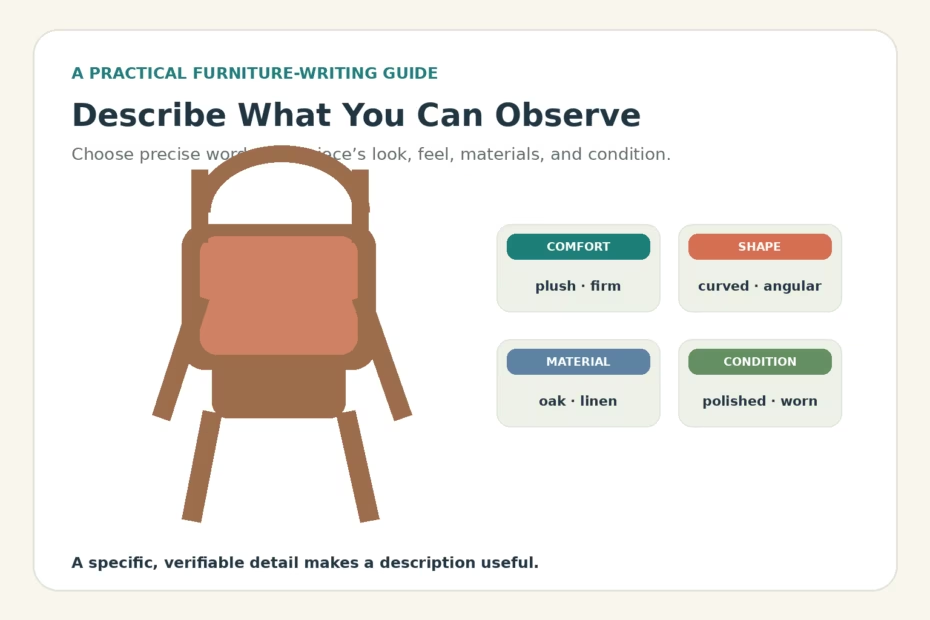
A useful furniture description tells readers what a piece looks like, how it feels, how it works, and what condition it is in. Choose words from the attribute you can actually observe. “A low, walnut-finished bookcase with adjustable shelves” gives a clearer picture than “a beautiful bookcase.” For a sales listing, pair each opinion with a visible or measurable detail.
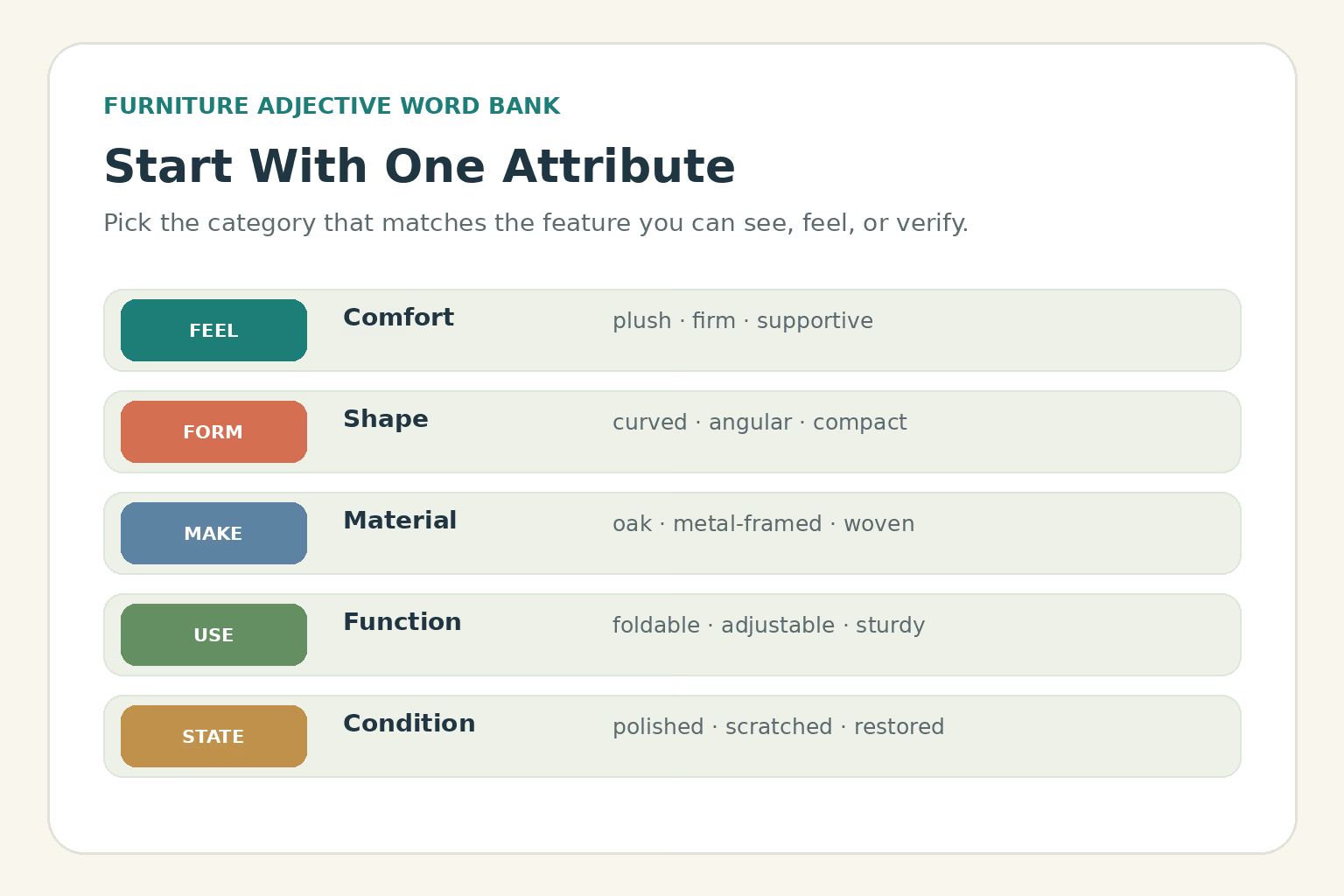
Furniture can be described by comfort, shape, scale, material, finish, construction, style, age, and condition. The word banks below group practical choices by what they communicate. Some words are subjective: “elegant” describes an impression, while “three-seat” or “solid oak” should be used only when those details are accurate.
Furniture Adjectives by Attribute
Comfort and feel
These words help describe seating, bedding, and other pieces people touch. Test the item before calling it comfortable or supportive.
- Comfortable: pleasant to sit or rest on.
- Cushioned: padded with a soft filling.
- Supportive: designed to hold the body steadily.
- Plush: softly padded with a full, luxurious feel.
- Firm: offering little give under pressure.
- Upholstered: covered with fabric or leather over padding.
- Textured: having a noticeable surface pattern or feel.
- Smooth: even and pleasant to touch.
- Scratchy: rough or irritating against skin.
- Rigid: stiff and not flexible.
- Springy: returning quickly after pressure.
- Breathable: allowing air to pass through, especially useful when describing fabric.
Shape, size, and layout
Scale words become more helpful when supported by measurements. If the furniture needs to fit a room or doorway, list its height, width, and depth rather than relying on “large” or “compact.”
- Compact, petite, small-scale: suited to limited floor space.
- Spacious, roomy, generous: offering ample seating or storage.
- Low-profile: close to the floor or visually short.
- Oversized, imposing, massive: noticeably large in a room.
- Slender, narrow, streamlined: taking up little visual or physical width.
- Angular, geometric, asymmetrical: defined by sharp or uneven lines.
- Curved, rounded, sculptural: shaped with flowing contours.
- Open, airy, lightweight: visually or physically light in form.
- Bulky, cumbersome: large or awkward to move.
- Modular, sectional, extendable: made of units or designed to change configuration.
Materials and surface finish
Material words work best when you know what the item is made from. A wood-look laminate is not solid wood, and a leather-like covering is not necessarily leather. Name a veneer, metal, glass, textile, or finish accurately; use “wooden” or “metallic” only when it fits.
- Wooden, oak, walnut, pine, veneered: identify the wood or wood surface when verified.
- Metal-framed, wrought-iron, chrome-plated: describe the metal and its treatment.
- Glass-topped, marble-topped, stone: name the visible surface material.
- Woven, cane, rattan, wicker: describe woven construction or material precisely.
- Leather, linen, velvet, wool, cotton: useful upholstery descriptors when confirmed.
- Polished, lacquered, painted, stained, waxed: indicate a surface treatment.
- Glossy, matte, satin, brushed: describe how the finish reflects light or feels.
- Grained, veined, speckled, patterned: describe visible surface markings.
- Natural, reclaimed, recycled: use only when the sourcing or material supports the claim.
Environmental and indoor-air terms deserve care. The US Environmental Protection Agency identifies furniture and some composite wood products as potential sources of indoor air pollutants. Avoid calling a piece “non-toxic,” “chemical-free,” or “low-VOC” based only on smell or appearance. Use specific emissions or certification language only when documentation supports it. Similarly, “FSC-certified” is a certification claim, not a decorative synonym for sustainable; check the product’s label or records before using it.
Construction, function, and quality
- Sturdy, solid, stable: resistant to wobbling during ordinary use.
- Well-built, well-joined, reinforced: describe construction details you can inspect.
- Handcrafted, hand-finished, machine-made: distinguish the actual production process.
- Adjustable, reclining, foldable, stackable: name a practical feature.
- Functional, versatile, convertible: useful for more than one purpose or arrangement.
- Ergonomic: shaped to support comfortable and efficient use; avoid using it as a vague synonym for comfortable.
- Wobbly, loose, squeaky, warped: disclose faults clearly in a listing.
- Durable, long-lasting: make claims only when supported by construction, testing, or experience.
Style, mood, and visual character
Style adjectives tell readers what a piece resembles or how it changes a room. Use a named movement or period when you can identify it; otherwise, a plain visual description is more reliable.
- Modern, contemporary, minimalist: often suggests clean lines and restrained ornament, though the terms are not interchangeable in every context.
- Traditional, classic, formal: suggests familiar forms, symmetry, or decorative detail.
- Rustic, farmhouse, industrial: evokes natural texture, rural simplicity, or utilitarian materials.
- Mid-century, Scandinavian, Art Deco, Victorian: identifies a design influence or period; confirm before assigning the label.
- Elegant, refined, graceful: communicates a polished or balanced appearance.
- Bold, dramatic, ornate, sculptural: draws attention through scale, detail, or form.
- Understated, simple, unadorned: keeps decoration restrained.
- Cozy, inviting, warm: describes the atmosphere a piece may create.
- Eclectic, playful, colorful: adds variety or strong visual personality.
Age and condition
Condition words should be honest and specific. “Antique” has an age-related meaning and should not be used to imply that any merely old-looking item is valuable. “Vintage” and “pre-owned” can also mean different things to different shoppers, so include an approximate age when known.
- New, unused, pre-owned, refurbished: state the item’s sale history or restoration status.
- Vintage, antique, period: use when the age or provenance is known.
- Pristine, well-kept, gently used: indicate a clean, well-maintained appearance.
- Worn, distressed, weathered: describe visible use or an intentional aged finish.
- Faded, chipped, scratched, stained: disclose the specific imperfection.
- Damaged, repaired, restored: explain the issue or work done.
- Clean, dusty, musty: report the item’s current condition, not just its style.
Examples: Describe Furniture in a Sentence
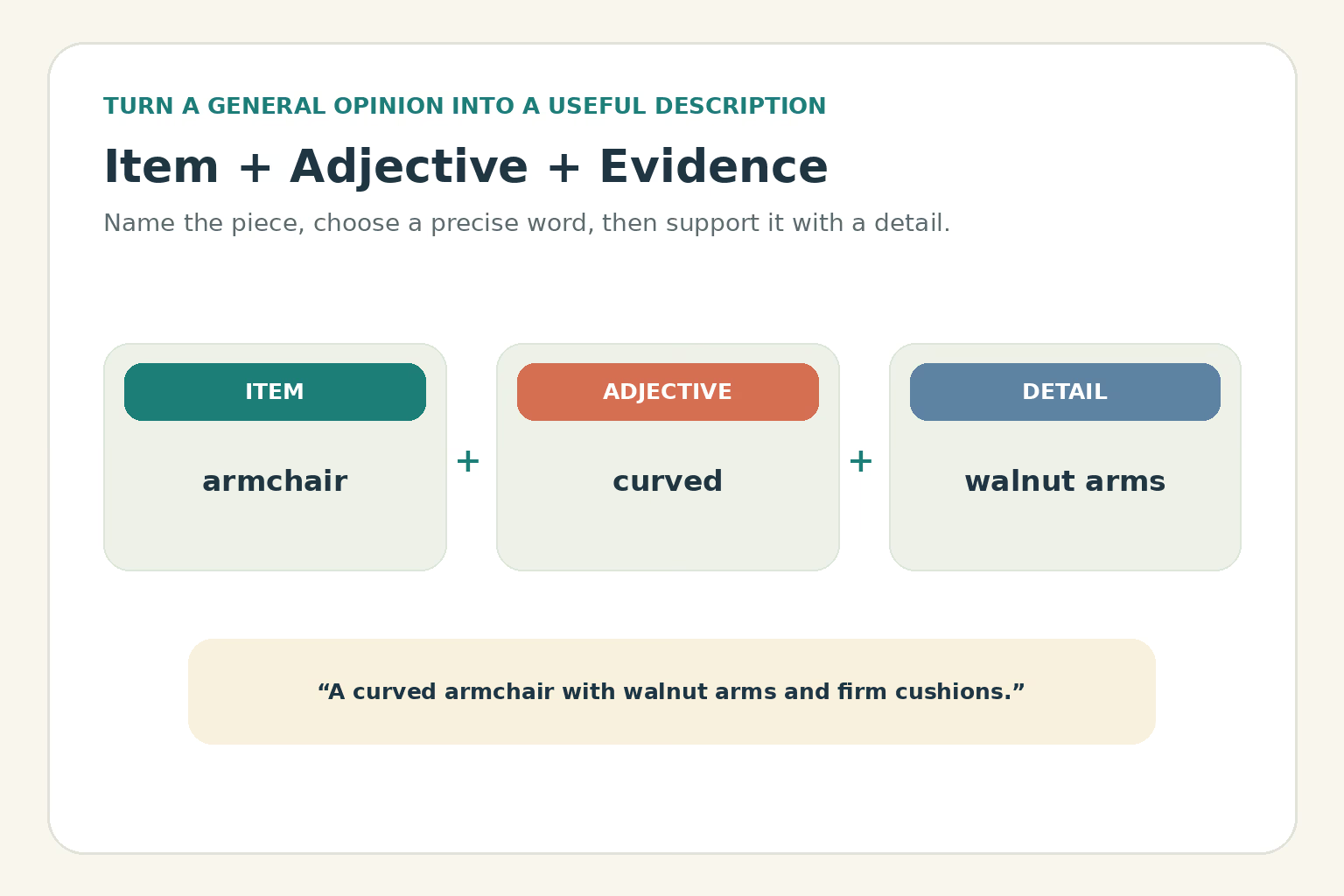
Combine one or two adjectives with evidence instead of stacking several generic compliments. These examples show how detail changes the picture:
- Instead of “a beautiful chair”: “A walnut dining chair with a curved back, woven seat, and a small scuff on the rear leg.”
- Instead of “a comfortable sofa”: “A three-seat sofa with firm cushions, washable linen-blend covers, and a low profile.”
- Instead of “an old table”: “A 1960s teak table with a polished top, tapered legs, and a repaired corner.”
- Instead of “a big cabinet”: “A 180-centimeter-tall pine cabinet with two adjustable shelves and a narrow footprint.”
- For room styling: “The slim black side table adds a crisp, modern accent beside the soft, textured armchair.”
Quick Tips for Furniture Listings and Reviews
- Start with the item and its use. Say whether it is a two-seat loveseat, writing desk, bedside table, or outdoor bench.
- Choose observable details. Mention measurements, color, material, storage, and visible wear.
- Separate facts from impressions. “Solid oak” is a material claim; “warm and welcoming” is your impression.
- Be precise about condition. Photograph and describe scratches, loose joints, stains, and repairs.
- Use fewer, stronger adjectives. One accurate word plus evidence is more helpful than a string of “amazing,” “gorgeous,” and “perfect.”
For material and sourcing claims, consult the product documentation. The US EPA’s indoor-air-quality guidance discusses furniture and materials that may contribute to indoor pollutants. The Forest Stewardship Council’s furniture guide describes FSC-certified furniture, while its label overview explains distinctions among FSC labels. These sources help make descriptions accurate; they do not establish the properties of a specific piece unless its own documentation matches.
Frequently Asked Questions
What are the best adjectives to describe furniture?
The best choice depends on the detail: use “sturdy” for stability, “plush” for soft padding, “compact” for small scale, “ornate” for elaborate decoration, or “weathered” for visible age. Add a concrete example or measurement whenever possible.
How do I describe furniture in a listing?
Name the furniture type, size, materials and features, then disclose condition. For example: “Oak-effect desk, 120 cm wide, with two drawers; light surface scratches on the right side.” Do not state an unverified material, certification, or performance claim.
What words describe old furniture?
Depending on verified age and condition, try “antique,” “vintage,” “pre-owned,” “weathered,” “well-kept,” or “restored.” Pair the term with an approximate date and note any repairs or wear.
Which adjectives describe comfortable furniture?
“Cushioned,” “plush,” “supportive,” “soft,” “firm,” and “ergonomic” describe different qualities. Choose the word that matches the actual feel or design, and explain what makes the piece comfortable.

When it comes to furniture, there are a lot of descriptive words that can be used to sell it. And, depending on the type of furniture you’re selling, you’ll want to use different words to describe it. For example, if you’re selling a couch, you might want to describe it as comfortable, stylish, and spacious.
But if you’re selling a dining room table, you might want to describe it as solid, sturdy, and able to seat a large number of people. Whatever the case may be, using descriptive adjectives is a great way to sell furniture.
So whether you’re a furniture salesman or simply trying to get rid of some old furniture, make sure to use descriptive adjectives when describing your goods. You never know, they just might help you make the sale.
Descriptive Adjectives Words For Furniture
In the market for a new piece of furniture? You’ll need to brush up on your adjectives first. After all, how else will you be able to narrow down your search among all the “fabulous,” “gorgeous,” and “stunning” options out there?

To help you out, we’ve compiled a list of words to describe furniture, so you can find the perfect fit for your home. From “cozy” to “elegant,” we’ve got you covered. So what are you waiting for? Start shopping for your next ” incomparable,” “magnificent” piece of furniture today!
A
| Actual | Administrative | Amazing |
| Ancient | Antiquated | Antique |
| Architectural | Artistic | Assyrian |
| Authentic |
B
| Bare | Basic | Beautiful |
| Bedding | Blue | Bodily |
| Bright | Broken | Brown |
| Bulky |
C
When it comes to adjectives for furniture, there are a lot of options out there. But if you’re looking for something that starts with the letter C, we’ve got you covered.
Here are some of our favorite adjectives for furniture that starts with C.
- Classy: This is a great option if you’re looking for something that’s both stylish and sophisticated. It’s perfect for formal living rooms or dining rooms.
- Comfortable: This is a must-have quality for any piece of furniture. After all, what’s the point of having furniture if it isn’t comfortable? We recommend checking out couches, chairs, and ottomans that are specifically designed for comfort.
- Cozy: Looking for something warm and inviting? Then cozy Furniture is a great option. These pieces are perfect for bedrooms or family rooms where you want to relax and unwind.
- Colorful: If you’re wanting to add a pop of color to your space, then look no further than Furniture that’s colorful. From bright reds to tranquil blues, there’s an option out there for everyone.
Whatever your style, we hope you’ll find the perfect adjective for your furniture needs right here!
| Certain | Cheap | Cheerless |
| Chief | Chinese | Classic |
| Clumsy | Coarse | Colonial |
| Colorfast | Comfortable | Common |
| Commonplace | Complementary | Conservatory |
| Considerable | Consistent | Constant |
| Contemporary | Costly | Coveted |
| Crafted | Crappy | Crated |
| Crude | Cumbrous | Curious |

D
Whether you’re looking for a word to describe your dining room table or your dresser, we’ve got you covered. Here are some of our favorite adjectives that start with D:
- Delightful: Furniture that makes you feel happy and content.
- Dazzling: Furniture that’s so beautiful it almost hurts to look at it.
- Divine: Furniture that’s fit for a goddess (or god).
- Dramatic: Furniture with bold colors or patterns that really make a statement.
- Drop-dead gorgeous: We had to include this one! This furniture is so stunning, you’ll be speechless.
| Dainty | Danish | Dark |
| Dead | Decadent | Decayed |
| Decent | Decorated | Decorative |
| Delicate | Delightful | Dental |
| Designer | Dingy | Dinnerware |
| Dirtiest | Disused | Domestic |
| Dumb | Dusty | Dutch |
E
| Eastern | Ecclesiastical | Egyptian |
| Eighteenth | Electronic | Elegant |
| English | Entire | Ephemeral |
| Ergonomic | Especial | Essential |
| European | Excellent | Excelsior |
| Expensive | Extra |
F
| Faded | Familiar | Fancy |
| Fashioned | Favorite | Fine |
| Fine Old | Flat | Formal |
| French | Functional | Fusion |
G
| Garish | Gawdy | Generous |
| German | Gilded | Gorgeous |
| Graceful | Grand | Grave |
| Greek | Green | Grey |
H
| Habitual | Handcrafted | Handsome |
| Handwoven | Heated | Heavy |
| Hebrew | Heterogeneous | Hispanic |
| Historic | Holdmahogany | Homemade |
| Huddled | Huge | Human |
| Humble |
I
| Immovable | Imperial | Impossible |
| Incomparable | Incongruous | Indian |
| Indisputable | Indoor | Inferior |
| Innovative | Interesting | Interior |
| Inventive | Inward | Italian |
| Itthe |
J | L
| Jacobean | Japanese | Japanned |
| Large | Lifeless | Light |
| Lightweight | Linear | Literal |
| Literary | Little | Lively |
| Lonely | Loose | Lovely |
| Luxurious |
M
| Magnificent | Marqueterie | Massive |
| Massive Old | Mediaeval | Mental |
| Minethe | Miscellaneous | Mission |
| Modern | Modest | Movable |
| Multitudinous |
N | O
| Napoleonic | Native | Neat |
| Nice | Occasional | Old Fashioned |
| Opulant | Opulent | Oratorical |
| Ordinary | Original | Ornamental |
| Ornate | Outdoor | Outrageous |
| Ox |
P
| Perfect | Persian | Piled |
| Pine | Pitiable | Plain |
| Plush | Polished | Ponderous |
| Poor | Precious | Present |
| Primitive | Proper | Pseudo |
Q | R
| Quality | Queer | Readymade |
| Real | Realistic | Red |
| Requisite | Retail | Rich |
| Ritual | Roman | Rough |
| Royal | Rude | Rustic |
S
We all know that adjectives are words that describe, modify or intensify a noun or pronoun. And when it comes to furniture, there are definitely plenty of adjectives to choose from! So if you’re looking for some inspiration, here’s a list of adjectives that start with S that you can use to describe furniture.

Sleek, solid and stylish are just some of the adjectives that come to mind when thinking about furniture that starts with the letter S. From sofas and chairs to tables and beds, there’s a wide range of furniture that fits this description. And whether you’re looking for something modern or classic, there’s sure to be an option out there that’s perfect for you.
So whatever your style, if you’re in the market for some new furniture, be sure to keep these adjectives in mind!
| Sacred | Saracenic | Satisfactory |
| Scandinavian | Scant | Scanty |
| Schoolroom | Sculpted | Sectional |
| Shabby | Shiny | Silent |
| Simple | Sized | Small |
| Smart | Soft | Sole |
| Solid | Somber | Sophistocated |
| Spanish | Splendid | Spooky |
| Stately | Stationary | Stickley |
| Stiff | Strange | Sturdy |
| Stylish | Substantial | Suitable |
| Sumptuous | Superfluous | Swedish |
T
| Tailored | Tasteful | Tawdry |
| Teak | Terrifying | Theological |
| Ticketed | Timeless | Toned |
| Traditional | Transitional | Typical |
U
| Uglier | Ugly | Uncleansed |
| Uncomfortable | Unlovely | Unnecessary |
| Unpainted | Unused | Unusual |
| Unwanted | Upholstered | Upturned |
| Useful | Useless | Usual |
V | W
| Valuable | Versatile | Victorian |
| Void | Western | White |
| Wonderful | Wooden | Worn |
| Wretched | Wrought |
Final verdict
In conclusion, it is important to choose your furniture adjectives wisely. After all, the way you describe your sofa says a lot about you as a person. If you’re looking for a sofa that screams “success,” you might want to consider a stately, leather Chesterfield. On the other hand, if you’re going for a more laid-back vibe, a comfy couch might be more your style. Whatever you choose, just make sure it fits your personality—and your living room.


