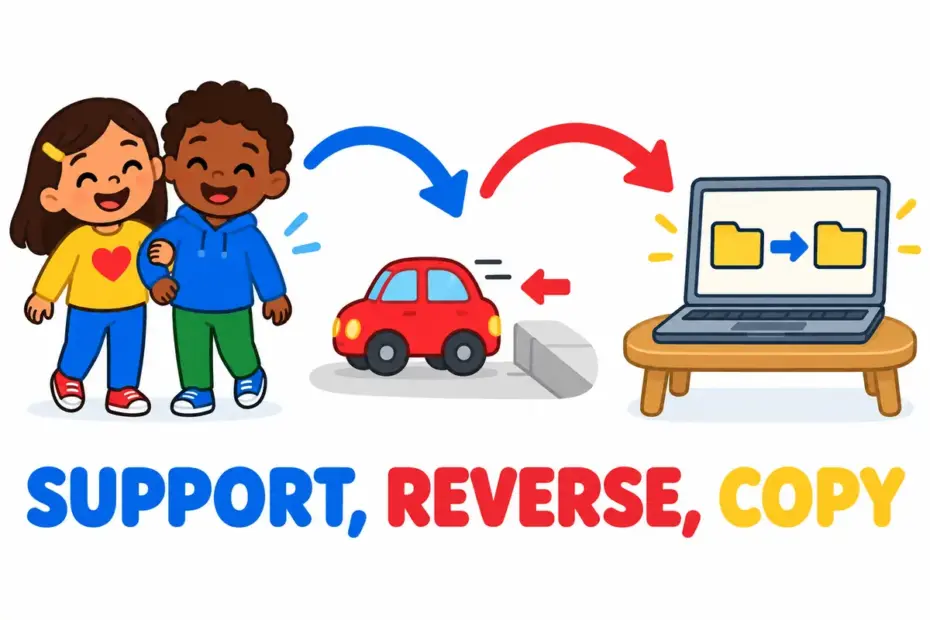
Back up means to support someone, to reverse a vehicle, or to copy files safely, and back up in a sentence shows all three: “Back me up in the meeting”, “back up the car”, and “back up the photos”. The object that follows is what tells a reader which sense is meant.
Back up at a glance
- Back up is a phrasal verb with three core senses: support, reverse and copy data.
- The particle up can move, so back me up and back up the claim are both correct.
- A pronoun object must sit between the verb and the particle: back me up, never back up me.
- The noun backup is one word; the verb is always two.
- The commonest error is spelling the verb as one word, as in backup your files.
What does back up mean?
Back up is a phrasal verb meaning to give support, to move backwards, or to make a spare copy of data. The Cambridge entry for back up separates the senses by object, and the object is the clue a reader uses. A person or claim is backed up in the supporting sense, a vehicle is backed up in the movement sense, and a file is backed up in the computing sense.
| Sense | Plain meaning | Example sentence |
|---|---|---|
| Support a person | Give help or show agreement | The whole team backed her up in the review. |
| Confirm a claim | Add evidence to an account | The receipts back up his version of events. |
| Reverse | Move a vehicle or person backwards | Back up slowly to the gate. |
| Copy data | Make a spare copy of files | Back up the folder before the update. |
One limitation is worth stating plainly. Back up does not mean to take over or to solve: someone who backs you up stands beside you, but does not do the job for you. Nor does the supporting sense imply agreement about everything, only that the person is not left alone. Confirming a fact is closer to corroborate than to rescue.
How do you use back up in a sentence?
Choose the sense from the object, then decide where the particle goes. The verb is separable, which means up can follow the object, but the two positions are not always interchangeable.
| Pattern | Example | What it signals |
|---|---|---|
| back up + person | The witness backed up the driver. | Support with evidence, person as object. |
| back + pronoun + up | I will back you up. | The pronoun must sit between verb and particle. |
| back up + claim | The data backs up the claim. | The confirming sense with a thing as object. |
| back up (no object) | Back up before you turn. | Movement only, with the direction left to context. |
| back up + files | Back up the reports weekly. | The computing sense, naming the data. |
The rule for placement is firm: a pronoun object goes in the middle, so back me up is correct and back up me is not. A full noun can go either side, so back up the claim and back the claim up both read naturally. When the sense is movement, the phrase is usually intransitive and no object appears at all.

Back up in a sentence: examples across contexts
Back up changes sense more than it changes register. The nine sentences below keep the same phrase while moving from a classroom to a server room, and each one names the object doing the work.
| Context | Example sentence | Why this works |
|---|---|---|
| Classroom | Can you back me up when I present the group’s results? | The pronoun sits between verb and particle, the correct pattern. |
| Workplace email | Please back up the shared drive before the migration. | The computing sense with a clear time limit. |
| News report | Two witnesses backed up the officer’s account. | The confirming sense with a formal subject. |
| Driving lesson | Back up the car until the mirror clears the wall. | The movement sense with a vehicle object. |
| Debate | Every figure she quoted backs up her argument. | A thing as object, so the claim is what is supported. |
| IT support | Back up your files before you restart the machine. | The everyday data-protection instruction. |
| Friendship | He backed his sister up when nobody else would. | The human sense, with the particle at the end. |
| Sports report | The keeper backed up the defence all afternoon. | Support described over a span of time. |
| Conversation | Wait, back up a second and explain that again. | A figurative use meaning rewind the explanation. |
Only two of the nine sentences describe a vehicle or data. The supporting and confirming senses do most of the work in ordinary writing, which is why the object matters more than the setting.
Back up vs back down
The phrase readers confuse it with most is back down, which reverses the idea of holding a position.
| Attribute | back up | back down |
|---|---|---|
| Core meaning | Support, confirm, reverse or copy | Withdraw from a position or demand |
| Direction of energy | Gives strength to someone or something | Gives ground under pressure |
| Typical subject | A colleague, witness, data or driver | A negotiator, rival or government |
| Connotation | Loyal and steady | Defeated or reasonable, by context |
| Common object | A person, claim, car or folder | Usually none |
| Replace with | support, corroborate | retreat, yield |
Verdict: choose back up when you add strength, and back down when you withdraw it; a colleague who corroborates your story backs you up, while one who stops arguing backs down. If you want the plainest supporting verb, support always fits.
Word forms and grammar of back up
The verb inflects normally, but the noun is a different shape entirely. The table lists both, plus the form learners wrongly build by closing the gap.
| Form | Part of speech | Example |
|---|---|---|
| back up | phrasal verb, base | We back up the files every night. |
| backs up | phrasal verb, third person | She backs up her manager in public. |
| backed up | phrasal verb, past | The traffic backed up for a mile. |
| backing up | phrasal verb, present participle | He is backing up the database now. |
| backup | noun (one word) | Keep a backup on a separate drive. |
| back-up | adjective before a noun | The back-up generator started at once. |
| non-standard: backup | verb, wrong | Wrong: backup your files tonight. |
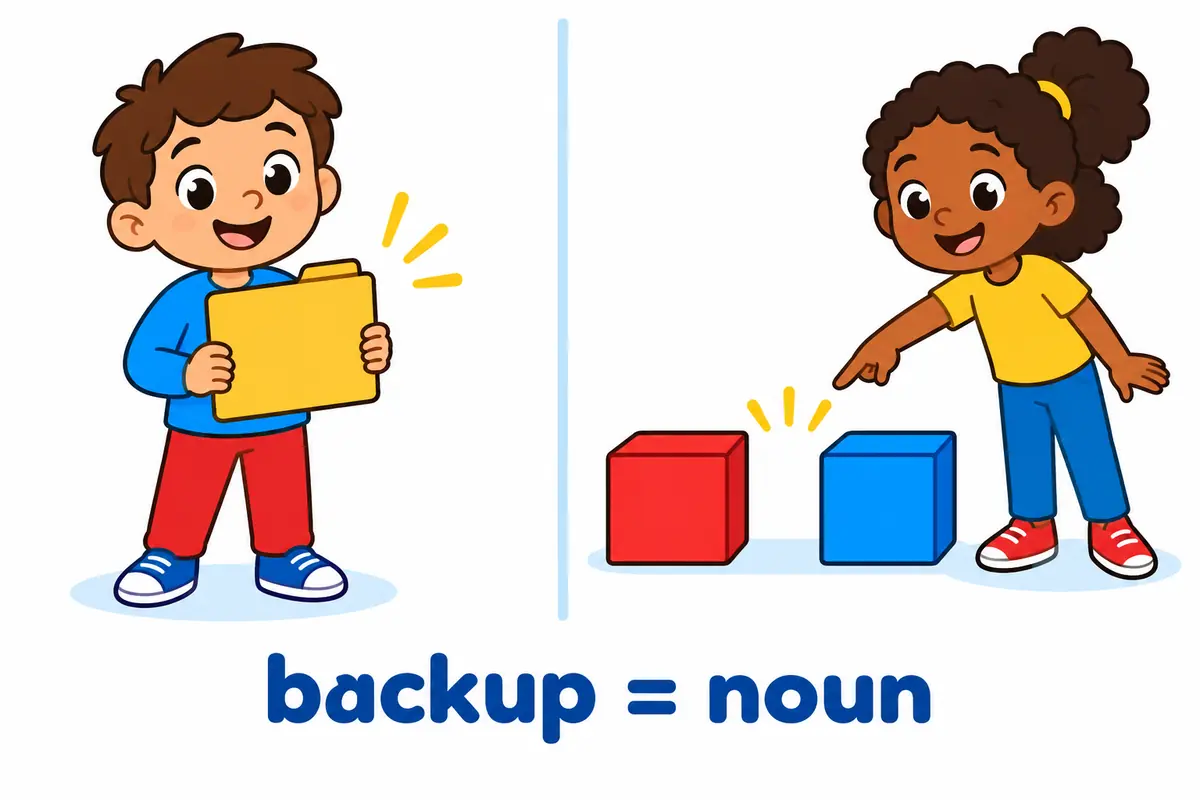
Keep the noun and the verb apart. A backup is a thing you own, while back up is something you do. The related back out means to withdraw from a promise, which is a third direction for this small family.
Common mistakes with back up
- Incorrect:
Please backup the folder now.Correct: Please back up the folder now. Rule: The verb is two words; only the noun is written as one. - Incorrect:
She backed up me in the meeting.Correct: She backed me up in the meeting. Rule: A pronoun object goes between the verb and the particle. - Incorrect:
The evidence backed up.Correct: The evidence backed up his story. Rule: The confirming sense is transitive and needs an object. - Incorrect:
He backed down his friends.Correct: He backed up his friends. Rule: Back down takes no object; backing friends means supporting them. - Incorrect:
Back up the door and I will catch the keys.Correct: Back up to the door and I will catch the keys. Rule: The movement sense needs a preposition, not a direct object.
Practice using back up
Work through the six items, then check the reasoning rather than only the answer.
- Fill the gap: Remember to ______ the photos before you sell the laptop.
- Choose the better word: The witness (backed up / backed down) the cyclist’s account.
- Correct the error: Can you back up me at the meeting?
- Build a sentence: use back up about a driver reversing into a tight space.
- Spot the register: which belongs in a workplace email — please back the drive up tonight, or save the stuff somewhere, yeah?
- Rewrite with a pronoun: The team supported Maya. Use back + pronoun + up.
Answers
- back up — the computing sense names the data and stays two words.
- backed up — backing down would mean withdrawing, which witnesses did not do.
- Can you back me up at the meeting? — the pronoun belongs between the words.
- Model answer: Back up the van slowly until the tyres touch the kerb.
- Please back the drive up tonight — an email keeps the full verb and avoids vague wording.
- The team backed Maya up — the full noun can follow the particle.
The bottom line
Use back up in a sentence for support, confirmation, reverse movement or a data copy, and let the object name the sense. Two nuances decide most sentences: a pronoun object goes between the words, so back me up, and the noun backup is a single word while the verb never is. Where you only mean to add strength to a claim, corroborate is the more formal neighbour.
Frequently asked questions about back up
Is it back up or backup?
Both exist, but they are different parts of speech. The verb is always two words: back up your files. The noun and the adjective are one word: keep a backup, and use the back-up plan. If you can ask what it does, you need the verb; if you can own it, you need the noun.
Is back up separable?
Yes. The particle up can move after a full noun object, so back up the claim and back the claim up are both correct. A pronoun object changes the rule, however: it must sit in the middle, giving back me up rather than back up me. In the movement sense there is often no object at all.
What does back up mean in computing?
In computing, back up means to make a spare copy of files so the originals can be restored if something fails. You back up a folder, a drive or a whole system, and the copy itself is a backup. The phrase is transitive here, so an object such as the reports is almost always present.
Can back up mean to confirm?
Yes, and it is one of the commonest uses in writing. When evidence backs up a claim, it supports the claim with facts, which is close to corroborate but less formal. The object is the claim or account, and the subject is the proof, such as data, records or a witness.
Do you ever find yourself needing to provide additional evidence or support for a claim or argument you’ve made? This act of reinforcing your statements with further information is commonly referred to as “backing up.”
In writing or conversation, “backing up” involves offering proof, examples, or details to solidify a point, making your stance more credible and convincing. This practice is crucial in ensuring the validity and strength of your arguments across various contexts.
7 Examples Of Back Up Used In a Sentence For Kids
- Back up your toys before you go home.
- Let’s all back up and make space for everyone to play.
- Remember to back up your drawings by saving them.
- It’s important to back up your friends when they need help.
- Don’t forget to back up your school bag with all your books.
- Let’s all back up a little and give each other some room.
- Make sure to back up your words with kind actions.
14 Sentences with Back Up Examples
- Back up all your assignments on a cloud storage service to prevent any loss of data.
- Make sure to back up your important documents before formatting your laptop.
- It’s always a good idea to back up your study notes on an external hard drive.
- Don’t forget to regularly back up your research papers to avoid any unforeseen mishaps.
- Before starting a group project, discuss a plan to back up everyone’s work for security purposes.
- Back up your class presentations on a USB drive as a precautionary measure.
- In case of an internet failure during an online exam, have a back up plan ready.
- When working on a group project, assign a member to back up all the data just in case.
- Ensure that you back up your research data at multiple locations for extra security.
- Always back up your project work on a cloud server to access it from anywhere.
- Create a habit of regularly backing up your notes to avoid losing valuable information.
- Back up your research papers on an online platform to easily share them with your peers.
- It’s essential to have a back up copy of your presentation in case of technical difficulties during the seminar.
- Before submitting your assignments online, make sure to back up a copy on your computer for reference.
How To Use Back Up in Sentences?
To use the term Back Up in a sentence means to express the action of creating a copy of files or data in case the original is lost or damaged. For example, “I always back up my important documents to an external hard drive to prevent any data loss.”
When using Back Up in a sentence, it is important to understand the context in which it is being used. Make sure to clearly indicate what is being backed up and where it is being stored. For instance, “Don’t forget to back up your photos to the cloud so you can access them from anywhere.”
To master the use of Back Up in a sentence, consider the following tips:
1. Clearly specify what you are backing up. This could be files, documents, photos, or any other data that is important to you.
2. Mention where you are backing up the data. This could be an external hard drive, a cloud storage service, or any other secure location.
3. Use back up in a sentence that demonstrates the importance of having a backup copy. This can help emphasize the need for regularly creating backups.
By using the term Back Up in a sentence effectively, you can ensure that your data remains safe and secure, ready to be restored in case of any unexpected incidents.
Conclusion
In conclusion, the importance of having solid evidence to support your claims cannot be overstated. Whether it’s in a debate, a research paper, or a decision-making process, having sentences with backup helps to strengthen your argument and credibility. By providing concrete examples, statistics, or references to back up your statements, you demonstrate a level of thoroughness and reliability that is essential in making a compelling case.
Utilizing sentences with backup not only bolsters the validity of your points but also enables others to understand and trust your perspective. It showcases your dedication to accuracy and helps you stand out as a knowledgeable and well-informed individual. Ultimately, incorporating backup into your sentences is a powerful tool in effectively communicating your ideas and persuading others to see things from your point of view.


