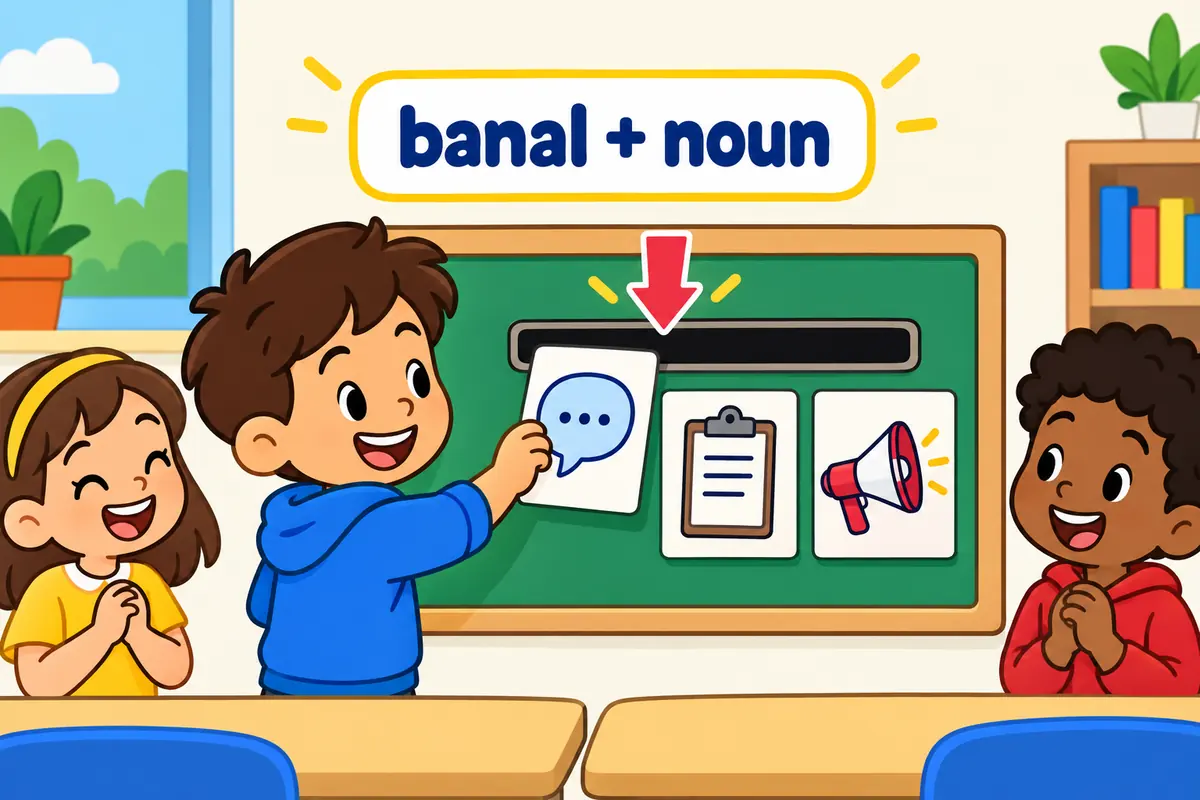
Banal is an adjective meaning dull and unoriginal because it is so obvious or overused. To use banal in a sentence, place it before a noun or after a linking verb: “The speech was banal.” It judges an idea or remark, never a person’s moral worth.
Banal at a glance
- Banal is an adjective; its noun is banality and its adverb is banally.
- It means dull and unoriginal, not evil, so it describes remarks, ideas and plots.
- It sits before a noun (a banal excuse) or after a linking verb (the speech was banal).
- Common partners are remark, excuse, plot, slogan, observation and pleasantries.
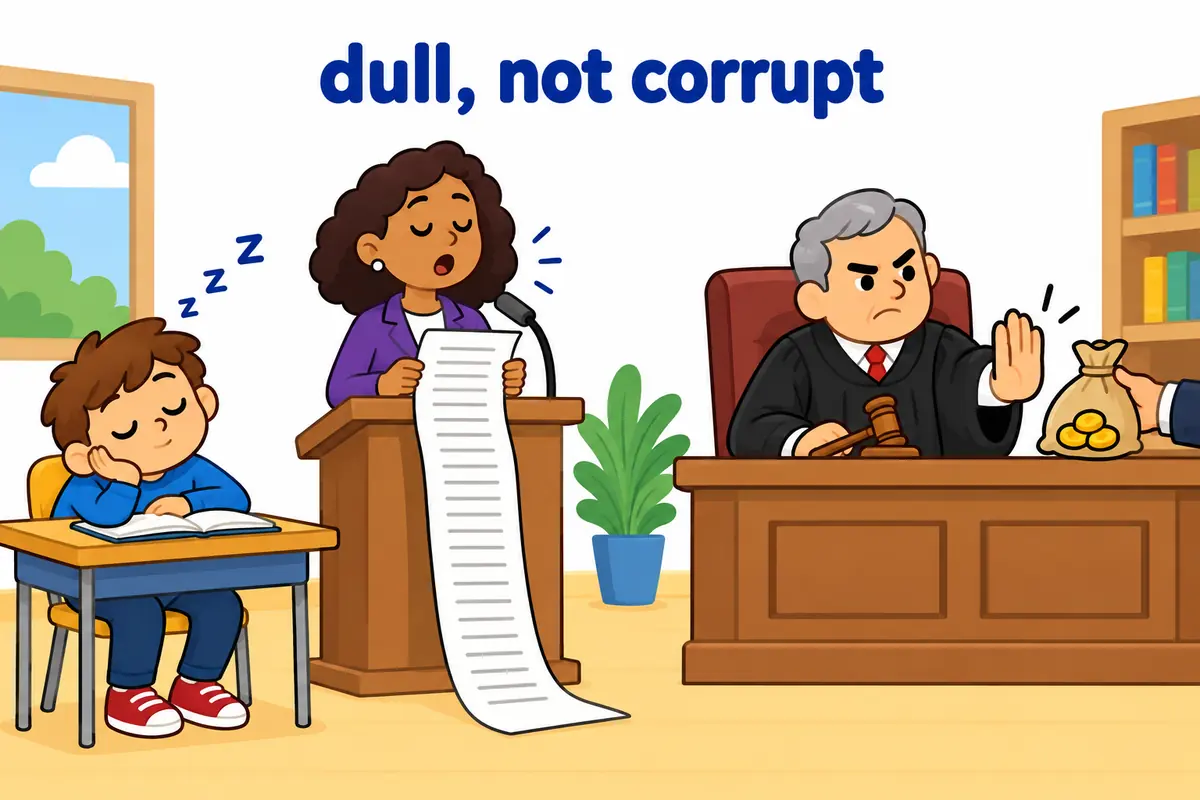
- The commonest error is confusing banal with venal, which means open to bribery.
What does banal mean?
Banal is an adjective meaning dull and unoriginal because it is so familiar and obvious. The dictionary entry for banal points to the same idea as mundane, though the two differ: mundane means ordinary and worldly, while banal adds the complaint that the thing has been said or done too often.
| Sense | Plain meaning | Example sentence |
|---|---|---|
| Unoriginal remark | A comment heard so often it adds nothing | His toast was a string of banal pleasantries. |
| Dull idea | A thought with no freshness or surprise | The script’s central idea is banal. |
| Overused style | A tired, predictable way of expressing something | The advert leaned on banal slogans about teamwork. |
One limitation matters. Banal is a judgement about freshness, not about truth or kindness. A true and useful remark can still be banal if everyone has heard it before. When a writer means simply boring, dull is the safer word, because banal accuses the speaker of laziness as well as dullness.
How do you use banal in a sentence?
Banal behaves like most adjectives: attributive before the noun, or predicative after a linking verb. It often appears in the phrase banal pleasantries, and a verb such as sound or seem softens the judgement into an impression.
| Pattern | Example | What it signals |
|---|---|---|
| banal + noun | He offered a banal excuse for the delay. | Attributive use; a settled judgement of the noun. |
| linking verb + banal | The whole debate sounded banal. | Predicative use; a reaction to what was heard. |
| banal + to + noun | The line felt banal to an audience that knew it by heart. | Names who finds it tired. |
| a string of banal + noun | We exchanged a string of banal observations. | Groups several unoriginal remarks. |
| find + object + banal | Critics found the sequel banal. | Reports a verdict after the object. |
The practical test is to ask what the thing adds. If it repeats something the reader has already met, banal fits; if it merely lacks excitement, boring or dull is fairer. Because banal carries a sting, a careful writer attaches it to the work rather than to the person who made it.
Banal in a sentence: examples across contexts
Banal keeps its judgement wherever it appears; only the thing being judged changes. The sentences below move from a school corridor to a review column, and each one names what has been said too often.
| Context | Example sentence | Why this works |
|---|---|---|
| Classroom | Our essays were full of banal openers about modern life. | Names a specific, forgivable habit. |
| Workplace email | Let us skip the banal greetings and get to the figures. | A practical request keeps the tone brisk. |
| News report | The minister’s answer was dismissed as banal. | A neutral frame reports a quoted verdict. |
| Review writing | The plot is banal, though the acting is superb. | Pairs the criticism with a contrasting strength. |
| Speech writing | Avoid banal phrases such as reach for the stars. | Uses the adjective to warn against cliches. |
| Academic prose | The study repeats a banal claim without new evidence. | Ties the tiredness to a missing proof. |
| Marketing talk | The campaign drowned in banal slogans about teamwork. | Groups several overused phrases. |
| Conversation | The small talk stayed banal until the topic turned to cricket. | Shows the word contrasting with a lively turn. |
Notice that banal rarely stands alone as a verdict. It usually points at a noun the reader can judge, such as an excuse, a slogan or an opener, which is why the collocation matters more than the adjective on its own.
Banal vs hackneyed, trite and venal
Banal is close to hackneyed and trite, and it is often misread for the sharper venal, which means corrupt. All three of the first group describe worn material, but each points to a different reason.
| Attribute | banal | hackneyed | venal |
|---|---|---|---|
| Core meaning | Dull and obvious | Overused to the point of staleness | Open to bribery |
| What it judges | An idea or remark | A phrase or device | A person or motive |
| Why it fails | Says nothing new | Has been used too often | Is morally corrupt |
| Typical noun | a banal excuse | a hackneyed phrase | a venal official |
| Tone | Critical but mild | Critical, about style | Strongly disapproving |
Verdict: use banal when an idea is too obvious to matter, hackneyed when a phrase has been worn smooth, and venal only when money is corrupting someone.
Word forms and grammar of banal
Banal has a full word family, and the adjective appears beside unoriginal in the same critical territory. The example below also shows the noun banality, which names the quality itself.
| Form | Part of speech | Example |
|---|---|---|
| banal | adjective | The dialogue was banal from the first scene. |
| banally | adverb | The host banally thanked everyone in turn. |
| banality | noun | The banality of the speech surprised nobody. |
| banalities | plural noun | They traded banalities about the weather. |
| venal | adjective — different meaning | A venal clerk took the bribe. |
Do not build a comparative with more banal unless the comparison is deliberate, such as more banal than the last draft. And remember that banal ends in a single l, so banally doubles the l when the adverb is formed.
Common mistakes with banal
- Incorrect:
The banal official accepted the money.Correct: The venal official accepted the money. Rule: banal means unoriginal, while venal means corrupt and open to bribes. - Incorrect:
She is a banal person.Correct: Her remarks were banal. Rule: the adjective judges ideas and remarks, so attaching it to a whole person sounds harsher than intended. - Incorrect:
The plot was very banal and boring.Correct: The plot was banal. Rule: banal already contains the idea of dullness, so boring repeats it. - Incorrect:
His banal was obvious to everyone.Correct: His banality was obvious to everyone. Rule: the adjective cannot stand as a noun; use banality or a phrase such as banal remark. - Incorrect:
The joke was banally funny.Correct: The joke was banal yet funny. Rule: the adverb describes how something is done, not how dull it is.
Practice using banal
Work through the six items, then read the reason beside each answer.
- Fill the gap: The opening paragraph was ______ and told us nothing new.
- Choose the better word: The judge jailed the (banal / venal) clerk who took bribes.
- Correct the error: The film was very banal and boring.
- Build a sentence: use banal pleasantries about small talk at a party.
- Spot the register: which suits a review — the plot is banal and predictable, or the plot is proper boring?
- Change the part of speech: The remark was banal. Rewrite using the noun banality.
Answers
- banal — the adjective follows the linking verb was and judges the paragraph.
- venal — the clerk is corrupt, so banal does not fit.
- The film was banal — dullness is already inside the adjective.
- Model answer: We exchanged banal pleasantries about the weather before anyone mentioned the real problem.
- The plot is banal and predictable — a review prefers the precise adjective to slang.
- The banality of the remark was clear — the noun names the quality itself.
The bottom line
Use banal in a sentence for an idea, remark or style that is dull because it is overfamiliar, either before its noun or after a linking verb. Two nuances decide most sentences: the word judges freshness rather than truth, and it easily collides with venal, which means corrupt. When the point is only that something is boring, choose dull.
Frequently asked questions about banal
Is banal a rude word?
It is critical but not offensive. Calling a remark banal says it is unoriginal, which can sting a writer, yet it says nothing about the speaker’s character. Applied to an idea or a draft, it is fair comment; applied to a person, it sounds like an attack, so keep the subject on the work.
What is the difference between banal and mundane?
Mundane means ordinary and everyday, with no criticism of freshness. Banal adds the complaint that something is not only ordinary but unoriginal. A routine of shopping and cooking is mundane; a speech that repeats the same shopping metaphor for an hour is banal, because listeners have heard it before.
How do you pronounce banal?
Most speakers rhyme it with canal, giving a stressed second syllable. Some speakers in Britain and America instead rhyme it with anal, stressing the first syllable. Both are established, so neither is an error, but a careful reader may notice the split and should not treat either version as wrong.
Can banal describe a person?
Only loosely. The adjective is meant for ideas, remarks and styles, so a banal remark is standard while a banal person is unusual and harsher. When writers do extend it to a person, they usually mean the person’s output or conversation, not their whole character, and the sentence is stronger when it names that output.
Banal, derived from the French word “banalité,” refers to something lacking originality and appearing trite or commonplace. In everyday terms, banal describes ideas, phrases, or situations that are predictable, mundane, and often uninspired.
Despite its negative connotation, understanding the concept of banality can actually enhance our appreciation for unique and imaginative expressions. By recognizing what is banal, we can strive for creativity, originality, and innovation in our own thoughts and creations.
7 Examples Of Banal Used In a Sentence For Kids
- Banana is a **banal fruit that many children love to eat.
- The banal color of the sky sometimes changes to beautiful shades of pink and orange during sunset.
- We often hear banal nursery rhymes that we can sing along to.
- It’s important to wash our hands regularly to prevent getting sick from banal germs.
- The banal sound of the rain can be calming and soothing to listen to.
- We should try to be creative and come up with new ideas instead of sticking to banal routines.
- Remember to always be kind to others, even when faced with banal challenges.
14 Sentences with Banal Examples
- The professor’s lecture was filled with banal information that most students had already read in the textbook.
- During group discussions, it’s important to avoid repeating banal arguments that everyone already knows.
- Many students find it boring to research and write about banal topics that have been discussed numerous times before.
- When it comes to choosing a topic for your dissertation, try to steer clear of banal subjects that won’t impress your advisor.
- It’s important to challenge yourself by delving into complex ideas rather than sticking to banal explanations.
- The student’s presentation lacked originality and was filled with banal statements that failed to capture the audience’s attention.
- When preparing for exams, focus on understanding concepts deeply rather than rote memorization of banal facts.
- Engaging in banal small talk at networking events won’t help you form meaningful connections with potential employers.
- To stand out in a job interview, avoid giving banal responses to common questions and instead showcase your unique skills and experiences.
- Many students feel frustrated by the banal routine of attending classes, studying, and completing assignments without much excitement.
- It’s easy to fall into a pattern of procrastination when faced with banal tasks that lack inspiration or challenge.
- Joining extracurricular clubs and activities can help break up the banal routine of academic life and provide opportunities for personal growth.
- It’s important to push yourself beyond your comfort zone in order to prevent your college experience from becoming predictable and banal.
- Engaging in thought-provoking discussions with peers can help stimulate your mind and prevent your college experience from feeling banal.
How To Use Banal in Sentences?
To use the word Banal effectively in a sentence, follow these simple steps:
-
Understand the meaning: Banal refers to something that is common, unoriginal, or lacking in originality. It can describe something that is predictable, mundane, or overused, making it uninteresting or boring.
-
Choose the right context: Consider using Banal when you want to convey a sense of dullness, lack of creativity, or something that is overly familiar or cliché.
-
Construct your sentence: Start by identifying a situation or object that fits the description of Banal. For example, “The movie was disappointing because of its banal plot.” This sentence uses Banal to express that the plot of the movie was clichéd and unoriginal.
-
Practice using Banal: Experiment with incorporating Banal into different sentences to gain a better understanding of how to use it effectively. For instance, “His speech was filled with banal phrases that failed to inspire the audience.”
-
Be cautious of overuse: While Banal can be a useful word to express a lack of originality, avoid using it excessively in your writing or speech. Balance it with other descriptive words to create a varied and engaging narrative.
By following these steps and practicing using Banal in different contexts, you can effectively incorporate this word into your vocabulary to enhance your communication skills.
Conclusion
In essence, using banal sentences in communication can contribute to a lack of interest or engagement from the listener or reader. Throughout this article, we have explored how these commonplace phrases can lead to monotony, predictability, and a lack of meaningful impact in messaging. By incorporating more original and thought-provoking language, individuals can enhance the effectiveness of their communication and better connect with their audience.
By recognizing the limitations of banal sentences and striving to infuse more creativity and depth into our expressions, we can elevate the quality of our interactions and convey our thoughts more effectively. Embracing originality and avoiding clichés can enrich our communication, fostering more engaging and memorable exchanges.


