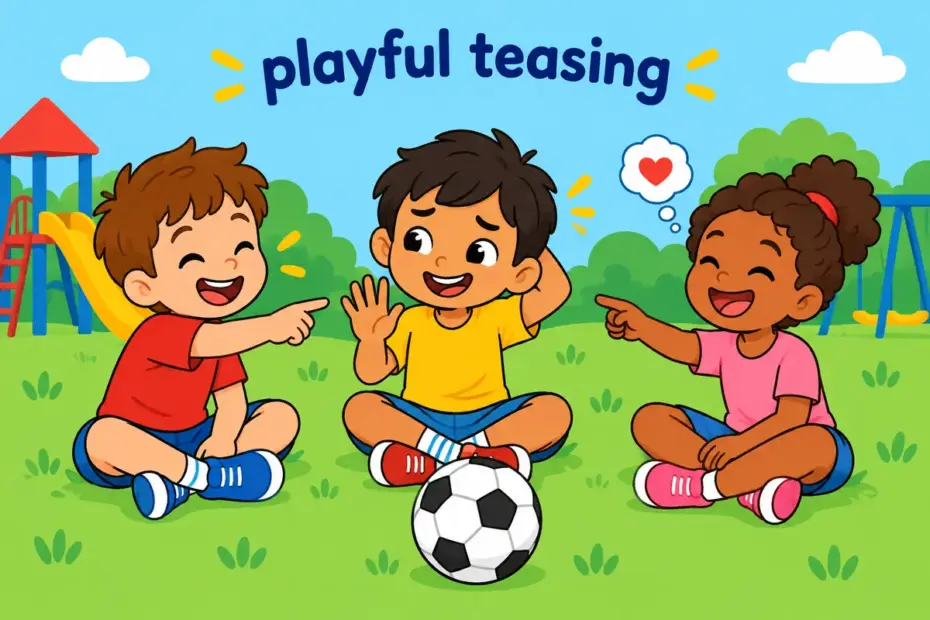
Banter is playful, teasing talk that stays friendly underneath the joke. To use banter in a sentence, name who is trading it or call the exchange itself banter: the two cooks kept up a running banter across the kitchen. The word works as both a noun and a verb, and both senses carry the same warmth.
Banter at a glance
- Banter is mainly a noun and also a verb; its forms are banters, bantered and bantering.
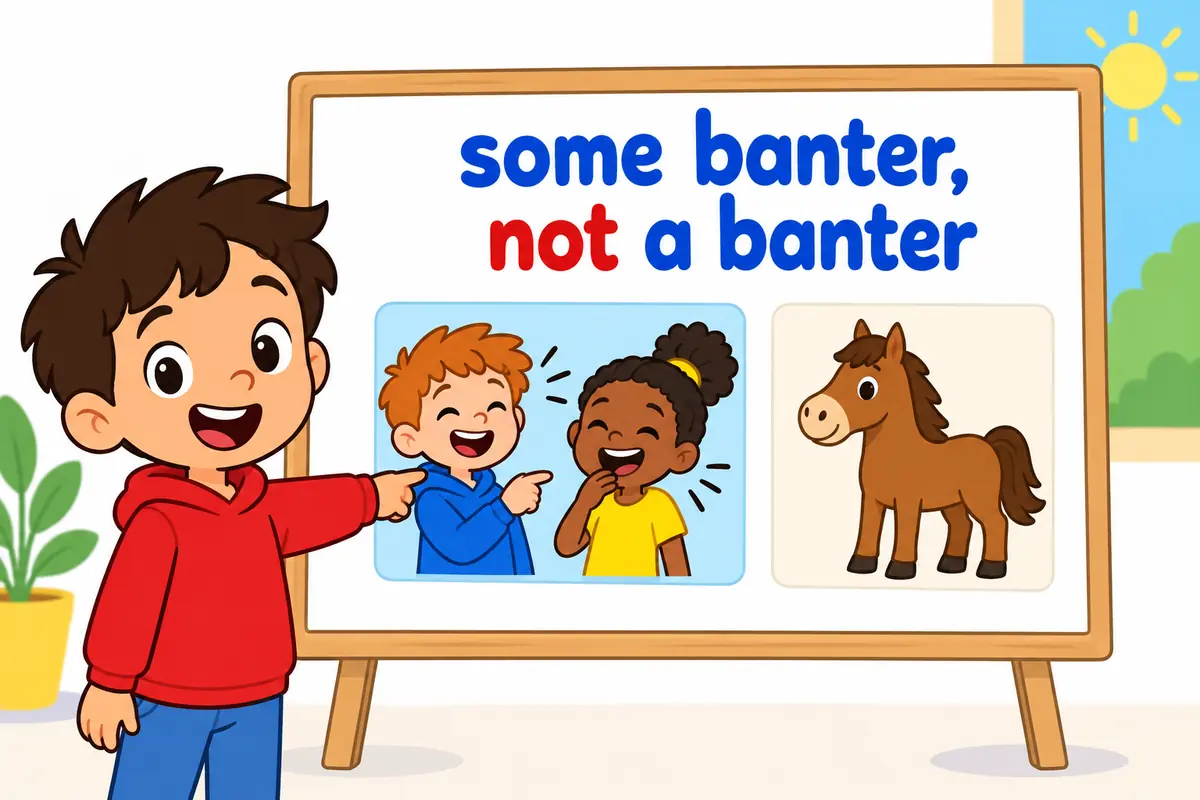
- The noun is usually uncountable, so writers say some banter, not a banter.
- The tone is teasing but affectionate; banter is not an argument.
- It appears with verbs like exchange, trade, keep up and enjoy.
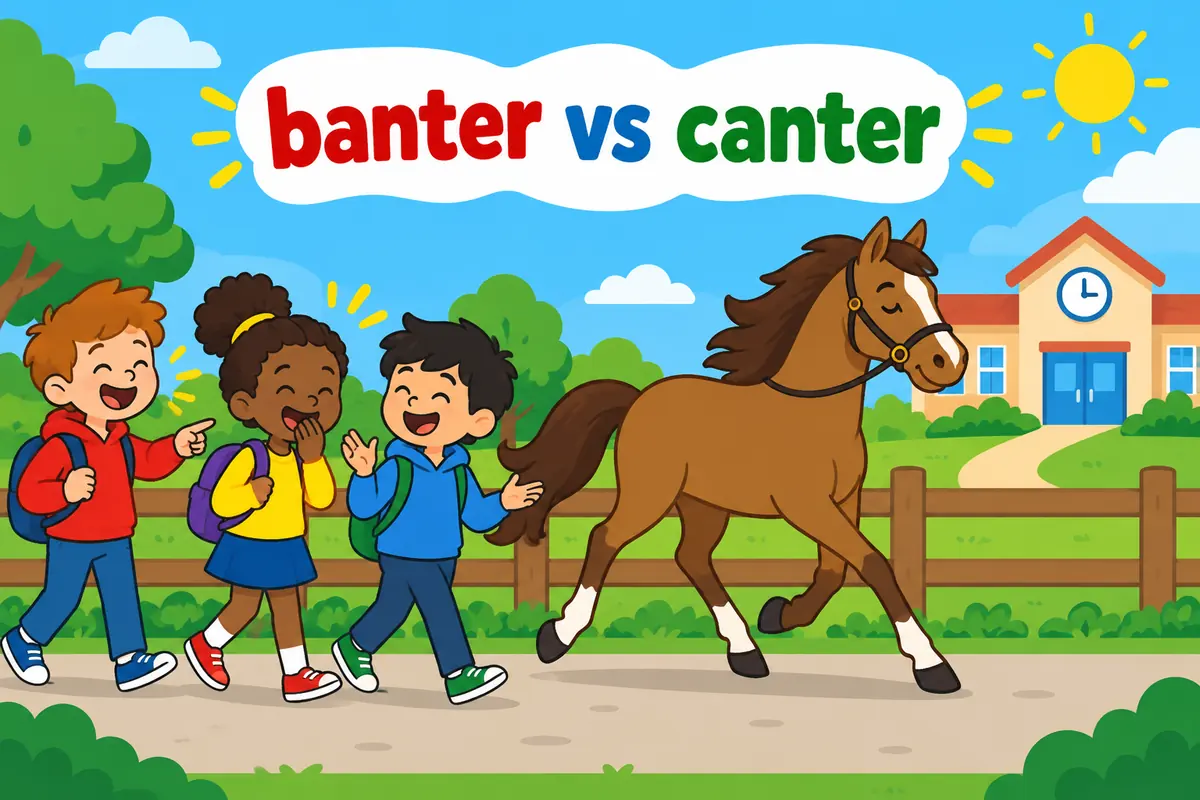
- The commonest error is confusing banter with canter, a horse’s pace.
What does banter mean?
Banter is light, teasing conversation in which the jokes are aimed at people present and the goodwill is never in doubt. The Cambridge entry for banter records the noun and the verb together, and the two senses stay close: the noun names the exchange, while the verb names the act of teasing. A rarer, more formal synonym is badinage, which suits essays better than it suits a kitchen.
| Sense | Plain meaning | Example sentence |
|---|---|---|
| Playful teasing | Friendly joking that pokes fun without malice | The teammates kept up their banter through warm-ups. |
| Witty exchange | Quick, light conversation traded back and forth | Their banter filled the long drive home. |
| Tease lightly (verb) | To joke with someone in a good-natured way | They bantered about whose turn it was to wash up. |
One limitation matters more with banter than with most words. The term assumes mutual goodwill, so teasing that keeps going after someone stops laughing is not banter, whatever the speaker calls it. The word also implies a light subject, which is why it is the wrong choice for a serious matter.
How do you use banter in a sentence?
Use banter as an uncountable noun or as an intransitive verb, and let the context show that both people are enjoying the exchange. The five patterns below cover the sentences writers actually build.
| Pattern | Example | What it signals |
|---|---|---|
| banter (uncountable noun) | There was easy banter between the shifts. | Treats the talk as a mood, not a countable thing. |
| banter with + person | She enjoys banter with the regulars. | Names the partner in the exchange. |
| exchange + banter | The two hosts trade banter before the news. | Pairs the noun with a reciprocal verb. |
| banter (verb) | The sisters bantered over breakfast. | Uses the intransitive verb for the act itself. |
| banter about + topic | They bantered about the weather for ten minutes. | Flags the harmless subject of the teasing. |
Banter in a sentence: examples across contexts
Banter keeps its meaning while the setting changes around it, and the eight sentences below move from a classroom to a workplace. Where the exchange turns on speed, repartee is the sharper word, and a single witty line is a quip rather than banter.
| Context | Example sentence | Why this works |
|---|---|---|
| Classroom | Friendly banter filled the room while the clay models dried. | Shows the uncountable noun carrying the mood. |
| Workplace email | A little banter helps the remote team feel closer. | Uses the some-style quantity common in work messages. |
| News report | The presenters’ banter has become part of the show. | Names the exchange as a regular feature. |
| Sports writing | The striker enjoyed banter with the away supporters. | Pairs the noun with the preposition with. |
| Conversation | We traded banter about whose turn it was to cook. | Uses the reciprocal verb trade naturally. |
| Academic prose | Workplace studies note how banter builds trust among staff. | Treats the noun as a measurable social habit. |
| Social media | The thread dissolved into banter about pineapple on pizza. | Shows the about pattern on a harmless topic. |
| Family | There was gentle banter about Dad’s famous burnt toast. | The adjective gentle rules out any real sting. |
One further distinction is worth keeping: teasing that targets a person’s appearance or a sore subject may be called a jest, but genuine banter leaves everyone free to laugh at themselves.
Banter vs canter
Banter and canter are close in spelling and unrelated in meaning, which makes them a common mix-up in fast writing. The table separates them by part of speech, meaning and typical company.
| Attribute | banter | canter |
|---|---|---|
| Part of speech | Noun and verb | Noun and verb |
| Core meaning | Playful, teasing talk | A horse’s easy three-beat pace |
| Typical subject | People talking together | A horse, or a rider on a horse |
| Common collocation | exchange banter | ride at a canter |
| Setting | Informal and social | Equestrian and descriptive |
| Confusion risk | Looks like canter at a glance | Looks like banter at a glance |
Verdict: keep banter for the joking that passes between people and canter for the horse’s smooth pace, because the two words share spelling patterns but nothing else.
Word forms and grammar of banter
Banter inflects like a regular verb, and its participial adjective bantering often describes the tone of a voice. The table also marks the adverb that learners sometimes invent.
| Form | Part of speech | Example |
|---|---|---|
| banter | noun, uncountable | The banter never stopped all evening. |
| banter | verb, base form | They banter every time they meet. |
| banters | verb, third person | She banters with everyone at the desk. |
| bantered | verb, past tense | We bantered on the walk home. |
| bantering | participle and adjective | a bantering tone in his reply |
| banteringly | adverb, rare | He added, banteringly, that he had seen nothing. |
Common mistakes with banter
- Incorrect:
They had a banter about the match.Correct: They had some banter about the match. Rule: Banter is uncountable as a noun, so it does not take the article a. - Incorrect:
He cantered with his friends before dinner.Correct: He bantered with his friends before dinner. Rule: Canter is a horse’s pace, while banter is talk. - Incorrect:
They bantered about the serious accident.Correct: They talked quietly about the serious accident. Rule: Banter assumes a light subject, so serious matters need another verb. - Incorrect:
Their banter was really an argument that hurt feelings.Correct: Their exchange was really an argument that hurt feelings. Rule: Banter implies mutual goodwill, so it cannot describe real conflict. - Incorrect:
She bantered an insult at him.Correct: She bantered with him about the goal. Rule: Banter is usually intransitive and does not take an insult as its object.
Practice using banter
Work through the six items, then check the reasoning rather than only the answer.
- Fill the gap: The kitchen staff kept up their ______ through the whole shift.
- Choose the better word: At the stables, the rider let the horse (banter / canter) along the fence.
- Correct the error: They had a banter about the match.
- Build a sentence: use banter with about two cousins who tease each other at dinner.
- Spot the register: which fits a workplace message — a bit of banter in the chat keeps the team close, or we did loads of banter, it was wild?
- Rewrite as a verb: They exchanged banter during the walk. Use banter as a verb instead.
Answers
- banter — the uncountable noun names the ongoing playful talk.
- canter — a canter is a horse’s easy pace, not a kind of conversation.
- They had some banter about the match — banter is uncountable and takes no article a.
- Model answer: The cousins bantered with each other all through dinner without anyone taking offence.
- A bit of banter in the chat keeps the team close — the measured phrase suits a work channel, while the second is too slangy.
- They bantered during the walk — the verb needs no object and keeps the friendly teasing.
The bottom line
Use banter in a sentence for playful, teasing talk that both sides enjoy, and remember that the noun is uncountable while the verb is usually intransitive. Two nuances decide most sentences: banter assumes goodwill, so it cannot describe real conflict, and it needs a light subject rather than a serious one. Where the exchange turns on quick wit, repartee is the more exact choice.
Frequently asked questions about banter
Is banter the same as flirting?
Not necessarily. Banter is friendly teasing between any two people, and flirting is romantic interest that may use banter as its vehicle. Colleagues can exchange banter for years without any romantic meaning. The tone, the setting and whether both people enjoy it decide what the exchange really is.
Is banter always harmless?
Banter is harmless only while everyone is laughing. The word assumes mutual goodwill, so teasing that targets one person, repeats a sore subject or continues after protests has stopped being banter. At that point it is closer to mockery, whatever the speaker chooses to call it.
Can banter be a verb?
Yes. Banter works as both a noun and a verb. As a verb it means to joke with someone in a light, teasing way, as in the two cyclists bantered about the hill. It is usually intransitive, so it does not need a direct object. Its forms are banters, bantered and bantering.
What is the difference between banter and joking?
Joking is the general activity of making jokes, while banter is a two-way exchange of teasing remarks. One person can tell jokes to an audience, but banter needs at least two people trading lines. Banter also leans on affection and shared history, which a stand-up routine does not require.
Banter, a playful exchange of teasing remarks, can add a light-hearted and enjoyable element to conversations. It involves quick-witted and good-natured back-and-forth interactions that often aim to amuse and entertain both parties involved.
By infusing banter into a conversation, individuals can create a lively and engaging atmosphere, fostering camaraderie and connection. This form of communication allows participants to showcase their humor and wit, ultimately enhancing the overall interaction.
7 Examples Of Banter Used In a Sentence For Kids
- Banter with your friends can make you smile.
- Let’s have some banter and laugh together.
- Banter is about sharing jokes and having fun.
- Join in the banter and enjoy yourself.
- Say something funny and start the banter.
- Banter with kindness makes everyone happy.
- Spread some joyful banter around the playground.
14 Sentences with Banter Examples
- Banter: Hey, are you really going to submit that assignment last minute again?
- Banter: I can’t believe you fell asleep during the marathon study session.
- Studying for finals is so much more fun when we add a little banter.
- Banter over the best chai spot in the city is what really keeps us going through exams.
- I’m pretty sure the only reason half the class shows up to lectures is for the banter.
- Banter: Can you believe how expensive these textbooks are? We should just share them.
- I love the friendly banter that goes on during group projects.
- Banter: Do you think we’ll ever get through a semester without pulling an all-nighter?
- What’s college life without a little banter over who has the messiest room?
- Banter during breaks is what makes attending long lectures worth it.
- Banter: I’ll challenge you to a game of foosball at the college cafe.
- Banter: Who’s up for a late-night dosa run after the library closes?
- Sometimes I feel like the only thing keeping us awake in class is our constant banter.
- Banter about weekend plans always lifts our spirits during stressful weeks.
How To Use Banter in Sentences?
Banter is a playful and light-hearted conversation that involves teasing, joking, or exchanging witty remarks. To use banter effectively in a sentence, follow these simple steps:
-
Choose the right context: Banter works well in casual settings, among friends, or in relaxed conversations. It is not suitable for serious or formal situations.
-
Know your audience: Make sure the people you are speaking with understand that you are engaging in banter. This will prevent any misunderstanding or offense.
-
Be playful and light-hearted: Keep the tone of your banter friendly and fun. Avoid making hurtful or offensive remarks, as the goal is to have an enjoyable exchange.
-
Use humor and wit: Incorporate jokes, puns, or clever remarks into your banter. This will make the conversation more engaging and entertaining.
-
Respond in kind: If someone initiates banter with you, feel free to respond with your own witty remarks. This back-and-forth exchange is what makes banter enjoyable for all parties involved.
-
Know when to stop: Pay attention to the reactions of others and stop the banter if it becomes uncomfortable or if someone is not enjoying it.
Remember, banter is meant to be fun and lighthearted. By following these guidelines, you can engage in playful conversations with others and enjoy the humor and camaraderie that banter brings.
Conclusion
In conclusion, banter adds light-heartedness and humor to conversations, enhancing social interactions by fostering camaraderie and creating an enjoyable atmosphere. Through playful exchanges and witty remarks, banter can strengthen relationships, break the ice, and even diffuse tension in various situations. It serves as a tool for building connections, improving communication, and brightening interactions with others.
By incorporating banter into conversations, individuals can connect on a more personal level, promoting a sense of unity and shared camaraderie. This form of lighthearted communication not only adds fun and laughter to social interactions but also helps build rapport and mutual understanding. Banter, when used appropriately and respectfully, has the power to enrich conversations and create memorable moments that contribute to positive and engaging relationships.


