What Does “Bare” Mean in a Sentence?
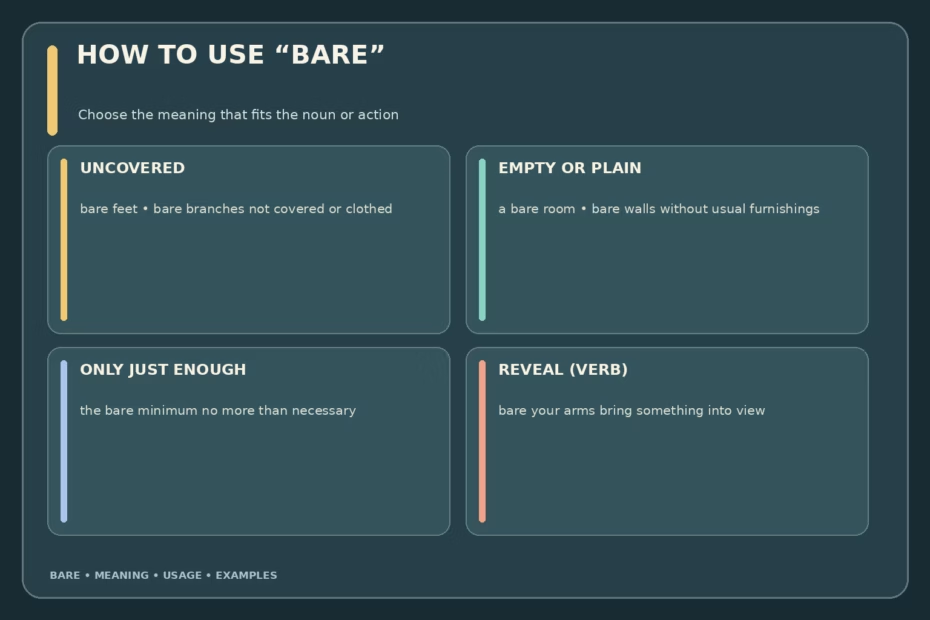
Bare most often describes something that is uncovered, exposed, empty, plain, or lacking its usual covering. It can also mean only just sufficient, as in the bare minimum. As a verb, to bare means to uncover or reveal: “The dancer bared her shoulders.” The sentence around the word shows which meaning is intended.
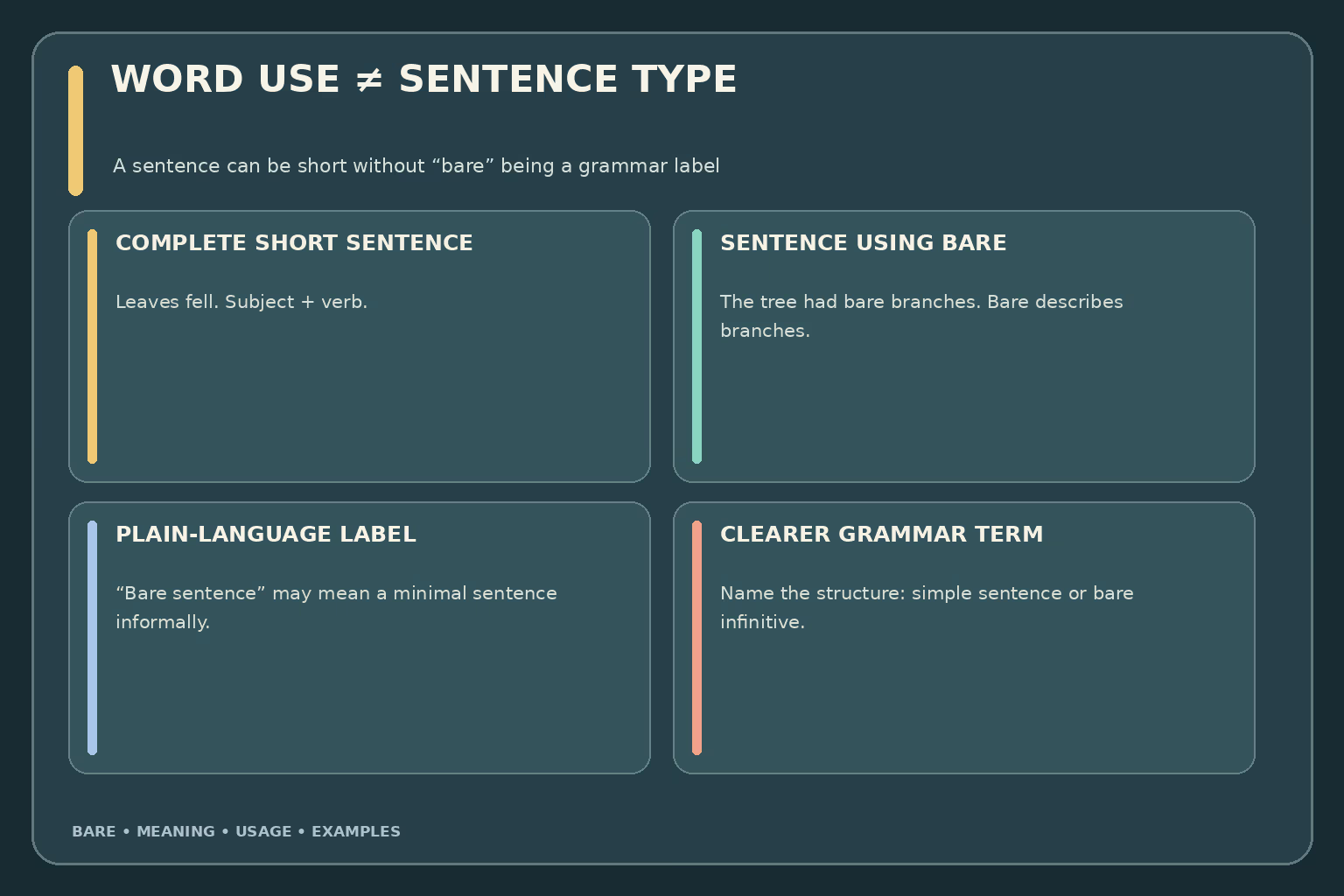
A grammar clarification: bare sentence is not a standard name for a sentence pattern. People may use it informally to mean a very short or unadorned sentence, but the word bare itself is not required. “Leaves fell” is a complete short sentence; “The tree had bare branches” is a sentence that uses bare as an adjective.
Common Meanings of Bare with Examples
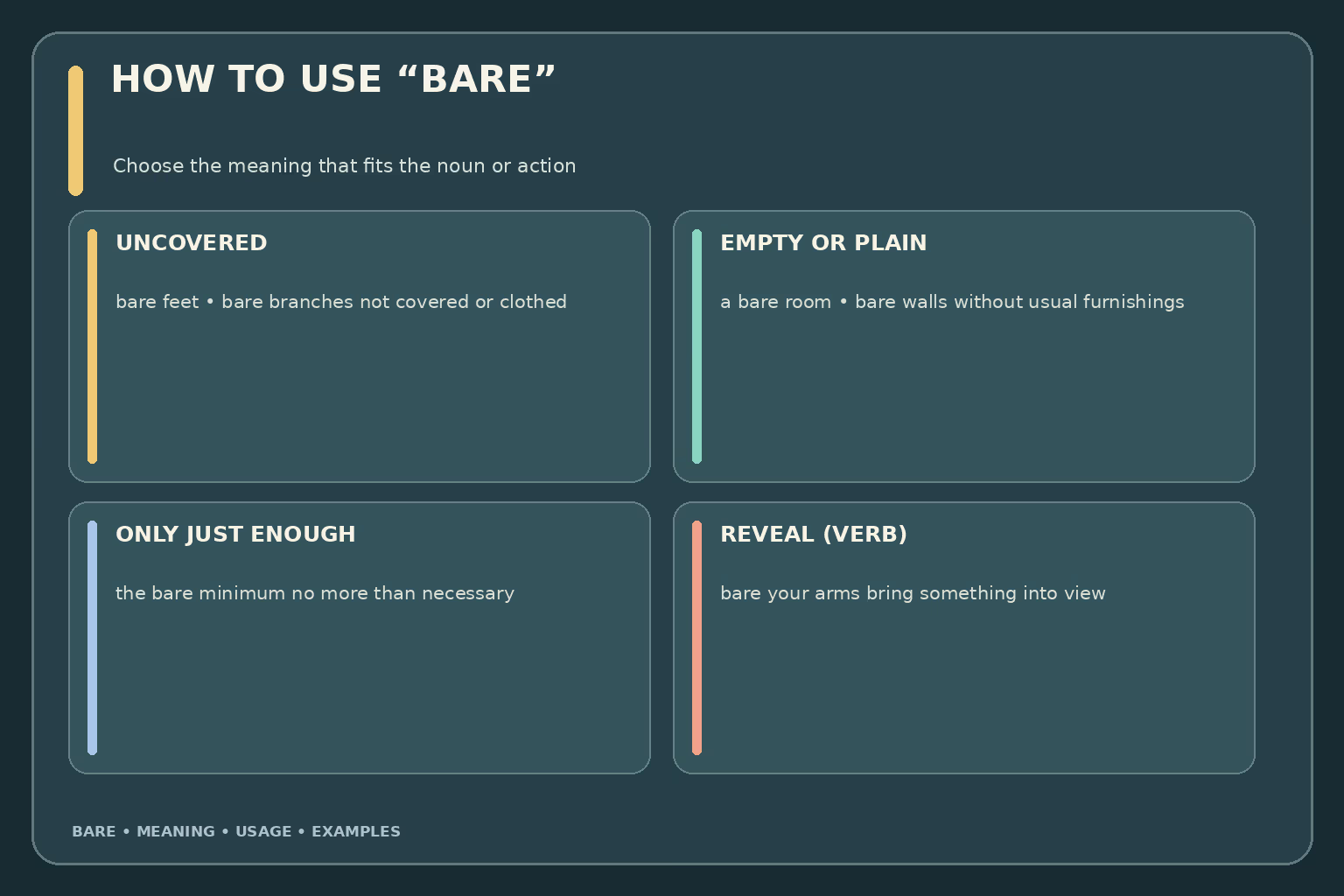
- Uncovered or not clothed: “We walked across the warm sand with bare feet.” The feet have no shoes or other covering.
- Without a usual covering: “Bare branches showed against the winter sky.” The branches have no leaves.
- Empty or unfurnished: “After the move, the apartment looked bare.” The room lacked its usual furniture and belongings.
- Plain or unadorned: “The invitation used a bare design with no border or illustration.” Here, bare means simple rather than decorated.
- Only just enough: “They had the bare necessities for one night.” The group had only the essentials, without extras.
- Open or plainly visible: “The report laid bare the causes of the delay.” This figurative use means the report exposed or made the causes clear.
- Reveal or uncover (verb): “He bared his arm so the nurse could place the bandage.” The past-tense form is bared; the present participle is baring.
Bare or Bear? How to Choose
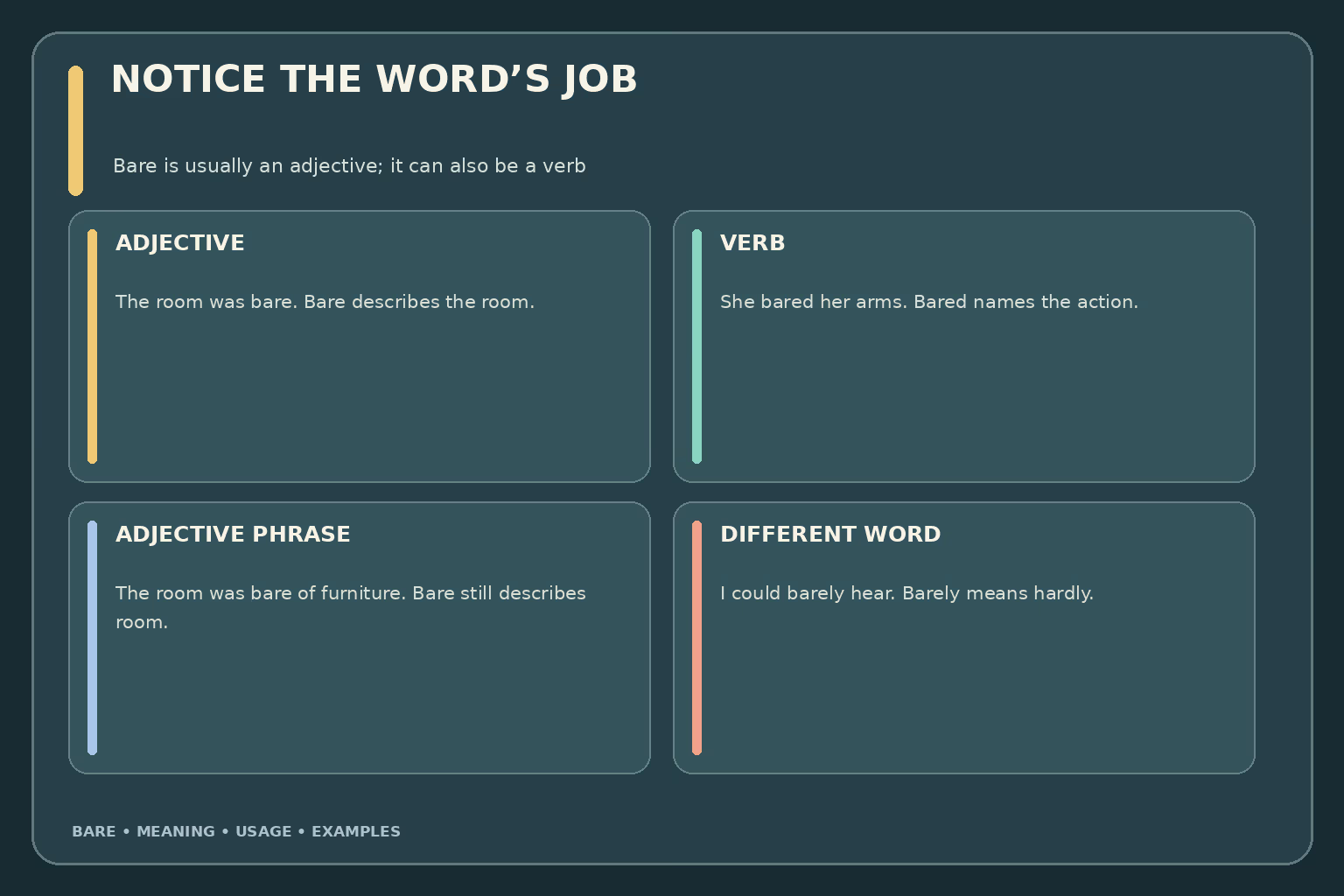
Bare and bear are homophones for many English speakers: they sound alike but have different spellings and meanings. Use bare for something uncovered, empty, plain, or revealed. Use bear for the animal, or for a verb meaning carry, support, endure, or tolerate.
| Word | Meaning | Example |
|---|---|---|
| bare | uncovered | “She wore sandals on her bare feet.” |
| bare | plain or empty | “The bare shelves held only a clock.” |
| bare | reveal (verb) | “The dog bared its teeth.” |
| bear | animal | “A bear searched the stream for food.” |
| bear | carry or support | “The bridge can bear the weight of the truck.” |
| bear | endure or tolerate | “I can barely bear the suspense.” |
Memory cue: bare is associated with being bare of a covering or with making something visible. A bear can carry a load or endure something. In “bear with me,” the verb means “be patient with me”; “bare with me” would suggest uncovering something together and is almost always a spelling mistake.
“Bare” and “Barely” Are Different Words
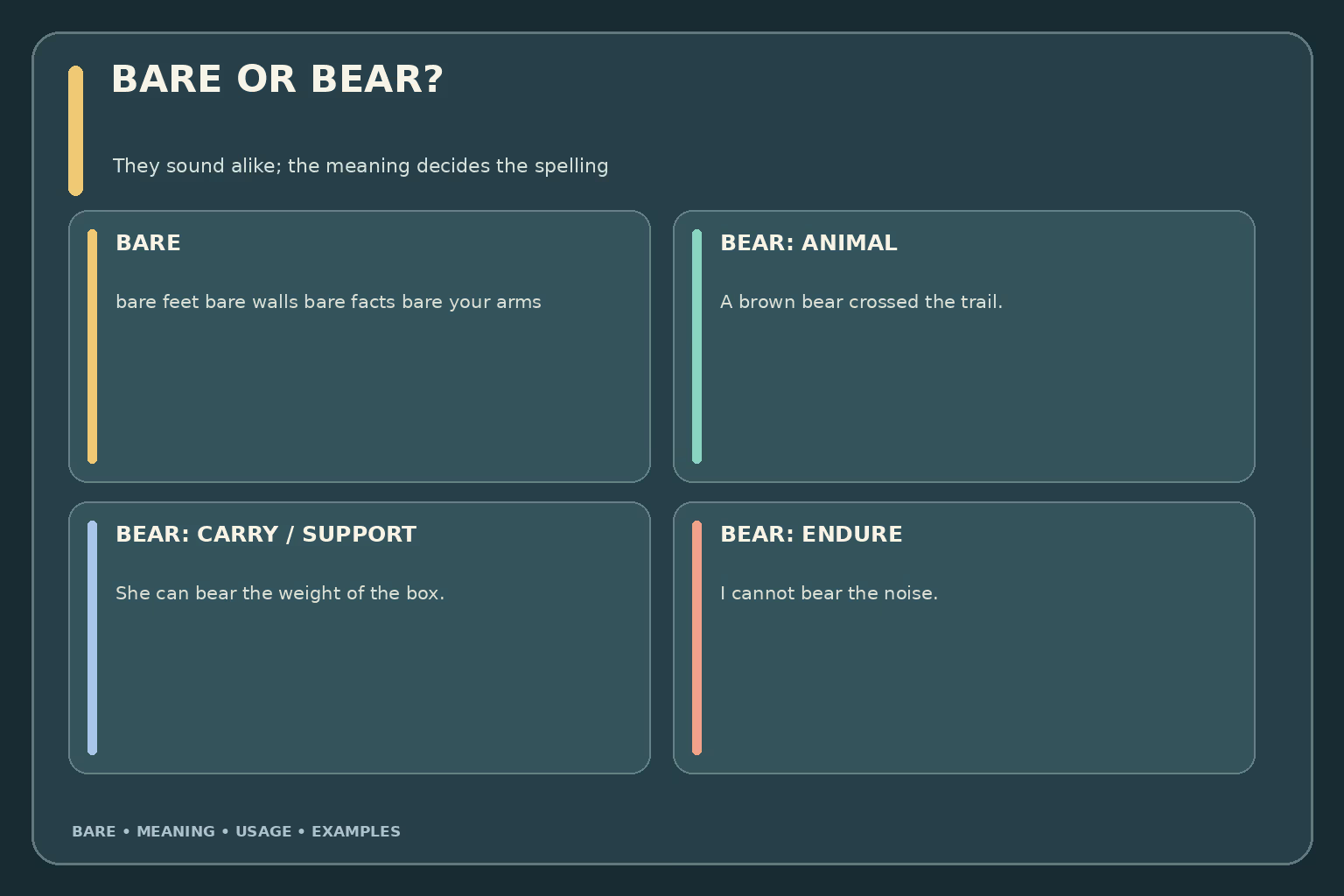
Bare is usually an adjective, as in “bare feet,” and it can be a verb, as in “bare your arms.” Barely is an adverb meaning “only just” or “hardly”: “The lamp was so dim that I could barely read.” It is related in spelling, but it does not mean “uncovered.”
In the phrase bare of, bare remains an adjective: “The cupboard was bare of dishes.” The adverb barely would change the meaning and grammar: “The cupboard barely held three dishes” means it held only just three.
More Sentences Using Bare
- Rain tapped on the bare roof after the shingles were removed.
- The artist sketched the bare outline before adding color.
- We packed the bare minimum for the overnight trip.
- With the curtains gone, the windows left the room feeling bare.
- The gardener planted bulbs in the bare patch beside the fence.
- She bared her hands to wash away the paint.
- The witness’s statement laid bare a gap in the timeline.
- He prefers bare facts to a long explanation.
- A bare bulb hung from the ceiling of the storage room.
- The path crossed a bare hillside with little shade.
- They were left with the bare essentials after the power outage.
- The puppy bared its teeth when it was startled, then backed away.
Frequently Asked Questions
What is a simple sentence with the word bare?
“The walls were bare.” In this sentence, bare is an adjective describing the walls.
Is “bare” an adjective or a verb?
It can be either. In “bare feet,” it is an adjective; in “bare your arms,” it is a verb meaning uncover or reveal. Sentence context identifies the role.
Is “bare of furniture” correct?
Yes. “The room was bare of furniture” means it had no furniture. Here, bare is an adjective followed by of.
What does “bare minimum” mean?
It means the least amount that is necessary or sufficient, with no extra amount or feature.
Is it “bear with me” or “bare with me”?
The usual expression is bear with me, meaning “please be patient with me.”
What is the difference between “bare” and “barely”?
Bare means uncovered, empty, plain, or reveal. Barely is an adverb meaning hardly or only just, as in “We barely caught the bus.”
Sources
- Cambridge Dictionary: bare (adjective and verb meanings).
- Modern Language Association: “Bear versus Bare” (word forms and examples for distinguishing the homophones).
- Dictionary.com: bare (definitions for uncovered, unfurnished, unadorned, sufficient, and reveal).

Do you know what it means to write a sentence using “bare”? When a sentence is constructed with minimal elements or stripped down to only the essential components, it is said to be a “bare” sentence.
In English grammar, a “bare” sentence typically consists of a subject and a verb without any additional elements such as adjectives, adverbs, or conjunctions. This form of sentence structure is often used to convey a direct and straightforward message, highlighting the primary action or information within the sentence.
7 Examples Of Bare Used In a Sentence For Kids
- You can see bare branches on the tree.
- The baby bird was bare of feathers.
- The squirrel was bare of nuts to eat.
- I could barely reach the high shelf.
- The field was bare of flowers in the winter.
- The little boy had bare feet on the sandy beach.
- The bear had a bare spot on its fur.

14 Sentences with Bare Examples
- Bare essentials are needed for a quick run to the grocery store.
- It’s important to have a bare understanding of the concepts before the exam.
- I was caught bare-faced when the professor asked me about the missing assignment.
- Sometimes, it’s better to keep things bare and not complicate them further.
- Planning a bare budget for the month helps in managing expenses effectively.
- I had to attend the meeting with just a bare minimum of preparation.
- It’s a good idea to keep a bare emergency kit handy in case of unexpected situations.
- The hostel room looked so bare after all the decorations were taken down.
- I felt bare without my phone when it suddenly ran out of battery.
- It’s better to go with a bare look for the presentation rather than distract with too many visuals.
- I could see the bare disappointment on their faces when they got back their test scores.
- He was left bare after losing his wallet with all his cash.
- The roommates decided to keep the kitchen bare and clutter-free to make cooking easier.
- It’s best to simplify your schedule and focus on the bare essentials during exam season.

How To Use Bare in Sentences?
Bare can have various meanings in English, and it’s important to understand the context in which you are using it in a sentence.
When bare is used as an adjective, it means uncovered or exposed. For example, “He walked around the house with bare feet.” Here, bare is describing the state of the feet being exposed.
Another common usage of bare is as a verb meaning to reveal or to make something plain. For instance, “She had to bare her soul to the therapist.” In this sentence, bare is explaining the action of revealing one’s innermost thoughts or feelings.

Lastly, bare can also be used as an adverb to emphasize the starkness or simplicity of something. For instance, “The room was bare of any furniture.” Here, bare is emphasizing the emptiness or lack of furniture in the room.
In each of these examples, make sure to consider the context in which bare is being used to ensure that you are conveying the correct meaning. Practicing using bare in different sentences can help you become more comfortable with its various meanings and applications in the English language.
Conclusion
In conclusion, sentences with “bare” can often convey simplicity, directness, or nakedness in their meaning. Whether describing a minimalistic style, a lack of covering or adornment, or a straightforward statement, these sentences can be striking in their clarity. The word “bare” in sentences can evoke a sense of transparency, honesty, and vulnerability, leading to powerful and impactful communication.
Overall, sentences with “bare” offer a straightforward and unadorned way of expressing ideas or describing situations. From minimalistic design to exposed truth, the versatility of “bare” in sentences allows for a range of interpretations, making it a compelling word choice for writers and speakers looking to convey a sense of immediacy and simplicity.


