Adjectives for Stress and Anxiety: Meaning & Examples
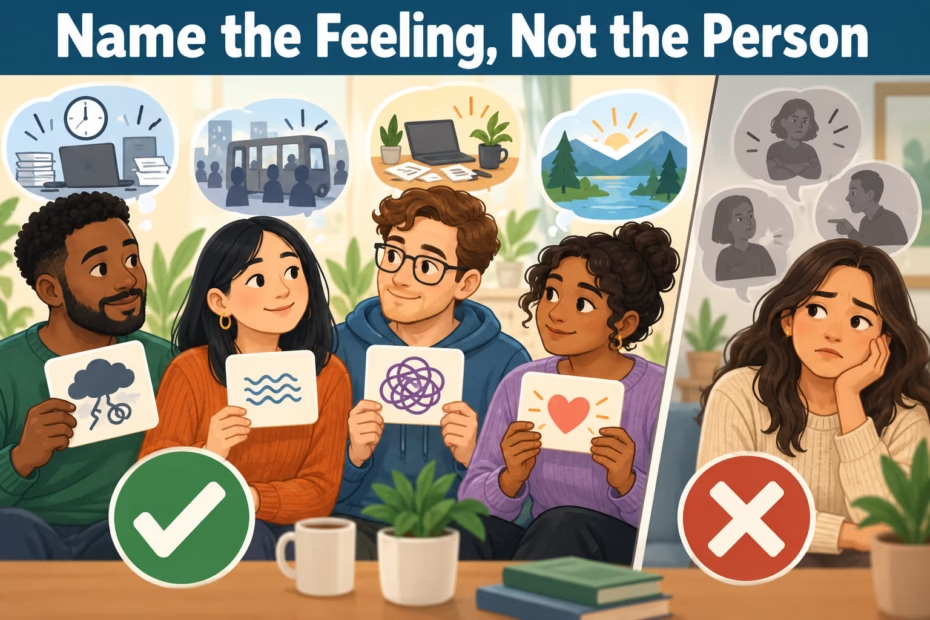
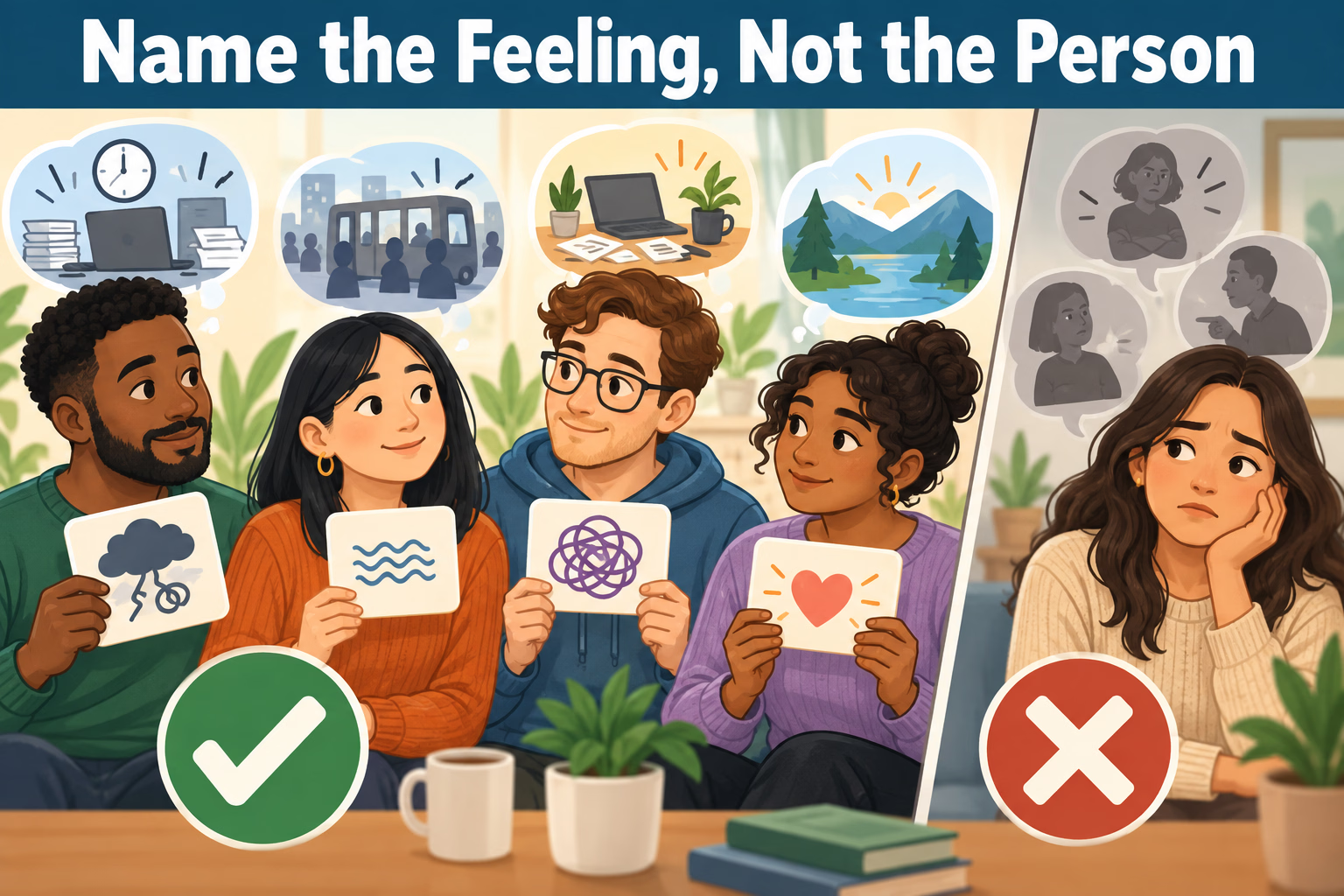
Adjectives for stress and anxiety describe a feeling, a moment, or the pressure of a situation; they do not diagnose a person. Words such as tense, worried, overwhelmed, and uneasy differ in intensity and focus, so choose the word that fits what someone says and the context in which they say it.
Quick guide to describing stress and anxious feelings
- Use an adjective to describe a specific feeling or situation, not to define someone’s identity.
- Stressed often points to demands or pressure; worried points to concern about an outcome.
- Overwhelmed suggests that demands feel difficult to manage; tense describes tightness or strain.
- A single word cannot tell you whether someone has a mental health condition.
- Ask how a person would describe their own experience when the wording matters.
Stress and anxiety overlap in everyday speech, but neither can be measured by a vocabulary list. The American Psychological Association describes stress in relation to how people perceive and respond to challenging circumstances; it also notes that anxiety can be future-oriented. These descriptions offer context, not a way to assess another person. APA: Stress; APA: Anxiety.
Which adjective fits the feeling?
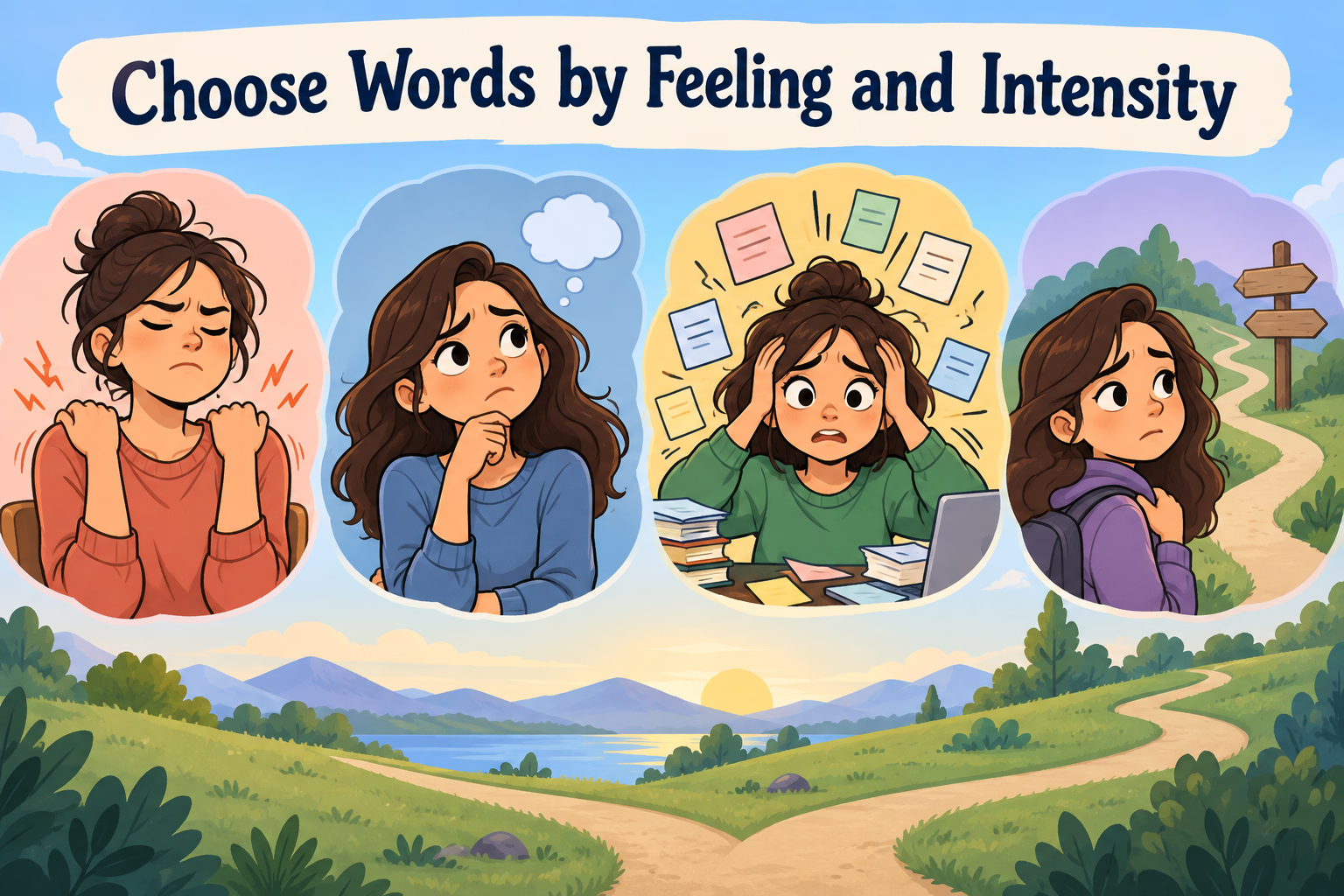
Start with the detail you want to communicate: pressure, uncertainty, intensity, energy, or relief. Similar words can carry different implications, and the person experiencing the feeling has the best information about which one fits.
| Adjective | Usual emphasis | Example |
|---|---|---|
| Stressed | Pressure or demands | “I feel stressed about the number of deadlines this week.” |
| Tense | Strain, tightness, or difficulty relaxing | “The tense wait for the result made the afternoon feel long.” |
| Worried | Concern about a possible outcome | “She is worried about whether the train will arrive on time.” |
| Apprehensive | Uneasy anticipation, often before an event | “He felt apprehensive before speaking to the new group.” |
| Uneasy | A general sense of discomfort or uncertainty | “I felt uneasy when the plans changed without explanation.” |
| Overwhelmed | Feeling that demands or feelings are too much at once | “They felt overwhelmed by several urgent requests arriving together.” |
| Restless | Difficulty settling or remaining still | “I was restless while waiting for an update.” |
| Frustrated | Annoyance when progress is blocked | “She felt frustrated when the instructions kept changing.” |
| Irritable | More easily annoyed than usual | “After a demanding day, he noticed he felt irritable.” |
| Drained | Low energy after effort or strain | “I felt drained after juggling several tasks.” |
| Relieved | Reduced concern after uncertainty or pressure eases | “She felt relieved once she had a clear answer.” |
| Calm | A quieter or more settled state | “He felt calm after taking time to think through the choice.” |
These are common-language distinctions rather than fixed categories. Cambridge Dictionary defines stressed as worried and nervous, and overwhelmed as having such a strong effect that it is difficult to think or act. A person may use these terms differently. See stressed, overwhelmed, and apprehensive.
Describe the person, situation, or task precisely
A small change in the subject can make a sentence more accurate and less judgmental. Describe the event when that is what creates pressure; describe the feeling when the person has named it.
| Focus | Example wording | Why it works |
|---|---|---|
| The person’s stated feeling | “I feel anxious about tomorrow’s presentation.” | It attributes the feeling to the speaker. |
| The situation | “The last-minute schedule change was stressful.” | It identifies the pressure without labeling anyone. |
| The amount of work | “The team has an overwhelming number of requests today.” | It names a demanding condition that can be discussed. |
| A visible moment, without guessing | “He paused before answering and said he felt uneasy.” | It separates an observable action from an interpretation. |
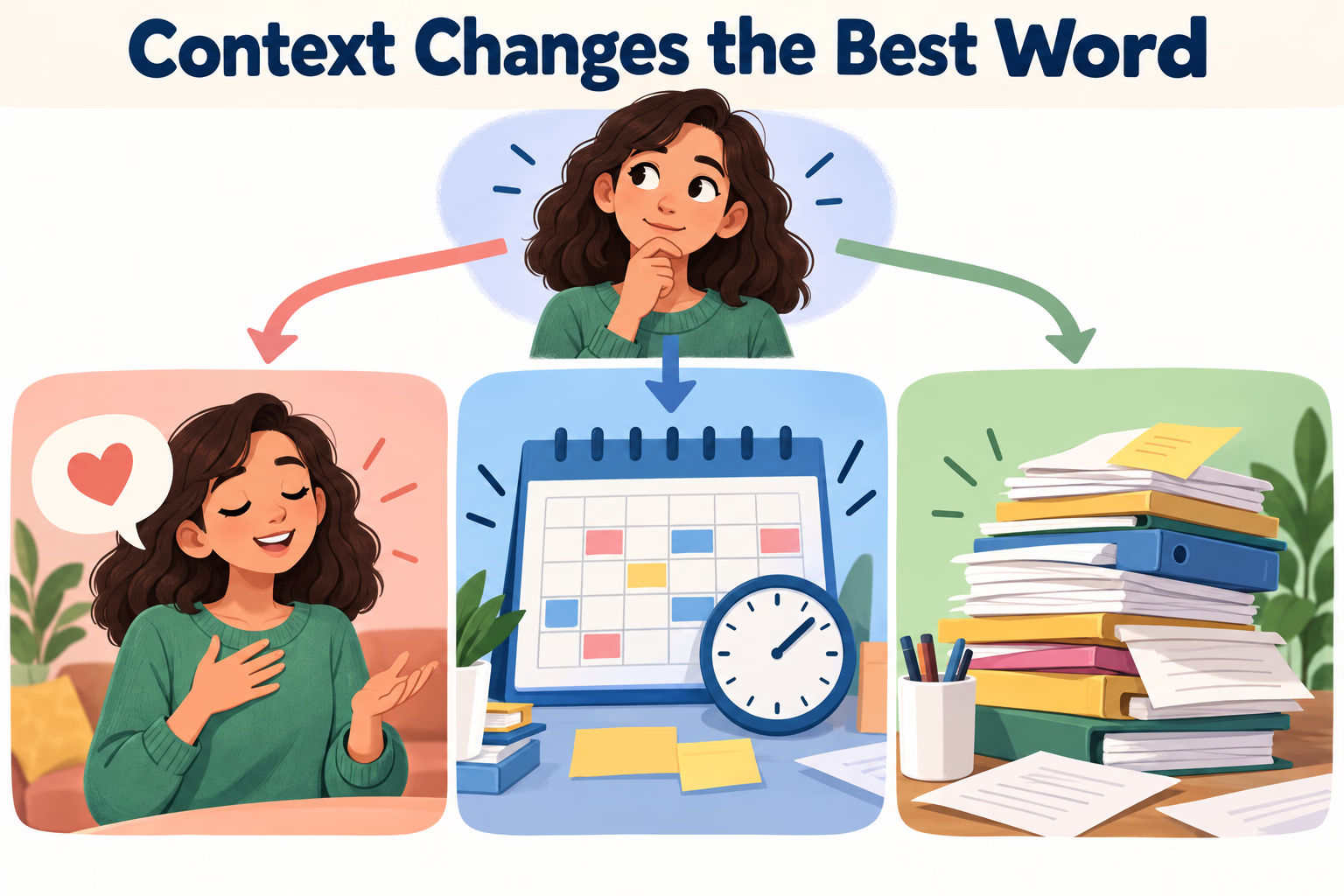
Examples of adjectives for stress and anxiety in sentences
- “I felt tense while I waited for the meeting to begin.”
- “The overlapping deadlines made the week feel stressful.”
- “Maya said she was worried about missing the connection.”
- “The unfamiliar route left us uneasy until we found the right stop.”
- “He felt apprehensive about asking for clarification.”
- “The number of decisions felt overwhelming at first.”
- “I was restless before hearing whether the plan had changed.”
- “She felt frustrated when the same problem kept interrupting her work.”
- “After a busy shift, Jordan felt drained and wanted a quiet evening.”
- “Once the travel details were confirmed, they felt relieved.”
- “The room became tense when nobody knew who would speak next.”
- “He described the conversation as unsettling, though he could not yet explain why.”
Respectful wording: describe a moment, not a person’s worth
Calling someone “weak,” “dramatic,” “crazy,” “attention-seeking,” or “a nervous wreck” turns a complex experience into a judgment. Those labels can shame or stereotype, and they do not explain what the person needs or what happened. Prefer the person’s own words, a neutral observation, or a description of the situation.

| Instead of | Try |
|---|---|
| “She is a nervous wreck.” | “She said she feels very anxious about the appointment.” |
| “He is too sensitive.” | “That comment upset him; ask what would help clarify the concern.” |
| “They are being dramatic.” | “They seem distressed; I do not know what they are experiencing yet.” |
| “She is an anxious person.” | “She feels anxious about this particular situation,” if that is her wording. |
“Anxious” can describe an ordinary feeling, but it should not be used by a writer or speaker to diagnose someone. The National Institute of Mental Health explains that occasional anxiety is part of life and distinguishes it from an anxiety disorder that involves persistent, excessive worry and interference with daily life. Only a qualified health professional can assess a condition. NIMH: Generalized Anxiety Disorder.
How to choose the right word
- Ask what is being described. Is it an emotion, a task, an atmosphere, or a possible outcome?
- Keep intensity proportional. “Uneasy” is milder than “overwhelmed”; do not intensify a person’s account for effect.
- Use evidence carefully. A pause or frown does not prove someone is anxious. Quote their description or stick to what you observed.
- Check the grammar. A person may feel anxious; a situation may be stressful; an outcome may be worrying.
- Let people revise their words. “Is ‘overwhelmed’ the word you’d use?” is more respectful than assigning a label.
Stress can affect people in different ways. The NHS lists feelings such as worry, irritability, and being overwhelmed among possible experiences, while also emphasizing that experiences vary. A vocabulary list cannot tell you the cause or the right response. If distress feels severe or persistent, or you are worried about your wellbeing, consider reaching out to a qualified health professional or a trusted support person. This article is for language learning, not medical advice. NHS: Stress.
Frequently asked questions
What is a neutral adjective for stress?
Stressed is a familiar, relatively neutral word for feeling pressure or strain. You can make it more precise by naming the source: “stressed about the deadline.” If describing a situation, “stressful” often fits: “The schedule was stressful.”
Are “stressed” and “anxious” the same?
They overlap in everyday conversation but are not exact synonyms. “Stressed” often points to pressure or demands, while “anxious” often emphasizes unease or worry about what may happen. Neither word alone identifies a disorder; context and the speaker’s own meaning matter.
Can I call another person anxious?
Use care. If the person has described themselves that way, you can reflect their wording. Otherwise, describe what you observed or ask how they feel. An adjective should not be used to infer a diagnosis or reduce someone to a single trait.
What adjective describes too many demands?
Overwhelming describes demands or a situation that feel difficult to manage; overwhelmed describes the person’s reported feeling. For example, “The workload is overwhelming” and “I feel overwhelmed by the workload.”
What is a respectful alternative to “nervous wreck”?
Describe the specific feeling and situation, such as “She said she feels very tense about the interview.” If you do not know the person’s experience, avoid guessing and ask what wording they prefer.
Conclusion
The most useful adjectives for stress and anxiety are precise, proportionate, and grounded in context. Choose words such as worried, tense, uneasy, or overwhelmed to describe a particular feeling or situation, and let people name their own experiences. These words can improve communication, but they cannot diagnose anyone.
Editorial note: The archived article below is preserved exactly as originally published, including its tables, examples, and images. Its long alphabetical lists contain mixed or unclear entries and some wording that should not be treated as guidance about mental health or as labels for people. The updated guide above offers context for using descriptive words carefully.

Are you stressed out? If so, you’re not alone. In today’s fast-paced world, stress is a common condition. But what exactly is stress? And how can we describe it?
One way to think of stress is as an emotional response to a situation or event that feels overwhelming or unmanageable. When we’re stressed, we may feel anxious, irritable, or on edge. We may also have physical symptoms like headaches, muscle tension, or stomachaches.
There are many adjectives that can be used to describe stress. Here are just a few:
Tense: feeling nervous or wound up
Ex: The interview was going well until I started to feel tense and fidgety.
Stressed: feeling overwhelmed or under pressure
Ex: I’ve been feeling really stressed lately with work, family, and everything else going on in my life.
Anxious: feeling fearful or worries about what might happen
Ex: I’m anxious about my upcoming surgery and whether everything will go well.
Frustrated: feeling annoyed or discontent because of unfulfilled hopes or expectations
Ex: I’m so frustrated with my computer
Words To Describe Anxiety and Strees – Adjectives

A
There are plenty of adjectives for stress that start with A, but we’ll only mention a few here. Stressed out? You might be feeling apathetic, anxious, or even angry. If your stress is caused by work, you might be described as an “ambition addict.”
And if you’re really struggling to cope, you might be called a “wreck.” But no matter how you’re feeling, remember that there’s always help available if you need it. Just reach out to a friend, family member, or mental health professional. They’ll be more than happy to offer a listening ear and some helpful advice.
| Abiotic | Abnormal | Absolute |
| Absurd | Academic | Accent |
| Accentual | Acculturative | Accumulated |
| Acute | Added | Adolescent |
| Affect | Affected | Affectionate |
| Afraid | Aghast | Agitated |
| Agonizing | Amiable | Anthropogenic |
| Anticipatory | Antsy | Anxious |
| Apparent | Appearancethe | Apprehensive |
| Armed | Attentive | Awful |
| Axial |
B
Is stress getting the best of you? feeling bamboozled by biology? Or perhaps you’re just having a bad day. Regardless of the cause, we can all use a little help when it comes to managing our stress levels. And adjectives are a great place to start. After all, what’s more cathartic than venting to a friend about how your boss is a “bully” or how your stressful job is making you feel “beaten down”?
So next time you’re feeling stressed, try reaching for one of these adjectives that start with “B.” You might just find the perfect way to describe how you’re feeling – and relieve some stress in the process.
| Bewildered | Biotic | Bitter |
| Blind | Bodeful | Breathless |
| Brotherly | Bugged |
C
If you’re feeling stressed, you might be experiencing some of the following adjectives: crummy, constricting, or just generally crappy. But don’t worry, there are plenty of other adjectives that can describe stress that don’t start with the letter C.

For instance, you could be feeling frazzled, overwhelmed, or even just plain old stressed out. Whatever adjectives you choose to describe your stress, remember that it’s important to take some time for yourself to relax and de-stress. And if all else fails, remember that ice cream is always a good solution.
| Capable | Cardiac | Certain |
| Cheerful | Chief | Childish |
| Chinese | Chronic | Clinical |
| Close | Cold | Collective |
| Communicative | Compressive | Concentrated |
| Concerned | Confused | Conscientious |
| Conscious | Consequent | Considerable |
| Constant | Contemporary | Continual |
| Continued | Continuous | Cortisol |
| Covert | Covid | Cowardly |
| Craven | Crippling | Critical |
| Cruel | Cumulative | Curious |
D
| Daily | Damaging | Deadly |
| Dear | Deep | Definite |
| Delicious | Delirious | Demographic |
| Dense | Dental | Depressing |
| Destructive | Developmental | Dim |
| Dire | Disowned | Disquieted |
| Distinct | Distressed | Disturbed |
| Divine | Domestic | Dominant |
| Double | Dramatic | Dread |
| Dreadful | Drunken | Dull |
E
| Eager | Earnest | Elastic |
| Electrical | Elevated | Emotional |
| Emphatic | English | Enormous |
| Environmental | Equivalent | Especial |
| Eternal | Everyday | Evident |
| Exaggerated | Excess | Excessive |
| Exempt | Existential | Exogenous |
| External | Extra | Extracytoplasmic |
| Extraordinary | Extravagant | Extreme |
F
| Faintest | Fanciful | Farther |
| Fearful | Feline | Fervent |
| Feverish | Fidgetty | Fidgety |
| Fierce | Financial | Fiscal |
| Fluid | Flushed | Fond |
| Foolish | Fourth | Fracture |
| Frantic | Frenzied | Frequent |
| Fresh | Frightened | Furious |
G
| Generalized | Generous | Genuine |
| Geopolitical | Global | Glowing |
| Grave | Graver | Greedy |
| Grievous | Grim | Groundless |
| Gruff |
H
| Habitual | Hard | Harrowing |
| Hasty | Heartfelt | Heavy |
| Heightened | Helpless | Hemodynamic |
| Hemostatic | Hidden | Hideous |
| Honest | Horizontal | Horrible |
| Horrific | Hot | Huge |
| Humiliating | Humorous |
I
| Immeasurable | Immediate | Immense |
| Impatient | Imperious | Incessant |
| Incidental | Increased | Incredible |
| Indescribable | Indeterminate | Inexplicable |
| Inexpressible | Inherent | Initial |
| Innumerable | Inquietud | Inquisitive |
| Inseparable | Intense | Internal |
| International | Inward | Irresistible |
J | K | L
| Jealous | Joint | Journalistic |
| Keen | Kind | Large |
| Larger | Laudable | Lawful |
| Live | Lively | Lopsided |
| Loverall |
M
| Mad | Major | Malicious |
| Marital | Mass | Massive |
| Masterful | Maternal | Maximum |
| Mean | Mechanical | Melancholy |
| Menspecial | Mental | Mere |
| Meticulous | Mighty | Mild |
| Minimal | Minor | Miserable |
| Mock | Momentary | Moral |
| Mortal | Motherly | Multiple |
| Multitudinous | Mute | Mutilated |
| Mutual | Mysterious | Mysticseastern |
N
| Natural | Needless | Neonatal |
| Nervous | Nervy | Neuralgic |
| Nitrosative | Normal | Nuclear |
| Numerous |
O
| Oblique | Obsequious | Obvious |
| Octavian | Official | Operational |
| Oppressive | Orthostatic | Overburden |
| Overmuch | Overwhelming | Oxidative |
P
| Painful | Palpable | Pandemic |
| Pardonable | Parental | Passionate |
| Past | Paternal | Pathetic |
| Patriotic | Pavement | Peculiar |
| Pecuniary | Perceptible | Perfluous |
| Permanent | Perpetual | Perplexed |
| Persistent | Perturbed | Petty |
| Pharmacologic | Physical | Physiologic |
| Physiological | Piteous | Pitiable |
| Pitiful | Placement | Plaintive |
| Poignant | Post | Posttraumatic |
| Powerful | Pre | Predictable |
| Predominant | Prenatal | Present |
| Pressing | Presumable | Pretended |
| Previous | Primary | Principal |
| Professional | Profound | Prolonged |
| Proper | Prophetic | Proud |
| Psychological | Psychosocial | Pure |
Q | R
| Questmuch | Quick | Racial |
| Real | Reasonable | Recurrent |
| Reduced | Reductive | Reflex |
| Regular | Related | Religious |
| Renal | Repetitive | Residual |
| Respectful | Restless | Righteous |
| Roguish |
S
| Scared | Scrupulous | Secret |
| Sentimental | Severe | Shadowy |
| Shaking | Sharp | Sharper |
| Sheer | Sick | Significant |
| Silent | Simple | Sincere |
| Singular | Sisterly | Situational |
| Skeletal | Sleepless | Slight |
| Socioeconomic | Soft | Sole |
| Solicitous | Solitary | Sore |
| Sorrowful | Spatial | Stepfather |
| Stop | Strained | Strange |
| Stressed | Structural | Sudden |
| Superfluous | Suppressed | Supreme |
| Swift | Sympathetic | Systemic |

T
| Tearful | Tectonic | Tempestuous |
| Temporal | Tender | Tense |
| Tensile | Terrible | Terrified |
| Terrour | Thermal | Tibial |
| Timid | Toxic | Tractive |
| Tragic | Transient | Trauma |
| Traumatic | Tremendous | Tremulous |
| Troubled | Trustful |
U
| Ultimate | Ultraviolet | Unaccustomed |
| Unavoidable | Unbalanced | Uncontrollable |
| Undefinable | Undefined | Undesirable |
| Undissembled | Undue | Uneasy |
| Unexpected | Unexpressed | Unfortunate |
| Unhappy | Unhealthy | Uniform |
| Uninitiated | Unique | Universal |
| Unjustified | Unmistakable | Unnatural |
| Unnecessary | Unprecedented | Unreasonable |
| Unrelaxing | Unremitted | Unspeakable |
| Unthinkable | Untold | Untreated |
| Unusual | Unutterable | Unwanted |
| Unwonted | Uptight | Urgent |
| Useless | Usual | Utmost |
V
| Vague | Verbal | Vicarious |
| Violent | Virtual | Visible |
| Visual |
W
| War | Warm | Watchful |
| Wearisome | Weighty | Whimsical |
| Widespread | Wifely | Wild |
| Wise | Worried |
Final verdict
The next time you’re feeling stressed, try reaching for a thesaurus instead of a pint of ice cream. While food can provide temporary comfort, it’s not going to do anything to solve the underlying problem.
On the other hand, adjectives can be surprisingly helpful in managing stress. By taking a few minutes to brainstorm a list of descriptive words, you can help yourself to perspective on your situation and find a more creative way to deal with your stressors.
So go ahead and give it a try – it just might be the best thing you’ve ever done for your mental health.


