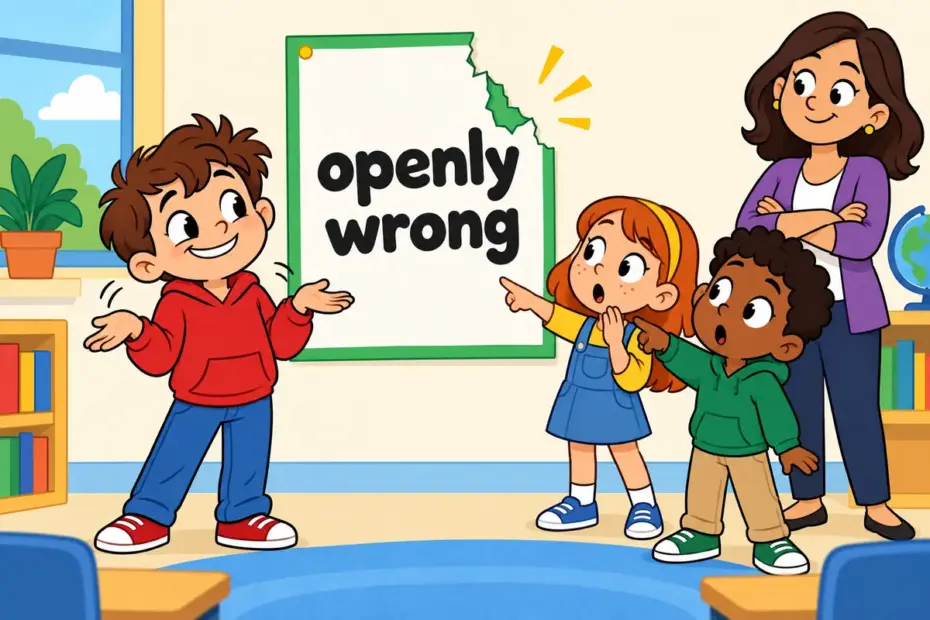
Blatant means done openly and without shame, so obvious that it cannot be missed. To use blatant in a sentence, put it before the noun: “That was a blatant lie.” The adjective accuses someone of hiding nothing, which is why it so often appears with dishonesty, bias and rule-breaking.
Blatant at a glance
- Blatant is an adjective meaning openly and unashamedly obvious.
- Its forms are blatant, more blatant, most blatant, blatantly and the rare noun blatancy.
- It describes lies, cheating, bias, errors and unfairness.
- Blatant carries disapproval, so it rarely describes anything innocent.
- The commonest error is using it for something merely striking or bright, where obvious or glaring fits better.
What does blatant mean?
Blatant is an adjective meaning done openly and without shame, or so obvious that it demands attention. The Cambridge entry for blatant links the two ideas: the wrong is clear, and nobody has tried to disguise it. Where the meaning is only that something is easy to see, the plainer obvious makes no accusation at all.
| Sense | Plain meaning | Example sentence |
|---|---|---|
| Openly unashamed | Done without any attempt to hide it | It was a blatant lie about the missing money. |
| Glaringly obvious | So clear that it cannot be missed | The report contained a blatant arithmetic error. |
| Unfair and visible | Shown openly rather than disguised | The team complained about blatant favouritism. |
Blatant is not neutral. It always carries a judgement that someone should have known better, so a blatant sunrise or a blatant smile sounds wrong. It also does not mean loud or bright: a blatant act may be quiet, but it is never hidden.
How do you use blatant in a sentence?
Blatant sits before its noun in almost every natural sentence, and the pairings that sound native are lie, attempt, bias, cheating and disregard. Five patterns cover the usual ground.
| Pattern | Example | What it signals |
|---|---|---|
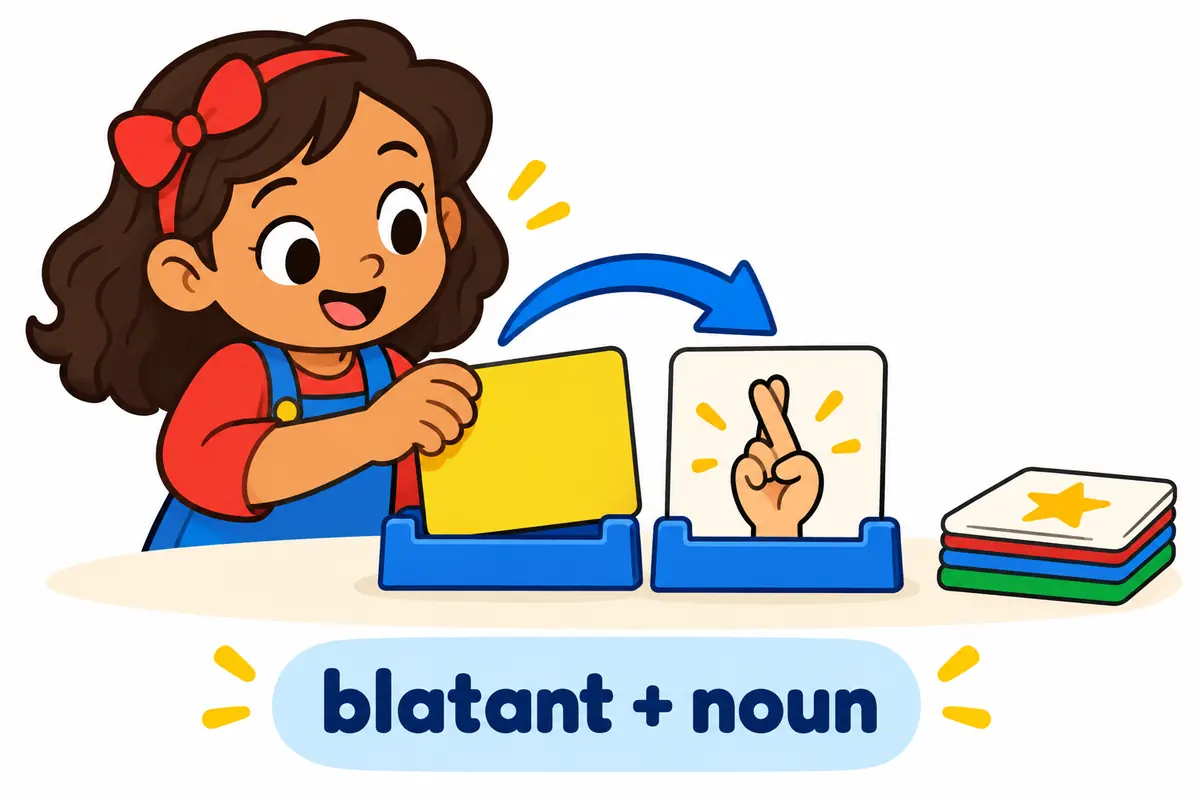
| blatant + noun | He won through blatant cheating. | The adjective before the noun names the offence. |
| be + blatant | The unfairness was blatant. | Predicate use, once the subject is known. |
| It is blatant that + clause | It was blatant that the rules had been broken. | Formal statement with an impersonal subject. |
| a blatant + abstract noun | She showed a blatant disregard for safety. | Pairs the word with a fault rather than a thing. |
| more / most blatant | This is the most blatant example yet. | Grades how shameless the act is. |
The word rarely follows the noun. A lie blatant reads oddly, because English prefers blatant lie. The one common exception is the predicate, as in the cheat was blatant, where the adjective completes the verb be.
Blatant in a sentence: examples across contexts
Blatant keeps its accusing tone while the setting changes. These sentences move from a playground to a formal inquiry, and each one names the open wrong.
| Context | Example sentence | Why this works |
|---|---|---|
| Classroom | Copying the answers was a blatant cheat. | A clear, familiar wrong for young readers. |
| Workplace email | We cannot ignore this blatant breach of the agreement. | Formal and firm without becoming emotional. |
| News report | The auditor found blatant errors in the accounts. | Names the fault and the authority that found it. |
| Legal writing | The ruling called the delay a blatant disregard for the deadline. | Quotes a fault in formal register. |
| Sports writing | The referee missed a blatant foul in the final minute. | Describes an offence everyone could see. |
| Conversation | That was a blatant excuse to leave early. | Everyday judgement between friends. |
| Academic writing | The paper exposes a blatant conflict of interest. | Formal claim supported by evidence elsewhere. |
| Business writing | The pricing shows blatant disregard for loyal customers. | Names the group affected by the unfairness. |
| Parent to child | Taking the last biscuit was a blatant fib. | Gentle use of the accusing word at home. |
Blatant vs flagrant, brazen and obvious
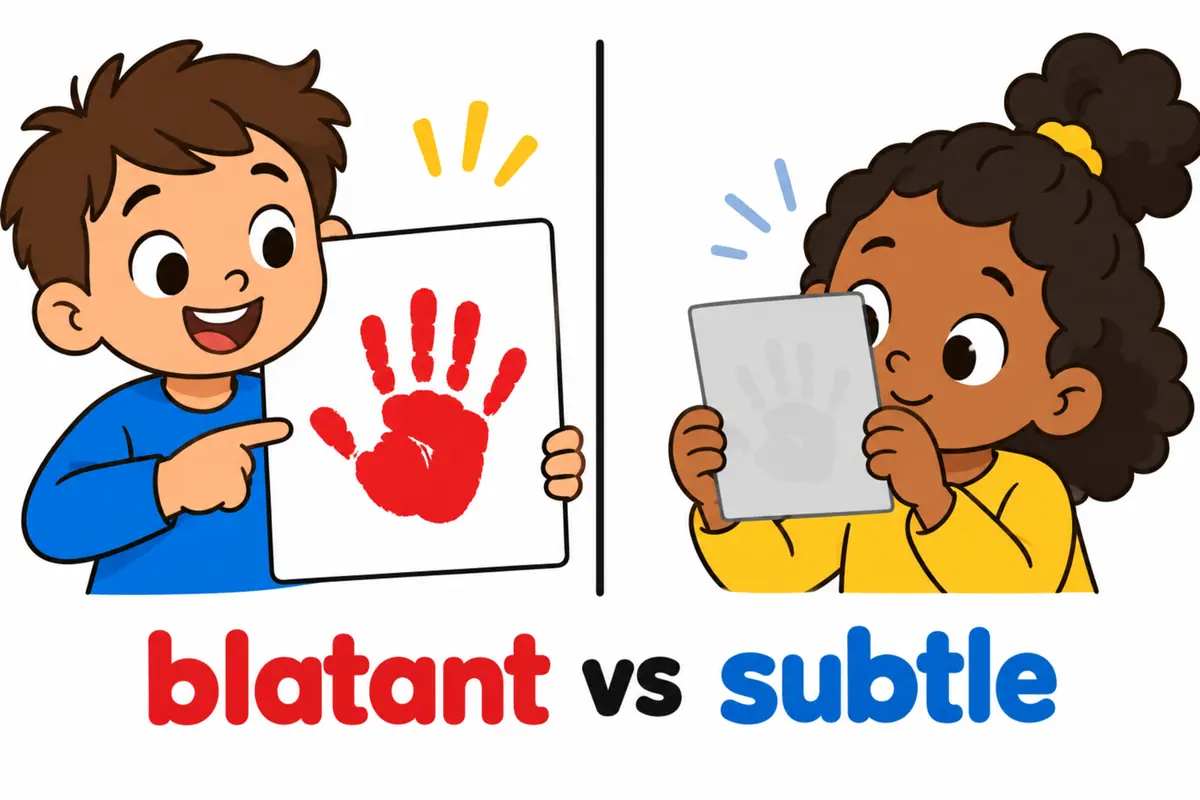
flagrant is the close cousin, but it applies to a serious offence or an immorality, while blatant applies to any open wrong. brazen adds a swagger, describing the person who shows no shame at all. subtle is the opposite end of the scale, naming something almost too small to notice.
| Attribute | blatant | flagrant | obvious |
|---|---|---|---|
| Core idea | Open and unashamed wrong | Serious and shocking offence | Easy to see |
| Moral weight | Strong disapproval | Strongest disapproval | None |
| Typical noun | Lie, error, bias | Violation, breach, foul | Reason, fact, answer |
| Register | Neutral to formal | Formal and emphatic | Neutral |
| Opposite | Subtle or concealed | Minor or technical | Hidden |
Verdict: use blatant for an open wrong, flagrant when the offence is grave, and obvious whenever you merely mean that something is clear.
Word forms and grammar of blatant
The adjective grades with more and most, and its adverb carries the same judgement into a verb phrase. The noun blatancy is rare and sounds bookish, so most writers use the adjective instead.
| Form | Part of speech | Example |
|---|---|---|
| blatant | adjective, base form | That was a blatant mistake. |
| more blatant | adjective, comparative | The second excuse was even more blatant. |
| most blatant | adjective, superlative | It was the most blatant case of bias this year. |
| blatantly | adverb | He blatantly ignored the warning. |
| blatancy | noun, rare | The blatancy of the error embarrassed the firm. |
blatantly usually modifies a verb such as ignore, cheat or lie, and it keeps the same disapproval as the adjective.
Common mistakes with blatant
- Incorrect:
He told a blatant story about his weekend.Correct: He told a funny story about his weekend. Rule: Blatant needs a wrong that should not be so open, so it cannot describe a harmless tale. - Incorrect:
The room was blatant with light.Correct: The room was bright with light. Rule: Blatant describes shameless behaviour, not physical brightness. - Incorrect:
She was blatant about her feelings.Correct: She was open about her feelings. Rule: Open is neutral, while blatant carries disapproval and clashes with innocent feeling. - Incorrect:
The mistake was blatant to everyone, but harmless.Correct: The mistake was obvious to everyone, but harmless. Rule: Use obvious when the point is only that something is clear. - Incorrect:
The weakness was blatant and had not yet appeared.Correct: The weakness was latent and had not yet appeared. Rule: Latent means hidden and not yet visible; blatant means wide open to view.
Practice using blatant
Work through the six items, then check the reasoning rather than only the answer.
- Fill the gap: The judge described the delay as a ______ disregard for the rules.
- Choose the better word: The spelling error was (blatant / obvious) but completely innocent.
- Correct the error: The sunset was blatant and filled the sky with colour.
- Build a sentence: use blatant + noun about a classmate who copied homework.
- Spot the register: which belongs in a formal complaint — This is a blatant breach of the contract, or This is so obviously cheating, yeah?
- Rewrite with the adverb: rewrite His cheating was open using blatantly.
Answers
- blatant — disregard is a fault, the kind of noun blatant accuses.
- obvious — an innocent error needs the neutral word, because blatant adds blame.
- The sunset was brilliant and filled the sky with colour — sunlight is not a shameless act.
- Model answer: Copying the answers was a blatant cheat.
- This is a blatant breach of the contract — a complaint keeps the formal noun and the firm tone.
- He blatantly cheated — the adverb replaces the adjective and keeps the disapproval.
The bottom line
Use blatant in a sentence when a wrong is done openly and nobody has tried to hide it. Two points settle most choices: keep the adjective before its noun, and reserve it for something that deserves blame rather than something merely clear. When the offence is grave, flagrant raises the stakes, and when it is only visible, obvious is the honest word.
Frequently asked questions about blatant
Is blatant a negative word?
Yes. Blatant carries clear disapproval, because it accuses someone of an open wrong. You can call a lie, a cheat or a bias blatant, but calling a harmless smile blatant sounds strange. If you only mean that something is easy to see, the neutral word obvious is the safer choice.
What is the difference between blatant and flagrant?
Both describe open wrongdoing, but flagrant is stronger and reserved for serious offences or immorality, such as a flagrant violation of a treaty. Blatant covers any open wrong, from a small fib to an accounting error. Choose flagrant when the act is grave and blatant when it is merely shameless.
Can blatant describe something that is not wrong?
Rarely. The word almost always implies blame, so it needs a fault such as a lie, an error or unfairness. A few phrases stretch it to plain obviousness, as in a blatant mistake, but even there the speaker sounds mildly critical. For neutral description, use obvious or clear instead.
What is the adverb form of blatant?
The adverb is blatantly, as in he blatantly ignored the rule. It keeps the same disapproving force as the adjective and usually modifies a verb of doing or refusing. The rare noun is blatancy, though most writers prefer to rewrite the sentence with the adjective rather than use it.
Have you ever come across a sentence that is so obvious, so unapologetic in its frankness that it can only be described as “blatant”? Blatant, as an adjective, means something that is done openly and unashamedly, without any attempt to conceal actions, characteristics, or intentions.
You may encounter blatant sentences in various contexts, from literature to everyday conversations. These sentences serve as bold declarations that leave little room for interpretation or doubt, making them stand out for their sheer straightforwardness and clarity.
7 Examples Of Blatant Used In a Sentence For Kids
- My teacher caught me with a blatant cheat sheet in the exam.
- The lion’s growl was blatant and scary.
- Please don’t make a blatant mess in the classroom.
- His lies were so blatant that everyone knew he was not telling the truth.
- The puppy’s blatant wagging tail showed how happy he was.
- I saw a blatant rainbow in the sky after the rain.
- She made a blatant mistake in her math homework.
14 Sentences with Blatant Examples
- Blatant cheating during exams will result in severe consequences.
- The professor’s favoritism towards certain students was blatantly obvious.
- Students often make blatant errors in their assignments due to lack of proofreading.
- The lack of preparation was blatantly apparent during the group presentation.
- His blatant disregard for the rules led to his suspension from college.
- The politician’s blatant lies did not sit well with the student audience.
- The blatant plagiarism in the research paper resulted in a failing grade.
- The blatant misuse of resources by the student council angered many students.
- The professor’s blatant favoritism towards certain students caused resentment among the class.
- The blatant disrespect shown towards teachers during the seminar was unacceptable.
- The student’s blatant lack of interest in the subject was evident throughout the semester.
- The blatant copying of assignments from others will not be tolerated in this college.
- The student’s blatant violation of the dress code resulted in disciplinary action.
- The blatant lack of effort put into the project was disappointing to the entire group.
How To Use Blatant in Sentences?
To use Blatant in a sentence, follow these simple steps:
-
Understand the Meaning: Blatant means extremely obvious or conspicuous, often in a way that is offensive or unashamed. Keep this definition in mind when constructing your sentence.
-
Choose the Right Context: Ensure that the context of your sentence aligns with the meaning of Blatant. It is commonly used to describe something that is clearly evident or done openly without any attempt at concealment.
-
Construct Your Sentence: Choose a subject or situation that exemplifies something blatant. For example, “The candidate’s blatant disregard for ethical standards during the campaign was apparent to all.”
-
Check for Clarity: Make sure your sentence clearly conveys the blatant nature of the subject or action. It should be unmistakable and evident to the reader.
-
Practice Using the Word: Experiment with using Blatant in different sentences to get comfortable with incorporating it into your vocabulary. The more you practice, the more natural it will become.
Remember, using Blatant effectively in your sentences can help you communicate more clearly and express ideas that are clearly visible or obvious.
Conclusion
In conclusion, the examples of sentences with the word “blatant” demonstrate its use to describe something that is obvious, conspicuous, or undisguised. Whether it is a blatant disregard for rules, a blatant lie, or a blatant attempt to deceive, the word highlights situations where something is unmistakably clear and apparent. By using “blatant” in a sentence, one can effectively convey a sense of transparency, brazenness, and lack of subtlety in a given context.
Overall, the word “blatant” serves as a straightforward and powerful adjective to emphasize the visibility or audacity of a particular action or situation. Its frequent use in literature, conversation, and everyday language underscores its versatility and importance in expressing blatant actions or behaviors.


