
To blow out is to put out a flame with your breath, or to burst outward under pressure, as a tyre does on the road. In a sentence the verb is transitive and separable: you blow out the candles or blow the candles out, but a pronoun must sit inside, as in blow them out.
Blow out at a glance
- Blow out is a phrasal verb; its forms are blows out, blew out and blowing out.
- The two common senses are putting out a flame and bursting outward.
- The verb is separable, so the object may follow out or sit between blow and out.
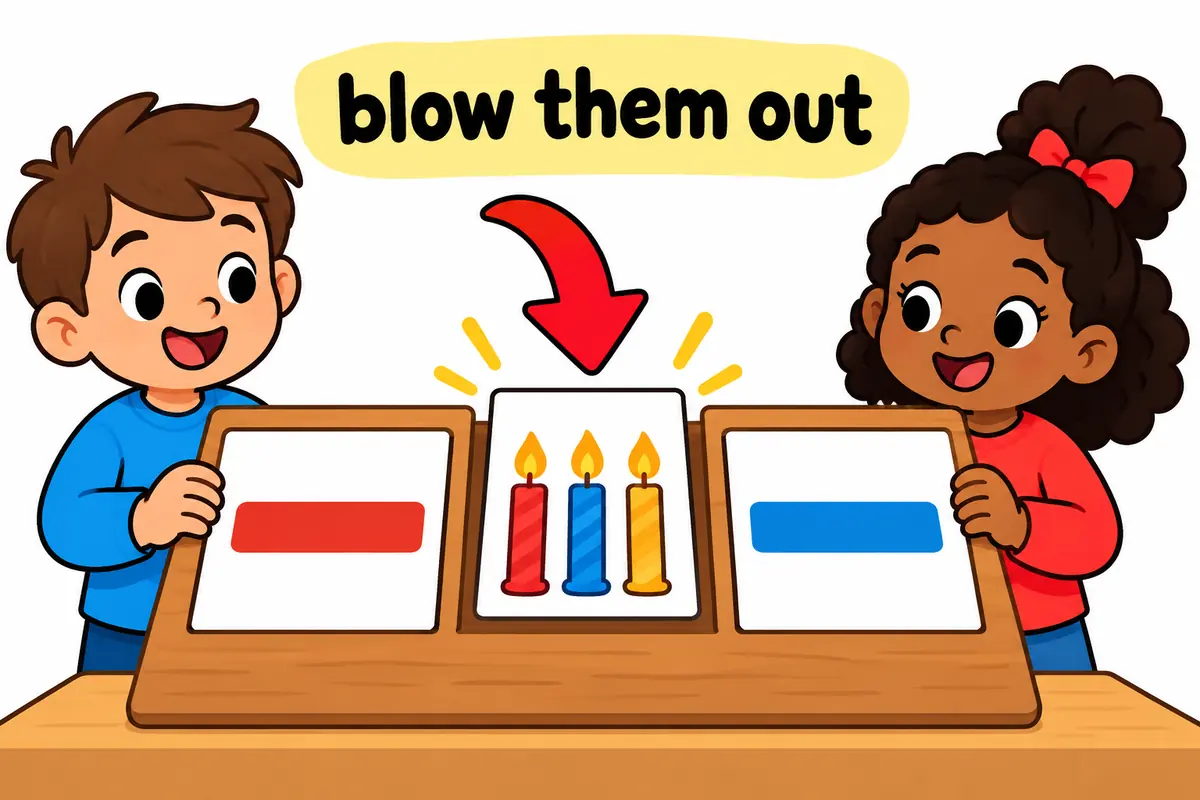
- A pronoun object goes in the middle: blow them out, never blow out them.
- The one-word noun blowout names a burst tyre, a large meal or an easy win.
What does blow out mean?
Blow out is a phrasal verb meaning to extinguish a flame by blowing, or to burst and empty suddenly under pressure. The Cambridge entry for blow out records both senses, and the second is intransitive when a tyre or a storm does the acting. A candle is extinguished by a puff, a flame can be snuffed with a fingertip, and a tyre can burst, so English keeps several verbs for one small event.
| Sense | Plain meaning | Example sentence |
|---|---|---|
| Put out a flame | Blow on fire until it goes out | She blew out the birthday candles. |
| Burst outward | Sudden release of air or pressure | The rear tyre blew out on the motorway. |
| Subside | Die down after spending its force | The gale blew itself out by dawn. |
One limitation matters. Blow out is not a synonym for explode or inflate; those belong to blow up. Blow out means either the quiet end of a small flame or a burst that lets pressure escape, so it never describes a growing blast.
How do you use blow out in a sentence?
Blow out is separable in the flame sense, where it takes an object, and intransitive in the bursting sense, where a tyre or a storm is the subject. The particle stays close to the verb, and a pronoun object is forced into the middle slot. The five patterns below cover nearly every natural sentence.
| Pattern | Example | What it signals |
|---|---|---|
| blow out + object | She blew out the match. | The commonest flame pattern; the object follows out. |
| blow + object + out | She blew the match out. | Separable form, usual for a short object. |
| blow them / it out | Make a wish and blow them out. | A pronoun must sit between blow and out. |
| blow out (no object) | The tyre blew out on the bend. | Intransitive burst sense; the object is the thing itself. |
| blow itself out | The storm blew itself out overnight. | Reflexive idiom for a force that dies down. |
The reflexive blow itself out is worth memorising because the pronoun follows the particle here, unlike an ordinary object. Storms and arguments blow themselves out; candles never do, because a candle has nothing left to spend.
Blow out in a sentence: examples across contexts
Blow out keeps one spelling while moving from a birthday table to a garage report. Each sentence below shows which sense is at work.
| Context | Example sentence | Why this works |
|---|---|---|
| Classroom | The children blew out the candles on the model volcano cake. | The object is a flame, so the extinguishing sense is clear. |
| Birthday card | Make a wish before you blow them out. | The pronoun sits between blow and out. |
| Driving report | The front tyre blew out at speed and the car pulled left. | No object, so the burst sense is unmistakable. |
| News report | A gust blew out the street lamps along the seafront. | The fire sense carries over to gas lamps in old streets. |
| Weather diary | The storm blew itself out before midnight. | The reflexive idiom shows a force fading. |
| Workshop note | Blow out the dust from the filter, not the bearings. | A different, technical sense of clearing by air. |
| Fiction | He blew out the lamp and the room went black. | A single prop action ends a scene. |
| Sports writing | The leaders blew out the field in the final lap. | An informal sense: to beat everyone easily. |
| Conversation | I blew out the candle before the smoke alarm noticed. | Everyday speech keeps the concrete object. |
The driving and weather rows need no object, while the candle rows do. That single difference tells a reader which sense you mean before the sentence finishes. Where a tyre loses air slowly rather than at once, the verb is deflate, not blow out.
Blow out vs blow up
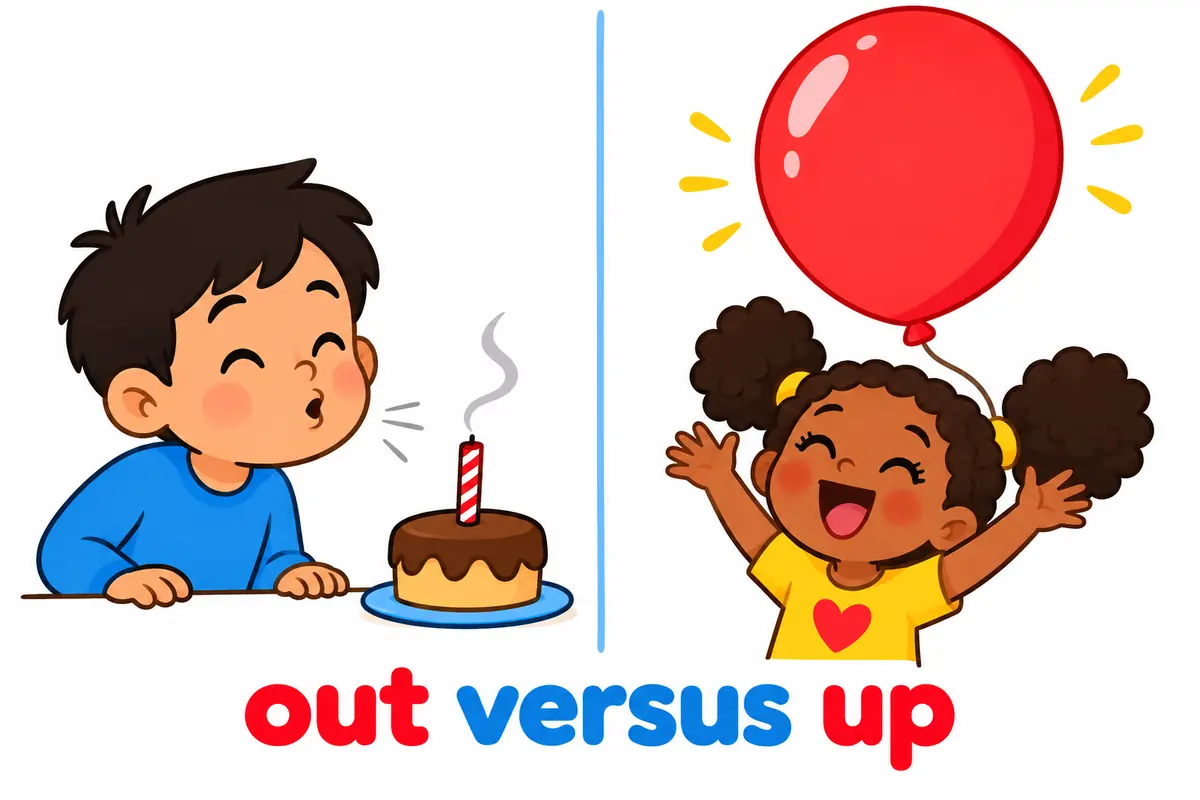
Blow out and blow up share the base verb but move in opposite directions. Blow out releases or ends; blow up expands or explodes, and it also means to inflate or to lose your temper.
| Attribute | blow out | blow up |
|---|---|---|
| Direction | Outward release or a flame ending | Growth, explosion or inflation |
| Common objects | A candle, a tyre, a lamp | A balloon, a building, a photo |
| Intransitive use | A tyre or storm blows out | A bomb blows up; a person blows up in anger |
| Emotional sense | None | To lose your temper suddenly |
| Example | The candle blew out in the draught. | The tyre blew up at the pump. |
Verdict: choose blow out for a flame going dead or pressure bursting outward, and blow up for something expanding, exploding or a temper flaring. To burst is close to the tyre sense of blow out, but burst can describe anything splitting, from a pipe to a bubble.
Word forms and grammar of blow out
Blow out inflects with the irregular past blew and the participle blown. The noun blowout is one word and carries several informal senses, so the spelling tells a reader whether you mean the act or the event.
| Form | Part of speech | Example |
|---|---|---|
| blow out | phrasal verb, base | Do not blow out the pilot light. |
| blows out | verb, third person singular | He blows out the candle every night. |
| blew out | verb, past tense | The heater blew out the flame. |
| blown out | verb, past participle | The candle had blown out in the wind. |
| blowing out | verb, present participle | Smoke was blowing out of the window. |
| blowout | noun, one word | A blowout on the ring road delayed us an hour. |
The noun keeps the part in view: the same event is a tyre blowout, and the part itself is the tire that failed. The noun also means a large meal or an easy win in sport, so context decides which blowout a reader pictures.
Common mistakes with blow out
- Incorrect:
Please blow out them before you leave.Correct: Please blow them out before you leave. Rule: A pronoun object must sit between blow and out. - Incorrect:
The tyre blew out itself on the bend.Correct: The tyre blew out on the bend. Rule: The burst sense is intransitive and takes no object, reflexive or otherwise. - Incorrect:
The balloon blew out in the sun.Correct: The balloon blew up in the sun. Rule: Something that expands or explodes blows up, not blows out. - Incorrect:
There was a blow out on the motorway.Correct: There was a blowout on the motorway. Rule: The noun is one word; the two-word form is only the verb. - Incorrect:
The argument blew out after an hour.Correct: The argument blew itself out after an hour. Rule: A force that fades uses the reflexive idiom blow itself out.
Practice using blow out
Work through the six items, then read the reasons rather than only the answers.
- Fill the gap: The wind ______ the candle before the cake arrived.
- Choose the better word: The balloon (blew out / blew up) until it popped in the sun.
- Correct the error: He blew out them one by one.
- Build a sentence: use blow itself out about a long storm.
- Spot the register: which fits a garage note — the offside tyre blew out at speed, or the tyre, like, went totally pop?
- Rewrite with the noun: The tyre blew out on the bridge. Use blowout.
Answers
- blew out — the object follows out, and the past tense matches the story.
- blew up — a balloon expands and explodes, while blow out means release or extinguish.
- He blew them out one by one — a pronoun sits between blow and out.
- Model answer: The storm blew itself out before the morning ferry sailed.
- The offside tyre blew out at speed — a garage note stays precise and avoids slang.
- The bridge saw a tyre blowout — the noun is one word and needs an article.
The bottom line
Use blow out in a sentence to describe a flame going dead, a tyre bursting outward, or a storm spending its force. Two nuances settle most sentences: the flame sense is transitive and separable, while the burst sense takes no object at all, and something that expands or explodes blows up instead. The one-word noun is blowout.
Frequently asked questions about blow out
Is blow out one word or two?
The verb is two words, as in blow out the candle, and it is separable, so the object can sit before out. The noun is one word, as in a tyre blowout or a party blowout. Spelling the verb as a single word is the commonest mistake, so keep the two forms apart.
What does it mean when a tyre blows out?
A blowout is a sudden loss of air, usually when the tyre bursts or tears, so the car can pull to one side. The verb takes no object in this sense, because the tyre itself is the subject that fails. A slow leak is different and calls for deflate.
Can blow out be used about a storm?
Yes, but only in the reflexive idiom blow itself out, which means the storm dies down after spending its force. The pronoun sits after the particle, so the storm blew itself out is correct. The same idiom covers an argument or a crisis that fades on its own.
Is a blowout always a tyre?
No. The noun also means a large, festive meal and, in sport, an easy win, as in a ten-nil blowout. The tyre sense is the most literal, and the others are informal. Context decides which one a reader pictures, so name the setting when you use it.
Have you ever wondered how to use the phrase “blow out” properly in a sentence? When someone mentions a “blow out,” they are referring to a sudden burst or release of something, typically air, gas, or liquid under pressure.
In everyday language, “blow out” can describe a variety of scenarios such as blowing out a candle, tire, or hair dryer. Understanding how to construct a sentence with this phrase can help clarify the context in which it is being used.
7 Examples Of Blow Out Used In a Sentence For Kids
- Blow out the candles on your birthday cake.
- Can you blow out the bubbles in your bubble wand?
- It’s fun to blow out dandelion seeds and watch them float away.
- Let’s try to blow out all the seeds off a dandelion puff.
- Don’t forget to blow out the flame after using a candle.
- Use your breath to blow out a gentle breeze on a hot day.
- Blow out the dust from your book before reading it.
14 Sentences with Blow Out Examples
- I need to buy new shoes because my old ones blow out during a basketball game.
- I was studying all night and then suddenly, the light bulb blew out.
- My laptop charger blew out right before my online exam.
- I forgot to budget for the month, and now my bank account is blown out.
- The professor’s final exam was so difficult, I felt like my brain was blown out.
- I was looking forward to attending the music concert, but the main performer blew out last minute.
- The printer in the library blew out while I was printing my assignment.
- I had so much work to do, but my motivation blew out after a long day of classes.
- I was organizing a college event, and the speaker system blew out during the performance.
- I had planned a movie night with my friends, but my TV blew out.
- I was cooking in my dorm room, and the gas stove blew out unexpectedly.
- My favorite pair of jeans blew out at the knees after wearing them for a year.
- The Wi-Fi connection blew out right when I was about to submit my assignment online.
- I lent my notes to a classmate, and they blew out the information to the entire class.
How To Use Blow Out in Sentences?
To Blow Out in a sentence means to extinguish a flame or light with a sudden burst of air. For beginners, it is important to understand how to use this phrasal verb correctly in a sentence. Here is a helpful guide:
-
Subject + Verb + Object: The most common way to use Blow Out in a sentence is to have a subject perform the action on an object. For example, “She blew out the candles on her birthday cake.”
-
Placement of Object: Make sure the object (the thing being extinguished) comes after the phrasal verb. For instance, “He blew out the match before leaving the room.”
-
Reflexive Pronouns: You can also use reflexive pronouns with Blow Out when the subject and object are the same person. For example, “I blew out the candles on my birthday cake.”
-
Past Tense: The past tense of Blow Out is blew out. For example, “Yesterday, she blew out the campfire before going to bed.”
-
Continuous Tense: In continuous tenses, use “is/am/are + blowing out.” For instance, “She is blowing out the candles on the cake.”
Remember to practice using Blow Out in different sentences to become more familiar with its usage.
Conclusion
In conclusion, “blow out” describes the sudden bursting or bursting of something due to excessive pressure, such as a tire or a candle. It can also refer to extinguishing a flame by blowing on it. For example, “He had to stop driving when his tire blew out,” or “She blew out the candles on her birthday cake.”
Whether used in a literal or figurative sense, “blow out” signifies a sudden and forceful release or extinguishing of something. Understanding its various contexts can help to clarify communication and avoid confusion in everyday situations where this phrase may be relevant.


