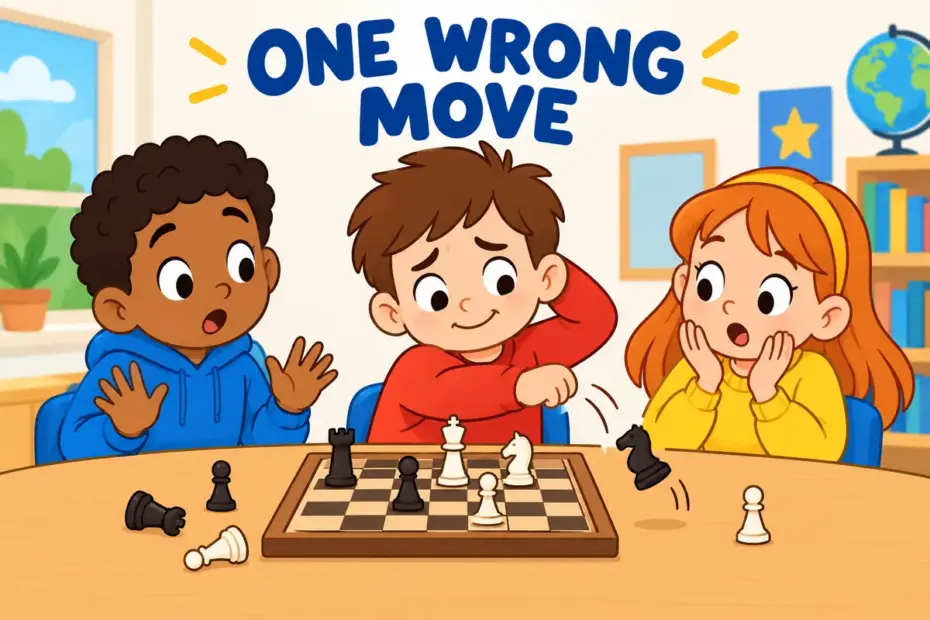
Blunder means a careless or embarrassing mistake, and as a verb it means to make such a mistake or to move clumsily. To use blunder in a sentence, name who made it and what went wrong: the keeper blundered badly. The word works as both a noun and a verb.
Blunder at a glance
- Blunder is both a noun and a verb, with forms blundered, blundering and blunders.
- As a noun it means a stupid or careless mistake, often with costly results.
- As a verb it means to make such a mistake or to move clumsily into something.
- The usual partners are a costly, serious, tactical, diplomatic or costly blunder.
- The commonest error is confusing blunder with the social word gaffe.
What does blunder mean?
Blunder is a noun meaning a careless or stupid mistake, and a verb meaning to make one or to move awkwardly. The Cambridge entry for blunder records both, and the noun is the one that carries blame: a blunder is not just an error but a failure of care that somebody could have avoided.
| Sense | Plain meaning | Example sentence |
|---|---|---|
| Noun: careless mistake | A serious slip that was avoidable | Leaving the file open was a costly blunder. |
| Noun: tactical error | A wrong move in a plan or game | The early substitution proved a blunder. |
| Verb: make a mistake | Act carelessly and get it wrong | The officer blundered by ignoring the warning. |
| Verb: move clumsily | Walk awkwardly into something | He blundered into the dark room. |
One limitation is worth stating plainly. A blunder is not any mistake. It adds carelessness and often scale, so a small typing slip is better called a typo, while a costly error suits a failure that was avoidable and damaging; where no blame is implied, error or mistake is the fairer word.
How do you use blunder in a sentence?
Use blunder as a countable noun after a or the, or as a verb that needs no object. Five patterns cover almost every real sentence, and each keeps the sense of carelessness.
| Pattern | Example | What it signals |
|---|---|---|
| a + adjective + blunder | It was a serious blunder. | The noun takes a determiner. |
| make / commit a blunder | The minister committed a blunder over the dates. | The standard verb partners for the noun. |
| blunder + by + -ing | She blundered by sending the draft. | Names the careless act. |
| blunder into + noun | He blundered into the wrong meeting. | Movement, literal or figurative. |
| a blunder + in + field | It was a blunder in a delicate negotiation. | Locates the mistake in a domain. |
The noun loves the verb make, as in make a blunder, while the verb itself needs no object. Where a mistake comes from poor execution rather than judgment, bungle the rescue is the closer verb, because it stresses clumsy handling. A tiny spoken error, by contrast, is only a slip of the tongue.
Blunder in a sentence: examples across contexts
Blunder keeps its edge of carelessness while moving from a chessboard to a newsroom. The nine sentences below show each setting naming the mistake and its cost.
| Context | Example sentence | Why this works |
|---|---|---|
| Classroom | Copying the wrong date was an easy blunder to fix. | Names a small, avoidable slip. |
| Workplace email | We must own the blunder and correct the file today. | Treats the noun as a countable event. |
| News report | The leak was described as a serious security blunder. | Adds a scale adjective for reporting. |
| Chess column | Moving the queen so early was the blunder of the game. | A tactical error in a contest. |
| Politics | The minister blundered by answering too quickly. | The verb plus by names the careless act. |
| Sport | The goalkeeper blundered and let the ball through. | Verb use adds immediate consequence. |
| Medicine | A dosing blunder was caught before any harm was done. | Shows the word used for clinical mistakes. |
| Diplomacy | Reading the wrong speech became a diplomatic blunder. | Pairs the noun with a domain. |
| Conversation | I made a real blunder with that text message. | The first person fits informal speech. |
In every sentence the mistake is avoidable, which is what separates blunder from accident. That built-in judgment is why news writing reaches for it when it wants to signal carelessness.
Blunder vs gaffe
Blunder and gaffe both name mistakes, and they are often mixed. The difference is the setting: a gaffe breaks a social rule, while a blunder breaks a plan.
| Attribute | blunder | gaffe |
|---|---|---|
| Core job | A careless mistake with consequences | A social slip that causes embarrassment |
| Typical setting | Strategy, sport, finance, security | Etiquette, politics, public events |
| Implies bad judgment | Yes, and often real damage | Yes, but usually social damage |
| Verb form | Blunder exists as a verb | Gaffe is a noun only |
| Usual scale | Can be huge and costly | Usually small but embarrassing |
Verdict: use blunder for a wrong move with real stakes and a diplomatic gaffe for a remark that merely offends. A gaffe can be harmless; a blunder rarely is.
Word forms and grammar of blunder
Blunder moves freely between noun and verb, and its root also gives a rare word for an old gun. The table lists the forms and the near neighbours learners substitute for them.
| Form | Part of speech | Example |
|---|---|---|
| blunder | noun, singular | That was a blunder nobody expected. |
| blunders | noun, plural | Two blunders cost them the match. |
| blunder | verb, base form | Try not to blunder under pressure. |
| blundered | verb, past and past participle | The pilot blundered in the fog. |
| blundering | verb, present participle | He came blundering through the door. |
| blunderbuss | noun, a different thing | The museum kept an old blunderbuss above the fireplace. |
The noun and verb share one spelling, so word order tells you which is meant. Keep blunderbuss separate: it is a firearm, not a mistake, even though the two words share a root.
Common mistakes with blunder
- Incorrect:
He made a blunder of forget the key.Correct: He blundered by forgetting the key. Rule: Use the verb plus by + -ing, or make a blunder of + noun. - Incorrect:
She blundered the email.Correct: She blundered when she sent the email. Rule: The verb blunder is intransitive and takes no direct object. - Incorrect:
It was a blunder of social manners.Correct: It was a social gaffe. Rule: A social slip is a gaffe; a blunder is a bad move with real stakes. - Incorrect:
The blunder was happened yesterday.Correct: The blunder happened yesterday. Rule: The noun takes an active verb, and happened needs no auxiliary. - Incorrect:
He blundered to the room.Correct: He blundered into the room. Rule: The movement sense of blunder takes into, not to.
Practice using blunder
Work through the six items and check the reason given with each answer.
- Fill the gap: The captain made a serious ______ by changing the plan late.
- Choose the better word: Forgetting her name was a social (blunder / gaffe) at the party.
- Correct the error: She blundered the whole presentation.
- Build a sentence: use blunder by + -ing about sending an angry message too soon.
- Spot the register: which suits a match report – the keeper blundered, or the keeper messed up big time?
- Rewrite as a noun: He blundered when he ignored the warning. Use blunder.
Answers
- blunder – a countable, serious and avoidable mistake.
- gaffe – a social slip fits gaffe; a blunder would suggest real stakes.
- She blundered during the whole presentation – the verb takes no object.
- Model answer: He blundered by sending an angry message before he had checked the facts.
- The keeper blundered – a formal report keeps the single strong verb.
- Ignoring the warning proved a blunder – the noun takes a determiner and a linking verb.
The bottom line
Use blunder in a sentence for a careless, avoidable mistake with real consequences, whether as a countable noun or an intransitive verb. The two facts that decide most sentences are these: the noun wants make or commit before it, and the verb never takes a direct object. Where the slip came from inattention rather than misjudgment, a costly oversight is the gentler, more neutral description.
Frequently asked questions about blunder
Is blunder a noun or a verb?
Blunder is both. As a noun it means a careless mistake, as in that was a costly blunder. As a verb it means to make such a mistake or to move clumsily, as in he blundered into the room. The noun is countable and the verb is intransitive.
What is the difference between a blunder and a gaffe?
A blunder is a careless wrong move with real consequences, common in strategy, sport and security. A gaffe is a social or public slip that mainly causes embarrassment. A gaffe can be forgiven quickly, while a blunder usually costs something concrete.
Can blunder be used without an object?
Yes. The verb blunder is intransitive, so it never takes a direct object. You say the pilot blundered or she blundered by sending it too soon, not she blundered the message. If you need an object, use the noun instead and write made a blunder.
Is blunder a formal word?
Blunder sits between neutral and formal, and it is common in news reporting, sport and political writing. It is less used in casual speech, where people tend to say mistake or mess up. The word is always safe in serious writing because it names carelessness without slang.
Have you ever made a blunder while speaking or writing, resulting in an embarrassing mistake? A blunder is a careless, foolish, or embarrassing error that can happen to anyone, causing a moment of awkwardness or regret. Struggling with language use can lead to blunders that affect communication and understanding.
Avoiding blunders in our language usage is crucial, as they can alter meanings and hinder effective communication. By understanding common pitfalls and practicing proper language skills, we can prevent blunders and ensure clear and accurate expression.
7 Examples Of Blunder Used In a Sentence For Kids
- I made a blunder by spilling my milk all over the table.
- It was a blunder when I forgot my homework at home.
- She made a blunder by wearing her shoes on the wrong feet.
- It was a blunder when I colored outside the lines in my drawing.
- He made a blunder by knocking over his block tower.
- It was a blunder when I tripped and fell on the playground.
- She made a blunder by mixing up the names of her friends.
14 Sentences with Blunder Examples
- Forgetting to submit your assignment on time would be a major blunder.
- Making a blunder during a presentation can be embarrassing in front of your professors.
- Accidentally deleting important project files can turn into a huge blunder.
- Mixing up dates for exams can lead to a serious blunder.
- Not citing your sources properly in a research paper could be considered a blunder.
- Skipping crucial information in your notes can result in a blunder during exams.
- Misinterpreting instructions for a group project can cause a blunder in your teamwork.
- Failing to proofread your essay before submission can result in a blunder with grammatical errors.
- Losing your student ID card can lead to a blunder when trying to access campus facilities.
- Forgetting to set reminders for important deadlines can result in a blunder in time management.
- Underestimating the difficulty of a subject and not studying adequately can lead to a blunder during exams.
- Choosing the wrong elective course without proper research can turn into a blunder in academic planning.
- Ignoring feedback from professors on your assignments can result in a blunder in improving your academic skills.
- Not double-checking the accuracy of your citations in a research paper can lead to a blunder with plagiarism accusations.
How To Use Blunder in Sentences?
Blunder is a versatile word that can be used in various situations to describe a mistake or error made by someone. When incorporating blunder in a sentence, it is important to understand its meaning and context in order to convey the message effectively.
Here are some tips on how to use blunder in a sentence:
-
Subject + Verb + Blunder: Start your sentence with the subject performing an action, followed by a verb, and then introduce the blunder as the mistake made. For example, “She blundered by forgetting to save her work before closing the document.”
-
Blunder + Consequence: You can highlight the consequence of the mistake by using blunder in the beginning of the sentence. For instance, “The team’s blunder in not double-checking the calculations led to a costly error.”
-
Adjective + Blunder + Noun: Add an adjective before blunder to provide more context or emphasize the nature of the mistake. For example, “His careless blunder during the presentation left the entire audience confused.”
Remember to always use blunder in a sentence where a mistake or error is evident and make sure the context fits the situation. With practice, you will become more comfortable incorporating blunder into your writing.
Conclusion
In conclusion, blunders are mistakes or errors that can occur due to carelessness, lack of experience, or misjudgment. These blunders can have varying degrees of consequences, ranging from minor setbacks to significant failures. For instance, forgetting to save an important document before closing a computer program could be a simple blunder, while a miscalculation in a financial report could have more serious implications.
It is important to recognize and learn from blunders to prevent their occurrence in the future. By being attentive, thorough, and seeking help or advice when needed, individuals can minimize the likelihood of making costly mistakes. Taking the time to double-check work, clarify instructions, and remaining focused can all help in avoiding blunders and ensuring smoother outcomes in various aspects of life.


