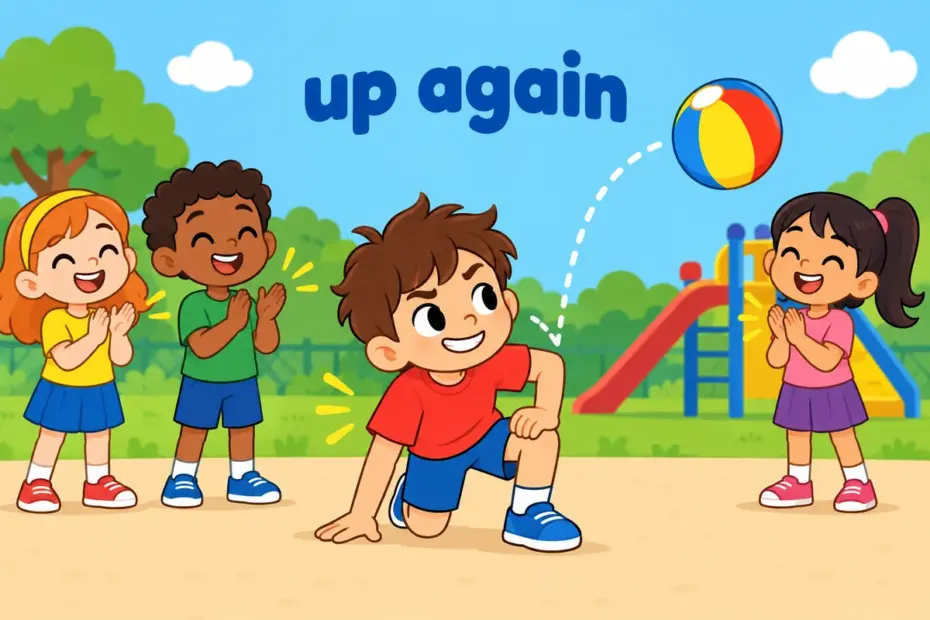
Bounce back is an intransitive phrasal verb meaning to recover after a setback, illness or defeat, or for something to return to its former level. To use bounce back in a sentence, name who or what recovers and from what: the team bounced back from the loss. The verb and particle never split.
Bounce back at a glance
- Bounce back is an intransitive phrasal verb; its forms are bounces back, bounced back and bouncing back.
- It means to recover after a setback, or to return to a former good level.
- It is inseparable: bounce and back always stay together, and no object goes between them.
- It usually appears with from: bounce back from an illness, a defeat or a bad quarter.
- The register is informal and journalistic; formal writing often prefers recover.
- The commonest error is trying to pass an object, as in bounce the team back.
What does bounce back mean?
Bounce back is a phrasal verb meaning to recover quickly after a difficulty or to return to a former level. The Cambridge entry for bounce back records the sense of becoming successful or healthy again. The literal image is a ball meeting the ground and rising, which is why the verb suits teams, markets and patients alike.
| Sense | Plain meaning | Example sentence |
|---|---|---|
| Recover after a setback | Return to a good state after failing | The shop bounced back after a quiet winter. |
| Return to a former level | Climb back to an earlier figure | Share prices bounced back by Friday. |
| Come back undelivered | Return to the sender, of a message | The email bounced back within a minute. |
Bounce back is not a neutral word for getting better, and it is not transitive. Where a patient simply regains health, recover from a fever is the plain verb; where an economy merely grows, improve fits better. Bounce back adds a clear sense that a previous good level has been regained after a fall.
How do you use bounce back in a sentence?
Because bounce back is intransitive, it never takes a direct object and never separates. A market that rallies after a crash is close in meaning, but only bounce back keeps the vivid image of hitting a low point and springing upward.
| Pattern | Example | What it signals |
|---|---|---|
| bounce back | The team bounced back. | The bare intransitive core, with no object. |
| bounce back from + noun | She bounced back from the illness. | Names the setback that was overcome. |
| bounce back to + noun | Sales bounced back to last year level. | Names the level that was regained. |
| bounce back after + noun | Markets bounced back after the news. | Names the event that preceded recovery. |
| be bouncing back | The town is bouncing back. | Progressive form for recovery in progress. |
Bounce back in a sentence: examples across contexts
The verb rarely stands bare for long; it usually names the setback, as when a small business enjoys a resurgence after a difficult year.
| Context | Example sentence | Why this works |
|---|---|---|
| Classroom | After a low mark, she bounced back in the next test. | Personal recovery with a clear event. |
| Workplace email | Sales bounced back in the second quarter. | Business result with a time frame. |
| News report | Tourism bounced back after two quiet summers. | Public recovery in a headline register. |
| Conversation | Give him a week and he will bounce back. | Spoken reassurance and informal tone. |
| Sport | The striker bounced back from a missed penalty. | A named setback suits the sporting sense. |
| Health | Most patients bounce back quickly after the treatment. | Informal where recover would be neutral. |
| Finance | The index bounced back to its spring high. | The to pattern names the regained level. |
| Email systems | Any undelivered note bounces back to the sender. | The literal returning sense. |
| Community | The village bounced back after the flood. | A concrete event and a shared subject. |
Bounce back vs recover
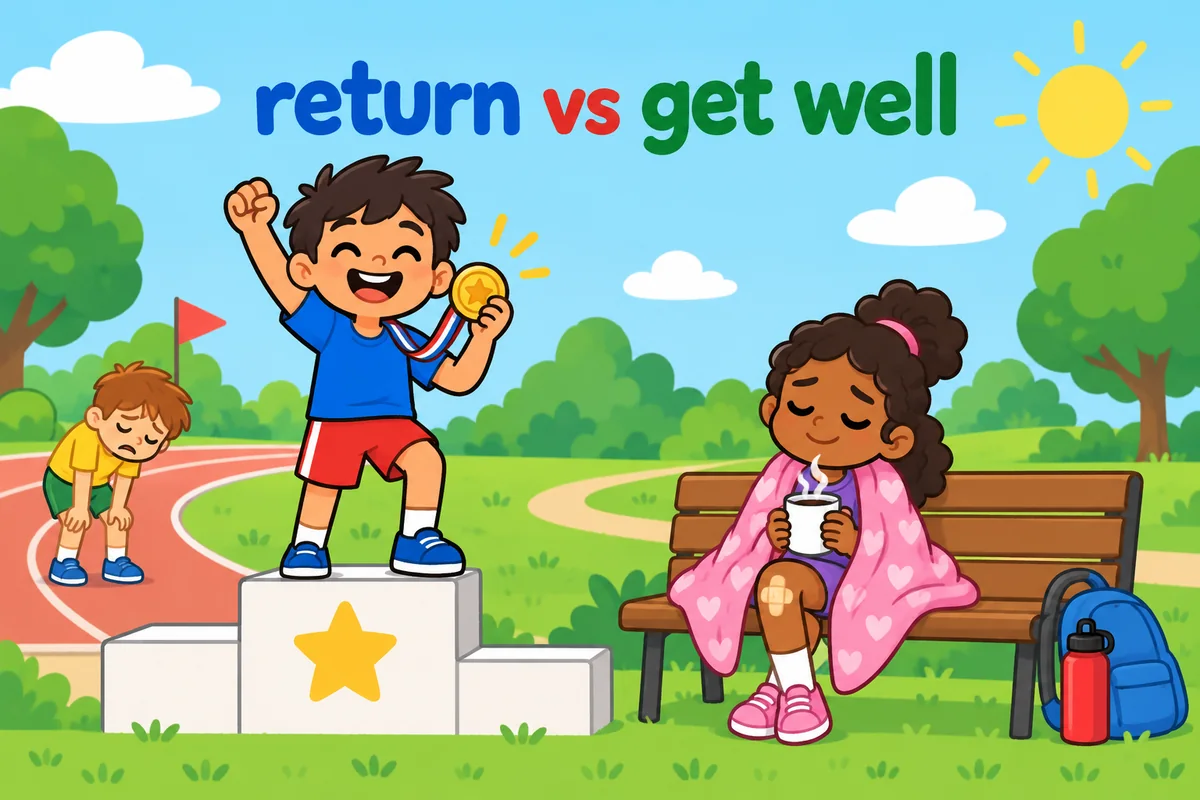
Bounce back and recover both describe returning to a better state, but bounce back is informal and stresses a quick return to a former level, while recover is neutral and can take an object. The table sets out the differences.
| Attribute | Bounce back | Recover |
|---|---|---|
| Meaning | Return to a good state after a fall | Get well or get something back |
| Register | Informal, sporting, journalistic | Neutral, medical, formal |
| Transitivity | Intransitive; no object | Can be transitive: recover the money |
| Typical subject | People, teams, markets | Patients, economies, costs |
| Implication | A former good level is regained | Return to health or possession |
Use bounce back for lively, quick comebacks and recover for plain or formal ones; when the recovery is lasting and stable, a resilient community describes the underlying strength rather than the moment of return, and a relapse into old habits describes the opposite of a comeback.
Word forms and grammar of bounce back
The family includes a hyphenated attributive form and a related noun; a remarkable comeback is the noun that often turns up beside the verb bounce back in a headline.
| Form | Part of speech | Example |
|---|---|---|
| bounce back | base phrasal verb | Small firms bounce back fast. |
| bounces back | third-person singular | The team bounces back every season. |
| bounced back | past and past participle | Prices bounced back overnight. |
| bouncing back | present participle and gerund | Bouncing back takes patience. |
| bounce-back | attributive adjective or noun | They sealed a bounce-back win. |
| bounce | verb and noun | The ball bounced twice. |
Common mistakes with bounce back
Incorrect: The coach bounced the team back after the defeat. Correct: The team bounced back after the defeat. Rule: bounce back is intransitive, so the recovering subject cannot become an object.
Incorrect: She bounced back it within a week. Correct: She bounced back within a week. Rule: the verb is inseparable, so nothing may sit between bounce and back.
Incorrect: He bounced back the injury. Correct: He bounced back from the injury. Rule: the setback follows the preposition from, not a direct object.
Incorrect: The patient recovered back quickly. Correct: The patient bounced back quickly. Rule: recover already means return to health, so back is redundant with it.
Incorrect: Profits bounced back from their record high. Correct: Profits bounced back to their record high. Rule: from names the setback, while to names the level regained.
Practice using bounce back
- Fill in the blank: The small shop ______ after the roadworks ended.
- Choose the better word: The patient slowly (bounced back / recovered) in the ward.
- Correct the error: The manager bounced the sales team back after a weak month.
- Build a sentence: use bounce back from about a lost match.
- Spot the register: Which suits a financial report, Shares bounced back or Shares recovered?
- Fill in the blank: Visitor numbers ______ to their old summer level last year.
Answers
- bounced back. The event follows the intransitive verb.
- recovered. A neutral medical context prefers the formal verb.
- The sales team bounced back after a weak month. The reviser cannot become the object.
- The club bounced back from a heavy defeat. The from phrase names the setback.
- Shares recovered. A formal report avoids the informal verb.
- bounced back. The to phrase names the level regained.
The bottom line
Bounce back means to recover after a setback or return to a former level, and it is an inseparable, intransitive phrasal verb. It usually takes from to name the setback and to to name the level regained, and it suits informal, sporting and journalistic writing. Use bounce back in a sentence for a vivid, quick return; choose recover when the tone must stay neutral.
Frequently asked questions about bounce back
Is bounce back separable?
No. Bounce back is inseparable because it is intransitive, so the verb and its particle stay together and nothing can sit between them. You say the team bounced back, never the team bounced itself back or bounced back it. The related hyphenated noun bounce-back does separate the words on the page.
What is the past tense of bounce back?
The past tense and past participle are both bounced back, and the present participle is bouncing back. Only the verb bounce changes; the particle back stays fixed in every tense. The third-person singular is bounces back, as in the town bounces back each spring.
Is bounce back formal enough for writing?
Bounce back is informal and appears most often in sport, business news and conversation. In a formal report, recover or rebound usually fits better, because those verbs carry no hint of casual language. In a headline or a quote, however, bounce back adds energy that the neutral verbs lack.
What preposition follows bounce back?
The most common preposition is from, which names the setback, as in bounce back from an injury. The preposition to names the level regained, as in bounce back to full strength, and after names the event that preceded the recovery. The bare verb takes no preposition when no setback is named.
If you have ever faced a setback and managed to recover quickly, you have experienced what is known as “bouncing back.” Bouncing back, also referred to as resilience, is the ability to adapt and recover from difficult situations, adversity, or failure.
In life, we all encounter challenges that can knock us down, but the key to resilience is our ability to bounce back from these setbacks. Developing resilience can help us navigate through life’s obstacles with strength and perseverance.
7 Examples Of Bounce Back Used In a Sentence For Kids
- Bounce back when you fall down.
- It’s important to always bounce back after facing a challenge.
- Let’s encourage each other to bounce back and try again.
- Remember, you can always bounce back from a mistake.
- When things get tough, don’t forget to bounce back with a smile.
- We are strong and can always bounce back from any problem.
- With determination, we can always bounce back and keep moving forward.
14 Sentences with Bounce Back Examples
- Bounce back after a bad exam grade by seeking help from your professors or joining a study group.
- If you miss a deadline, don’t panic, just bounce back by communicating with your professor and asking for an extension.
- Bounce back from a breakup by focusing on self-care and engaging in activities that bring you joy.
- After receiving constructive criticism on your project, take it as an opportunity to bounce back and improve your work.
- Bounce back from a failed presentation by practicing more and seeking feedback from your peers.
- If you feel overwhelmed with assignments, take a break and bounce back with a clear mind and a prioritized to-do list.
- Bounce back from a rejection letter by staying positive and continuing to apply for other opportunities.
- When facing a challenging course, don’t be discouraged, bounce back by seeking tutoring or joining a study group.
- Bounce back from a missed internship opportunity by networking and exploring other avenues for gaining experience.
- After a disagreement with a friend, take the initiative to bounce back by communicating openly and resolving the issue.
- If you experience burnout from studying, take a step back, recharge, and bounce back with a refreshed mindset.
- Bounce back from a missed scholarship opportunity by applying for different grants and scholarships.
- When feeling unmotivated, bounce back by setting small achievable goals and rewarding yourself for completing them.
- After receiving a low grade on a paper, don’t dwell on it, instead bounce back by revising and seeking feedback for improvement.
How To Use Bounce Back in Sentences?
Bounce Back means to recover quickly from a setback or difficult situation. It signifies resilience and the ability to turn a negative experience into a positive one by bouncing back stronger than before.
In a sentence, you can use Bounce Back to describe someone who has overcome obstacles and emerged stronger. For example, “After facing a series of failures, she was able to bounce back by learning from her mistakes and achieving even greater success.”
To effectively use Bounce Back in a sentence, it is important to highlight the resilience and determination of the individual to overcome challenges. You can convey this by emphasizing the setback faced and the subsequent comeback.
Additionally, when using Bounce Back in writing, it is helpful to provide context for the situation to make it clear how the individual has shown resilience. This can help the reader understand the significance of the bounce back and appreciate the effort put into overcoming adversity.
Remember that Bounce Back is a powerful phrase that can inspire others to persevere through tough times and come out stronger on the other side. It is a reminder that setbacks are temporary, and with the right attitude and effort, one can always bounce back from any situation.
Conclusion
In conclusion, “bounce back” is a term often used to describe the ability to recover quickly from setbacks or difficult situations. This resilience is evident in various contexts, such as sports, business, and personal relationships. For example, a team that loses a game can bounce back in the next match with a win, a failing business can bounce back by restructuring and regaining profitability, and individuals facing hardship can bounce back by persevering and adapting to challenges.
The concept of bouncing back implies a sense of strength, adaptability, and determination. It serves as a reminder that setbacks are a natural part of life, but with resilience and a positive mindset, one can overcome obstacles and ultimately thrive. Whether it’s a small setback or a major crisis, the ability to bounce back is a valuable skill that can lead to growth, success, and well-being.


