Bungle means to do a job so clumsily that you spoil it. To use bungle in a sentence, name the task and the person doing it: “They bungled the delivery.” The verb is transitive, so a plan, a task or an occasion usually follows it, and the noun bungle names the mess itself.
Bungle at a glance
- Bungle is a verb; its forms are bungles, bungled and bungling, and the same spelling also works as a noun.
- The verb is transitive in almost every use: you bungle a task, a plan, a match or an opportunity.
- The subject is usually a person or a team, and the object is the thing they spoil.
- Bungle is neutral and common in news writing; botch and mess up are its closest substitutes.
- The commonest error is treating bungle as a synonym for lose: a bungled match was misplayed, not necessarily lost.
What does bungle mean?
Bungle is a verb meaning to carry out a task so clumsily or carelessly that the result is spoiled. The Cambridge entry for bungle gives the same core sense: to do something wrong in a careless or stupid way. One meaning covers almost every sentence, so the table below separates the verb from its noun rather than splitting hairs between senses.
| Use | Plain meaning | Example sentence |
|---|---|---|
| Verb, spoil a task | Carry something out so badly that it goes wrong | The crew bungled the rescue and lost an hour. |
| Verb, mishandle a chance | Waste an opportunity through clumsiness | He bungled his only chance to apologise. |
| Noun, a mess | The clumsy mistake or badly handled affair itself | The whole bungle began with one wrong label. |
One limitation is worth stating plainly. Bungle describes how a job was done, not how it ended. A bungled operation can still succeed by luck, and a neatly run one can fail. Where you mean the outcome alone, choose fail or lose instead.
How do you use bungle in a sentence?
Put the person first and the spoiled thing second: someone bungles something. The five patterns below cover nearly every real sentence, and only the last one drops the object. A goalkeeper who handles the ball awkwardly, for instance, can be said to fumble a catch, which names the clumsy moment rather than the whole match.
| Pattern | Example | What it signals |
|---|---|---|
| person + bungle + task | The new clerk bungled the delivery. | A named actor spoils a concrete job. |
| bungle + it | You had one job and you bungled it. | A pronoun replaces the whole task; common in speech. |
| be bungled (passive) | The signing was bungled from the start. | Keeps attention on the failure, not the culprit. |
| bungle + an opportunity | The team bungled its chance to qualify. | The object is a chance rather than a thing. |
| bungle + manner (no object) | They bungled badly in the final minute. | Reports how badly the work was done, without naming what was spoiled. |
Bungle in a sentence: examples across contexts
Bungle keeps the same meaning as it moves from a kitchen to a courtroom; what changes is who is being judged. Each row below names who was doing the work and what was spoiled.
| Context | Example sentence | Why this works |
|---|---|---|
| Classroom | Maya bungled the last line of the poem, then laughed and started again. | A small, low-stakes task shows the word without real harm. |
| Workplace email | We bungled the handover, and the client noticed. | First person plural reports a team failure honestly. |
| News report | Officials bungled the evacuation as the storm closed in. | The impersonal subject suits reporting. |
| Sport | The keeper bungled a simple catch and gifted a goal. | Pairs the clumsy action with its consequence. |
| Technical writing | The lab bungled the sample handling, so the result was void. | Names the spoiled procedure, not the people. |
| Home | I bungled the souffle by opening the oven too early. | Concrete cause makes the clumsiness visible. |
| Conversation | He bungled the introduction and called her by the wrong name. | Everyday register keeps the verb natural. |
| Academic | The study was bungled at the data-entry stage. | Passive keeps the focus on the method. |
| Finance | The bank bungled the transfer and charged a fee anyway. | Institutional subject with an ironic consequence. |
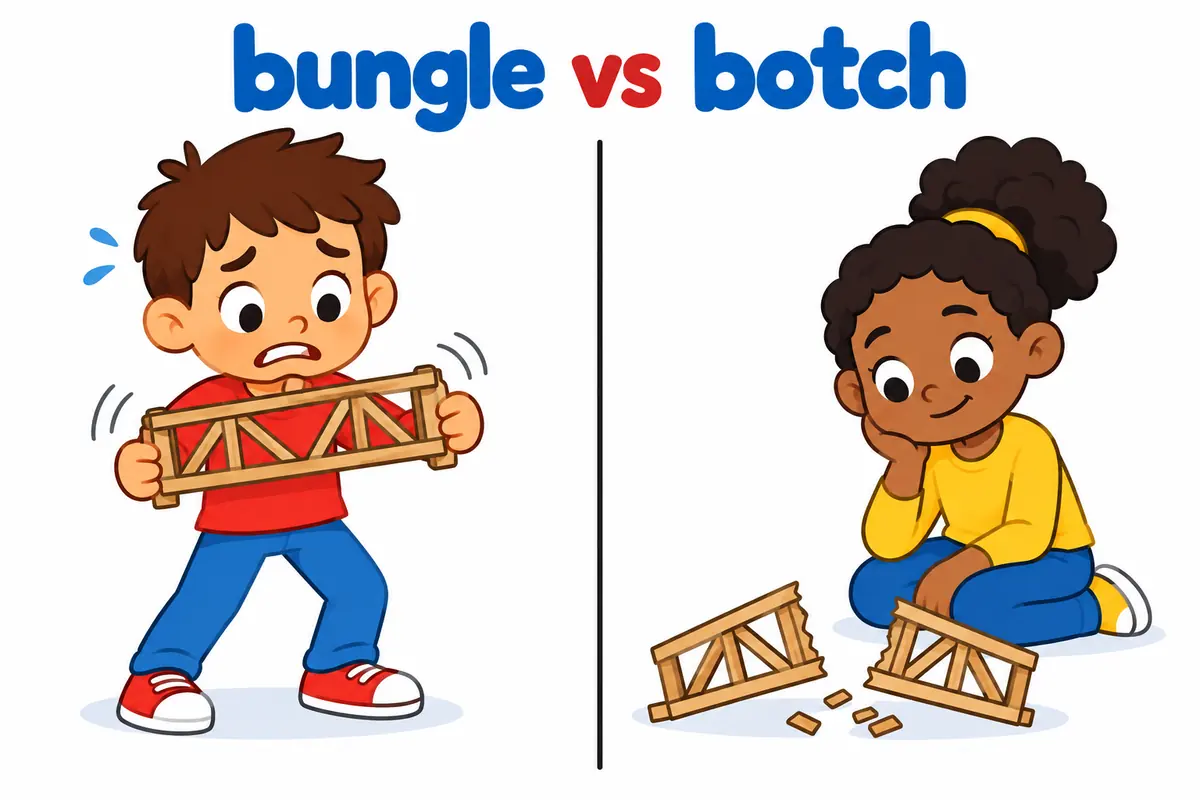
Bungle vs botch
Bungle and botch both mean to spoil a job, but they point at different causes. Where a single careless slip spoils things, blunder names the slip itself; bungle spreads the blame over the whole handling, and botch stresses the damage left behind.
| Attribute | bungle | botch |
|---|---|---|
| Core focus | The clumsy handling | The spoiled result |
| Typical object | A task, plan, chance or match | A job, repair, edit or launch |
| What is blamed | The person’s ineptitude | The ruined thing itself |
| Register | Neutral, frequent in news | Slightly informal, frequent in speech |
| Intensity | Wasteful and embarrassing | Often ruinous |
Verdict: choose bungle when the story is about a person who could not do the job, and botch when the story is about the wreckage left behind.
Word forms and grammar of bungle
Bungle inflects regularly, and its agent noun matters because learners often build the wrong one. The person who fails is a bungler; the act itself is a bungle.
| Form | Part of speech | Example |
|---|---|---|
| bungle | verb, base form | Do not bungle the announcement. |
| bungles | verb, third person singular | She bungles every deadline. |
| bungled | verb, past and past participle | They bungled the order completely. |
| bungling | verb, present participle; also an adjective | A bungling official made it worse. |
| bungle | noun, the act | The launch was a bungle from start to finish. |
| bungler | noun, the person | The firm quietly blamed its own bungler. |
Common mistakes with bungle
- Incorrect:
The manager bungled.Correct: The manager bungled the handover. Rule: Bungle is transitive, so name the thing that was spoiled unless the context already did. - Incorrect:
She bungled to send the file.Correct: She bungled the file transfer. Rule: Bungle takes a noun phrase, never an infinitive; use forgot for an action left undone. - Incorrect:
The rescue was bungled by them badly.Correct: They bungled the rescue badly. Rule: The passive is fine, but an agent phrase plus an adverb crowds it; make the doer the subject. - Incorrect:
He is a bungle.Correct: He is a bungler. Rule: The person is a bungler; bungle as a noun names the act, not the person. - Incorrect:
They bungled up the whole thing.Correct: They bungled the whole thing. Rule: Bungle takes no particle; the particle up belongs to mess up.
Practice using bungle
Work through the six items, then check the reasoning rather than only the key.
- Fill the gap: The electrician ______ the wiring, and the lights still flicker.
- Choose the better word: After the failed repair the engine was (bungled / botched) beyond saving.
- Correct the error: The clerk bungled to stamp the passport.
- Build a sentence: use bungle with an opportunity about a missed job interview.
- Spot the register: which belongs in a news report — Officials bungled the evacuation, or Officials totally bungled it?
- Rewrite with the person noun: The team bungled the rescue. Use bungler instead.
Answers
- bungled — the wiring is the task spoiled, so the verb fits.
- botched — the emphasis is on the ruined engine, which is botch’s focus.
- The clerk bungled the passport stamp — bungle takes a noun phrase, not an infinitive.
- Model answer: Priya bungled her chance to make a good first impression.
- Officials bungled the evacuation — a report avoids totally and the casual tone.
- The bungler on the team ruined the rescue — bungler names the person, so the sentence is rebuilt.
The bottom line
Use bungle in a sentence when someone’s clumsy handling spoils a task, and let the verb carry the blame. The two nuances that decide most sentences are that bungle is transitive, so the spoiled thing must be named, and that it judges the handling rather than the outcome. Where the wreckage, not the person, is the point, botch the repair is the sharper choice.
Frequently asked questions about bungle
Is bungle a formal word?
Bungle is neutral rather than formal, and it appears often in news reports about failed rescues, launches and matches. In everyday speech, mess up and make a mess of are more common. Writing the hospital bungled the handover sounds natural in a report, while a friend would probably say they messed it up.
What is the difference between bungle and botch?
Bungle stresses the clumsy handling of a task, while botch stresses the damaged result. A mechanic who bungles a repair works badly step by step; a botched repair is one you cannot rely on afterwards. Use bungle for the person’s ineptitude and botch for the wreckage.
Can bungle be a noun?
Yes. Bungle works as a countable noun meaning a clumsy mistake or a badly handled affair, as in the whole bungle began with one wrong label. The plural is bungles. Learners sometimes write a bungle for a person; the correct word for the person is bungler.
Does a bungled task always fail?
No. Bungle describes how a job was carried out, so a bungled attempt can still succeed by luck. The chef who bungles a sauce may rescue it at the last second. If you mean only the outcome, choose fail or lose, because those words say nothing about clumsiness.
Ever find yourself in a situation where you mess up a task so badly it becomes a blooper reel moment in your own life? That’s what we’ll delve into with the concept of bungling. To bungle is to clumsily mishandle or mess up a task, often resulting in error or failure due to incompetence or carelessness.
These missteps can range from simple blunders to more significant mistakes, leaving behind a trail of mishaps that can lead to unintended consequences. Whether it’s a small slip-up or a major fumble, the act of bungling can sometimes teach us valuable lessons in humility and the importance of attention to detail.
7 Examples Of Bungle Used In a Sentence For Kids
- Bungle means to make a mistake.
- Be careful so you don’t bungle your work.
- It’s okay to bungle, we can try again.
- Let’s laugh and learn from the bungle we made.
- Remember, it’s normal to bungle sometimes.
- Don’t be afraid to ask for help if you bungle.
- Together, we can fix any bungle that happens.
14 Sentences with Bungle Examples
- Bungle occurred during the group project presentation when one member forgot their part.
- As a result of a bungle, the exam schedule was incorrect, leading to confusion among students.
- The student’s attempt to finish the assignment in one night resulted in a bungle and a poor grade.
- During the internship interview, the candidate’s nervousness caused a bungle in their responses to the questions.
- The confusion over the submission deadline led to a bungle with several students missing the opportunity to turn in their assignments on time.
- A bungle in the scheduling system caused overlapping exams for some students.
- Trying to juggle multiple tasks at once often leads to a bungle in time management for many college students.
- The student’s efforts to impress the professor with a complex theory only resulted in a bungle as they misunderstood the topic.
- Lack of clear communication between students and the faculty sometimes leads to a bungle in understanding assignment requirements.
- In an attempt to participate in various extracurricular activities, some students end up bungling their priorities and academics suffer.
- A bungle in the college’s system caused confusion about the registration process for the upcoming semester.
- Rushing to complete a project without proper planning can often lead to a bungle in the final outcome.
- The student’s attempt to multitask and study for multiple exams at once resulted in a bungle as they struggled to retain the necessary information.
- Ignoring important details during an experiment can result in a bungle that could affect the research findings.
How To Use Bungle in Sentences?
Bungle means to make a mistake or error, and it is typically used in a negative context. When using the word Bungle in a sentence, it is important to keep in mind its meaning and connotation.
To use Bungle in a sentence, simply follow these steps:
- Identify a situation where a mistake or error has occurred.
- Select a subject who made the mistake or error.
- Choose the appropriate verb tense to match the context of the sentence.
- Insert the word Bungle into the sentence to describe the mistake.
For example:
– “I Bungled my presentation by forgetting to include the most important slide.”
– “The team Bungled the project deadline by not coordinating their efforts effectively.”
– “She realized she had Bungled the exam when she saw her low score.”
Remember to use Bungle when referring to mistakes or errors that have been made unintentionally. It is important to acknowledge and learn from these mistakes in order to prevent them from happening again in the future.
Practice using the word Bungle in different sentences to become more comfortable with its usage and to improve your vocabulary.
Conclusion
In conclusion, the examples of sentences containing the word “bungle” showcase instances of mistakes, blunders, or botched attempts. Whether it’s a simple slip-up in daily tasks or a more serious mishandling of a situation, the word “bungle” is used to describe errors or failures. These sentences highlight the importance of attention to detail, proper planning, and careful execution in avoiding bungling.
By understanding and learning from the examples of sentences with “bungle,” individuals can strive to improve their performance, prevent mistakes, and achieve successful outcomes. It serves as a reminder of the consequences of oversight and the need for diligence in all endeavors to avoid bungling and its associated setbacks.


