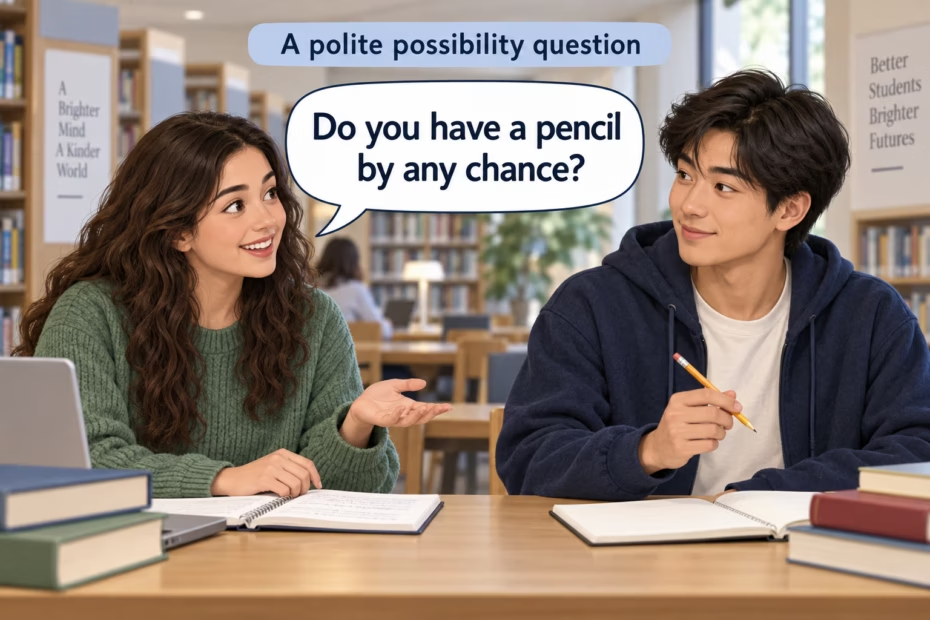
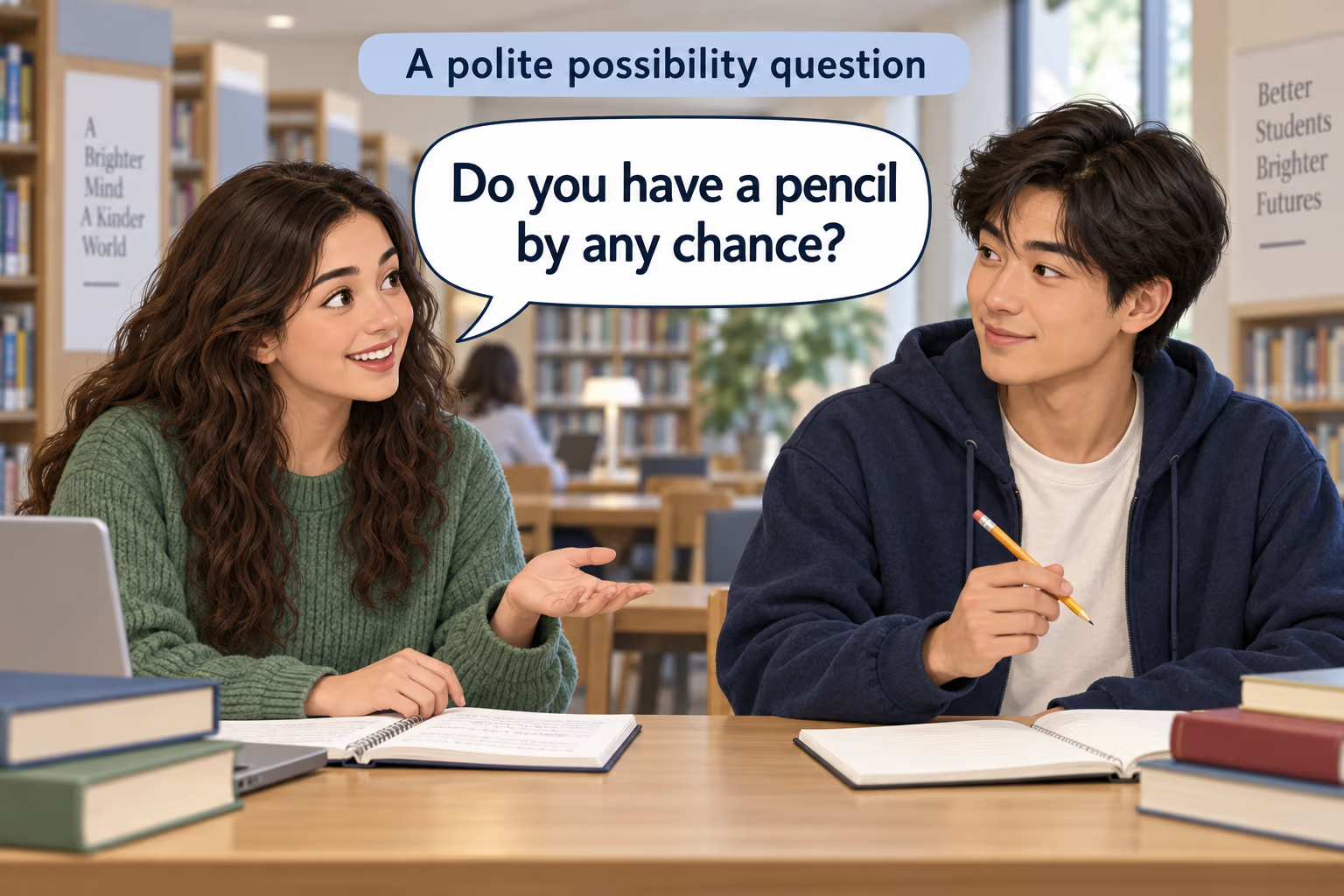
By any chance is an expression used especially in questions to ask whether something is true or possible. It often softens an inquiry, but context and tone still determine how the question comes across.

Have you ever wondered how to politely ask about a possibility without seeming too direct? This is where the phrase “by any chance” comes in. It is a versatile expression that can be used to inquire about something in a casual and polite manner.
“By any chance” is commonly used in English to introduce a question where the speaker is seeking confirmation or further information on a specific topic. It is a useful phrase to use when you want to inquire about something without sounding too forceful or imposing.
Dictionary examples show that the phrase can appear at the beginning, middle, or end of a question: Oxford Learner’s Dictionaries, Collins Dictionary, and Cambridge Dictionary.
What does “by any chance” mean?
By any chance is used especially in questions to ask whether something is true or possible. It signals that the speaker is checking rather than assuming the answer. For example, “Are you by any chance the new editor?” asks whether that possibility is true.
The expression often softens a request or inquiry, as in “Do you have a spare charger by any chance?” That effect depends on the words, relationship, and situation; the phrase does not automatically make every request polite. A demanding request can still sound demanding.
In this question use, by any chance does not simply mean “accidentally.” Compare Did you meet by chance?, where by chance means without planning it, with Did you meet the author, by any chance?, which asks whether the meeting happened. The extra word any helps form the inquiry about possibility.

Where does the phrase go in a question?
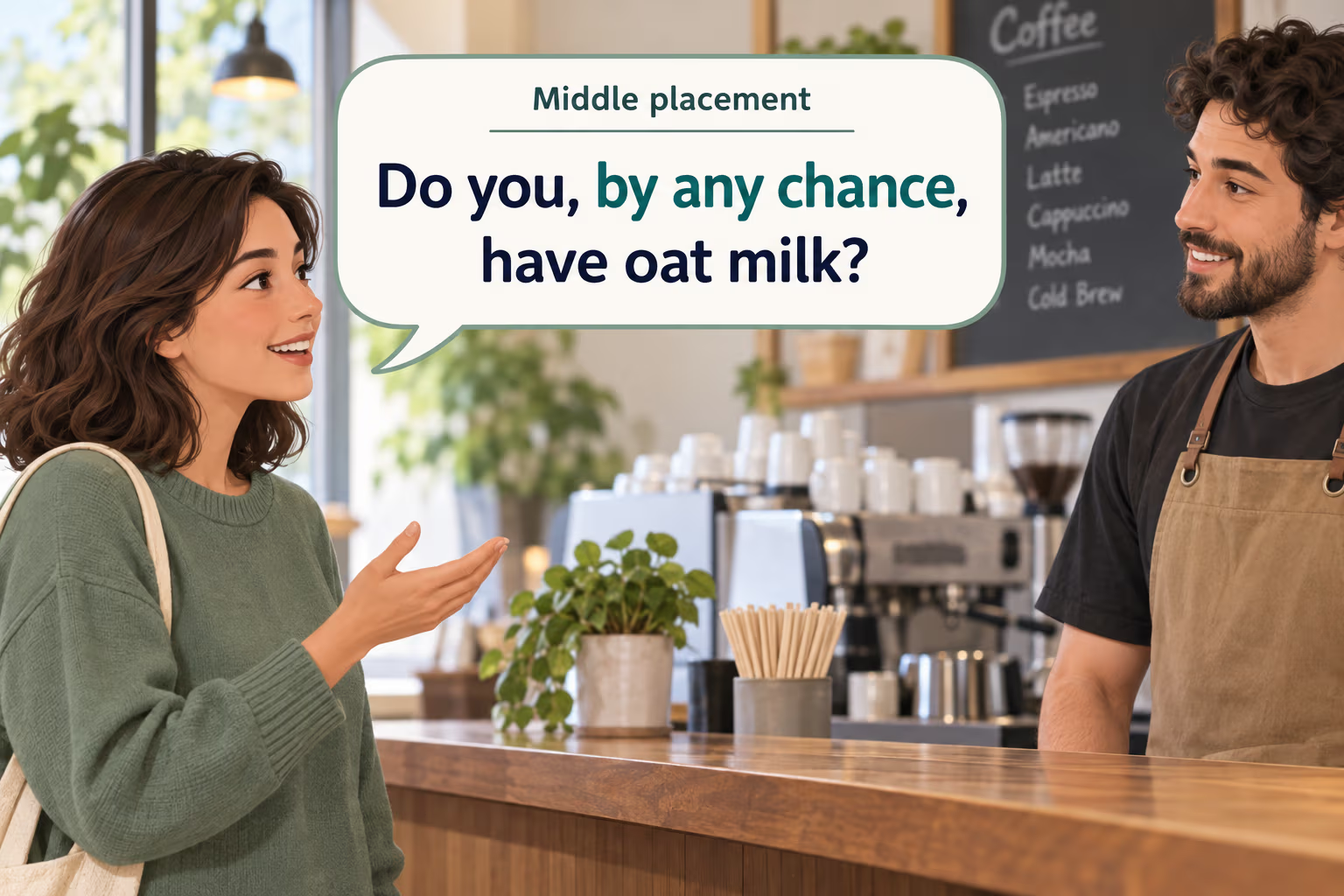
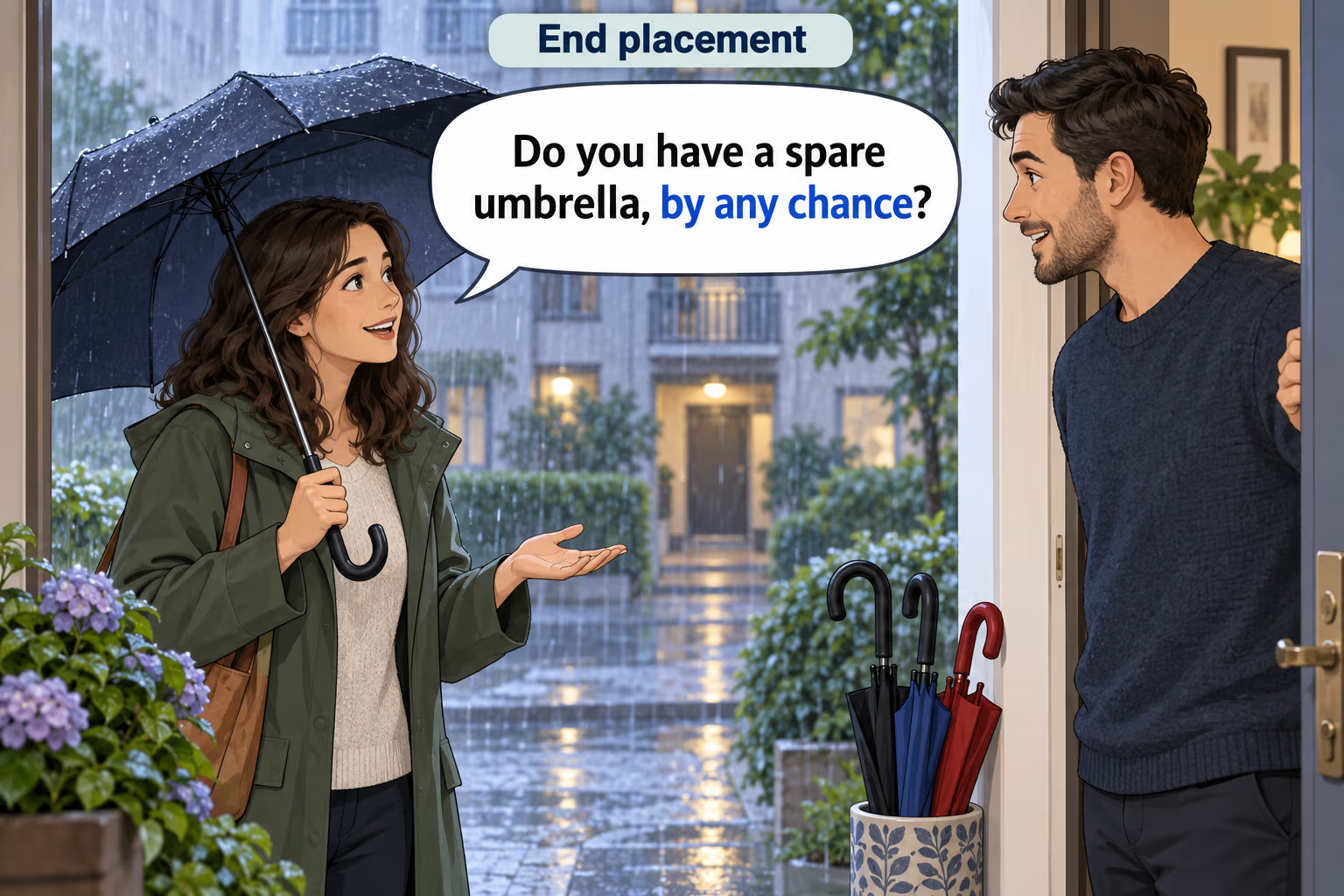
It can appear at the beginning, in the middle, or at the end of a question: “By any chance, do you know the room number?”; “Do you, by any chance, know the room number?”; or “Do you know the room number, by any chance?” Choose the position that sounds natural in the sentence.
Commas depend on how the phrase fits the sentence. A comma commonly follows an opening phrase (“By any chance, is the office open?”); paired commas can set off a parenthetical middle phrase (“Is the office, by any chance, open?”); and a comma often comes before the phrase at the end of a question (“Is the office open, by any chance?”). The paired commas are not a mandatory mark around every occurrence: when the phrase is integrated into the question, punctuation can follow the sentence’s structure and house style.
Keep the question’s normal word order, too: “Do you have a minute, by any chance?” is a question; “You have a minute, by any chance?” may work as a conversational question with rising intonation, but it is not the neutral written pattern.
7 Examples Of By Any Chance Used In a Sentence For Kids
- By any chance, did you bring your favorite book to school today?
- By any chance, can you help me count these colorful blocks?
- By any chance, did you see a butterfly fluttering outside?
- By any chance, would you like to share your toys with a friend?
- By any chance, have you ever seen a rainbow after the rain?
- By any chance, do you know the name of the bird chirping in the tree?
- By any chance, would you like to color a picture with me?
14 Sentences with By Any Chance Examples
- By any chance, do you have an extra pen I could borrow for the exam?
- I was wondering, by any chance, did you attend the guest lecture last week?
- By any chance, have you seen my calculator? I think I left it in the study room.
- Could you, by any chance, send me the notes from yesterday’s class?
- By any chance, are you going to the library later? I could use some company for studying.
- By any chance, do you know if our assignment deadline got extended?
- By any chance, are you free this weekend to work on the group project?
- Do you know by any chance where I can find past year question papers for practice?
- By any chance, have you tried the new cafe near campus?
- By any chance, could you help me with understanding this concept for the upcoming test?
- I was wondering, by any chance, if you know any good study spots other than the library?
- By any chance, have you heard about the internship opportunity with that company?
- By any chance, do you have a spare laptop charger I could borrow for a few hours?
- I was thinking, by any chance, could you recommend a good tutor for this subject?
How To Use By Any Chance in Sentences?
By Any Chance is a common expression used to ask about the possibility of something being true or happening without showing too much certainty or formality.
When using By Any Chance in a sentence, keep in mind the following guidelines:
-
Placement: Typically, By Any Chance is placed at the beginning or end of a sentence. For example, “Do you have a pen by any chance?” or “Is Sarah coming with us, by any chance?”
-
Tone: It is used to soften a question or request, making it sound more polite and less direct.
-
Informal: By Any Chance is considered more informal and colloquial, suitable for situations where you want to show courtesy or make a casual inquiry.
-
Surprise: It can also be used to express surprise or doubt about a situation. For instance, “Are you related to the famous actor, by any chance?”
-
Variations: You can also use phrases like “By any possibility” or “In any case” to convey a similar meaning.
Learning how to use By Any Chance effectively can help you engage in more polite and respectful conversations. Practice incorporating this expression in your daily interactions to sound more natural and considerate in your communication.
Conclusion
In conclusion, using phrases like “by any chance” in sentences can help soften requests, make inquiries in a polite manner, or express slight doubts or possibilities. This kind of language can help communicate in a more approachable and courteous way, showing consideration for the listener’s perspective and feelings. By incorporating such phrases into our communication, we can enhance the clarity and effectiveness of our message while also maintaining a friendly and respectful tone.
Whether seeking a favor, asking for information, or subtly suggesting a potential outcome, the use of phrases like “by any chance” can add a touch of politeness and consideration to our interactions. These small linguistic adjustments can make a significant difference in how our messages are received, fostering better communication and stronger connections with others in various situations.


