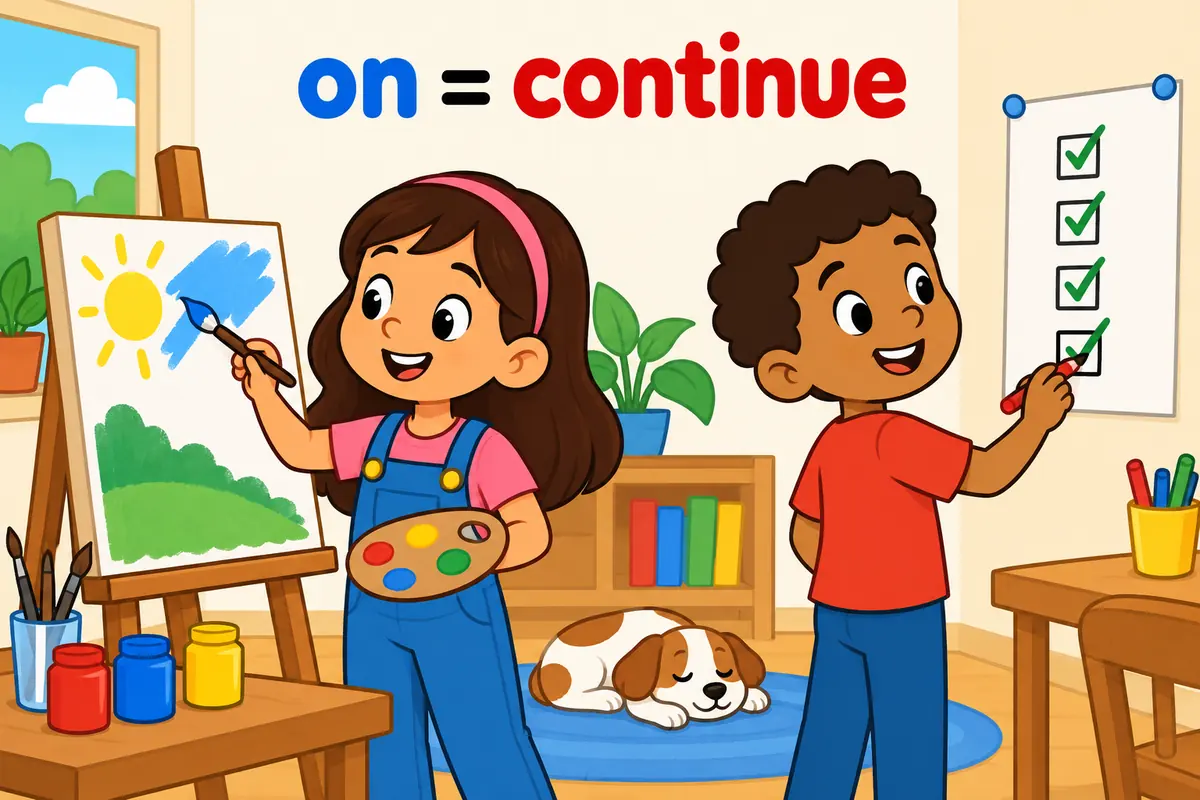
Carry on means to keep doing something after a pause or a difficulty. To use carry on in a sentence, let the action continue and add with before a noun: “Carry on with the lesson.” The phrasal verb is inseparable, so the particle on stays tight against the verb and never drifts to the end.
Carry on at a glance
- Carry on is an inseparable phrasal verb; the particle on stays beside the verb.
- Its main sense is to continue an activity, used alone or with with plus a noun.
- A British informal sense means to behave noisily or foolishly.
- A third informal sense means to have a secret romantic affair with someone.
- The hyphenated noun carry-on means a fuss, or a piece of hand luggage.
What does carry on mean?
Carry on is an inseparable phrasal verb meaning to continue doing something. The Cambridge entry for carry on records the main sense and two informal senses, and the context decides which one a speaker intends.
| Sense | Plain meaning | Example sentence |
|---|---|---|
| Continue | Keep doing what was already under way | Carry on with your reading. |
| Behave noisily | Act foolishly or dramatically, informal | The children carried on all afternoon. |
| Have an affair | Continue a secret relationship, informal | He was carrying on with a colleague. |
| Noun: carry-on | A fuss, or cabin luggage | There was a huge carry-on at the gate. |
In its plainest sense carry on simply means to continue after an interruption, though a formal minute may prefer to proceed with the agenda. The informal sense, by contrast, sits closer to misbehave than to continuing anything, which is why context decides which reading a listener takes.
One limitation is worth stating plainly. Carry on never means to finish or complete something; it means the action survives an interruption and keeps going. Where the actor completes a task or obeys an order, carry out is the correct member of the family, and the two are not interchangeable.
How do you use carry on in a sentence?
Carry on is inseparable, so the particle never leaves the verb, and the object is added with with or sits after the whole phrase. Five patterns cover nearly every real sentence.
| Pattern | Example | What it signals |
|---|---|---|
| carry on (no object) | Carry on as if nothing happened. | Intransitive continue, the plainest use. |
| carry on + with + noun | Carry on with your homework. | The standard way to name what continues. |
| carry on + noun | We carried on the family business. | Transitive continue; the particle stays with the verb. |
| carry on + -ing | She carried on talking through the noise. | A participle follows directly, with no with. |
| be carrying on | The kids were carrying on upstairs. | Progressive form, usually the informal misbehave sense. |
Because the verb is inseparable, the object can never sit between carry and on. A sentence such as the team carried the project on is possible only if you mean a different, separable verb, and most editors would rewrite it as the team carried on with the project.
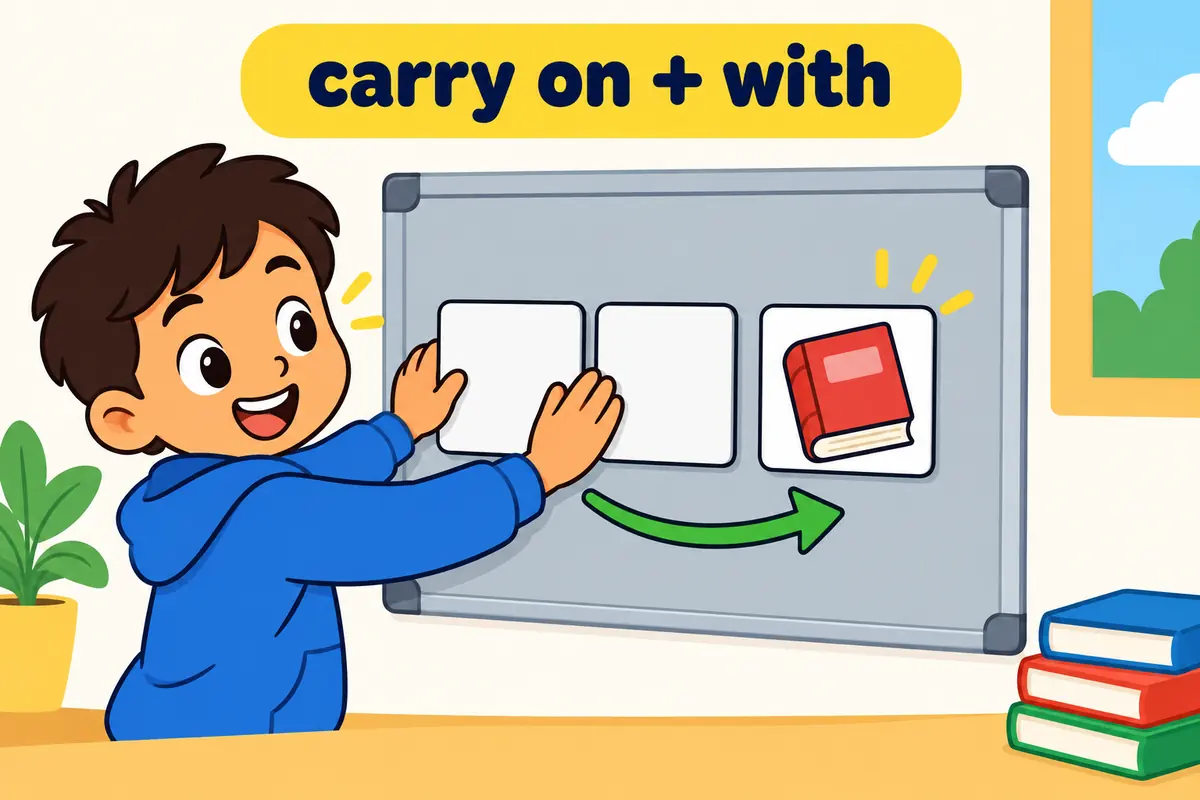
Carry on in a sentence: examples across contexts
Carry on shifts register more than it shifts meaning. The nine sentences below move from a classroom to a news desk, and each one shows how the same phrasal verb adapts.
| Context | Example sentence | Why this works |
|---|---|---|
| Classroom | Carry on with the next three questions while I check. | A direct instruction with with plus a noun. |
| Workplace email | Please carry on with the audit until Friday. | Polite continuation with a clear endpoint. |
| News report | Rescue teams carried on through the night. | The intransitive form suits a continuing effort. |
| Conversation | Sorry to interrupt; carry on with your story. | The everyday use after an apology. |
| Sports commentary | The midfielder carried on despite the knock. | Shades toward endurance under strain. |
| Parent to child | The twins carried on all the way home. | The informal sense of behaving noisily. |
| Formal writing | The inquiry will carry on with its scheduled hearings. | Keeps the verb but avoids the informal senses. |
| Business report | The firm carried on trading during the review. | Transitive use about a business continuing operations. |
| Narrative | She carried on as though the letter had never arrived. | The as-if clause shows a deliberate choice to continue. |
A collocation note: carry on pairs naturally with with, as if and regardless. Learners who write carry on the work hardly sound slightly translated; the natural phrasing is carry on with the work.
Carry on vs carry out
Carry on shares its base verb with carry out and carry over, and the particle decides which meaning applies. The three are never interchangeable, even though all three are standard English.
| Attribute | carry on | carry out | carry over |
|---|---|---|---|
| Core meaning | Continue an activity | Perform or complete a task | Transfer to a later time |
| Typical object | None, or with + an activity | A plan, order, test or promise | An unused amount or a skill |
| Separable | No | Yes, carry the plan out | Yes, carry the total over |
| Implied endpoint | None; the action goes on | Yes; the task is finished | Yes; a new period begins |
| Register | Neutral, often spoken | Neutral to formal | Business and accounting |
Verdict: choose carry on to keep an activity going, carry out to complete a specific task, and carry over to move something into the next period. Only carry out and carry over allow the object to sit between the verb and the particle.
Word forms and grammar of carry on
Carry on inflects through carry, and its noun is written with a hyphen. The table lists the forms learners most often misspell.
| Form | Part of speech | Example |
|---|---|---|
| carry on | phrasal verb, base form | Carry on with the rehearsal. |
| carries on | phrasal verb, third person singular | She carries on regardless of the noise. |
| carried on | phrasal verb, past and past participle | They carried on until dawn. |
| carrying on | phrasal verb, present participle | He kept carrying on about the delay. |
| carry-on | noun, hyphenated | The carry-on at reception lasted an hour. |
| carry-ons | noun, plural | Two carry-ons fit in the overhead locker. |
Two spellings trip up learners: writing carryon as one word for the verb, and writing carry on as two words for the noun. The hyphen belongs only to the noun.
Common mistakes with carry on
- Incorrect:
Carry on you work.Correct: Carry on with your work. Rule: A noun object needs with, because the verb is inseparable. - Incorrect:
Please carry the work on.Correct: Please carry on with the work. Rule: The particle on never separates from carry in this sense. - Incorrect:
The team carried on the project to finish it.Correct: The team carried out the project to finish it. Rule: Completing a task is carry out, not carry on. - Incorrect:
There was a carry on at the gate.Correct: There was a carry-on at the gate. Rule: The noun is hyphenated; only the verb is two separate words.
Practice using carry on
Work through the six items, then read the reason beside each answer.
- Fill the gap: After the fire alarm, the class ______ with the experiment.
- Choose the better phrasal verb: The officer (carried on / carried out) the inspector’s orders.
- Correct the error: We carried the meeting on after the break.
- Build a sentence: use carry on + with about a musician continuing a rehearsal.
- Spot the register: which belongs in a formal report — the review will carry on, or the review will keep carrying on?
- Rewrite with the noun: There was a lot of fuss at the desk. Use carry-on instead.
Answers
- carried on — the activity resumes after the interruption.
- carried out — completing orders is carry out, which is separable.
- We carried on with the meeting after the break — the verb never splits.
- Model answer: The violinist carried on with the rehearsal despite the broken string.
- The review will carry on — a report avoids the repeated progressive and keeps the verb plain.
- There was quite a carry-on at the desk — the noun takes a hyphen.
The bottom line
Use carry on in a sentence to say that an activity continues, adding with before any noun that names the activity, and remember that the verb never splits. Two nuances decide most examples: the particle on keeps the verb closed, and the informal senses of behaving noisily or having an affair belong to speech. When the action reaches an end, carry out is the right member of the family, and when a task calls for patience under strain, endure often says it better.
Frequently asked questions about carry on
Is carry on one word or two?
The verb is always two words, carry on, as in please carry on. The hyphenated noun carry-on is different: it means a fuss or a bag you take onto a plane. So you carry on working, but you pack a carry-on. The spelling depends entirely on whether you are using the verb or the noun.
What does carrying on mean in British English?
In British English carrying on has a second life as an informal verb for behaving noisily, foolishly or dramatically. A teacher might say the class was carrying on, meaning the pupils were making a commotion. It is not rude in itself, but it signals mild disapproval, and it sits firmly in speech rather than formal writing.
Is carry on separable?
No. Carry on is inseparable, so the particle stays next to the verb and the object follows it, as in carry on with the work. You cannot say carry the work on. This is the opposite of a separable phrasal verb such as switch off, where the object may sit between the verb and its particle.
Can carry on be used as a noun?
Yes, but only in the hyphenated form carry-on. It means a commotion or a fuss, as in there was a right carry-on at the desk. It also names a small bag allowed in an aircraft cabin. The noun takes a plural, carry-ons, while the verb keeps its two separate words in every tense.
Have you ever come across the term “carry on” in conversation or writing and wondered what it really means? When someone says “carry on,” they are typically advising you to continue with what you are doing or saying without letting anything disrupt or distract you.
In English, the phrase “carry on” is commonly used to suggest that one should persevere, move forward, or keep going in a particular situation or activity. It can be a simple way to encourage someone to persist despite challenges or obstacles they may be facing.
7 Examples Of Carry On Used In a Sentence For Kids
- Let’s carry on playing games in the playground.
- You can carry on drawing pictures of animals.
- Remember to carry on sharing your toys with your friends.
- It’s important to carry on being kind to everyone in the class.
- Don’t forget to carry on listening to your teacher during the lesson.
- Let’s carry on singing the rhymes we learned in class.
- We will carry on learning new words in our English lesson.
14 Sentences with Carry On Examples
- Carry on studying for your upcoming exams.
- Make sure to carry on with your group project discussions.
- Don’t forget to carry on submitting your assignments on time.
- It’s important to carry on participating in extracurricular activities.
- Remember to carry on networking with your classmates.
- Carry on exploring internship opportunities to gain practical experience.
- Don’t give up and just carry on working towards your goals.
- Make sure to carry on attending all your lectures and workshops.
- Don’t get distracted, just carry on focusing on your academics.
- Always remember to carry on learning new skills outside the classroom.
- Keep a positive attitude and carry on facing challenges with determination.
- Carry on seeking guidance from professors whenever you need help.
- Don’t hesitate to carry on seeking mental health support if needed.
- Stay connected with your friends and family as you carry on with your studies.
How To Use Carry On in Sentences?
To use Carry On in a sentence, follow these steps:
-
Identify when to use “Carry On”: “Carry On” is a phrasal verb that means to continue doing something, despite difficulties or interruptions.
-
Find the right place: “Carry On” is typically used in informal situations, like conversations with friends or family. It is not commonly used in formal writing.
-
Choose the right context: Determine if you want to use “Carry On” to encourage someone to keep doing a task, to describe your own actions of continuing despite obstacles, or to describe the actions of others.
-
Construct the sentence: Start with the subject (the person or thing performing the action), followed by the verb “Carry On,” and then the rest of the sentence. For example, “Despite the rain, Sarah decided to carry on with her outdoor picnic plans.”
-
Revise if necessary: Make sure the context is clear and the sentence flows well. You can also try using synonyms of “Carry On,” like “continue,” “persevere,” or “persist,” to see if they fit better in the sentence.
-
Practice: The best way to learn how to use “Carry On” in a sentence is to practice using it in different contexts. Pay attention to how others use it in conversations or in books.
Remember, using “Carry On” effectively takes practice, so don’t be afraid to experiment with different sentence structures and contexts to find what works best for you.
Conclusion
In conclusion, the examples of sentences with “carry on” demonstrate the versatility and common usage of this phrase in everyday language. Whether it is used to indicate continuing an action or behavior, as in “I will carry on studying,” or to suggest perseverance and determination, like in “Despite the challenges, she decided to carry on,” the phrase “carry on” is a simple yet powerful way to convey a range of messages. It can serve as a reminder to stay focused, keep moving forward, and not give up in the face of obstacles.
Overall, the various ways in which “carry on” can be used in sentences highlight its importance in communication and encouraging persistence. By embracing the meaning behind these words and incorporating them into our language, we can remind ourselves and others to press on with determination and resilience in pursuit of our goals.