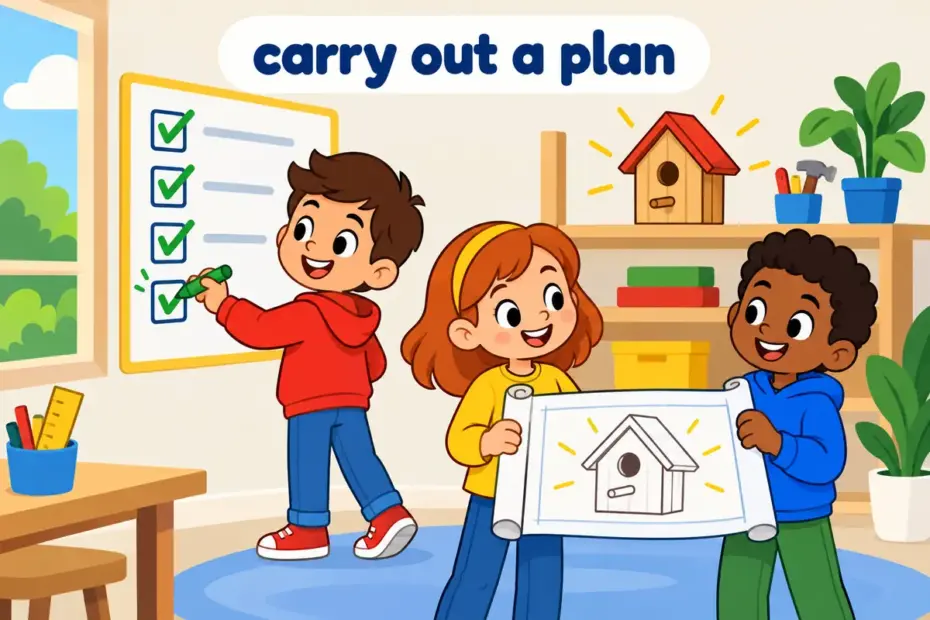
Carry out means to perform or complete a task, plan, order or test that someone has decided on. To use carry out in a sentence, put the doer as the subject and the task as the object: “The team carried out a safety check.” The phrase is transitive and separable, so carried the check out also works.
Carry out at a glance
- Carry out is a transitive phrasal verb: it always takes an object such as a task or a plan.
- It is separable, so the particle can move after the object: carry the plan out.
- The phrase is neutral in register and common in business, science and the military.
- The strongest collocations are carry out a check, a plan, an order and research.
- The commonest error is using carry out for physically moving something.
What does carry out mean?
Carry out is a phrasal verb meaning to perform or complete something that has been decided, ordered or planned. The Cambridge entry for carry out records that sense and also the literal one of taking something outside, which is why context has to make the meaning clear.
| Sense | Plain meaning | Example sentence |
|---|---|---|
| Perform a task | Do work that was planned | The team carried out a safety check. |
| Obey an order | Put an instruction into effect | Soldiers carried out the order at dawn. |
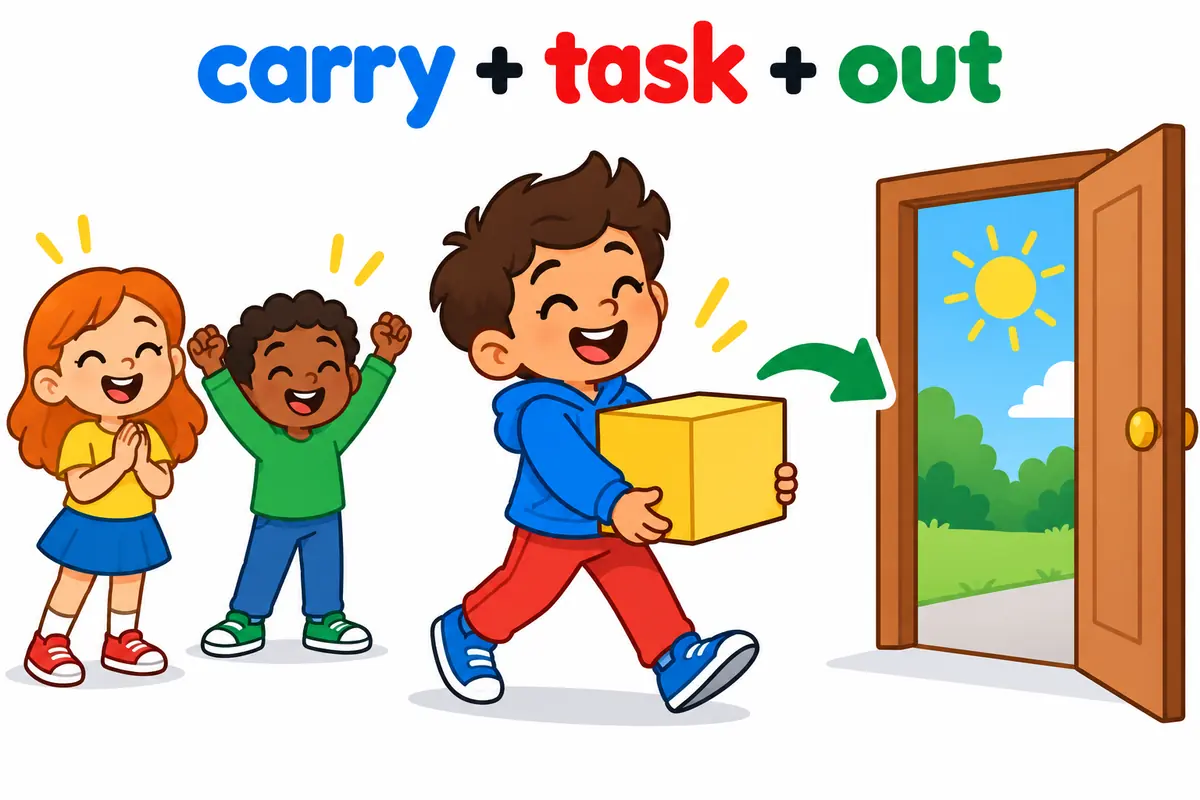
| Take outside | Move something to the open air | She carried the boxes out to the van. |
Carry out is the wrong verb for a one-off physical action with no plan behind it; lift, move or take out is then the plain choice.
How do you use carry out in a sentence?
Carry out names work that somebody conducts and completes, so the patterns below all keep a task in the object slot.
| Pattern | Example | What it signals |
|---|---|---|
| carry out + a task | The auditors carried out a full review. | Names planned work that reaches completion. |
| carry out + an order | The unit carried out the order without delay. | Frames the action as obedience. |
| carry out + research | The lab carried out the survey twice. | Points to a formal procedure. |
| carry + object + out | They carried the repair out overnight. | Uses the separable order for a long object. |
| carry out + the plan | We carried out the plan exactly as written. | Signals execution of a stated design. |
Carry out in a sentence: examples across contexts
Carry out appears wherever planned work must be seen through to the end, from laboratories to construction sites.
| Context | Example sentence | Why this works |
|---|---|---|
| Workplace email | We will carry out the migration over the weekend. | Project work names the task being completed. |
| Science report | The team carried out three trials of the new coating. | Formal research favours the phrase. |
| Military briefing | The patrol carried out its orders before sunrise. | Orders and obedience belong together. |
| Healthcare | Nurses carried out the checks on every ward. | Procedures are carried out, not simply done. |
| News report | Inspectors carried out an unannounced visit. | Journalism uses it for official action. |
| Conversation | Please carry out the plan and call me when it is done. | Everyday speech still keeps the object. |
| Legal writing | The trustee must carry out the terms of the will. | Duties are carried out to the letter. |
| Construction | Engineers carried out a stress test on the bridge. | Technical work runs through the phrase. |
Carry out vs carry on
Carry out and carry on share the verb carry but split on meaning, because one finishes a task and the other simply keeps going.
| Attribute | carry out | carry on |
|---|---|---|
| Core meaning | Perform or complete a task | Continue doing something |
| Object | A task, plan or order | Usually no object, or an activity |
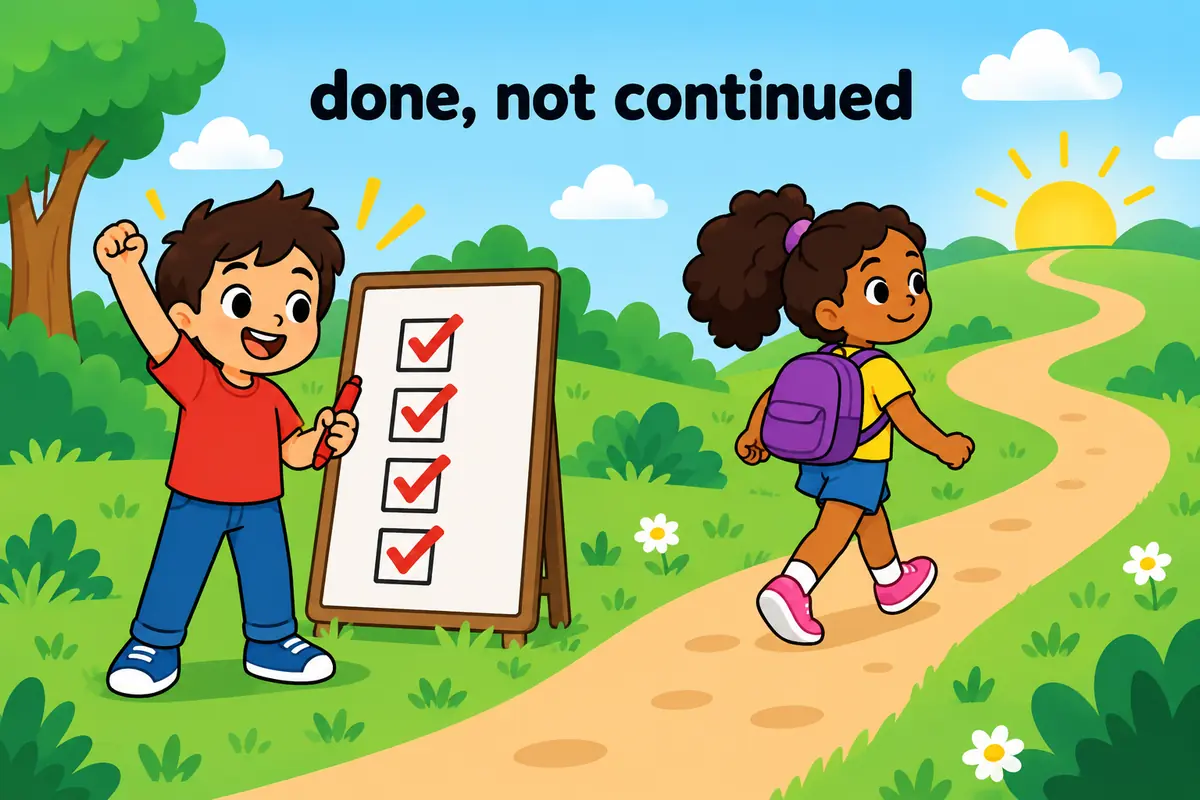
| Focus | Reaching completion | Not stopping |
| Typical setting | Business, science, military | Everyday and spoken English |
| Example | carry out a check | carry on working |
Choose carry out when an object must be completed, and carry on when nothing needs finishing.
Word forms and grammar of carry out
Carry out inflects on carry alone, and it behaves like other separable phrasal verbs, including ones built from the particle out.
| Form | Part of speech | Example |
|---|---|---|
| carry out | phrasal verb, base | They carry out the plan weekly. |
| carries out | third-person singular | The clerk carries out the checks. |
| carried out | past tense and participle | We carried out the repair. |
| carrying out | present participle | The team is carrying out a review. |
| carry out (non-standard) | word-order error | Wrong: carry out it. Right: carry it out. |
| carry on | different phrasal verb | Please carry on with your work. |
Common mistakes with carry out
Most carry out errors come from word order or from using the phrase to mean physical movement. To put a policy into effect, writers prefer implement a policy when the tone is very formal.
- Incorrect:
Please carry out the boxes to the truck.Correct: Please carry the boxes out to the truck. Rule: The phrasal verb carries out a task; moving objects uses carry plus out as a direction. - Incorrect:
We carried out it yesterday.Correct: We carried it out yesterday. Rule: When the object is a pronoun, the particle must follow it. - Incorrect:
The plan was carried out irresponsibly by the manager.Correct: The plan was carried out under the manager’s supervision. Rule: Carry out means to perform, not to perform badly or to supervise. - Incorrect:
She carried out her breath.Correct: She carried out her duty. Rule: The object must be a task, plan, order or procedure, not a bodily action.
Practice using carry out
Work through the six items, then read the reasoning rather than only the answers.
- Fill the gap: The lab ______ three tests before publishing the result.
- Choose the better word: The workers will (carry out / carry on) the repairs tonight.
- Correct the error: The nurse carried out it before lunch.
- Build a sentence: use carry out a survey about a school asking pupils about lunches.
- Spot the register: which belongs in a science report — the team carried out a controlled trial, or the team had a go at testing it?
- Rewrite with the pronoun object: They carried out the order at once. Use it.
Answers
- carried out — the lab performed planned tests, which is the core sense.
- carry out — the repairs will be completed, not continued, so carry on is wrong.
- The nurse carried it out before lunch — a pronoun object must sit between verb and particle.
- Model answer: Pupils carried out a survey about school lunches and shared the results.
- The team carried out a controlled trial — a report keeps the formal phrasal verb.
- They carried it out at once — the pronoun splits the separable phrasal verb.
The bottom line
Use carry out in a sentence when somebody performs a task, plan, order or procedure that was already decided. Two nuances settle most sentences: the verb is transitive and separable, so a pronoun object must sit between carry and out, and it means perform, not physically move. For the general sense of finishing something, perform a task is a close formal synonym.
Frequently asked questions about carry out
Is carry out separable?
Yes. The particle out can move to follow the object, so both carry out the plan and carry the plan out are correct. A pronoun, however, must go between the verb and the particle, giving carry it out. Writing carry out it is the commonest word-order mistake learners make.
What is the difference between carry out and carry on?
Carry out means perform or complete a task, and it needs an object such as a plan or an order. Carry on means continue doing something and usually takes no object, as in carry on working. The shared verb carry makes the two easy to confuse, but the particles change the meaning completely.
Is carry out formal?
Carry out is neutral and appears in business, science and military writing, so it suits reports and instructions. In very relaxed speech people often say do instead, as in do the checks. The phrasal verb still works in conversation when the task sounds official or planned.
Does carry out always need an object?
Yes. Carry out is transitive, so a task, plan, order or procedure must follow it. Leaving the object out, as in the team carried out, makes the sentence incomplete. If no object is needed, the speaker probably wants carry on or get on with instead.
Have you ever wondered what it really means to “carry out” a task or project? When we talk about carrying out something, we are referring to the act of completing or performing a specific action or assignment.
To carry out a task involves taking the necessary steps to bring it to fruition, whether it’s following a set of instructions, executing a plan, or simply realizing an idea. It is about putting an idea or concept into action and seeing it through until completion.
7 Examples Of Carry Out Used In a Sentence For Kids
- Carry out your pencil and eraser in your pencil case.
- Make sure to carry out your lunch box and water bottle for lunchtime.
- Remember to carry out your homework folder before leaving for home.
- Let’s carry out the activity the teacher has assigned us.
- Can you help me carry out these toys to the playground?
- It’s important to carry out our classroom tasks before school ends.
- We need to carry out our teacher’s instructions carefully.

14 Sentences with Carry Out Examples
- Carry out research before choosing a college for higher studies.
- Make sure to carry out regular maintenance checks on your laptop to avoid any technical issues.
- It is important to carry out your assignments diligently to secure good grades.
- Always carry out experiments carefully in the science lab to avoid accidents.
- Don’t forget to carry out self-assessments to track your progress in academics.
- Carry out group study sessions to better understand difficult topics.
- Ensure you carry out proper time management to balance your academics and extracurricular activities.
- Carry out campus placements to explore career opportunities before graduation.
- Participate in social events to carry out community service and give back to society.
- It is necessary to carry out internships to gain real-world experience in your field of study.
- Always carry out peer reviews for feedback on your academic work.
- Attend career counseling sessions to carry out aptitude tests for better career decisions.
- Students should carry out volunteer work to build their resume and gain practical skills.
- Carry out campus research projects to contribute to your academic learning and personal growth.

How To Use Carry Out in Sentences?
To use Carry Out in a sentence, you need to remember that it is a phrasal verb that means to complete a task or action. Here is a simple guide for beginners on how to use it effectively:
- Identify the task: Before using Carry Out in a sentence, you need to identify the specific task or action that you or someone else will be completing.
- Choose the subject: Determine who is going to Carry Out the task. This could be yourself, someone else, or a group of people.
- Structure the sentence: Start your sentence with the subject, followed by the phrase “Carry Out,” and then the task that is being completed. For example, “She will carry out the experiment tomorrow.”
- Be clear and concise: Make sure your sentence is clear and direct. Avoid using unnecessary words or complicated phrases that could confuse the meaning.
- Practice using it in context: To become more comfortable with using Carry Out in sentences, try incorporating it into your daily conversations or writing exercises. This will help reinforce your understanding and usage of the phrase.
By following these steps, you can effectively incorporate Carry Out into your sentences to convey that a task or action has been completed. Remember to keep your sentences clear and concise to ensure that your message is easily understood.

Conclusion
In conclusion, the importance of properly carrying out tasks and responsibilities cannot be overstated. Efficiently executing plans and following through on commitments is essential for achieving success in various aspects of life, whether it be in work, relationships, or personal goals. By diligently carrying out tasks, individuals can demonstrate their reliability and commitment, leading to positive outcomes and opportunities for growth.
Moreover, effective communication and organization play a crucial role in ensuring that tasks are carried out smoothly and effectively. Clear instructions and regular follow-ups can help in avoiding misunderstandings and ensuring that objectives are met efficiently. Overall, the ability to carry out tasks with precision and dedication is a valuable skill that can contribute significantly to personal and professional success.