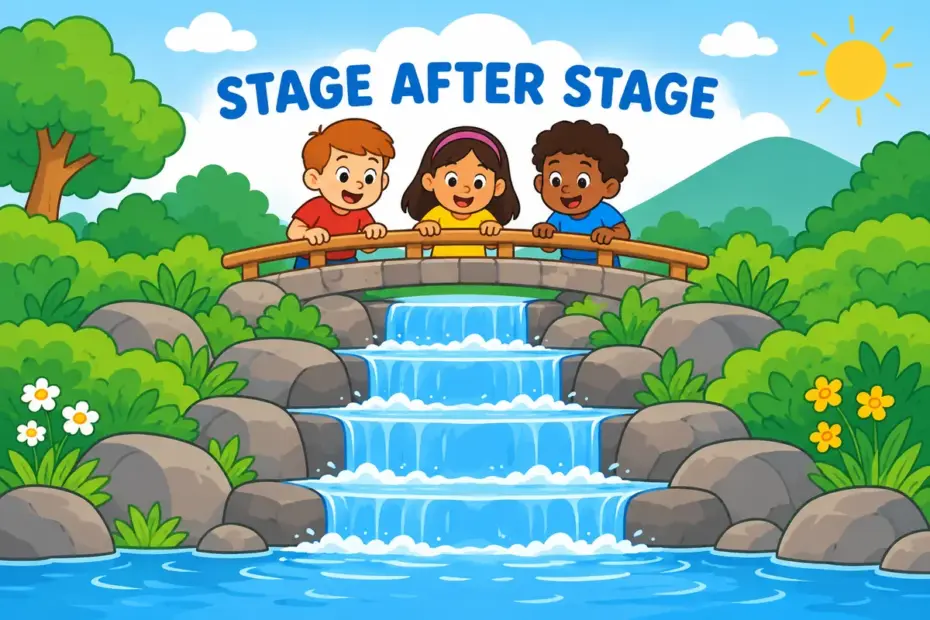
Cascade means a small waterfall, or a chain of events in which each stage triggers the next. To use cascade in a sentence, decide whether it is a noun or a verb: “a cascade of errors followed the outage” uses the noun, while “the water cascaded over the rocks” uses the verb.
Cascade at a glance
- Cascade is both a noun and a verb, with a waterfall sense and a chain-of-events sense.
- As a verb it usually describes liquid, light or sound falling in stages.
- The noun is countable and often appears as a cascade of plus a plural noun.
- The dominant collocation is a cascade of events, failures, changes or effects.
- The commonest error is making the verb transitive, as in she cascaded the papers.
What does cascade mean?
Cascade is a noun and a verb meaning a small waterfall, or a sequence in which each part sets off the next. The Cambridge entry for cascade keeps the water sense and the chain sense together, and the grammar is what separates them: the water sense is concrete, while the chain sense is usually abstract.
| Sense | Plain meaning | Example sentence |
|---|---|---|
| Waterfall, noun | A small fall of water, often in stages | A narrow cascade tumbled into the pool. |
| Chain of events, noun | A sequence where each stage triggers the next | A cascade of faults brought down the power grid. |
| Fall in stages, verb | To flow or fall like a small waterfall | Rainwater cascaded down the cliff face. |
| Pass down, verb | To send information or effects downward | The results cascade to every regional office. |
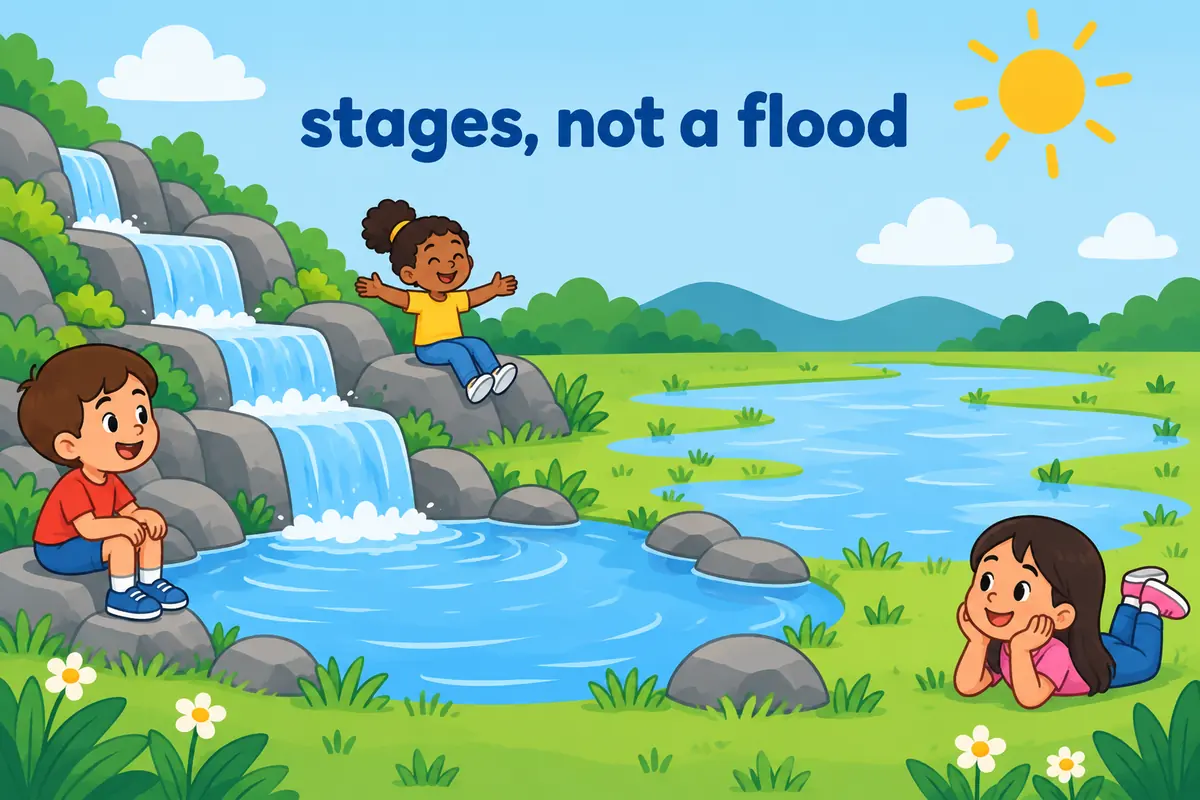
One limitation is worth stating plainly. Cascade is not a general word for flooding, and it is not truly a synonym for a waterfall. A flood spreads as one body of water, while a cascade arrives in separate falling stages, which is the detail the noun always keeps.
How do you use cascade in a sentence?
The noun needs a chain to describe, and the verb needs a preposition of direction such as down, over or through. Five patterns cover almost every real sentence, and the verb stays intransitive throughout.
| Pattern | Example | What it signals |
|---|---|---|
| a cascade of + plural noun | A cascade of small faults delayed the flight. | Chains several countable events into one image. |
| cascade + down/over/from | Water cascaded over the weir. | The verb with a preposition of direction. |
| cascade through + place | Cheers cascaded through the stadium. | Sound or feeling moving in waves through space. |
| cascade to + recipient | The changes cascade to every branch. | Information passing down a hierarchy. |
| cascade + noun (business) | Managers cascade targets to their teams. | Corporate use that some readers find jargon. |
Notice that no pattern puts a direct object straight after the verb. You cascade, or something cascades; nothing is cascaded. The related verb flow behaves the same way, which is why the two often appear in the same description.
Cascade in a sentence: examples across contexts
Cascade moves easily between water, sound, data and business, so context decides which sense is live. The nine sentences below keep the chain idea visible, and each one shows whether the word is a noun or a verb.
| Context | Example sentence | Why this works |
|---|---|---|
| Classroom | A cascade of claps spread around the hall after the play. | Uses the noun for sound moving in waves. |
| News report | The outage set off a cascade of train cancellations. | Chains clear events with a cause at the front. |
| Engineering | Water cascaded over the spillway during the storm. | Uses the verb with a preposition of direction. |
| Business email | We will cascade the figures to each regional lead on Friday. | Shows the pass-down sense in workplace language. |
| Weather writing | Rain cascaded from the gutter onto the path below. | Names the source and the direction of the fall. |
| Computing | One bad update created a cascade of broken links. | Treats software faults as a countable chain. |
| Academic writing | The hormone triggers a cascade of chemical reactions. | Keeps the noun technical and sequential. |
| Conversation | Then came a whole cascade of little problems. | Uses the noun loosely for everyday mishaps. |
| Sports writing | Applause cascaded down the stands as the team walked off. | Applies the verb to sound rather than water. |
Two of these rows describe water and the rest describe something moving like water. That borrowed motion is what overflow shares with cascade, though overflow stresses the excess rather than the stages.
Cascade vs waterfall and flood
Cascade sits between two words it resembles without matching. A waterfall is a single large drop, and a torrent is a violent, fast-moving rush of water.
| Attribute | cascade | waterfall | flood |
|---|---|---|---|
| Core image | Water or events falling in stages | One tall drop of water | Water spreading over dry land |
| Number of stages | Several, linked one to the next | Effectively one | One continuous spread |
| Figurative use | Common: faults, data, feelings | Rare | Common: of complaints, calls, tears |
| Usual scale | Small to medium, in steps | Large, in one place | Wide, overwhelming |
| Works as a verb | Yes, intransitive | No | Yes, often transitive |
Verdict: choose waterfall for one big drop, flood for water or messages spreading as a single mass, and cascade when the point is that each stage sets off the following one, whether the subject is water, sound or a chain of failures.
Word forms and grammar of cascade
Cascade inflects regularly, and the same spelling serves as noun and verb, so only the surrounding words show the difference. The table also marks the transitive use that should be avoided.
| Form | Part of speech | Example |
|---|---|---|
| cascade | noun, singular | A cascade of leaves blocked the drain. |
| cascade | verb, base form | The lights cascade in a fixed order. |
| cascades | noun plural and verb, third person | The cascades freeze in winter; water cascades down the steps. |
| cascaded | verb, past and past participle | The news cascaded through the office. |
| cascading | verb, present participle | Cascading water hid the cave mouth. |
| cascaded the file | non-standard transitive use – avoid | write the file cascaded to the team instead |
Computing has its own fixed phrases with the same word, including cascading style sheets, and a page on cascading shows the participle in that technical role.
Common mistakes with cascade
- Incorrect:
The water cascaded the rocks.Correct: The water cascaded over the rocks. Rule: Cascade is intransitive, so it needs a preposition before the surface. - Incorrect:
There was a cascade of one small problem.Correct: There was a cascade of small problems. Rule: The chain sense needs a plural or a collective noun. - Incorrect:
A cascade of water spread across the field.Correct: A pool of water spread across the field. Rule: Cascade means falling stages, not a single spreading body of water. - Incorrect:
He cascaded down the stairs.Correct: He tumbled down the stairs. Rule: Cascade suits liquid, light, sound or abstract sequences, not people. - Incorrect:
The cascade waterfall was loud.Correct: The cascade was loud. Rule: Cascade already contains the waterfall image, so the extra noun is redundant.
Practice using cascade
Work through the six items, then check the reasoning rather than only the answer.
- Fill the gap: One delayed delivery set off a ______ of missed orders.
- Choose the better word: After the storm, (a cascade / a flood) of muddy water covered the whole lane.
- Correct the error: Rain cascaded the roof all night.
- Build a sentence: use cascade to about new rules reaching local offices.
- Spot the register: which belongs in a technical report – a cascade of sensor failures triggered the alarm, or loads of little faults set the alarm off?
- Rewrite as a verb: A cascade of light fell through the window. Start with The light.
Answers
- cascade – the missed orders form a chain of separate stages.
- a flood – the water spreads as one body, so the waterfall-stage sense does not fit.
- Rain cascaded off the roof all night – the intransitive verb needs a preposition.
- Model answer: The new rules cascade to every local office in turn.
- A cascade of sensor failures triggered the alarm – a report keeps the technical noun and drops the casual phrasing.
- The light cascaded through the window – cascaded is the intransitive verb form.
The bottom line
Use cascade in a sentence for water or events that fall in linked stages, and decide first whether the word is a noun or a verb. The two points that decide most sentences are these: the noun normally appears as a cascade of plus a plural, and the verb is intransitive so it takes a preposition rather than an object. When the motion is one continuous rush, waterfall or surge fits better.
Frequently asked questions about cascade
Is cascade a noun or a verb?
It is both. The noun means a small waterfall or a chain of events, as in a cascade of errors. The verb means to fall or flow in stages, as in the water cascaded down the steps. Only the grammar around the word tells you which one is being used.
What does a cascade of events mean?
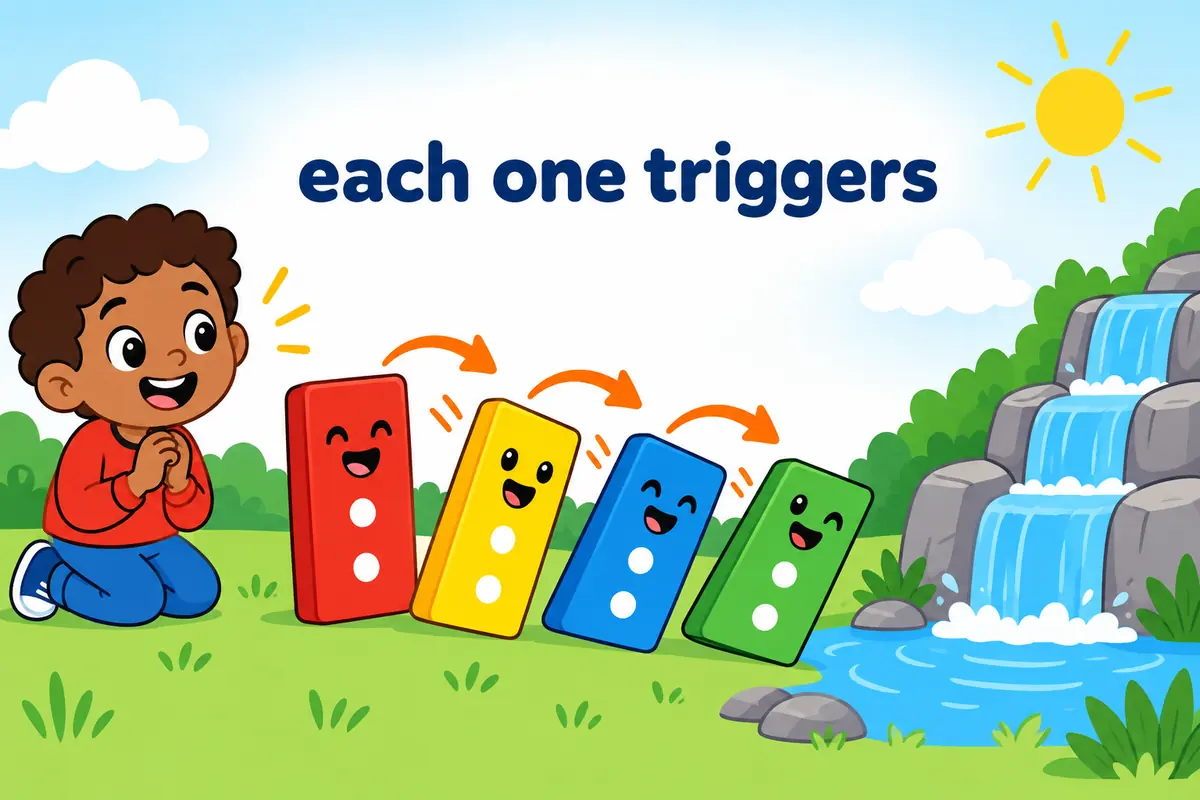
It means a sequence in which each event causes or triggers the next, like falling dominoes. The phrase usually needs a plural noun after of, such as changes, failures or effects. It suggests that one starting cause produced a whole chain of consequences.
Can cascade be used transitively?
In careful writing, no. The verb normally stays intransitive, so water cascades over something rather than cascading it. Business writing does produce transitive uses such as cascade the targets to each team, but many readers treat that as jargon and prefer pass or share.
Is cascade the same as waterfall?
They overlap but differ in size and structure. A waterfall is usually one large drop, while a cascade is smaller water falling in several linked stages. Cascade also has a common figurative sense of a chain of events, which waterfall almost never carries.
Have you ever seen a water cascade down a mountain, flowing over rocks in a beautiful and continuous stream? In the English language, a cascade refers to a sequence of connected events or elements that unfold in a specific order, much like a cascading waterfall.
When constructing a sentence using the word “cascade,” keep in mind that it typically implies a flow or progression from one element to another in a fluid manner. This word can be used to describe a variety of situations, both literal and metaphorical, where events or actions follow one after another in a cascading fashion.
7 Examples Of Cascade Used In a Sentence For Kids
- Cascade is a beautiful waterfall.
- We can see a cascade of colors in the sky during sunset.
- The river formed a cascade as it flowed down the rocks.
- The princess wore a dress with a cascade of sparkles on it.
- I love to watch the cascade of bubbles when I add soap to water.
- The magician made a cascade of coins appear out of thin air.
- The trees sway gently in the wind, creating a cascade of leaves.
14 Sentences with Cascade Examples
- As the monsoon season begins, the cascade of raindrops falling on the campus creates a soothing ambiance.
- The professor’s feedback had a cascade effect on the student’s confidence, inspiring them to strive for academic excellence.
- When the bell rings for the lunch break, a cascade of students fills the college cafeteria, eager to grab a quick meal.
- Submitting the final project triggered a cascade of relief among the students, knowing they could finally relax for a while.
- During cultural festivals, the vibrant performances and colorful decorations create a cascade of excitement among the student body.
- Hosting a poetry slam event can lead to a cascade of creativity as students share their written pieces with each other.
- The idea of a spontaneous road trip can spark a cascade of adventure-seeking among college friends looking for a thrilling escapade.
- College club fairs can cause a cascade of interest among students wanting to join various organizations and make new connections.
- The announcement of a guest lecture by a renowned industry expert can trigger a cascade of attendance from eager students wanting to gain insights.
- Participating in a sports tournament can unleash a cascade of school spirit as students come together to cheer on their teams.
- When a popular band is set to perform at the college annual fest, a cascade of ticket sales is expected as students rush to secure their spots.
- A sudden hailstorm during exam season caused a cascade of panic among students worried about their textbooks getting wet.
- Starting a community service project can lead to a cascade of volunteering efforts among students looking to give back to society.
- Attending a career fair can spark a cascade of networking opportunities for students seeking internships or job placements.
How To Use Cascade in Sentences?
Cascade can be used as both a noun and a verb in a sentence. As a noun, it refers to a succession of things falling or flowing in sequence. For example, “The cascade of waterfalls in the national park was breathtaking.” As a verb, cascade means to fall or flow in a succession or to happen in sequence. For instance, “The colorful leaves cascaded down from the trees in the autumn breeze.”
To use cascade in a sentence, start by identifying whether you want to use it as a noun or a verb based on the context. Once you have determined this, you can construct your sentence accordingly. It is important to ensure that the sentence flows naturally and that the meaning of cascade is clearly conveyed to the reader.
Remember to use proper punctuation and grammar when incorporating cascade into your sentence. This will help in effectively communicating your message and showcasing your understanding of the word. Practice using cascade in various sentences to become more comfortable with its usage and to expand your vocabulary.
Overall, incorporating cascade into your writing adds depth and vividness to your sentences, making them more engaging and descriptive.
Conclusion
In essence, a cascade of events or actions refers to a series of interconnected occurrences that occur one after another in a domino effect. Each event or action triggers the next in a chain reaction, leading to a cumulative and often escalating outcome. For example, in a business context, a delay in one department can cascade through various processes, causing delays in other areas and potentially affecting the entire operation.
Understanding how sentences with the keyword “cascade” exemplify this concept helps illustrate the interconnected nature of events and actions. By recognizing the potential for cascading effects, individuals and organizations can anticipate and mitigate the impact of these interconnected occurrences, ultimately allowing for better decision-making and smoother operations.


