
Catch up is a phrasal verb meaning to reach the same point as someone ahead, or to learn the news and work you have missed. To use catch up in a sentence, name the person or task you are closing a gap with, as in she caught up with the leaders, because the verb needs a clear distance to overcome.
Catch up at a glance
- Catch up is an intransitive phrasal verb in its main senses; a separate transitive use means to bring someone up to date.
- Its forms are catch up, catches up, caught up and catching up.
- It usually takes a preposition: catch up with a person, catch up on work or news, catch up to a leader.
- The transitive sense catch someone up is separable, so a pronoun goes in the middle: catch them up.
- The commonest error is adding no preposition at all, as in catch up you, which is never correct.
- The register is neutral and spoken, which is why it fills emails, meetings and family conversation.
What does catch up mean?
Catch up is a phrasal verb meaning to close a gap, either by reaching someone ahead or by learning what you have missed. The Cambridge entry for catch up records several senses, and the preposition is what separates them: with points at a person, on points at news or work, and to points at a level or speed. A runner who draws level with the pack has caught up, and a colleague who reads three days of email catches up on the inbox. Where the idea is simply to work alongside someone without a gap, keep up is the correct verb. The phrase grows from catch, the base verb it is built on.
| Sense | Plain meaning | Example sentence |
|---|---|---|
| Reach the same point | Close a lead held by someone else | The cyclist caught up with the front group on the last hill. |
| Learn the latest news | Find out what has happened | Let us catch up on everything we missed. |
| Meet after time apart | Spend time with someone to exchange news | We caught up over coffee on Saturday. |
| Become entangled | Be drawn into something difficult | He was caught up in the dispute before he understood it. |
| Bring someone up to date | Give a person the information they lack | Catch her up on the changes before the meeting. |
One limitation is worth stating plainly. Catch up always implies a gap that is being closed, so it is wrong when two things move at the same speed and no distance exists. If nothing is behind, nothing is caught; for matching a pace rather than closing a gap, keep up is the correct verb.
How do you use catch up in a sentence?
The phrase is intransitive in most senses, which means it cannot take an object directly. The preposition after it, or the position of a pronoun, is the whole grammar of the word, so choose the frame first.
| Pattern | Example | What it signals |
|---|---|---|
| catch up with + person | I caught up with my sister. | A person is reached or met after a gap. |
| catch up on + topic | She caught up on the news. | News, work or a task has been neglected. |
| catch up to + level | The firm caught up to its rivals. | A standard or speed is reached, not passed. |
| catch + pronoun + up | I will catch you up later. | Transitive sense: bring a person up to date. |
| be caught up in + event | They were caught up in the excitement. | Absorbed or entangled by something larger. |
Separability matters in one sense only. The transitive catch someone up, meaning to brief them, is separable, and a pronoun must sit between the words: catch her up, never catch up her. The everyday intransitive senses are not separable at all.
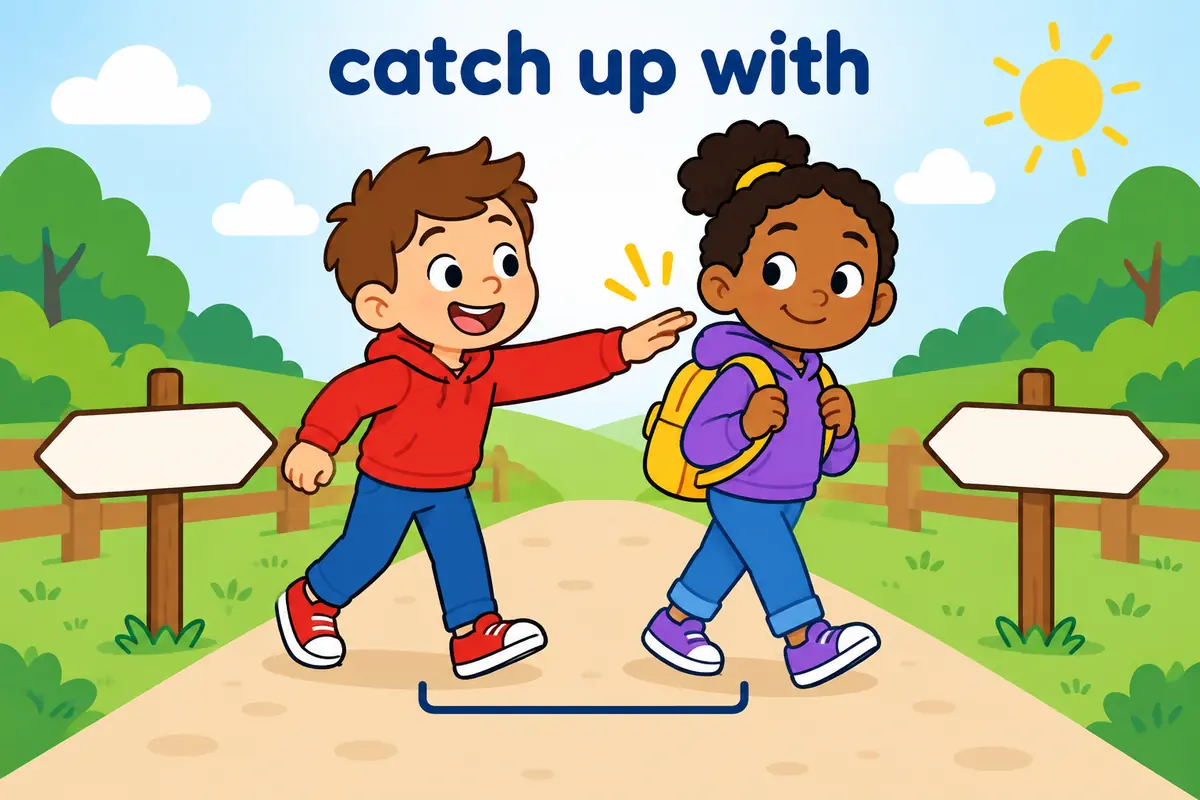
Catch up in a sentence: examples across contexts
The phrase keeps its central idea of closing a gap while the setting changes. The nine sentences below move from a classroom to a workplace update, and each chooses the preposition its sense requires.
| Context | Example sentence | Why this works |
|---|---|---|
| Classroom | The pupil stayed late to catch up on two missed lessons. | On marks the work left undone. |
| Workplace email | Can we catch up with the client on Friday? | With marks a meeting with a person. |
| Team meeting | Let me catch you up on the schedule change. | Uses the separable form to brief a colleague. |
| News report | The early leader was caught up by the chasing pack. | Passive voice keeps attention on the gap closing. |
| Sports | She caught up to the marathon leader with a mile to go. | To marks reaching a level rather than passing. |
| Conversation | We should catch up soon and swap all our news. | The bare verb is natural in a friendly invitation. |
| Project update | Two weeks off meant a lot of work to catch up on. | On names the backlog that has to be cleared. |
| Reported speech | She said she had got caught up in the planning and lost track of time. | Be caught up in means absorbed by a task. |
| Customer service | I will catch you up on the delivery delays next week. | Pronoun sits between catch and up. |
Only two rows use the transitive form, and both keep the pronoun inside the phrase. When the sense is reaching a level, overtake goes one step further, because catching up ends level while overtaking passes.
Catch up vs overtake
Catch up and overtake both describe closing a gap, and the difference is what happens at the end. Catching up means drawing level with whoever was ahead, while overtaking means moving past them into the lead.
| Attribute | catch up | overtake |
|---|---|---|
| Core meaning | Reach the same point as another | Move past another into the lead |
| Relationship to the other | Equal at the end | Ahead at the end |
| Typical subject | A runner, a student, a company | A vehicle, a rival, a growing firm |
| Preposition | with or to | None needed |
| Register | Neutral and everyday | Neutral and slightly more formal |
Verdict: choose catch up when the gap is closed and the two sides become level, and choose overtake when one side finishes ahead of the other.
Word forms and grammar of catch up
Only the base verb catch changes, so the phrase inflects exactly like the verb it is built on. The hyphenated noun catch-up is a different word and belongs in a different slot.
| Form | Part of speech | Example |
|---|---|---|
| catch up | phrasal verb, base form | We can catch up after the lesson. |
| catches up | phrasal verb, third person singular | He catches up on email each morning. |
| caught up | phrasal verb, past and past participle | They caught up before the bell. |
| catching up | phrasal verb, present participle | She is catching up on sleep this weekend. |
| catch-up | noun or adjective, hyphenated | We held a catch-up meeting on Monday. |
| catch out | phrasal verb, different meaning | A trick question can catch out a careless reader. |
The noun takes a hyphen, so a catch-up call is correct while a catch up call is not. Keep catch out separate in meaning: it means to expose someone by surprise rather than to close a gap.
Common mistakes with catch up
- Incorrect:
I will catch up you later.Correct: I will catch up with you later. Rule: the everyday sense is intransitive and needs with, or the transitive form moves the pronoun inside: catch you up. - Incorrect:
She caught up the news.Correct: She caught up on the news. Rule: on introduces the topic or task that was missed. - Incorrect:
We need to catch up ourselves on the plan.Correct: We need to catch up on the plan. Rule: on already links the verb to its topic, so a reflexive object is wrong. - Incorrect:
The firm caught up its rivals.Correct: The firm caught up to its rivals. Rule: to marks reaching a level; with a direct object the sentence would mean the firm briefed them. - Incorrect:
Let us have a catch up call.Correct: Let us have a catch-up call. Rule: the noun and adjective forms are hyphenated.
Practice using catch up
Work through the six items below, then read the reason with each answer. Related phrases such as follow up and touch base appear in the answers because they are easy to mix with catch up.
- Fill the gap: I stayed late to ______ on my marking.
- Choose the better word: The runner finally (caught up with / overtook) the leader and then passed her on the bend.
- Correct the error: Can you catch up me on the changes?
- Build a sentence: use catch up with about meeting a friend after a long time apart.
- Spot the register: which fits a work email — a quick catch-up call, or a quick catch up call?
- Change the form: She ______ on three days of email this morning. Use the past tense.
Answers
- catch up — on introduces the marking that had fallen behind.
- caught up with — she drew level first; overtook would describe passing her in one move.
- Can you catch me up on the changes? — the pronoun belongs between catch and up.
- Model answer: I caught up with an old friend at the weekend.
- a quick catch-up call — the adjective form takes a hyphen in formal writing.
- caught up — the past tense of catch is caught.
The bottom line
Use catch up in a sentence to close a gap, whether you are reaching someone ahead or learning what you missed, and let the preposition fix the sense. The two details that settle most sentences are that the everyday verb is intransitive, so it needs with, on or to, and that the transitive catch someone up keeps a pronoun in the middle. When the gap is not merely closed but passed, switch to overtake.
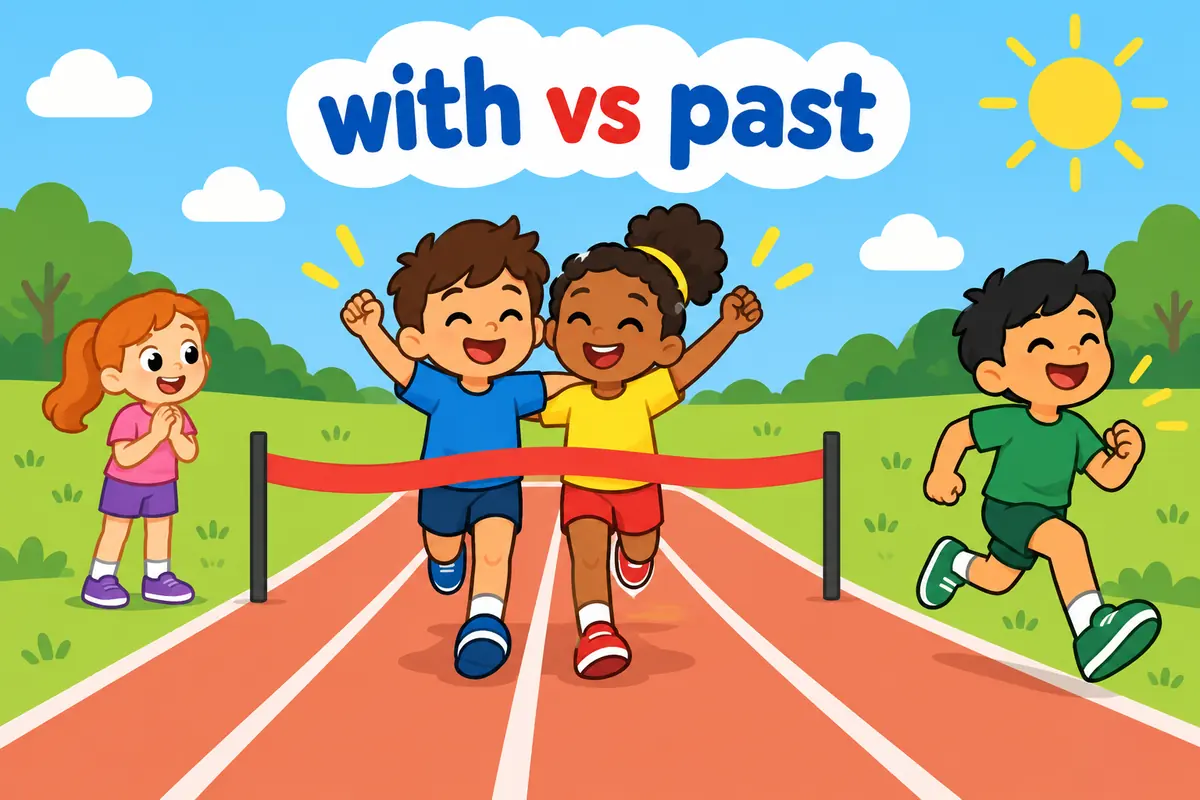
Frequently asked questions about catch up
Is catch up one word or two?
The phrasal verb is two words, catch up, as in we should catch up soon. The noun and adjective form a single hyphenated word, so a catch-up meeting is correct. In ordinary writing, keep the verb open and add a hyphen only when it is naming the event itself.
What does catch up with someone mean?
Catch up with someone means to reach a person who is ahead, or to meet them after time apart and exchange news. A runner catches up with the pack, and friends catch up with each other over coffee. Context tells you whether the gap is distance or simply time since the last meeting.
Can you say catch up you later?
No, that order is not natural English. The everyday verb is intransitive, so you say catch up with you later. If you want the transitive sense of briefing someone, the pronoun moves inside the phrase: I will catch you up later. Both are correct, but catch up you never is.
What is the difference between catch up and keep up?
Catch up means closing a gap after falling behind, while keep up means matching a pace and staying level from the start. A student who missed class catches up; a student who follows every lesson keeps up. Only catch up implies that a distance had opened before the effort began.
Have you ever felt like you were falling behind or missing out on important information? That’s where the phrase “catch up” comes into play. In simple terms, “catch up” means to bring oneself up to date, especially in areas where one has fallen behind or needs to be on par with others.
Whether it’s in school, work, or even in personal relationships, the concept of catching up is essential for staying informed and staying relevant. It involves making up for lost time, filling in the gaps, and ensuring that you are not left behind in any situation. So if you ever find yourself needing to catch up, don’t worry – with a little effort and dedication, you can get back on track and keep pace with the rest.
7 Examples Of Catch Up Used In a Sentence For Kids
- Let’s catch up with our friends during recess.
- We can catch up on our coloring together.
- I need to catch up with my classmates in counting.
- Let’s play tag and try to catch up with each other.
- Can you help me catch up in learning the alphabet?
- Let’s catch up on the story we were reading yesterday.
- We should catch up on the latest rhymes during playtime.
14 Sentences with Catch Up Examples
- Catch up with your classmates after missing a few lectures.
- Don’t forget to catch up on the readings for your upcoming exams.
- Let’s catch up during the lunch break to discuss the group project.
- It’s important to catch up on your sleep during the weekends.
- Catch up with your professors during their office hours for clarification on assignments.
- Make sure to catch up on the notes from the last class you missed.
- Take some time to catch up on the latest industry trends and news.
- Join a study group to catch up on difficult subjects.
- Allocate some time each week to catch up on assignments and deadlines.
- Use study breaks to catch up on socializing with friends.
- Catch up on extracurricular activities that you enjoy to unwind from academic stress.
- Plan ahead to catch up on any missed classes or practical sessions.
- Use weekends to catch up on practical sessions or group projects.
- Allocate time in your schedule to catch up on exercise and physical activity.
How To Use Catch Up in Sentences?
Catch Up is a phrasal verb that means to reach the same level or be on par with someone or something. To use Catch Up in a sentence, follow these steps:
-
Identify the person or thing you want to catch up to. For example, “I need to catch up to my classmates in math.”
-
Make sure the subject of the sentence is actively trying to reach the same level as the person or thing mentioned. For instance, “She is trying to catch up to her older brother in running.”
-
Use the phrasal verb Catch Up followed by the preposition “to” or “with” and the person or thing you want to equalize with. For example, “I am trying to catch up with the latest news.”
-
You can also use Catch Up in a past tense form by saying “caught up” to indicate that you have already reached the same level. For instance, “I finally caught up with my reading assignments.”
-
Remember that Catch Up implies making progress to be at the same level as someone or something, so it is commonly used when there is a gap that needs to be closed.
By following these simple steps, you can effectively use Catch Up in a sentence to convey the idea of reaching the same level as someone or something.
Conclusion
In conclusion, catching up on tasks, work, or information is essential for staying organized and informed in various aspects of life. By prioritizing certain tasks, setting aside time for catching up, and maintaining a consistent routine, individuals can effectively manage their workload and responsibilities. Whether it be catching up on emails, work projects, or news updates, staying current is key to staying productive and informed.
Additionally, making use of tools like to-do lists, calendars, and reminders can help facilitate the catching up process, ensuring that nothing falls through the cracks. By incorporating these strategies into daily routines, individuals can efficiently catch up on any backlog of work or information, ultimately leading to increased productivity and a greater sense of accomplishment.


