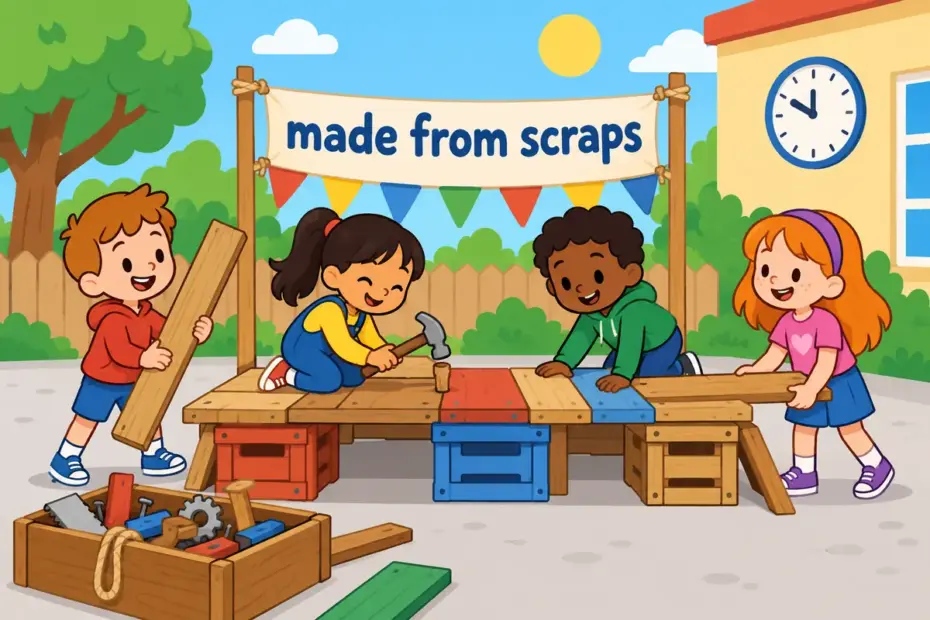
Cobble together means to make or assemble something quickly from whatever pieces are at hand, accepting a rough result. To use cobble together in a sentence, name the thing made and the makeshift parts: “They cobbled together a shelter from two old doors.”
Cobble together at a glance
- Cobble together is a phrasal verb and is always written as two words.
- Its forms are cobbles together, cobbled together and cobbling together.
- The phrase usually carries a mild judgement that context decides, praising resourcefulness or criticising a slapdash result.
- A pronoun object sits between the verb and the particle: cobble it together.
- The phrase fits meals, shelters, teams, plans and reports.
What does cobble together mean?
Cobble together is a phrasal verb meaning to put something together hurriedly from materials or resources that happen to be available. Cambridge records the expression as quick, rough assembly. Two shades run through it: a resourceful improvisation that gets a job done, and a careless patchwork whose joins show.
| Sense | Plain meaning | Example sentence |
|---|---|---|
| Make from scraps | Build something useful from parts on hand | The volunteers cobbled together a stage from pallets. |
| Improvise a plan | Put a plan or a group together in haste | Managers cobbled together a roster at short notice. |
| Show the joins | Produce something that looks hastily made | The final chapter reads as if it was cobbled together overnight. |
Cobble together is the wrong choice for slow, careful construction, where build or assemble is plainer. It also does not mean to repair something that already exists; that idea belongs to mend or to patch a leak, so the phrase is about making rather than mending.
The judgement the phrase carries comes from the finished object, not from the phrase itself. A shelter that keeps a family dry for a night earns the word as praise, while a report read by an auditor earns it as a warning. Adding the result or the deadline is therefore what tells a reader how to take it. When cooks lack ingredients they often improvise a meal, a verb that stresses creativity rather than the rough finish.
How do you use cobble together in a sentence?
| Pattern | Example | What it signals |
|---|---|---|
| cobble together + noun | We cobbled together a menu from the fridge. | The default order for a full noun object. |
| cobble + noun + together | She cobbled a costume together in an hour. | Puts the object in focus; equally correct. |
| cobble + pronoun + together | They cobbled it together before dawn. | The only correct order with a pronoun. |
| be + cobbled together | The bid was cobbled together in three days. | Passive, common in news and reviews. |
| cobble together + from + source | He cobbled together a desk from scaffolding planks. | Names the raw material. |
Cobble together in a sentence: examples across contexts
Across the nine contexts below the phrase keeps its core idea of speed and scarce parts, while the judgement shifts from admiring to critical.
| Context | Example sentence | Why this works |
|---|---|---|
| Classroom | The class cobbled together a model bridge from straws and tape. | Shows improvised construction with named materials. |
| Workplace email | We cobbled together a short handover before the office closed. | Marks the work as quick but still workable. |
| News report | Relief teams cobbled together a clinic in the school hall. | Reports haste without judging quality. |
| Home cooking | He cobbled together a supper from cold rice and leftovers. | Everyday spoken register. |
| Business writing | The startup cobbled together enough funding to finish the trial. | Notes a temporary arrangement. |
| Literary review | The plot feels cobbled together from two better novels. | Uses the phrase to criticise visible joins. |
| Sports writing | The coach cobbled together a back four from midfielders. | Names the makeshift resources. |
| Technical writing | Engineers cobbled together a test rig before the deadline. | Neutral, focusing on speed under pressure. |
| Conversation | We cobbled together a quiz for the party. | Casual and light in tone. |
Cobble together vs piece together
| Attribute | Cobble together | Piece together |
|---|---|---|
| Core idea | Fast, rough assembly from odds and ends | Careful reconstruction of parts into a whole |
| Connotation | Often slapdash or temporary | Often patient and investigative |
| Typical object | Meals, shelters, teams, funds | Evidence, clues, a story, a puzzle |
| Register | Informal to mid-formal | Mid-formal, common in reporting |
| Result | Workable but unfinished-looking | Completed and coherent |
| Emphasis | Speed and availability | Accuracy and completeness |
Choose cobble together when speed and scarce parts matter more than polish, and piece together the story when the point is patient assembly into a finished, coherent whole.
Word forms and grammar of cobble together
| Form | Part of speech | Example |
|---|---|---|
| cobble together | phrasal verb, base | We can cobble together a plan. |
| cobbles together | third-person singular | She cobbles together a lunch most days. |
| cobbled together | past tense and past participle | They cobbled together a raft. |
| cobbling together | present participle | We are cobbling together a budget. |
| cobble | verb, to mend shoes | An experienced worker can cobble a boot. |
| cobbler | noun, a shoe mender or a fruit pudding | The cobbler mended the heel. |
Non-standard forms to avoid are cobble up, which does not exist, and cobble together it, which reverses the required object order. The root also survives in the trade noun, where a cobbler mends shoes, and in pull together a team, where the sense is coordination rather than improvisation.
Common mistakes with cobble together
- Wrong:
They cobbled together it.Right: They cobbled it together. Rule: A pronoun object goes between the verb and the particle. - Wrong:
The team cobbled up a plan.Right: The team cobbled together a plan. Rule: The fixed particle is together, so up is not a substitute. - Wrong:
She cobbled together the old vase.Right: She mended the old vase. Rule: Cobble together means making something from parts, not repairing an existing object. - Wrong:
We cobbled together a careful, permanent extension.Right: We built a permanent extension. Rule: The phrase implies haste and a rough finish, so it clashes with careful and permanent. - Wrong:
Manuscripts were cobbled together over ten painstaking years.Right: Manuscripts were assembled over ten painstaking years. Rule: A decade of care contradicts the haste built into the phrase.
Practice using cobble together
- Fill in the blank: The students ______ ______ a shelter from cardboard and string.
- Choose the better word: for gathering clues into one account use ______; for making a meal from leftovers in ten minutes use ______.
- Correct the error: He cobbled together it before the guests arrived.
- Build a sentence: describe a team put together quickly for a weekend tournament; use cobble together with a noun object.
- Spot the register: which fits a review that criticises the joins, (a) the ending was assembled, or (b) the ending was cobbled together from outtakes?
- Fill in the blank with the correct form: By noon they had ______ ______ a passable lunch.
Answers
- cobbled together, because the past tense matches the finished action.
- piece together, then cobble together; careful reconstruction differs from hurried assembly.
- He cobbled it together before the guests arrived; the pronoun goes in the middle.
- Model: The organisers cobbled together a team for the weekend tournament.
- Sentence (b), because the phrase openly signals rough joins.
- cobbled together, because the past perfect takes the past participle.
The bottom line
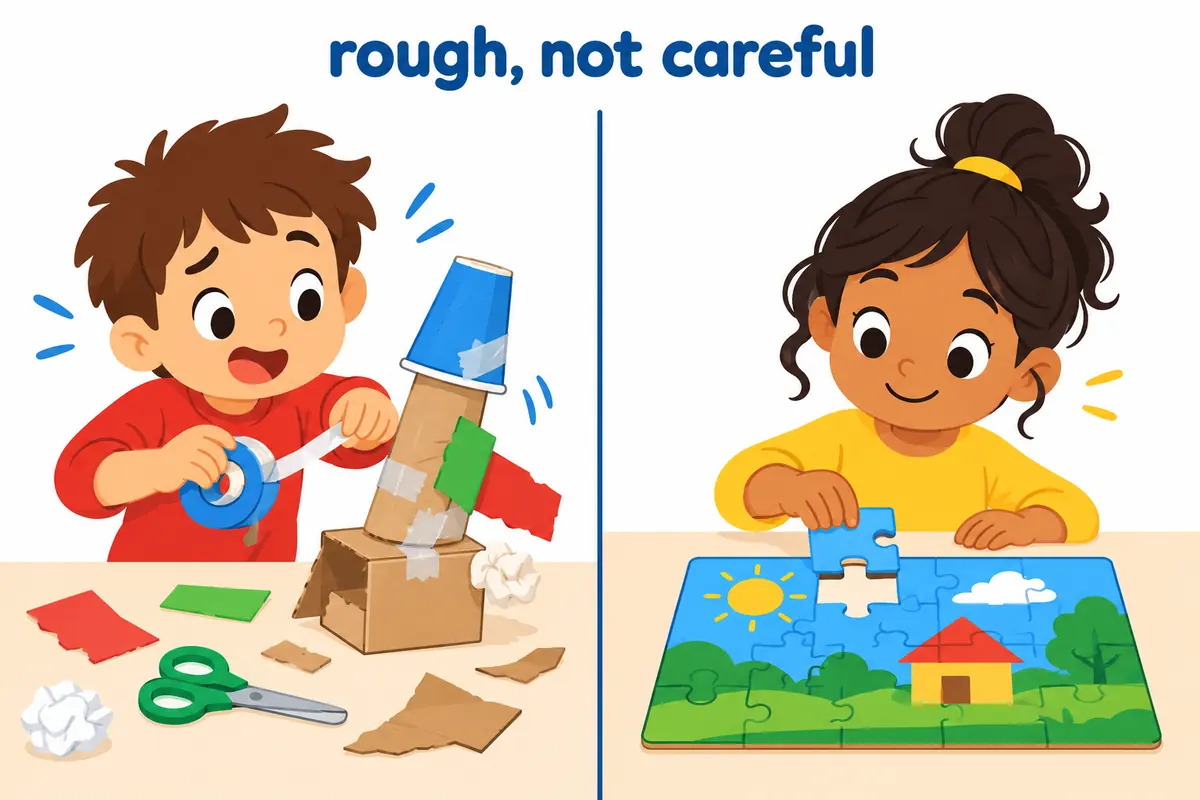
Cobble together in a sentence describes fast, rough assembly from whatever is available, so it suits meals, shelters, teams and plans made under time pressure. Keep a pronoun object between verb and particle, as in cobble it together, and choose piece together when the process is careful and the result is meant to be coherent.
Frequently asked questions about cobble together
Is cobble together a phrasal verb?
Yes. It is a separable phrasal verb made from the verb cobble and the particle together, and it behaves as a single unit of meaning. Its forms are cobbles together, cobbled together and cobbling together, and the object can move between the two parts.
What is the difference between cobble together and cobble up?
Cobble up is not standard English, so treat it as an error. The only fixed phrasal verb from this base is cobble together. If you need another sense, use a genuinely different verb such as assemble or improvise rather than inventing cobble up.
Can you cobble together something that already exists?
No. Cobble together means making something from parts, not repairing an object that already exists. For repair work on an existing thing, use mend, patch or fix, which describe restoring rather than building from whatever is available at short notice.
How formal is cobble together?
It sits between informal and mid-formal. It appears in conversation about meals and costumes, and also in news reports about clinics and shelters, so it is not slang. It would still sound out of place in a contract or a technical specification, where assembled reads better.
Cobble together means to assemble something quickly or roughly from available pieces or resources. Use cobble together in a sentence when improvisation matters: “We cobbled together a meal from the remaining vegetables.” The phrase often suggests a workable temporary result rather than a carefully planned, polished construction.
Key facts at a glance
- Cobble together is a phrasal verb.
- Cobbled together is the past-tense form.
- Cobbling together drops the final e before -ing.
- A pronoun object normally goes between cobble and together.
What does cobble together mean?
Cobble together emphasizes quick or rough assembly from whatever is available. Cambridge Dictionary documents the expression. It can describe a physical object, a meal, an argument, or a plan. The point is the manner of assembly rather than the material alone.
The phrase can admire resourcefulness or criticize a makeshift result. “We cobbled together a useful prototype overnight” praises improvisation in context; “The report was cobbled together from unrelated notes” questions coherence. Add the result or limitation so readers understand which judgment you intend.
Cobble together in a sentence: examples
- We cobbled together a shelter from spare boards.
- She cobbled together a meal from leftovers.
- The students cobbled together a prototype before the presentation.
- He cobbled the plan together during the train journey.
- They cobbled it together with borrowed equipment.
- Our group is cobbling together a temporary schedule.
- The editor said the argument had been cobbled together too quickly.
- We can cobble together a working version for the demonstration.

How does word order work?
| Choice or pattern | Meaning or use | Example |
|---|---|---|
| Noun after the phrase | Natural placement | We cobbled together a plan. |
| Noun between the parts | Also natural | We cobbled a plan together. |
| Pronoun between the parts | Usual pronoun pattern | We cobbled it together. |
| Past tense | Completed assembly | She cobbled together a meal. |
“We cobbled together it” is not the normal pronoun-object order. Put it between the verb and particle. The same practical distinction matters with them: “They cobbled them together.” With a long noun phrase, placing the noun after together often makes the sentence easier to follow.
How do cobble together and assemble differ?
Assemble is a broader, more neutral verb for putting parts together. Cobble together adds a sense of improvisation, haste, or roughness. Use assemble for a planned process when you do not intend that extra implication.
- Name what is being made.
- Identify the available resources or time pressure.
- Choose the phrasal verb if improvisation matters.
- Add the result to clarify praise or criticism.
A cobbled-together solution may be sufficient for a demonstration yet unsuitable for a final release. Describe the relevant limitation rather than assuming the phrase always means useless or always means clever.

Putting the examples into practice
Use cobble together in a sentence with attention to meaning, context, and grammatical role. Choose an example that matches the idea you want to express, then replace its details with accurate information about your own subject.
Frequently asked questions
Can cobble together describe an idea?
Yes. Cobble together can describe an argument, explanation, plan, or schedule as well as a physical object. It emphasizes how the pieces were brought together. “The team cobbled together a plan overnight” suggests haste or improvisation; add a result if you want readers to know whether the plan worked.
Is cobble together always negative?
No. It may praise resourcefulness under constraints or criticize a rough, poorly integrated result. The surrounding details supply the judgment. A quick prototype can be useful even if it is cobbled together, while a final report assembled without coherent evidence may be criticized for the same manner of construction.
Where does it go in cobble it together?
The pronoun it goes between cobble and together: “We cobbled it together.” A noun can appear in either position, as in “We cobbled together a plan” or “We cobbled a plan together.” Pronoun placement is less flexible, so avoid the unnatural order “We cobbled together it.”
What is the correct -ing form?
Write cobbling together. Drop the final e of cobble before adding -ing, as in “They are cobbling together a temporary plan.” The past tense is cobbled together. Keep the particle together in the expression because cobble alone does not communicate this particular phrasal-verb meaning as clearly in ordinary usage.
Have you ever struggled to put together a quick and makeshift solution using whatever resources are at hand? This act of hastily assembling or constructing something using various materials is known as “cobble together.”
When you cobble together something, you are essentially piecing it together using whatever is readily available, often without much planning or preparation. This term typically conveys the sense of makeshift or temporary construction, highlighting the improvisational nature of the task at hand.
7 Examples Of Cobble Together Used In a Sentence For Kids
- Let’s cobble together colorful beads to make a pretty necklace.
- We can cobble together different shapes to make a fun puzzle.
- Use your imagination to cobble together a story using these pictures.
- Let’s cobble together some leaves and sticks to make a beautiful art project.
- We can cobble together our favorite toys to have a pretend tea party.
- Cobble together some fruits and veggies to make a yummy salad.
- Let’s cobble together our building blocks to make a tall tower.
14 Sentences with Cobble Together Examples
- Before the deadline, we had to cobble together our research findings into a cohesive presentation.
- With limited resources, we had to cobble together a low-cost solution for our project.
- To complete the assignment on time, we had to cobble together our notes from multiple classes.
- Despite our busy schedules, we managed to cobble together a study group for the upcoming exam.
- Unable to find the required materials, we had to cobble together a makeshift laboratory for our experiment.
- Struggling with conflicting ideas, we had to cobble together a compromise for our group project.
- The team had to cobble together a last-minute list of references for the research paper.
- With everyone’s input, we were able to cobble together a successful event for the college fest.
- Trying to meet the word count, we had to cobble together additional examples for our essay.
- Despite our different backgrounds, we were able to cobble together a multicultural project presentation.
- In a time crunch, we had to cobble together a quick outline for our class presentation.
- Missing some key information, we had to cobble together data from various sources for our report.
- Struggling with conflicting schedules, we had to cobble together a study timetable that worked for all of us.
- To showcase our talents, we had to cobble together a performance for the college cultural night.
How To Use Cobble Together in Sentences?
Cobble Together means to assemble or create something quickly using whatever materials are available. When using this phrase in a sentence, make sure to include the action of putting things together in a makeshift or improvised manner.
For example, instead of saying “I made a cake,” you could say “I cobble together a cake using leftover ingredients in the pantry.”
When using the term Cobble Together, it is important to convey the sense of resourcefulness and creativity involved in the process. This phrase is often used to describe situations where one is making do with limited resources or time constraints.
To effectively use Cobble Together in a sentence, consider the context in which it is being used. Make sure to emphasize the act of assembling or creating something quickly and with whatever is available. This could involve using random items to build or repair something, or combining different elements to form a cohesive whole.
In summary, Cobble Together is a versatile phrase that can be used to describe the act of putting things together in a makeshift or improvised way. By highlighting the resourcefulness and creativity involved, you can effectively convey the meaning of this expression in your sentences.
Conclusion
In conclusion, the phrase “cobble together” is used to describe the act of creating or assembling something from various different parts or sources in a makeshift or haphazard manner. This can range from piecing together a last-minute presentation with limited resources to hastily composing a meal from leftover ingredients in the kitchen. The term conveys a sense of resourcefulness and ingenuity, often in the face of constraints or urgency, demonstrating the ability to make do with what is at hand.
Whether it’s cobbling together a solution to a problem at work or cobbling together a meal from random items in the pantry, the phrase highlights the skill of improvisation and adaptability. It underscores the idea that sometimes, the most effective and creative solutions come from skillfully combining diverse elements to achieve a desired outcome, even when faced with challenges or limitations.


