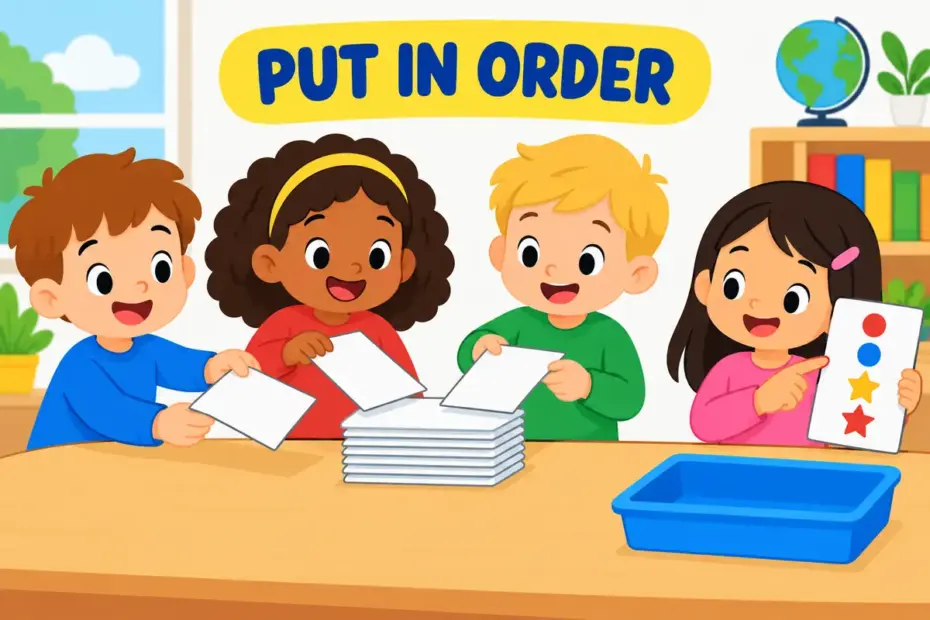
Collate means to gather pieces of information or pages and put them into a deliberate order. To use collate in a sentence, name both the parts and the order: She collated the survey responses by region. The verb implies arrangement, not just collection.
Collate at a glance
- Collate is a transitive verb with the forms collates, collated and collating.
- The core meaning is to gather items and arrange them in a set order.
- Its usual objects are documents, pages, responses or data, not physical objects.
- The noun is collation, and the person or machine that does it is a collator.
- The commonest error is adding together to collate, since the verb already means bring together.
What does collate mean?
Collate is a verb meaning to bring together pieces of writing or information and arrange them in a deliberate order. The Cambridge entry for collate records both the gathering sense and the printing sense of checking that pages are in sequence. The word always implies a system: something is sorted as it is gathered.
| Sense | Plain meaning | Example sentence |
|---|---|---|
| Gather and arrange | Collect items and put them in order | He collated the notes into a single brief. |
| Combine sources | Merge material from several places | She collated the results from all four schools. |
| Check page order | Verify that printed pages are in sequence | The booklet was collated before it was stapled. |
One limitation is worth stating. Collate does not mean to add up or summarise. A person who collates the figures has arranged them, not totalled them, and a spreadsheet that sums a column is not collating. Where the only action is amassing things, collect the forms is the plainer verb.
How do you use collate in a sentence?
The verb is transitive, so the material being arranged is always the object. Five patterns cover almost every real sentence, and the passive is common in reports about finished compilations.
| Pattern | Example | What it signals |
|---|---|---|
| collate + object | Please collate the applications. | The core pattern; names the material and implies order. |
| collate + object + by / into | She collated the replies by date. | A preposition names the organising principle. |
| collate + object + from | He collated the data from three surveys. | Shows the sources being combined. |
| be collated | The minutes were collated overnight. | Passive voice for a finished compilation. |
| collate + object + into + result | They collated the findings into one volume. | Names the single artefact the parts become. |
The practitioner rule is simple: collate needs two things, parts and a rule for ordering them. Where only one of those exists, another verb fits better. To arrange the pages stresses the order itself, which is the half of the meaning readers usually notice.
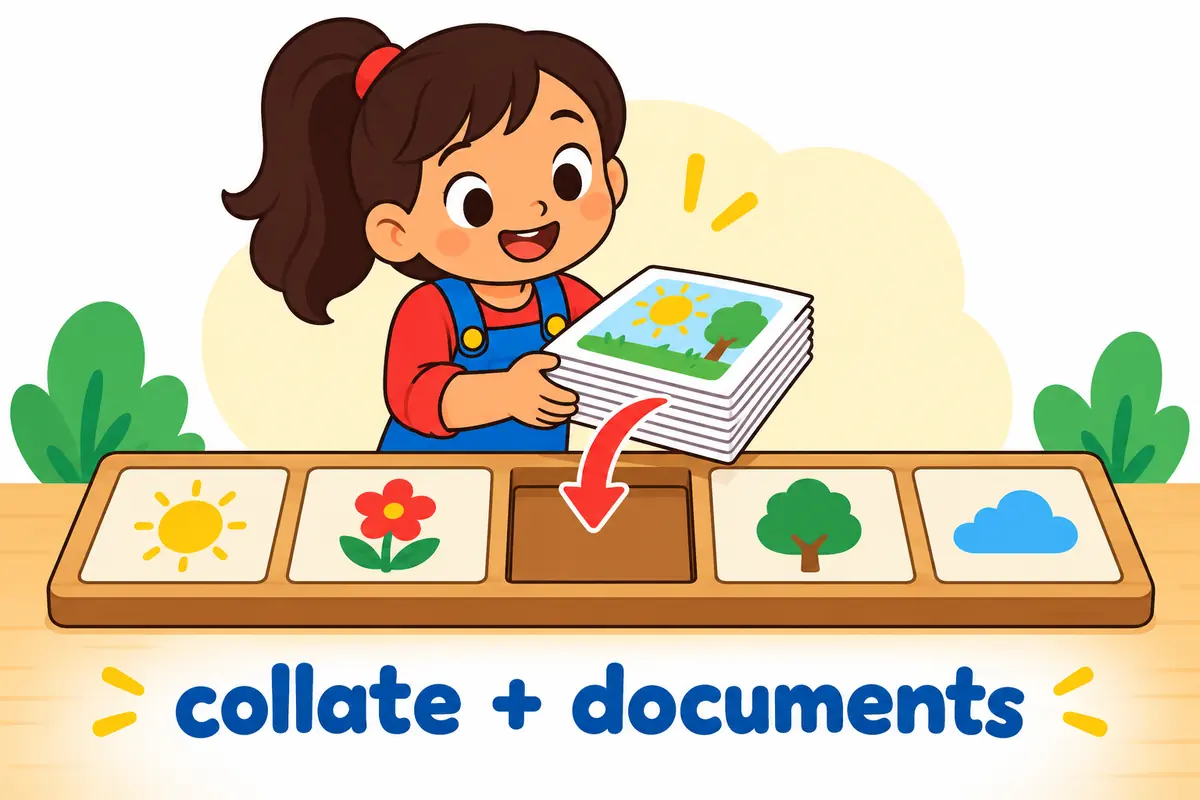
Collate in a sentence: examples across contexts
Collate changes register more than it changes meaning. The nine sentences below move from a school office to a printer’s workshop, and each one names the parts and the order that the verb demands.
| Context | Example sentence | Why this works |
|---|---|---|
| School office | The secretary collated the permission slips by class. | Names both the material and the organising rule. |
| Workplace email | Could you collate the feedback before Friday? | A polite request using the bare transitive pattern. |
| Research writing | We collated the readings from all six sites. | Shows sources being merged into one dataset. |
| News report | Officials collated the damage reports overnight. | Uses the verb for a rapid, systematic gathering. |
| Printing | The pages are collated before binding. | Uses the technical sense of checking sequence. |
| Legal writing | Counsel collated the exhibits into a single bundle. | Names the artefact the parts become. |
| Charity report | Volunteers collated hundreds of donations by postcode. | Pairs a large quantity with a clear ordering rule. |
| Classroom | Each group collated its answers on one sheet. | Uses the verb in a task pupils can picture. |
| Publishing | The editor collated the chapters into a clean manuscript. | Shows the finished result as well as the parts. |
Only the printing sentence uses the technical sense. The other eight share the same logic: many parts, one rule, one ordered whole.
Collate vs collect and compile
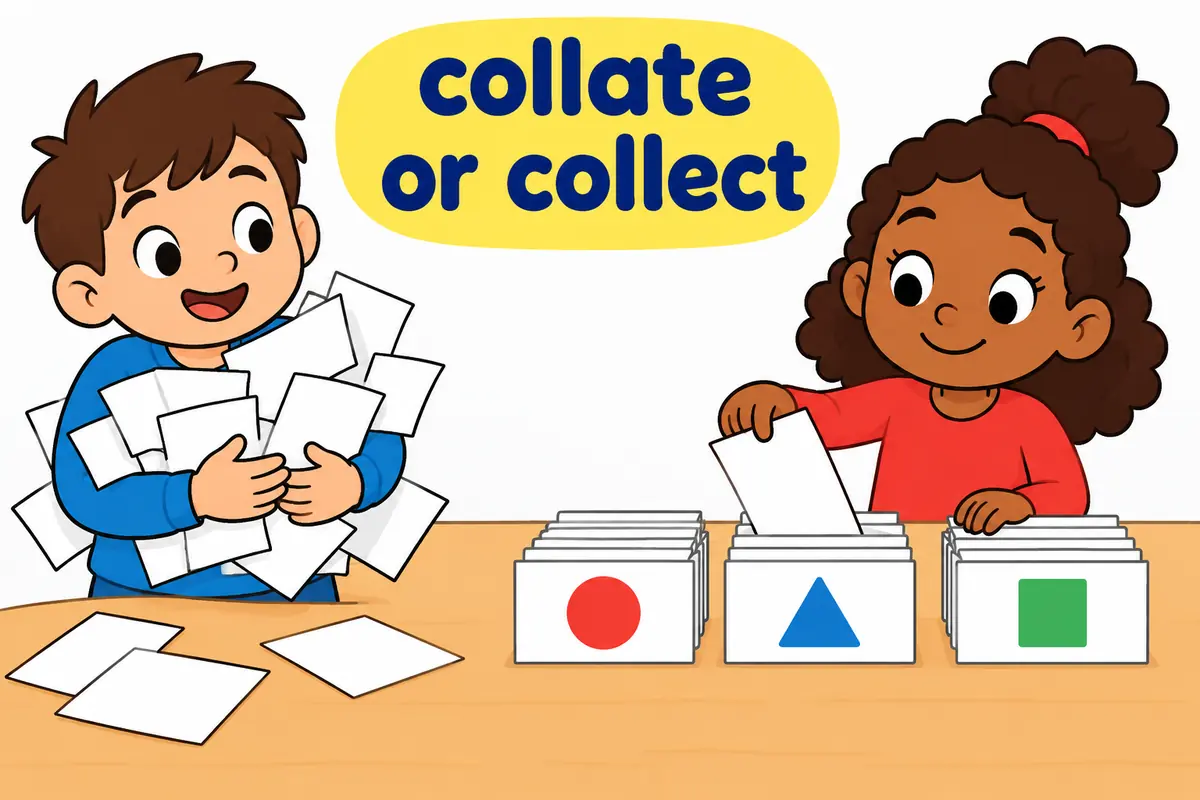
Collate sits in a small family of gathering verbs and overlaps with two of them. compile a report means assemble material from many sources into one work; collect simply brings things together; collate arranges them in a set order.
| Attribute | collate | collect | compile |
|---|---|---|---|
| Core action | Gather and order | Bring together | Assemble into one work |
| Ordering | Essential | Not implied | Implied by the finished text |
| Typical object | Pages, replies, data | Forms, stamps, evidence | Report, list, anthology |
| Result | An ordered set | A pile or group | A single finished document |
| Register | Office and technical | Everyday | Formal and editorial |
Verdict: choose collate when the parts are put into a deliberate order, collect when they are simply gathered, and compile when the aim is one finished work. To sort the replies describes the ordering step on its own, which is often what a learner means.
Word forms and grammar of collate
Collate inflects regularly, and its family stays inside the office and the print room. The table also includes the redundant phrase learners build from the meaning.
| Form | Part of speech | Example |
|---|---|---|
| collate | verb, base form | Please collate the surveys this afternoon. |
| collates | verb, third person | The system collates entries automatically. |
| collated | verb, past | She collated the minutes before the meeting. |
| collating | verb, present participle | He is collating the responses now. |
| collation | noun | The collation of the evidence took a week. |
| collator | noun | The collator checks every set of pages. |
| collate together | redundant phrase | Avoid it; collate already contains together. |
The related verbs organize the files and gather the data split the same job between them: organize stresses the rule, gather stresses the collecting.
Common mistakes with collate
- Incorrect:
She collated together the pages.Correct: She collated the pages. Rule: Collate already means bring together, so together is redundant. - Incorrect:
He collated his socks into pairs.Correct: He paired his socks. Rule: Collate takes documents, data or texts, not everyday household objects. - Incorrect:
Please collate me the results.Correct: Please collate the results. Rule: The material is the object; collate does not take a person as indirect object. - Incorrect:
He collated the data, so the total is forty.Correct: He collected the data, so the total is forty. Rule: Collate arranges; it does not total or summarise. - Incorrect:
The intern collated to the receipts.Correct: The intern collated the receipts. Rule: Collate takes a direct object with no preposition.
Practice using collate
Work through the six items, then check the reasoning rather than only the answer.
- Fill the gap: The assistant ______ the forms by department before the audit.
- Choose the better word: The editor had to (collate / collect) the chapters into one manuscript.
- Correct the error: The intern collated together all the receipts.
- Build a sentence: use collate + object + from about findings from two experiments.
- Spot the register: which belongs in a project report — the team collated the responses by region, or the team got all the responses sorted out?
- Rewrite with the noun: They collated the evidence quickly. Use collation instead.
Answers
- collated — the past tense adds -ed, and the department rule supplies the ordering.
- compile — the aim is one finished manuscript, which is the compile sense.
- The intern collated all the receipts — together repeats the meaning of collate.
- Model answer: They collated the findings from two experiments.
- The team collated the responses by region — a report names the organising rule and avoids slang.
- The collation of the evidence was quick — the noun takes an article and fits formal prose.
The bottom line
Use collate in a sentence when many parts are gathered and arranged in a deliberate order, and name both the material and the rule. The two details that decide most sentences are order and object: collate needs a system, and its object is documents or data rather than a person. Where nothing is being ordered, collect or gather is the honest verb, and where one finished work is the goal, compile fits better.
Frequently asked questions about collate
What does collate mean on a printer?
On a printer, collate means the machine prints complete sets in order, so page one to page ten come out together before the second set begins. Switch collation off and you receive ten copies of page one, then ten of page two. The setting uses the same sense of arranging pages into sequence.
Is collate a formal word?
Collate belongs to office, academic and technical writing rather than casual chat. It appears in requests such as please collate the responses and in descriptions of printing and record keeping. In everyday speech people often say gather or sort out instead, which is why the verb can sound slightly formal.
Does collate mean to add up?
No. Collate means to gather and arrange items in order, not to total them. A person who collates the figures has organised them by date, source or category, but the sum still has to be calculated separately. If adding is the task, use total or add up, and keep collate for the arranging.
What is the noun form of collate?
The noun is collation, as in the collation of the evidence took a week. The person or machine that arranges the pages is a collator. Both forms keep the core idea of ordering, and both are standard in print and record-keeping contexts rather than conversation.
Have you ever wondered how to efficiently organize and assemble various pieces of information into a coherent format? This process is known as collating. Collating involves gathering, arranging, and sorting data or documents to ensure they are in proper order or sequence.
Whether you are compiling research findings, organizing financial records, or putting together a report, proper collation is essential for clarity and comprehension. By mastering the skill of collating, you can streamline information, facilitate accessibility, and present your content in a structured and logical manner.
7 Examples Of Collate Used In a Sentence For Kids
- Collate all the red blocks together.
- Let’s collate the pictures of animals.
- We need to collate the books by size.
- Can you help me collate the stickers?
- It’s time to collate the colored pencils.
- We will collate the toys by type.
- Please collate the fruits into different groups.
14 Sentences with Collate Examples
- Students can collate all their research findings and references in one document for easier referencing.
- It is important for college students to collate all their notes from various classes to prepare for exams.
- Before starting a group project, students should collate all their ideas and present them to each other.
- To save time on group assignments, it’s helpful to collate everyone’s contributions into one cohesive project.
- When writing a thesis, it’s crucial to collate all relevant data and sources to support your argument.
- As part of their final project, students may be required to collate data from surveys or experiments.
- In order to better understand a complex topic, students should collate information from multiple sources.
- To effectively study for an upcoming exam, students should collate their notes, textbooks, and additional resources.
- When working on a literature review, it’s important to collate all the relevant studies on the topic.
- Before submitting a research paper, students should collate all their findings and analyze the data.
- College students can collate their class schedules, assignment due dates, and extracurricular activities in a planner to stay organized.
- One way to improve group presentations is to collate all members’ insights and findings into a cohesive narrative.
- To streamline their research process, students can use software tools to automatically collate and organize data.
- Faculty members can encourage students to collate their thoughts and questions before engaging in classroom discussions.
How To Use Collate in Sentences?
Collate means to collect, arrange, and assemble related items in a systematic way. To use collate in a sentence, start by identifying a group of items or information that needs to be organized. For example, “Please collate all the documents related to the project proposal.”
Next, determine the order in which the items should be arranged. You can use words like “alphabetically,” “numerically,” or “chronologically” to specify how the items should be collated. For instance, “After you collate the papers, arrange them chronologically according to their submission dates.”
When constructing a sentence with collate, make sure to include a clear instruction or request to ensure that the recipient understands what needs to be done. For example, “I need you to collate the sales reports and organize them alphabetically by region.”
Remember to be specific and provide all necessary details when using collate in a sentence. This will help avoid confusion and ensure that the items are collated correctly. Practice using collate in different contexts to become more comfortable with incorporating it into your writing and communication.
Conclusion
In summary, the process of gathering, organizing, and comparing information from various sources or datasets, known as collating, is essential for ensuring accuracy and efficiency in data analysis. By collating key details or data points, researchers, analysts, and professionals can derive meaningful insights and make informed decisions. This method facilitates the identification of patterns, trends, and discrepancies, ultimately leading to well-informed conclusions.
Through collating data, individuals can streamline the analysis process, identify correlations, and pinpoint areas for further investigation. This systematic approach helps in synthesizing diverse information into a coherent and comprehensive overview, enabling better understanding and interpretation of complex datasets. Overall, the practice of collating enhances the quality of decision-making, research outcomes, and problem-solving strategies by integrating and organizing information in a structured and logical manner.


