What does “commentary” mean?
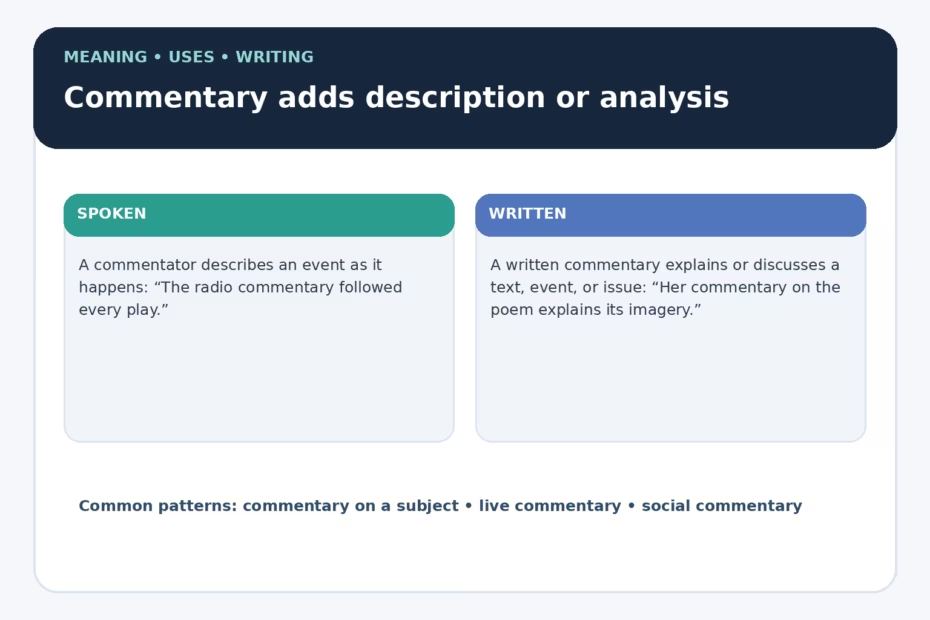
Commentary is spoken description or written discussion that explains, interprets, or gives an opinion about a subject. Oxford Learner’s Dictionaries lists spoken description of an event, written explanation of a work, and discussion or criticism of an issue as common meanings. Oxford Learner’s Dictionaries: commentary.
In sports and broadcasting, a commentator gives live commentary while an event is happening. In books, film, journalism, and school essays, commentary usually means analysis or explanation. For example, a director’s commentary may explain how a film was made; a student’s commentary may explain what a quotation shows about a character.

How to use “commentary” in a sentence
A common pattern is commentary on + a subject: “The article offers commentary on the election.” You can also use commentary about, especially in everyday speech. For live broadcasts, say sports commentary, radio commentary, or running commentary. For analysis, common phrases include social commentary, political commentary, and a critical commentary on a poem. Cambridge Dictionary includes both the broadcast and written-discussion meanings. Cambridge Dictionary: commentary.
Is “commentary” countable?
It can be countable or uncountable, depending on the meaning. Use the uncountable form for commentary as material or ongoing narration: “The commentary was clear,” or “They provided commentary throughout the match.” Use a commentary for a particular written explanation or discussion: “She published a commentary on the novel.” The plural is commentaries.
Comment vs. commentary
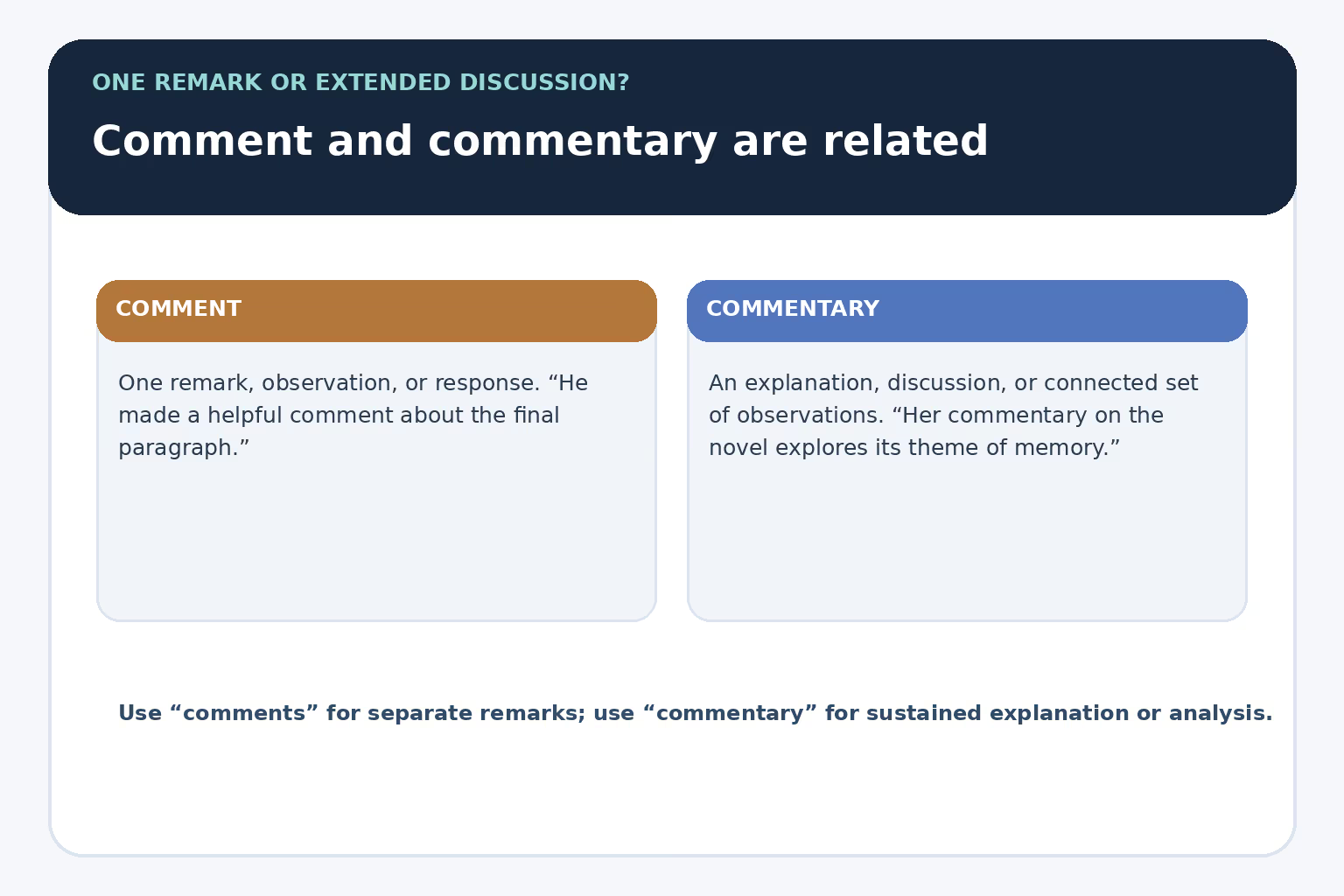
A comment is often one remark, opinion, or observation. Commentary more often refers to a connected explanation, discussion, or stream of description. The words can overlap, but “Please leave a comment” asks for a response, while “the documentary includes commentary by the historian” points to a longer explanation. Cambridge lists comment as a related word for some senses of commentary, not as a perfect substitute in every phrase.
Commentary in an academic paragraph
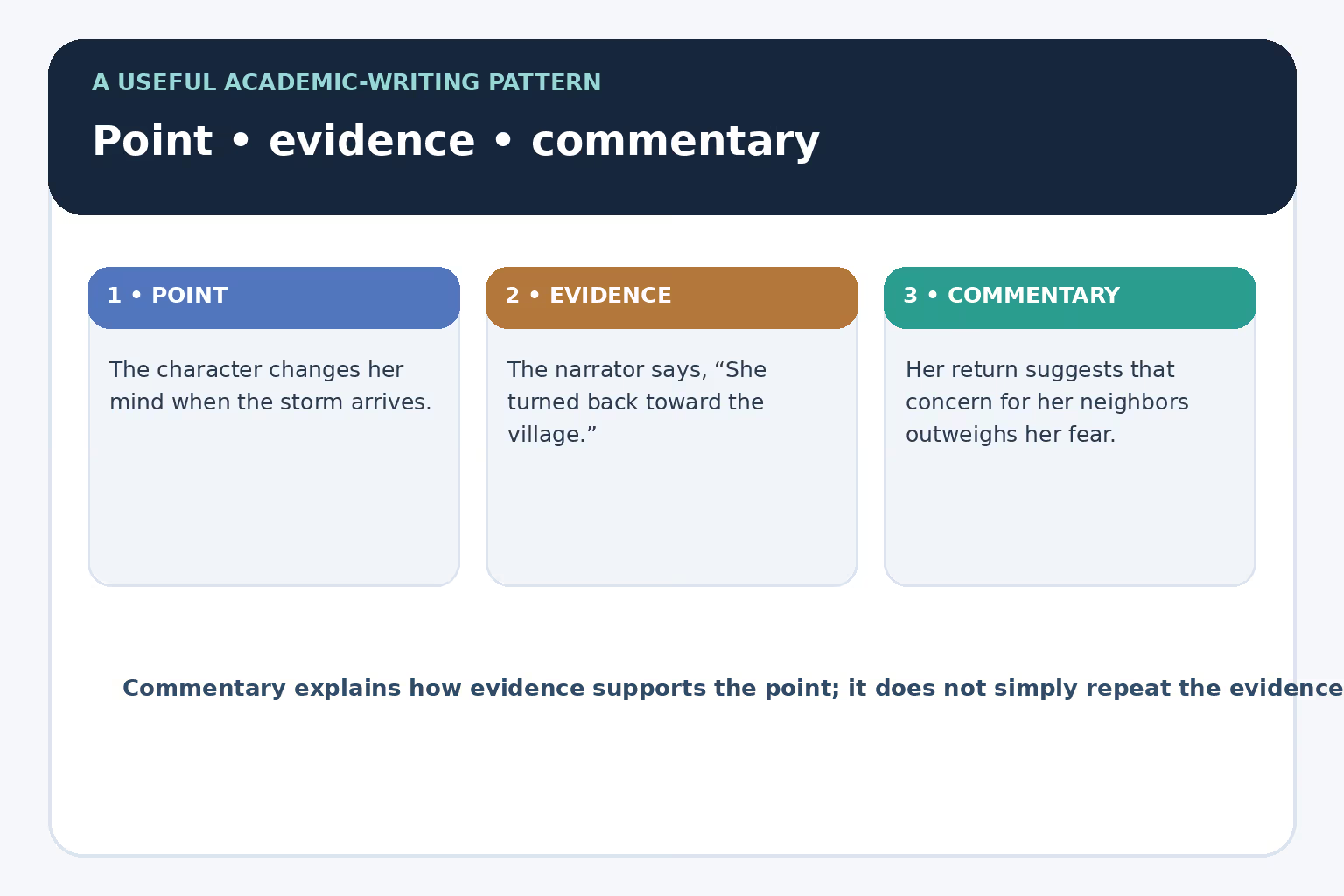
In literary or argumentative writing, commentary explains why evidence matters. A practical sequence is point, evidence, commentary: state the idea, provide a relevant quotation or fact, then explain how that evidence supports the idea. The commentary should add reasoning rather than repeat the quote in different words.
- Point: The character begins to trust her neighbors.
- Evidence: “She left the key beneath the flowerpot.”
- Commentary: Sharing access to her home suggests that she now feels safe relying on them.
Not every sentence needs a transition such as therefore or however. Choose a transition only when it accurately shows the relationship between ideas. Commentary can follow evidence directly, as in the example above.
Common examples and clearer revisions
Some sentences use commentary correctly but would be clearer with a more specific subject or noun. If several people offer separate opinions in a group discussion, comments or observations may fit better. If a speaker explains an event as it unfolds, commentary is natural.
| Sentence | Usage note |
|---|---|
| The radio commentary described each goal as it happened. | Natural use for live spoken description. |
| The book includes a commentary on the author’s historical references. | Natural use for a written explanation. |
| Each student shared commentary during the discussion. | For separate contributions, “shared comments” or “offered observations” is usually more precise. |
| The film is a commentary on how advertising shapes identity. | Natural use for an interpretation or critique of an issue. |
| The commentator gave a running commentary on the parade. | Running commentary means continuous description as events unfold. |
Example sentences with “commentary”
- The newspaper invited a historian to write commentary on the new exhibit.
- We listened to the live commentary while following the match on the radio.
- Her commentary on the poem helped the class notice its repeated images.
- The documentary’s audio commentary explains why the director changed the ending.
- The novel offers social commentary on the pressures facing a small town.
- The guide gave a running commentary as the bus passed the old harbor.
- His commentary was brief, but it clarified the report’s main conclusion.
- The journal publishes scholarly commentaries on recently discovered letters.
Frequently asked questions
What does commentary mean in simple words?
It means a spoken description or a written discussion that explains, analyzes, or gives an opinion about something.
What is an example of commentary in a sentence?
“The reviewer’s commentary on the novel explains why its ending feels unresolved.”
What is the difference between a comment and commentary?
A comment is often one remark or observation. Commentary is usually a longer or connected explanation, discussion, or description.
Is “commentary” singular or plural?
Commentary is singular; its plural is commentaries. It can also be uncountable when referring to narration or analysis generally.
Which preposition follows commentary?
Commentary on is common in both speech and writing. Commentary about is also used, especially in conversational contexts.
Sources
- Oxford Learner’s Dictionaries, “commentary”
- Cambridge Dictionary, “commentary”
- Cambridge Dictionary, “comment”
The original 21 example sentences and the original usage section below are retained from the published article.
Have you ever come across an example sentence with “commentary” and wondered what it really meant? In writing, commentary serves as an analysis or explanation provided alongside a main text, offering insight, critique, or reflection on the content.
Commentary can be found in various forms of literature, journalism, or academic writing to help elucidate the author’s thoughts or to provide context for the reader. It adds depth and perspective to a piece of writing, offering a unique lens through which to interpret the subject matter.
7 Examples Of Commentary Used In a Sentence For Kids
- I love to listen to commentary during cricket matches.
- The teacher gave us commentary during storytime.
- We can hear commentary during a movie to understand the story better.
- The radio announcer provided commentary for the live sports event.
- The nature guide offered commentary during our nature walk.
- The sports announcer gives commentary on the game happening.
- The news anchor provides commentary on current events.
14 Sentences with Commentary Examples
- Students often find it helpful to listen to commentary while studying for their exams.
- Attending a live sports match with commentary in the background can be a great stress-reliever for college students.
- Watching documentaries with commentary can provide valuable insights on various subjects for students.
- Commentary on current affairs can help students stay informed about important news and events.
- Engaging in group discussions with commentary from different perspectives can enhance students’ critical thinking skills.
- Podcasts featuring expert commentary are a popular way for college students to expand their knowledge on various topics.
- The use of commentary in academic journals can help students understand complex theories and concepts better.
- Watching a movie with audio commentary can offer students a deeper understanding of filmmaking techniques and storytelling.
- Students can benefit from reading books with commentary by scholars to gain a deeper insight into literary works.
- Participating in seminars with commentary from guest speakers can provide students with valuable real-world insights.
- Following social media influencers who provide commentary on trending topics can keep college students well-informed.
- College students often rely on online forums for commentary and discussions on their academic assignments.
- Watching debates with commentary from experts can help students develop their argumentative and reasoning skills.
- Attending workshops with commentary from industry professionals can give students a better understanding of career opportunities.
How To Use Commentary in Sentences?
To use Commentary in a sentence, start by introducing your main idea or argument. This could be a statement you want to elaborate on or a topic you want to discuss. Once you have your main point, insert a commentary to explain, analyze, or provide additional information about it.
For example, if your main idea is “The protagonist’s actions in the story reveal his true character,” your commentary could be “This highlights the internal conflict he faces throughout the novel.” Make sure your commentary enhances the reader’s understanding and adds depth to your statement.
When adding commentary in a sentence, it’s important to connect it smoothly to your main idea. Use transition words like “therefore,” “however,” or “thus” to show the relationship between your statement and the commentary. This helps to create a coherent and persuasive argument.
Remember to keep your commentary concise and relevant to the main point of the sentence. Avoid going off on tangents or introducing unrelated information. Focus on providing insightful analysis or explanation that strengthens your argument and engages the reader.
Practice incorporating commentary into your sentences to improve your writing skills. With time and effort, you’ll learn how to effectively use commentary to enhance your ideas and communicate more effectively.
Conclusion
In conclusion, sentences with commentary serve as valuable tools in providing additional context, explanation, and analysis to the main idea or message being conveyed. By incorporating commentary, writers can help readers better understand the significance of the information presented, deepen their comprehension, and encourage critical thinking. Whether used in academic papers, articles, or creative writing, sentences with commentary add depth and insight, enhancing the overall quality of the content.
Furthermore, by offering commentary alongside facts, opinions, or observations, writers can engage their audience, spark conversation, and prompt reflection. This approach not only helps to connect the reader with the material on a deeper level but also allows for a more enriching and informative reading experience. Ultimately, sentences with commentary play a crucial role in enhancing communication, fostering understanding, and encouraging readers to consider different perspectives and insights.


