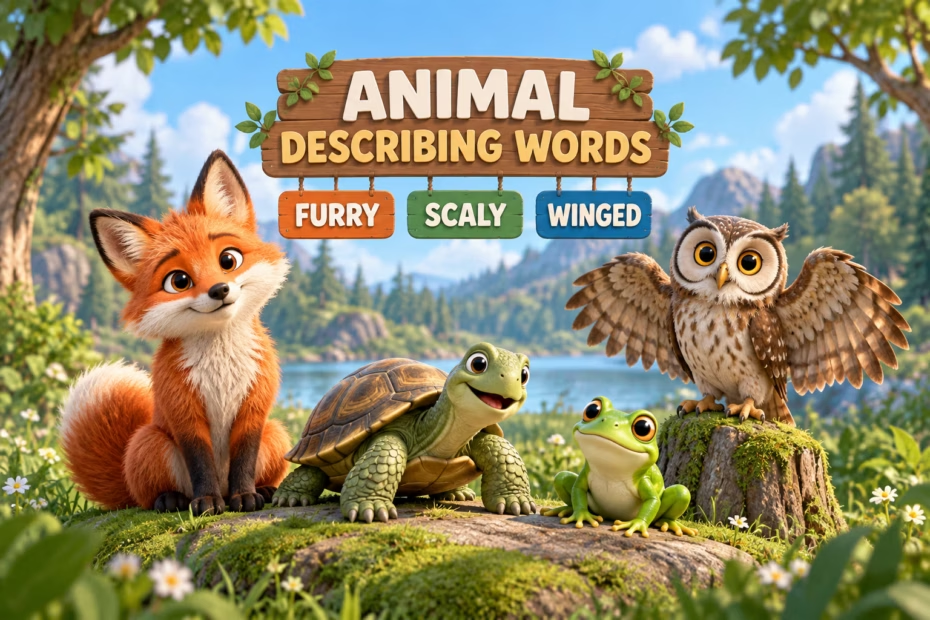
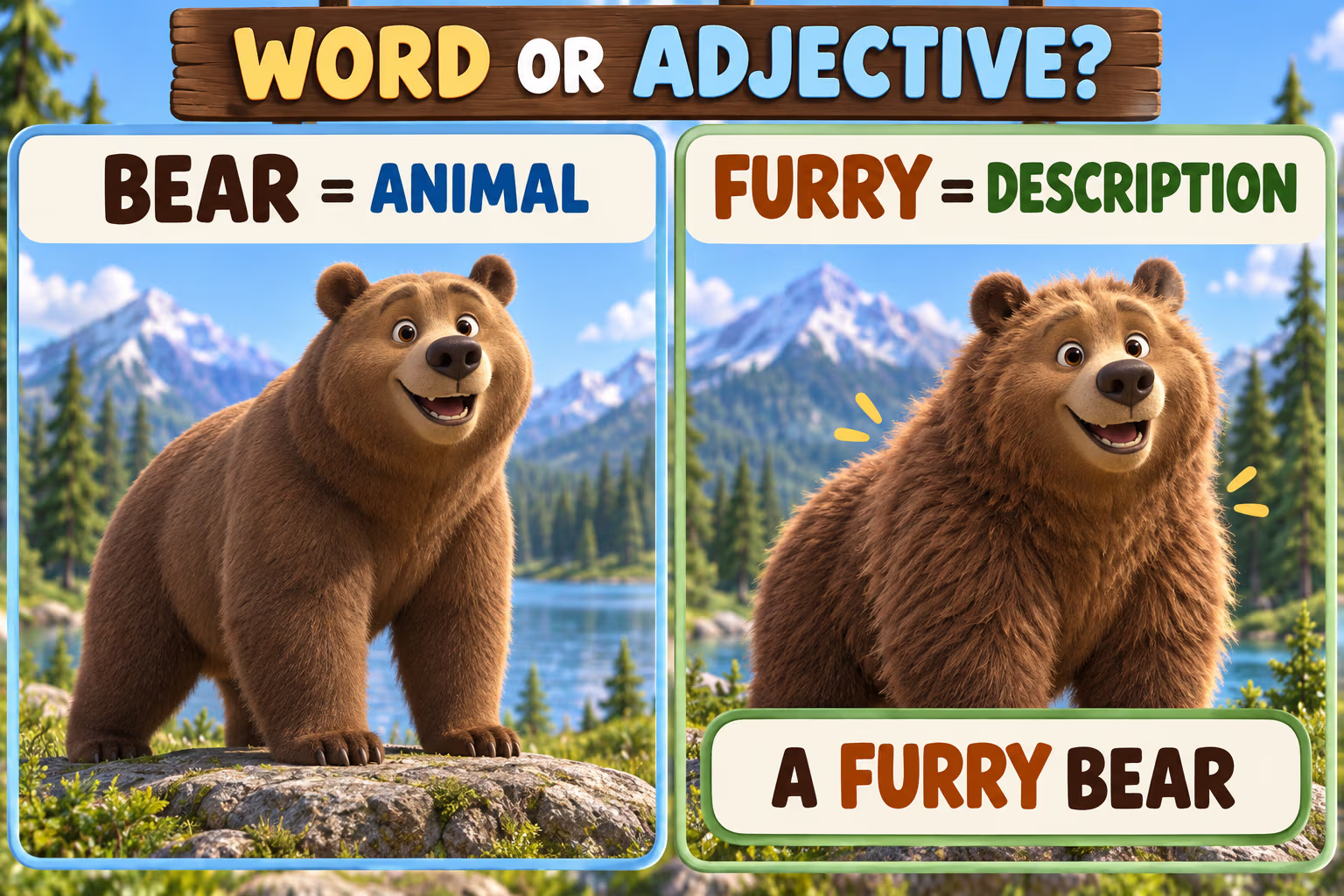
Adjectives for animals describe observable traits, habitat or ecology, behavior in a specific context, or a relationship to an animal group. An adjective modifies a noun—“a furry bear”—while “bear” names the animal. Because alphabetic word lists also include animal names and technical terms, choose each word by what it means in its sentence.
Key points
- An animal name such as “owl” is a noun; an adjective such as “feathered” describes a feature of an owl.
- Some animal-related adjectives describe habitat, activity, or a relationship to a group rather than appearance.
- Words such as “shy,” “aggressive,” or “tame” need context and should not be treated as permanent verdicts based on one moment.
- “Feral” and “wild” are not synonyms for angry, dangerous, or diseased.
- “Rabid” names a disease-related condition, not a neutral synonym for an animal that looks fierce.
How to Read This Alphabetic Animal Word List
The original alphabetic list is a broad vocabulary collection, not a grammar-filtered list of adjectives. It contains animal names such as “bear,” “owl,” and “whale,” alongside descriptive adjectives, technical or relational terms, behavior words, and status terms. Its 18 letter headings organize 21 tables with 94 rows; the entries remain below exactly as published.
Cambridge Grammar Today treats nouns and adjectives as separate word classes and gives animal names among its noun examples. The sentence decides how a word works: “A bear crossed the trail” uses a noun; “A furry bear crossed the trail” uses an adjective plus a noun (Cambridge Dictionary, “Nouns”).
| Kind of word | Examples from the original list | How it can work |
|---|---|---|
| Animal-naming nouns | bear, fox, frog, whale | Name an animal: “The fox paused.” |
| Visible features | downy, furry, scaly, horned, web-footed | Describe a feature that can be seen: “a web-footed bird.” |
| Habitat or activity | aquatic, arboreal, nocturnal, diurnal, migratory | Describe an ecological association or activity pattern when it is accurate. |
| Relationship terms | canine, feline, bovine, ursine | Relate a noun to a type or group; these may sound formal or technical. |
| Behavior or impression | gregarious, territorial, shy, tame, savage | Use carefully, with a particular observation and context. |
| Conservation status | endangered, threatened, extinct | Use only with a named, current assessment or legal authority. |
Use the original tables as a place to discover candidate words, then check the word class and meaning before using one. A list entry can be useful without being an adjective; keeping that distinction clear makes a description more accurate.
We all know adjectives. They’re the words we use to describe how we feel, what we see, and what we taste. And, of course, to describe people and animals.
When we describe people, we might use adjectives like kind, caring, or helpful. But when we describe animals, we often use different adjectives. We might say an animal is adorable, ferocious, or lazy.
Why is that? It might be because we see animals differently than we see people. Or it might be because we have different feelings about animals than we do about people.
Whatever the reason, using the right adjective can help us better understand and appreciate the animals in our lives.
Adjectives For Animals
If you’re a animal lover, you know that each animal has its own unique personality. And, just like people, you probably have a few favorite adjectives that you use to describe your favorite animals.
Here are a few of our favorite adjectives for animals:
- Cute: This is probably the most popular adjective used to describe animals. And, it’s no wonder why. Animals are just so darn cute!
- Funny: Animals can be hilarious! They do the funniest things, and sometimes they even make us laugh out loud.
- Loyal: Animals are some of the most loyal creatures on the planet. They’re always there for us, no matter what.
- Brave: Animals can be brave, too. They’re not afraid to stand up for themselves or their loved ones.
- Adorable: Another popular adjective used to describe animals. They’re just so stinking’ adorable!
- Gentle: Animals can be gentle giants. They might be big, but they have a gentle soul.
These are just a few of our favorite adjectives for animals. What are some of your favorite adjectives for animals?

A
| Accipitrine | Acciptrine | Alligator |
| Amphibious | Anatine | Androgynous |
| Anguine | Anserine | Ant |
| Anthropoid | Any Wild Animal | Ape |
| Apian | Apiarian | Apic |
| Aquatic | Aquiline | Arachnine |
| Arachnoid | Arboreal | Articulate |
| Asexual | Asinine | Ass |
| Avine |
B
| Badger | Bat | Batrachian |
| Bear | Bee | Best-Of-Breed |
| Bird | Bison | Bovine |
| Bubaline | Buffalo | Bull |
| Butterfly |
C
| Caged | Calf | Camel |
| Cameline | Cancrine | Canine |
| Caprine | Captive | Cat |
| Centipede | Cervine | Cetacean |
| Cetaceous | Chicken | Cold-Blooded |
| Colubrine | Common | Corvine |
| Cow | Crab | Crocodile |
| Crocodiline | Crow | Crow, Raven |
| Cygnine |
D
| Deer | Delphine | Dipterous |
| Diurnal | Dog | Dolphin |
| Domestic | Domesticated | Donkey |
| Downy | Draft | Drowny |
E
| Eagle | Earthworm | Elapine |
| Elephant | Elephantine | Elk |
| Endangered | Endemic | Equine |
| Eusuchian | Extinct |
F
| Falcon | Falconine | Feathered |
| Feline | Feral | Ferine |
| Ferret | Fish | Fluffy |
| Fly | Flying | Formic |
| Fox | Freshwater | Frog |
| Furred | Furry |
G
| Galline | Gastropodian | Giant |
| Goat | Goose | Great |
| Gregarious | Gull |

H
| Hare | Hawk | Helminthic |
| Higher | Hippopotamine | Hippopotamus |
| Hircine | Hirundine | Horned |
| Hornet | Horse | Housebroken |
| House-Trained | Hystricine |
I | J | L
| Indigenous | Jellyfish | Juvenile |
| Lacertine | Larine | Leonine |
| Leopard, Panther | Leporine | Lesser |
| Leverine | Lion | Lizard |
| Lop-Eared | Lumbricine | Lupine |
M
| Man-Eating | Mangy | Mature |
| Migratory | Mongoose | Monkey |
| Moose | Mouse | Murine |
| Musteline | Myrmecine |
N | O
| Native | Naturalized | Noctillionine |
| Nocturnal | Omnivorous | Ostracine |
| Ostrich | Otarine | Ovine |
| Oyster |
P
| Parasitic | Pardine | Passerine |
| Pavonine | Peacock | Pedigree |
| Pet | Petrified | Phocine |
| Picine | Pieridine | Pierine |
| Pig | Pigmy | Piscine |
| Poisonous | Polymorphous | Porcine |
| Porcupine | Porpoise | Predatory |
| Proboscidean | Proboscine | Pteropine |
| Purebred | Pygmy |
R
| Rabbit | Rabid | Ranine |
| Rat | Rogue |

S
| Sable | Saltwater | Savage |
| Scaly | Sciurine | Scolopendrine |
| Scyphozoan | Seal | Serpent |
| Serpentine | Sheep | Shrew |
| Shy | Simian | Snail |
| Snake | Social | Soricine |
| Sparrow | Spider | Spineless |
| Squirrel | Struthionine | Stuffed |
| Suilline | Swallow | Swan |
| Swine |
T
| Tame | Taurine | Temperate |
| Territorial | Testudine | Threatened |
| Tiger | Tigrine | Toad |
| Tolerant | Tortoise | Transgenic |
| Tufted |
U | V
| Untrained | Ursine | Venomous |
| Vermian | Vespine | Viper |
| Viperine | Vituline | Viverrine |
| Vulpine | Vulture | Vulturine |
W
| Warm-Blooded | Wasp | Weasel |
| Webbed | Web-Footed | Well-Bred |
| Whale | Wild | Wildness |
| Winged | Wolf | Woodpecker |
| Worm |
Z
| Zebra | Zebrine | Zibeline |
Final verdict
As you can see, there are a variety of adjectives that can be used to describe animals. Whether you’re looking to describe a specific animal or just want to find a new way to describe your favorite animal, these adjectives should help you do just that! It’s always fun to learn new words, so why not learn some new adjectives for animals today?
Which Words Actually Describe an Animal?
A describing adjective adds a quality to an animal noun or follows a linking verb to describe the animal. Compare “a scaly lizard” with “the lizard is scaly”: the noun identifies the animal, and the adjective describes a feature.
Animal names do not become adjectives merely because they appear before another noun. In “a dog bowl,” dog is a noun modifying another noun; in “a canine bowl,” canine functions as an adjective meaning related to dogs. In formal or technical writing, check a dictionary for the intended word class rather than relying on position alone.
Some adjectives are formed from animal names with endings such as -like, but the result can be figurative or imprecise. “Bear-like” might describe a shape, movement, or impression; it does not automatically mean that a person or object is literally a bear. State the feature you intend if readers could interpret the comparison differently.
How Do Animal Adjectives Group by Meaning?
Animal adjectives become easier to choose when you first decide whether you are describing a visible feature, a habitat connection, a relationship, a behavior, or a verified status. The same word can be useful in one kind of writing and misleading in another.
Appearance and body features
Words such as furry, feathered, scaly, horned, webbed, and winged point toward physical traits. Use them when the trait is visible or otherwise established. “A spotted deer moved through the clearing” gives the reader an image; “a perfect deer” gives a judgment without saying what made it seem perfect.
Habitat and activity
Words such as aquatic, arboreal, freshwater, nocturnal, diurnal, and migratory describe ecology, habitat, or activity rather than looks. They can be useful in a field guide, school report, or nature caption, but confirm the term fits the species and the context. An animal being seen at night once does not, by itself, establish that it is nocturnal.
Relationship and classification
Canine, feline, bovine, and ursine are relational adjectives used for words or features associated with dogs, cats, cattle, or bears, respectively. A phrase such as “canine features” is more formal than “dog-like features.” These terms can compress meaning, but a general reader may find a familiar animal name clearer.
Behavior and temperament
Social, gregarious, territorial, shy, and aggressive describe behavior or an impression about behavior. These words need a species, situation, and observed evidence. A single action can be shaped by the setting; it should not automatically be converted into a permanent personality description.
Why Should Behavior Words Include Context?
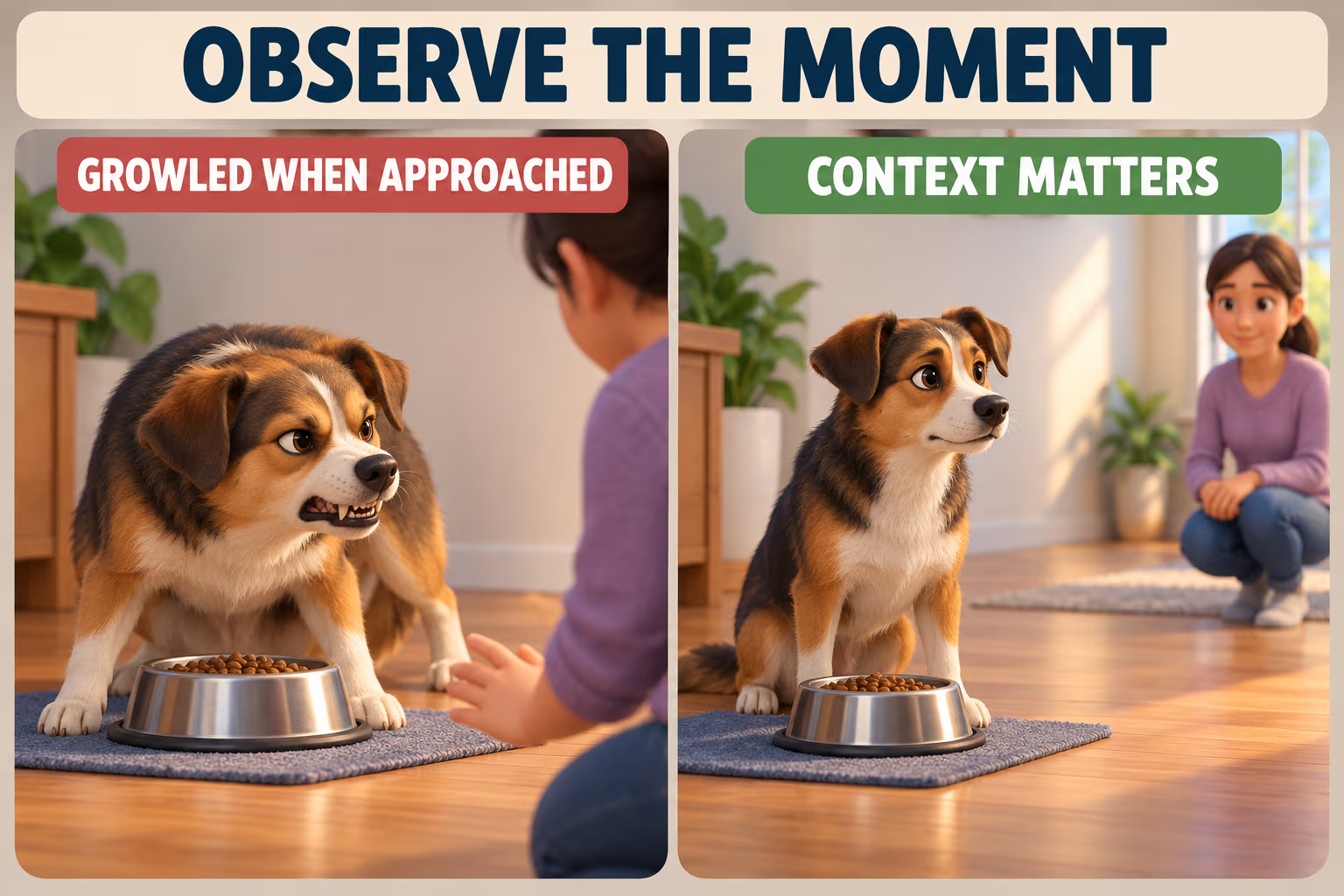
Behavior adjectives are clearer when the sentence says what happened, where it happened, and what occurred immediately before it. “The dog growled when a person approached its food bowl” records an action and setting; “the dog is savage” turns one moment into a broad and loaded judgment.
The Merck Veterinary Manual’s dog-behavior guidance says that “aggressive” should describe a dog’s action in a given context, not the dog’s temperament. The same manual explains that fear, anxiety, arousal, learning, and environment can affect behavior; its dog-specific guidance should not be generalized to every species. A precise writer can describe a dog as growling, retreating, barking, or guarding in a particular situation without diagnosing motivation.
This rule also improves less severe descriptions. Instead of “a lazy cat,” write “the cat slept through the afternoon”; instead of “a friendly horse,” write “the horse approached the fence and accepted a hand-fed apple,” if that is what was observed. Concrete actions are easier to verify and less likely to confuse an impression with a stable trait.
Are “Wild,” “Feral,” and “Tame” Interchangeable?
No. These words describe different relationships between animals and people, so choose them according to known history and setting rather than as synonyms for personality. “Wild” may describe an animal outside domestication or human care; it does not mean vicious or rabid.
Oxford Learner’s Dictionaries defines feral for animals as living wild, especially after escaping life as a pet or on a farm. That history-related meaning is different from “aggressive.” A feral animal may avoid people, while the word itself does not tell a reader how one individual will behave in a specific encounter.
Captive describes an animal kept under human control; domestic and domesticated relate to domestication; tame suggests an individual accustomed to people. These terms are not interchangeable. If the animal’s history is unknown, describe what is known—such as “a fox seen near the campsite”—instead of guessing whether it is wild, feral, or tame.
When Are Conservation Adjectives Factual Status Terms?
Words such as endangered, threatened, and extinct carry conservation meaning, so they should be supported by a current assessment rather than used as decorative synonyms for “rare.” Name the species and the authority or assessment system when status matters.
The U.S. Endangered Species Act gives “endangered” and “threatened” specific legal definitions in the United States. The IUCN Red List uses a global assessment framework and also recognizes regional assessments; a species’ status can differ by geographic scope. A current factual description should therefore state which listing or assessment it relies on and, where relevant, its date (U.S. Fish & Wildlife Service, ESA definitions; IUCN Red List categories and criteria).
For a short creative description, a writer can use “rare-looking” only as an impression and should not present it as conservation status. A single sighting, unusual color, or small local group does not establish that a species is endangered or extinct.
Why Is “Rabid” Not a Synonym for “Fierce”?
Rabid is a disease-related word, not a neutral way to say that an animal is angry, energetic, wild, or frightening. The CDC describes rabies as a viral disease of mammals that is usually transmitted through the bite of an infected animal; an adjective based on appearance or a brief action cannot establish that an animal has rabies.
Writers sometimes use “rabid” figuratively for extreme enthusiasm or hostility. That figurative meaning is strongly charged and can confuse a factual description, so choose words such as “agitated,” “loud,” or “intense” when those are the actual observations. If a real-world rabies concern is involved, use official public-health guidance rather than inferring disease from a word list (CDC, About Rabies).
How Can You Write a Precise Animal Description?
A strong animal description connects the animal, a verified or observable feature, and enough context to make the adjective understandable. This four-step check works for school writing, captions, stories, and factual nature notes.
- Name the animal: identify the animal noun first—fox, frog, owl, dog, or a more precise species if known.
- Choose the category: decide whether you mean appearance, habitat, activity, relationship, behavior, or official status.
- Check evidence and scope: confirm a technical or status term with a credible source; for behavior, state the action and context.
- Test the sentence: ask whether the adjective helps a reader picture or understand the animal, and whether a more specific detail would be fairer.
| Vague wording | More precise wording | Why it helps |
|---|---|---|
| “A beautiful bird sat there.” | “A blue-feathered bird perched on the fence at sunrise.” | Names a visible feature and setting instead of an unsupported value judgment. |
| “The wild cat was mean.” | “The cat hissed and moved behind the shed when people came near.” | Records behavior without guessing the animal’s history or motive. |
| “An endangered animal crossed the road.” | “A [verified species name] crossed the road; the current [named authority] assessment lists it as [status].” | Connects a status term to a species and source instead of using it as a synonym for rare. |
| “The rabid wolf looked angry.” | “The wolf bared its teeth and moved away; its health status was not known.” | Separates visible action from an unsupported disease claim. |
For a species-specific vocabulary example, browse our guides to cow adjectives and bunny adjectives; apply the same check for word class, observable evidence, and context.
Conclusion
Adjectives for animals are most useful when they identify a clear feature, ecological association, relationship, or context-specific action. The original alphabetic tables remain intact as a vocabulary resource, but animal nouns and technical terms need to be used according to their role in a sentence. Prefer observable details, verify factual status words, and avoid turning one behavior into a species-wide or permanent character judgment.
Frequently Asked Questions About Adjectives for Animals
Is “bear” an adjective or a noun?
“Bear” is normally a noun naming an animal, as in “A bear crossed the path.” In “bear-like,” the compound can function adjectivally to mean resembling a bear. A word’s role depends on how it is used; the fact that “bear” appears in an adjective list does not make the animal name itself an adjective.
What is the difference between an animal noun and an adjective?
An animal noun names the creature, such as “owl,” “cat,” or “whale.” An adjective describes a quality of that noun, as in “a silent owl” or “the cat is curious.” Some words related to animal groups, such as “feline,” work as adjectives, while animal names remain nouns in ordinary descriptions.
Can I call a dog aggressive?
In ordinary writing, say what the dog did and in what context—for example, “the dog growled when someone approached its bowl.” Merck Veterinary Manual guidance says “aggressive” should describe a dog’s action in context, not its temperament. Do not generalize that dog-specific guidance to all animal species.
Does “feral” mean dangerous?
No. “Feral” describes an animal living wild, especially after escaping life as a pet or farm animal; Oxford Learner’s Dictionaries does not define it as a temperament label. The word alone does not tell you whether an individual animal is aggressive, fearful, healthy, or likely to approach people.
Can “rabid” simply mean a wild or angry animal?
No. “Rabid” has a specific disease-related meaning because rabies is a viral disease of mammals. Figurative uses exist, but the word is misleading in factual wildlife or pet descriptions unless rabies is actually established by appropriate information. Describe observable actions instead of guessing an animal’s health.


