Choose an adjective that tells readers what you can actually see: a cloud’s shape, height, texture, color, movement, or how much sky it covers. Wispy, layered, patchy, towering, and translucent give more concrete information than a general judgment such as beautiful or ominous. You can combine two kinds of detail: “thin, featherlike cirrus clouds crossed the pale evening sky.”
Clouds consist of tiny water droplets, ice crystals, or both. Their forms vary with the air around them, so an adjective is a useful visual description, while a cloud-type name is a meteorological category. The basic shapes help connect the two: cumulus clouds often look puffy, stratus clouds form broad layers, and cirrus clouds are high, thin, and feathery.
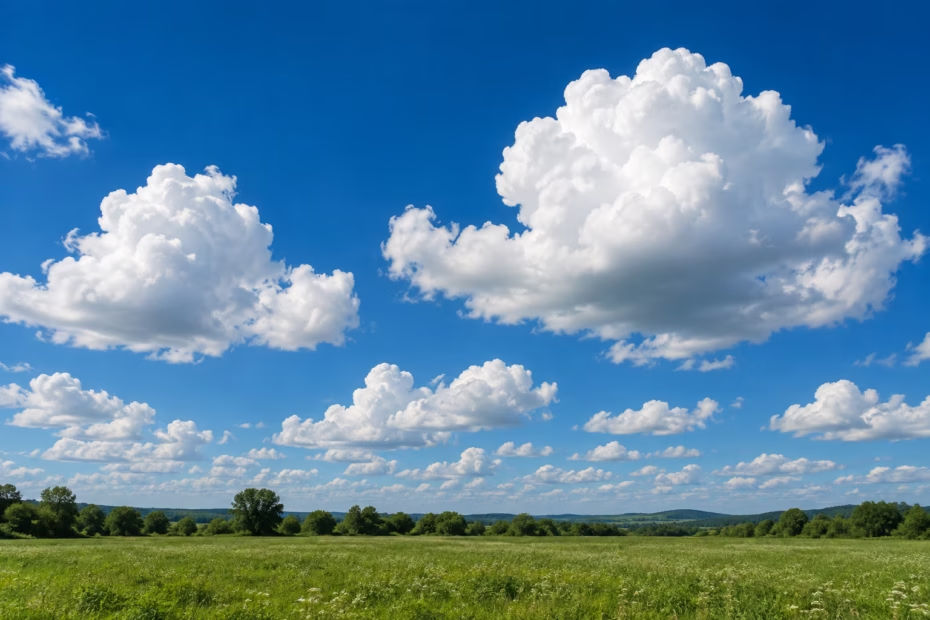
Puffy and rounded describe the visible form of a cumulus cloud.
Adjectives for cloud shape and texture
Adjective
What it describes
Example
billowy
Full, rolling shapes that seem to swell
Billowy cumulus clouds rose over the fields.
fluffy
Soft-looking, rounded edges
Fluffy clouds drifted above the playground.
feathery
Fine strands or delicate plumes
Feathery cirrus clouds stretched across the west.
wispy
Thin, trailing strands
Wispy clouds appeared high above the ridge.
layered
Arranged in distinct bands or sheets
Layered clouds covered the distant hills.
patchy
Separated groups with gaps between them
Patchy clouds let sunlight reach the garden.
ragged
Uneven, broken edges
Ragged low clouds clung to the mountain slopes.
towering
Great vertical height
Towering clouds grew above the warm plain.
dense
Thick appearance that blocks more light
Dense clouds hid the ridge from view.
translucent
Light passes through, though forms may remain visible
Translucent cloud softened the sun.
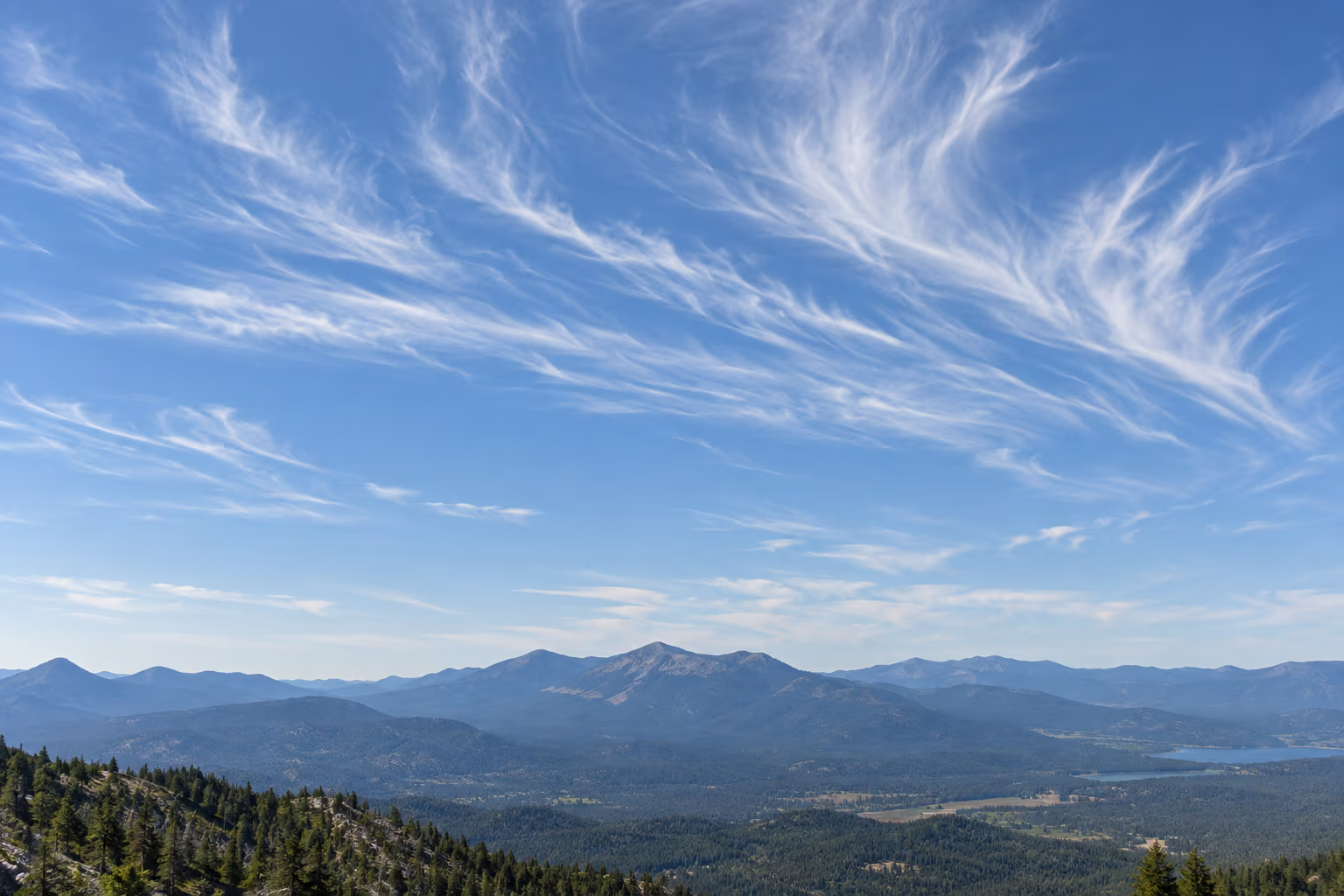
Wispy and feathery are precise choices for many cirrus clouds.
Adjectives for cloud color and light
White, gray, pale, silvered, and golden describe color or the way light appears on a cloud. Shadowed and backlit describe lighting rather than a permanent cloud property. A cloud may look bright white from one side and dark underneath; its appearance changes with the sun, the cloud’s thickness, and the viewer’s position.
Use dark or heavy-looking as visual descriptions, but don’t treat a dark cloud as proof that a severe storm is coming. If the weather matters, use a forecast or the known cloud type rather than guessing from color alone. Mood words such as threatening, peaceful, and dreamlike can work in creative writing, where they express the observer’s impression.
Cloud-type words and their visual clues
Cumulus: often rounded or puffy, with separate cloud elements.
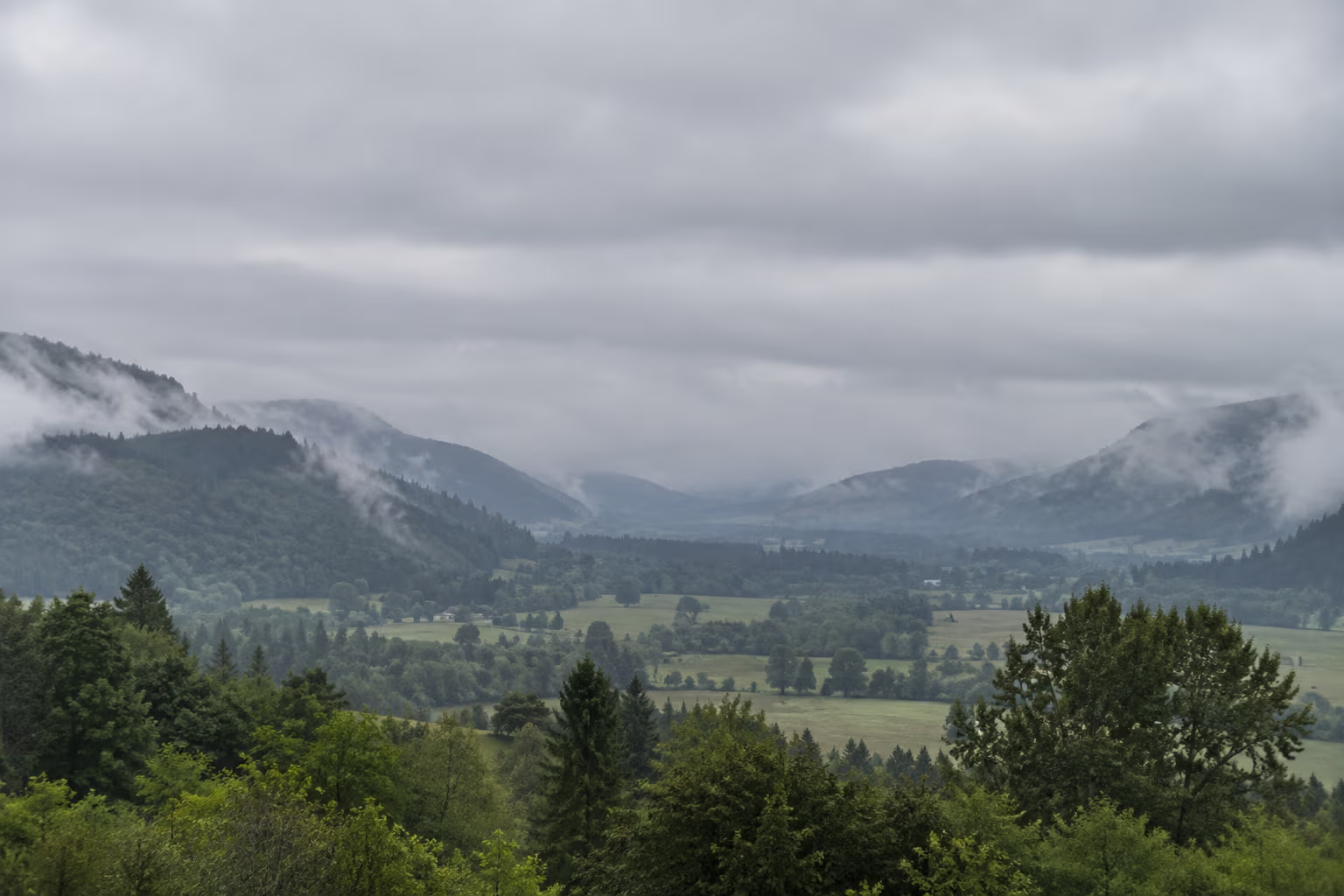
Stratus: generally low and spread in a uniform sheet or layer; it may look gray or appear in ragged patches.
Cirrus: high, thin, and often wispy or feathery.
Altocumulus: middle-level patches or groups with a rounded, rippled look.
Nimbostratus: a broad precipitation-bearing layer, often dark gray.
Cumulonimbus: a cloud that can grow vertically into a tall storm cloud.
These names identify types; they are not interchangeable adjectives. For example, calling a sky “stratus” is less natural than “a stratus layer” or “a low, uniform sheet of cloud.” NASA and UCAR explain that cloud groups are classified by both shape and altitude, and a cloud’s exact height can vary by region.
Uniform and gray are common visual descriptions for a stratus layer.
Cloud adjectives for different kinds of writing
For a science report, prefer observable terms: “a high, thin, icy cloud” or “a low, uniform gray layer.” For a story, add a comparison or mood: “ragged clouds tore across the moonlit sky” or “soft golden light edged the cloud.” For a short caption, one or two strong details are usually enough. Avoid stacking near-synonyms such as fluffy, puffy, billowy, cottony unless the repetition is intentional.
Also check whether the word normally describes a cloud. Cloudy usually describes a sky or day with many clouds; cloudless means without clouds. Stormy often describes weather or a sky, while storm-tossed may be more literary. Words such as angry or anxious can personify clouds, but they describe a creative impression rather than an objective cloud feature.
Quick examples
Wispy cirrus clouds curved above the blue horizon.
A dense gray layer dimmed the morning light.
Patchy white clouds drifted past the sunlit peak.
Towering cumulonimbus clouds gathered beyond the coast.
Golden light traced the ragged edges of the clouds.
A low blanket of stratus covered the valley.
Frequently asked questions
What are the best adjectives for clouds?
Useful choices include wispy, feathery, billowy, fluffy, layered, patchy, ragged, towering, dense, translucent, gray, and golden. Pick words that match the specific cloud rather than treating them as universal synonyms.
Are “cumulus,” “stratus,” and “cirrus” adjectives?
They are primarily names for cloud types. They can modify another noun in compounds such as “a cirrus cloud” or “stratus layer,” but for ordinary descriptive writing use an adjective like puffy, layered, or wispy.
Is “nimbus” an adjective for a dark cloud?
Nimbus is used in names for clouds associated with precipitation, such as nimbostratus and cumulonimbus. It is not a general synonym for “dark” or “stormy.”
The legacy material below is retained as written for reference. Its long alphabetical list includes words that are not normally cloud adjectives, along with a few apparent typos; use the curated descriptions above when accuracy and natural usage matter.
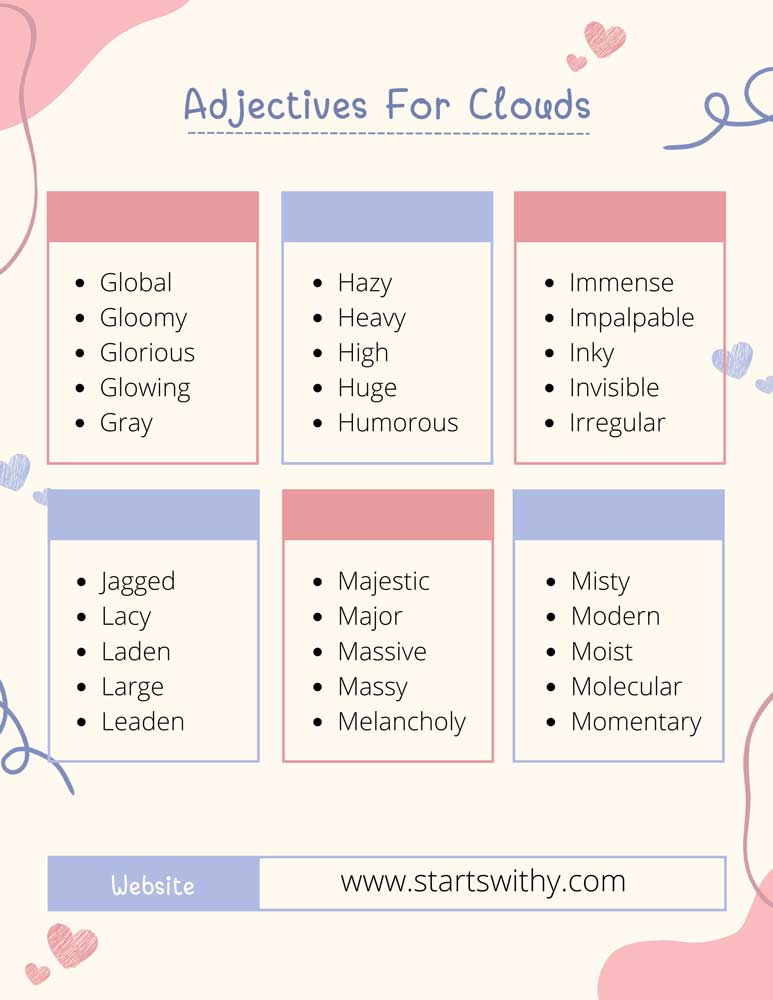
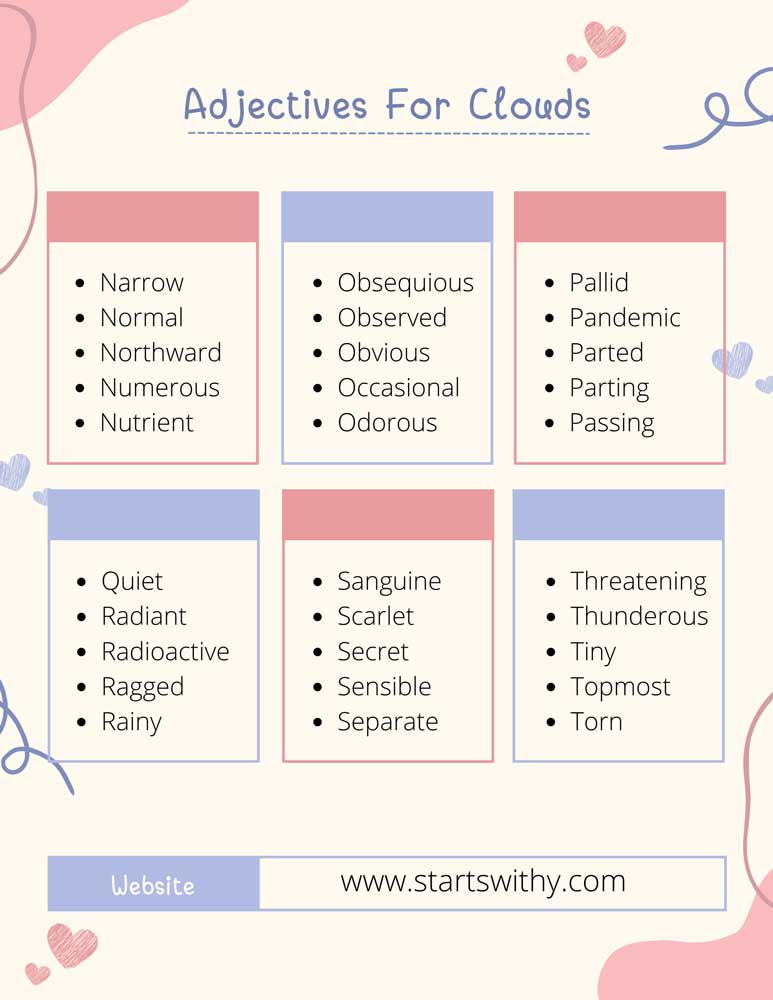
Original adjectives-for-clouds title graphic.
In this article, we will be discussing adjectives for clouds. As you probably know, clouds are a very important part of the Earth’s atmosphere. They play a vital role in the water cycle and help to regulate the Earth’s temperature. Without clouds, the Earth would be a very different place!
Clouds come in all shapes and sizes, and they can be described using a wide range of adjectives. In this article, we will be looking at some of the most common adjectives used to describe clouds. We hope that this will help you to improve your vocabulary and to better understand the English language. Adjectives are a great way to describe the world around us, so let’s get started!
Adjectives For Clouds
The sky is a deep blue, and the sun is a blazing orange. The clouds are fluffy and white.
When we look up at the sky, we see different shapes and colors of clouds. But what are clouds made of?
Clouds are made up of tiny water droplets or ice crystals. These droplets are so small that they can stay suspended in the air.
The temperature and amount of moisture in the air determine the type of clouds that form. For example, if the air is warm and has a lot of moisture, cumulus clouds will form. If the air is cold and has less moisture, cirrus clouds will form.
There are many different types of clouds, and each has its own unique adjective. Here are some examples:
Cumulus clouds are fluffy and white.
Stratus clouds are low-lying and often look like a sheet.
Cirrus clouds are high in the sky and often have a wispy, feathery appearance.
Nimbus clouds are dark and foreboding. They are often a sign of bad weather to come.
What is your favorite type of cloud? Do you have a favorite cloud adjective?
A
Abyssinian
Accompanying
Adverse
Agitated
Agreeable
Airy
Alternate
Amorous
Ancient
Angry
Annoying
Anxious
Approaching
Argent
Artificial
Atlantic
Atom
Atomic
Autumnal
Awful
Azure
B
Bankrupt
Barren
Battlemented
Bearish
Beautiful
Beloved
Belowthe
Big
Billowing
Billowy
Black
Blackening
Blacker
Blank
Bleak
Blended
Blind
Bloody
Blown
Blue
Blueish
Bluish
Boundary
Bright
Brilliant
Broad
Broken
Brown
C
Calm
Cañon
Centralized
Certain
Checkered
Choking
Close
Clustering
Cold
Collied
Color
Colored
Coloured
Column 1
Column 2
Column 3
Columnar
Comfortable
Commercial
Complex
Concentrated
Confused
Considerable
Continuous
Coral
Cornered
Cornish
Creamy
Crimson
Cumbrous
Cumulous
Cumulus
Curdled
Curious
Curtaining
D
Damp
Dark
Darker
Darkling
Darknessa
Darksome
Dazzling
Decided
Decorative
Deep
Definite
Delicate
Dense
Detached
Devouring
Dewy
Diaphanous
Difficult
Dim
Dimming
Dingy
Dirty
Disband
Discouraging
Dismal
Distant
Distributed
Divine
Domestic
Downy
Dreary
Drifting
Dripping
Driving
Drunken
Dull
Dumb
Dusky
Dusty
Dynamic
E
Easterly
Eastern
Easy
Eddying
Effulgent
Elastic
Electric
Enormous
Entire
Envious
F
Faint
Fair
Fat
Fierce
Fiery
Fitful
Flaky
Fleecy
Fleeting
Floating
Fluffy
Flying
Formless
Foul
Fragrant
Fresh
Frozen
Fugitive
Funnel
Funny
Furious
G
Galactic
Gay
Giant
Global
Glooming
Gloomy
Glorious
Glowing
Golden
Gray
Great
Green
Grey
H
Hanging
Hazy
Heavy
High
Huge
Humorous
Hung
Hybrid
I
Illumined
Immense
Impalpable
Impending
Impenetrable
Inky
Invisible
Irregular
J | L
Jagged
Lacy
Laden
Large
Lazy
Leaden
Level
Light
Lightening
Livid
Lofty
Loose
Lovely
Low
Luminous
Luminous Cloud
Lurid
M
Majestic
Major
Massed
Massive
Massy
Melancholy
Mere
Mighty
Milky
Mist
Misty
Mobile
Modern
Moist
Molecular
Momentary
Motionless
Moving
Multi
Multiple
Murky
Mysterious
N | O
Narrow
New
Normal
Northward
Numerous
Nutrient
Obscuring
Obsequious
Observed
Obvious
Occasional
Odorous
Oily
Olympian
Ominous
Opal
Opaque
Open
Opposing
Optimistic
Original
Outer
Outlying
Overburdened
Overwhelming
p
Pale
Pallid
Pandemic
Parted
Parting
Passing
Past
Patchy
Peaceful
Peculiar
Perfect
Perfumed
Perilous
Permanent
Perpetual
Persistent
Petty
Phantom
Picturesque
Piled
Pillared
Pillowy
Pink
Pistonssuch
Pitchy
Placea
Poisonous
Polar
Portentous
Predate
Pregnant
Presumptuous
Primary
Pro
Prodigious
Promising
Protoplanetary
Puffy
Pungent
Pure
Purple
Pyramidal
Pyrocumulonimbus
Q | R
Quiet
Radiant
Radioactive
Ragged
Rainy
Real
Rebellious
Red
Reddened
Reddish
Reflected
Reliable
Religious
Remote
Resell
Rich
Riotous
Riven
Rolling
Roseate
Rosy
Round
Rounded
Roundish
Royal
Rural
Rushing
S
Sable
Sad
Sandy
Sanguine
Scarlet
Scented
Secret
Sensible
Separate
Serpentine
Shadowy
Shaped
Sheeted
Shifty
Showery
Sifting
Significant
Silent
Silver
Silvery
Simultaneous
Single
Sinister
Skythe
Sleepy
Slender
Slight
Slippery
Slow
Smitten
Smoky
Smooth
Snowiest
Snowy
Sodden
Soft
Solemn
Solid
Solitary
Somber
Sombre
Sooty
Sorrowful
Sparkling
Speechless
Splendid
Spotless
Spungy
Stagnant
Stately
Stationary
Steady
Stealthy
Steely
Sticky
Stinging
Stingy
Stormy
Strange
Stratified
Stratospheric
Stray
Streaky
Stupendous
Sublime
Subsequent
Sudden
Sullen
Sulphureous
Sulphurous
Sumptuous
Sunlit
Sunny
Sunrise
Superb
Suspicious
Sweeping
Sweet
Swift
Swollen
T
Tattered
Telltale
Tempestuous
Temporary
Terrible
Text
Ther
Thick
Thin
Threatening
Thunderous
Thundrous
Tiny
Topmost
Torn
Toxic
Transient
Translucent
Transparent
Tremendous
Tropical
Troubled
Tumultuous
Twin
Twisted
U
Ugly
Uncanny
Uncomfortable
Undistinguished
Unendurable
Unfettered
Uniform
Unknown
Unlit
Unobstructed
Unusual
Unwilling
Upper
Upthe
Usual
V
Vanquished
Vapory
Variable
Vast
Vaulted
Veiling
Vengeful
Vernal
Vertical
Violet
Visible
Visual
Voiceless
Volatile
Voluminous
W | Y
Wandering
War
Warm
Watery
Wavering
Wavy
Weird
Westering
Western
Wet
Whitish
Wicked
Wide
Widespread
Wild
Winding
Windy
Winged
Wispy
Wonderful
Woollen
Woolly
Wretched
Writingsthick
Wrought
Yellow
Yellowish
Final verdict
When it comes to clouds, there are a lot of different adjectives that can be used to describe them. Whether you’re looking at them from a scientific standpoint or simply enjoying their beauty, each type of cloud has its own unique characteristics.
From fluffy cumulus clouds to the ominous-looking thunderheads, there’s something special about each and every one.
Robin founded StartsWithy in 2022 to make English words easier to understand and use. Robin oversees our 30,000+ guides, checks meanings and grammar against trusted dictionaries such as Cambridge, Oxford Learner’s and Collins, and is accountable for every correction we make.