Adjectives for Feelings and Emotions: Words & Examples
Adjectives for feelings and emotions help explain what a person is experiencing. The most useful word depends on the feeling, its intensity, and the situation: you might feel content after a quiet afternoon, relieved when a concern is resolved, or apprehensive before an uncertain event. A word can describe a moment without defining a person.
Start with a specific question: What am I feeling, how strong is it, and what happened around it? A concrete adjective is often more helpful than a broad label such as “good” or “bad.” For example, “I felt disappointed when the plans changed” tells the reader more than “I felt bad.” Choose words that fit your own experience, and ask rather than assume when describing someone else.
The American Psychological Association’s introductory psychology lesson offers one useful technical definition of emotion as a brief, synchronized subjective, behavioral, and physiological response. In technical psychology, mood often refers to a less intense and longer-lasting state that may not have one clear cause. Everyday speech uses “feeling,” “emotion,” and “mood” more loosely, so these distinctions are guides rather than rules for ordinary conversation. The APA’s emotion-words checklist offers further examples of words people may use to describe their experience.
Words for different feelings
These groups are starting points, not rigid categories. A word’s meaning and tone can shift with context, and two near-synonyms may not fit the same sentence.
“I felt hopeful but still uncertain about the move.”
What is the difference between “overwhelmed” and “overwhelming”?
Many adjectives ending in -ed describe the person or other experiencer of a reaction: “I felt overwhelmed by the number of choices.” An -ing form often describes the thing or situation that prompts the reaction: “The number of choices was overwhelming.” The same pattern appears in pairs such as interested/interesting, bored/boring, and upset/upsetting. This is a useful pattern, although not every adjective follows it in exactly the same way.
The -ed form commonly describes the person experiencing the feeling.The -ing form often describes the situation that prompts a reaction.
Check who or what the adjective describes. In “the children were excited,” the children experience the feeling; in “the game was exciting,” the game produces interest or enthusiasm. This small grammar check can make descriptions clearer.
Can you have more than one feeling at once?
Yes. People may describe mixed reactions to the same event, such as feeling proud and nervous before a performance, or relieved and sad when a demanding project ends. Pairing adjectives with and or but often communicates this better than forcing one label: “I was excited and a little apprehensive.”
A person may feel more than one thing about the same moment.
Are all feeling words adjectives?
No. Some commonly used descriptions name a physical condition, behavior, or broader judgment rather than an emotion. Tired and hungry usually describe bodily states; thoughtful may describe behavior or character; and careless evaluates conduct. These words can matter when describing a whole situation, but they are not interchangeable with a feeling such as worried or pleased. Avoid turning a momentary emotion into a permanent judgment about someone.
How can you use emotion adjectives respectfully?
Describe your own experience when possible: “I felt uneasy about the change.”
Include the context when it helps explain the word: “She seemed relieved after hearing the update.”
Use a question when another person’s feelings are not clear: “How did that feel for you?”
Do not use an adjective as a diagnosis. Words such as anxious and depressed can appear in everyday speech, but a sentence alone cannot establish a health condition.
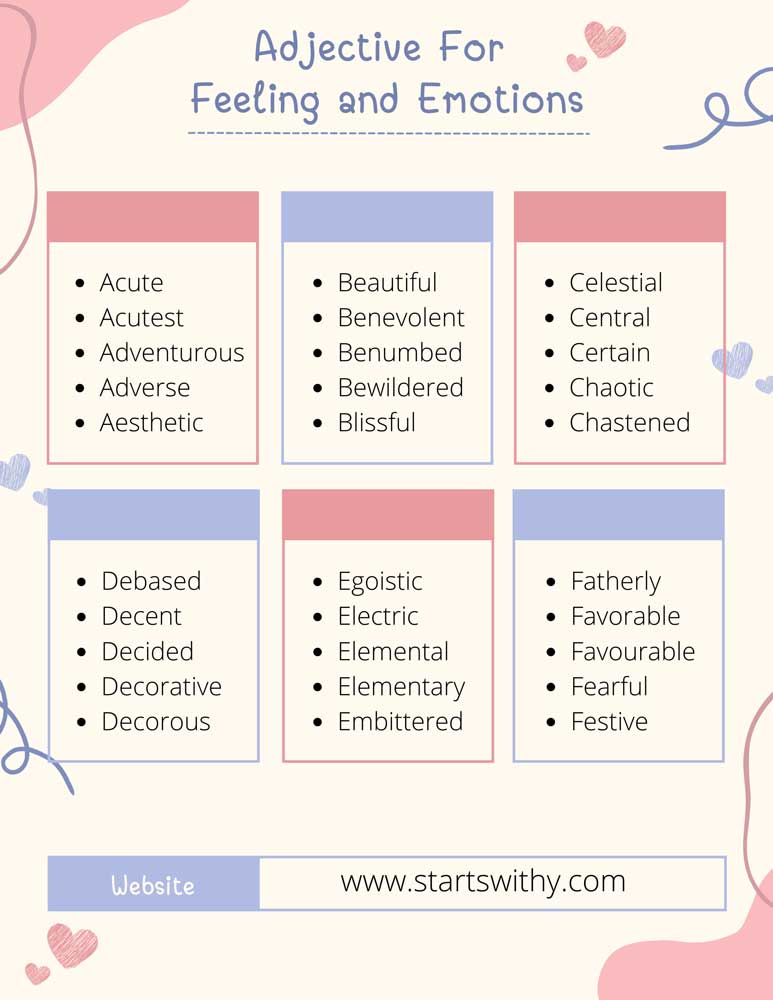
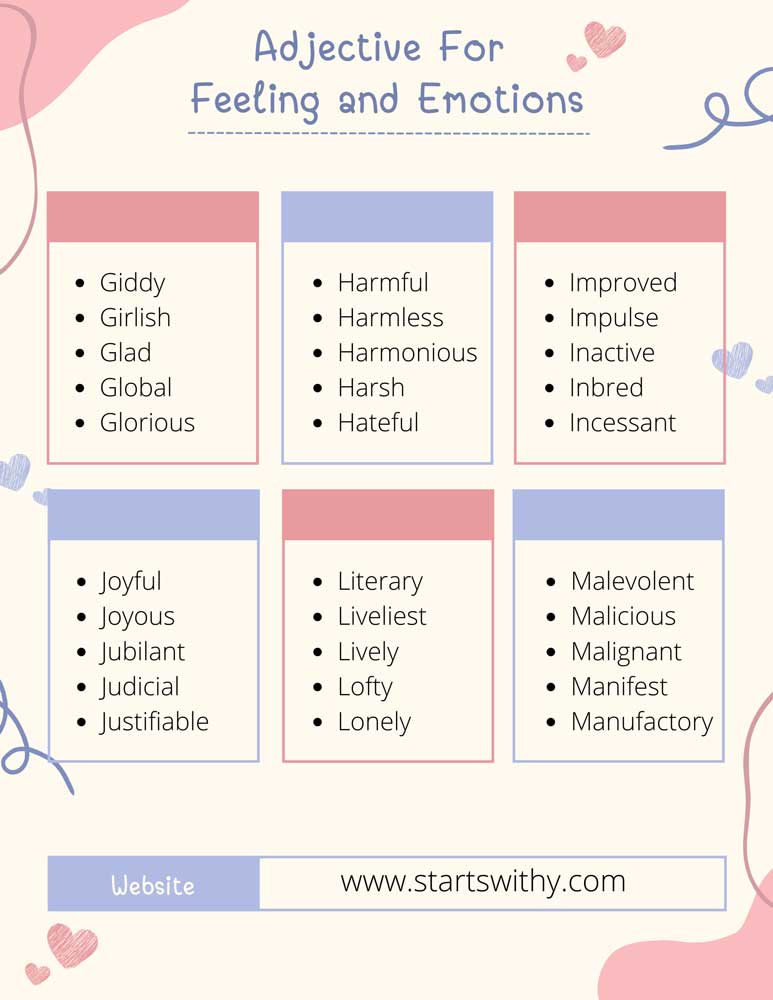
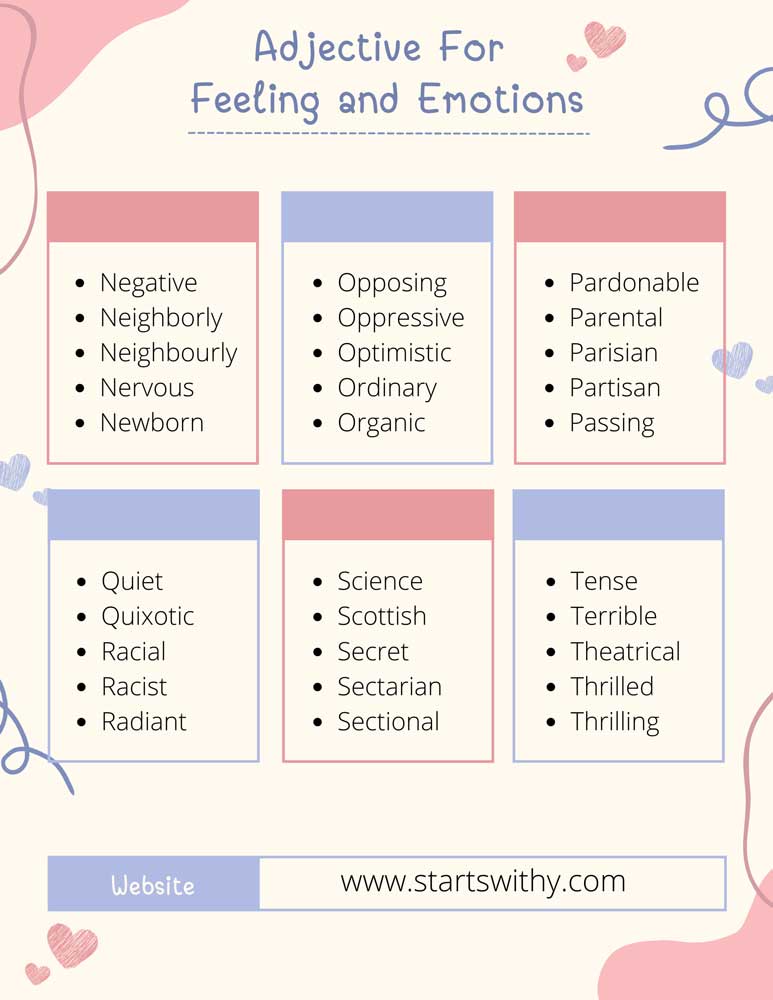
The alphabetized legacy list below is retained from the original article. It includes words from several grammatical and semantic categories, not only adjectives for emotions, so check a current dictionary and the surrounding sentence when choosing an entry.
Frequently asked questions
What are positive adjectives for feelings?
Depending on the context, joyful, content, grateful, hopeful, affectionate, and relieved can express pleasant or welcome feelings. “Positive” describes their usual tone; it does not mean a person should feel this way all the time.
What adjectives describe mixed emotions?
Ambivalent and conflicted can describe having competing reactions. You can also name both directly: “hopeful but worried,” “sad and grateful,” or “excited yet uncertain.”
What is the difference between a feeling and a trait?
A feeling usually describes a current or recent experience, while a trait suggests a more enduring tendency or characteristic. “I felt impatient during the delay” describes a moment; calling someone “an impatient person” makes a broader judgment. Context helps readers tell which meaning you intend.
Note on the preserved source: this legacy list is not a vetted emotion-word bank. Its opening claims that some people are “more emotional” or “more in touch” with feelings are subjective generalizations, not universal measures. The alphabetical entries mix emotions with unrelated traits, physical states, nationality, religion, and sexual-orientation labels; some are outdated or malformed. The N-section word “niggard” is archaic, easily misinterpreted, and generally best avoided (Dictionary.com usage note). A fictional example also uses “disfigured” as a horror cue; that wording is preserved for transparency, not recommended for describing real people. None of these legacy entries should be treated as a diagnosis or as evidence that a person is dangerous.
We all have feelings and emotions. And we all have different ways of describing them. Some people are more emotional than others. And some people are more in touch with their feelings than others. But we all have adjectives that we use to describe our feelings and emotions.
Here are some common adjective words that we use to describe feeling and emotions:
Happy
Sad
Angry
Afraid
Disgusted
Surprised
Tired
Embarrassed
Proud
Some people might feel one or more of these emotions at the same time. For example, you might be both happy and tired, or both angry and afraid.
What are some other words that you use to describe your feelings and emotions?
Adjective For Feeling and Emotions
When you’re trying to describe how you feel, sometimes it’s difficult to find the perfect words. That’s where this list of adjective words to describe feeling and emotions comes in handy. Whether you need to describe happiness, sadness, anger, love, or any other emotion, you’ll find just the right word on this list.
In conclusion, it is important to know a variety of adjective words to describe feeling and emotions. This will help you better communicate with others and understand what they are going through. Adjective words can also be used to describe your own emotions. When you are able to label your emotions, you can better deal with them.
Robin founded StartsWithy in 2022 to make English words easier to understand and use. Robin oversees our 30,000+ guides, checks meanings and grammar against trusted dictionaries such as Cambridge, Oxford Learner’s and Collins, and is accountable for every correction we make.