
Constitute is a verb meaning to form, make up or amount to something, and to use constitute in a sentence you name the parts first and the whole second: “Three clauses constitute the agreement.” The verb is transitive, so it always needs a subject and an object, and it often appears in formal and legal writing.
constitute at a glance
- Constitute is a transitive verb; its forms are constitutes, constituted, constituting and constitution.
- The core sense is to make up a whole, as when twelve judges constitute an appeals panel.
- A second sense is to amount to something, as when a late reply constitutes consent.
- Its subjects are usually lists of parts, single acts or proportions, not physical materials.
- The commonest error is swapping in the passive “is comprised of” where constitute belongs.
What does constitute mean?
Constitute is a transitive verb meaning to make up or form a whole, or to amount to something in effect. The Cambridge entry for constitute records both senses, and the difference decides the sentence: the first counts parts that together form a whole, while the second treats one act as equivalent to another. Where a sentence only needs the everyday sense of forming a group, make up is the plainer choice, because constitute sounds formal.
| Sense | Plain meaning | Example sentence |
|---|---|---|
| Make up a whole | Be the parts that together form something | Twelve judges constitute the appeals panel. |
| Amount to | Have the effect of being something | A late reply can constitute consent. |
| Set up by law | Establish a body or office formally | The 1998 Act constituted a new regulator. |
Constitute does not mean to create something from nothing, and it does not mean to be a typical example of a group. A person does not constitute a committee; a person sits on one. When the intended meaning is to build or to found, establish carries the weight that constitute cannot. The amount-to sense sits close to the phrase amount to, as when a late reply constitutes consent.
How do you use constitute in a sentence?
Put the parts or the act in the subject position and the whole in the object: three chapters constitute the report. The passive is common in official writing, where the body being formed matters more than the parts that form it.
| Pattern | Example | What it signals |
|---|---|---|
| parts + constitute + whole | Three chapters constitute the report. | The subject is a list of elements that add up. |
| act + constitute + breach | One error can constitute a breach. | A single act is treated as equal to a legal wrong. |
| whole + be constituted + of parts | The panel is constituted of five members. | Passive, common in official and legal prose. |
| body + constitute + itself as | The group constituted itself as a charity. | A body gives itself a formal status. |
| proportion + constitute + share | Women constitute half the workforce. | A proportion is stated as the makeup of a group. |
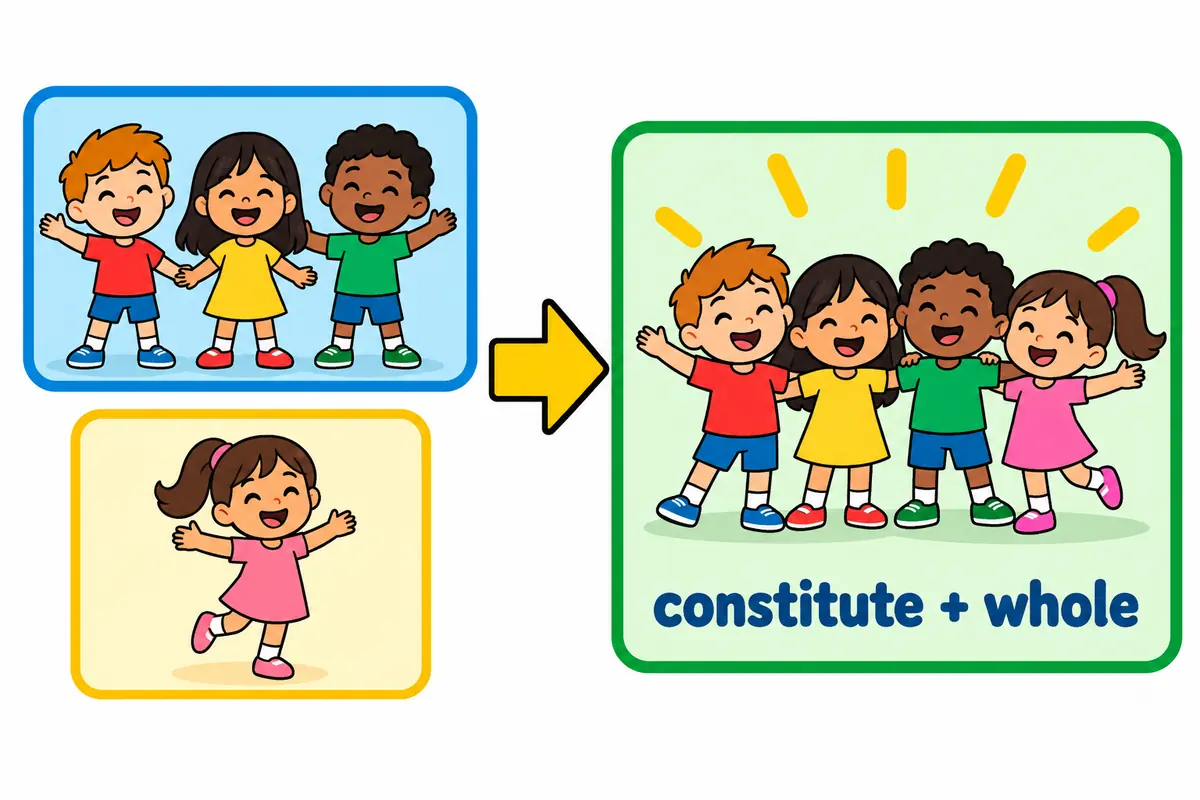
constitute in a sentence: examples across contexts
Constitute keeps the same meaning as it moves between registers; what changes is the kind of subject doing the forming. The nine sentences below run from a classroom to a legal opinion, and each names its parts or its single act.
| Context | Example sentence | Why this works |
|---|---|---|
| Classroom | Four house captains constitute the pupil council. | Concrete roles show parts forming one group. |
| Workplace email | Overdue invoices constitute a large share of the backlog. | A proportion is the subject, which reads naturally in a report. |
| News report | The two leaks constitute the worst breach in the agency’s history. | A single act is weighed as a legal wrong. |
| Legal writing | Failure to declare the payment may constitute an offence. | The modal may keeps the claim appropriately conditional. |
| Academic prose | These three variables constitute the model used in the study. | The subject is a named list, the usual academic frame. |
| Science writing | Impurities constitute less than one per cent of the sample. | A measured proportion is stated as makeup. |
| Government notice | The tribunal is constituted of three members and a clerk. | The passive names the structure of an official body. |
| Business report | These costs constitute the bulk of the increase. | Bulk signals a large share without overstating it. |
| Conversation | Those two mistakes constitute most of my score. | The pattern survives in speech with a small list. |
The formal register lives in the passive rows and the legal rows; only the last sentence would sound at home in casual speech.
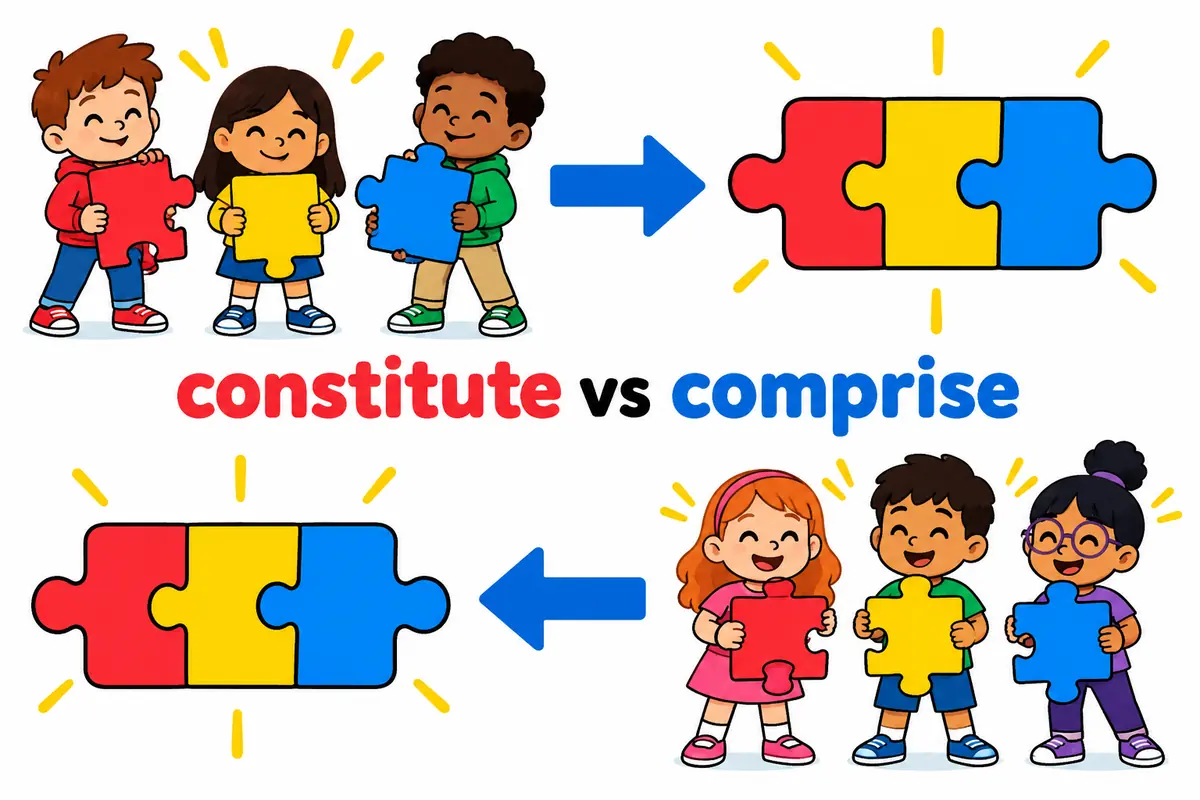
constitute vs comprise
Comprise is the verb writers most often reach for when they mean constitute, and the two point in opposite directions. Constitute runs from the part to the whole, while comprise runs from the whole to its parts.
| Attribute | constitute | comprise |
|---|---|---|
| Core job | Be one of the parts that form a whole | Contain or consist of the whole |
| Direction | Parts constitute the whole | The whole comprises the parts |
| Typical subject | A part, a list or a single act | A complete group or collection |
| Passive form | Be constituted of is accepted | Be comprised of is widely criticised |
| Register | Formal, legal and official | Neutral to formal |
Verdict: write ten chapters constitute the book, or the book comprises ten chapters, but never let comprise run from parts to whole.
Word forms and grammar of constitute
Constitute inflects regularly, and its family includes the noun constitution, the word that names a founding document rather than the act of forming. The table also lists the adjective learners build from constituent by mistake.
| Form | Part of speech | Example |
|---|---|---|
| constitute | verb, base form | Three points constitute the argument. |
| constitutes | verb, third person singular | One late payment constitutes a breach. |
| constituted | verb, past and past participle | The board constituted a subcommittee. |
| constituting | verb, present participle | The groups constituting the alliance met in June. |
| constitution | noun | The constitution sets out the court’s powers. |
| constituent | noun or adjective | Each constituent signed the founding charter. |
| constitutional | adjective | The judges called the rule unconstitutional. |
Note that constitutional, meaning relating to a constitution, is a different word from constituent, which names a member or a component.
Common mistakes with constitute
- Incorrect:
The committee is comprised of seven members.Correct: The committee is constituted of seven members. Rule: Comprise runs whole to parts; constitute runs parts to whole, and comprised of is criticised by most editors. - Incorrect:
The book is constituted of ten chapters.Correct: The book consists of ten chapters. Rule: Be constituted of is rare; consist of is the ordinary phrase for listing contents. - Incorrect:
Three reasons constitute why he left.Correct: Three reasons explain why he left. Rule: Constitute takes a noun, never a that-clause or an adverb clause. - Incorrect:
The meal constitutes of three courses.Correct: The meal consists of three courses. Rule: Constitute is never followed by of in the active voice. - Incorrect:
Her silence constitutes as agreement.Correct: Her silence constitutes agreement. Rule: Do not add as; the object follows the verb directly.
Practice using constitute
Work through the six items, then check the reasoning rather than only the answer.
- Fill the gap: Eleven players ______ a cricket team.
- Choose the better word: Four chapters (constitute / comprise) the whole guide.
- Correct the error: The delay is constituted of a serious problem.
- Build a sentence: use constitute a breach about a missed deadline.
- Spot the register: which belongs in a formal report — these costs constitute the bulk, or these costs are the big part?
- Rewrite with the passive: Three judges form the panel. Use be constituted of.
Answers
- constitute — eleven players are the parts that form the whole team.
- constitute — the chapters are parts moving toward the whole; comprise would run the other way.
- The delay constitutes a serious problem — constitute takes a direct object, not of.
- Model answer: A missed deadline can constitute a breach of the contract.
- These costs constitute the bulk — a formal report chooses the precise verb over a vague phrase.
- The panel is constituted of three judges — the passive keeps the formed body in focus.
The bottom line
Use constitute in a sentence when you are naming the parts or the single act that makes up a whole, and keep the parts as the subject. The two nuances that settle most sentences are these: the verb is transitive, so the whole must always follow it, and its passive be constituted of is acceptable while be comprised of is not. Where you need the opposite direction, from whole to parts, choose comprise instead.
Frequently asked questions about constitute
Is constitute a formal word?
Constitute sits in legal, academic and official writing, where it names parts that form a whole or an act that amounts to a wrong. In casual speech most people say make up instead, so the rules constitute a problem would sound stiff at a kitchen table while it reads perfectly in a policy memo.
What does constitute mean in law?
In legal writing constitute usually means to amount to a particular offence or breach, as in a late filing may constitute contempt. It can also mean to establish a body formally, as in the Act constituted a new tribunal. Context decides which of the two senses a sentence carries.
What is the difference between constitute and comprise?
Constitute runs from the parts to the whole: three judges constitute a panel. Comprise runs from the whole to its parts: the panel comprises three judges. The passive be constituted of is accepted, but the passive be comprised of is widely criticised, so keeping the two directions straight prevents the commonest error.
Can you say comprised of?
Most editors avoid it because comprise already means include, so of is redundant. Write the committee comprises seven members instead. If you want the passive shape, use be constituted of, as in the committee is constituted of seven members, which is accepted in official and legal prose.
Do you know what it means when something “constitutes” part of a whole? The word “constitute” refers to the act of forming or making up a particular thing, group, or concept. It entails being an essential or integral element that contributes to the overall structure or composition.
When various components come together to create something larger or more complex, they constitute the entirety of that entity. In simpler terms, “constitute” is used to describe how individual parts combine to form a whole.
7 Examples Of Constitute Used In a Sentence For Kids
- Constitute means to make up something.
- A group of colors constitute a rainbow.
- My toys constitute my playtime fun.
- Different shapes constitute a puzzle.
- Letters constitute words in a book.
- Numbers constitute a math problem.
- Fruits and vegetables constitute a healthy meal.
14 Sentences with Constitute Examples
- Constituting a study group with fellow classmates can help improve academic performance.
- Attending lectures and taking notes constitute a vital part of college learning.
- Completing assignments and projects on time constitutes good time management skills.
- Proper planning and organization constitute the foundation for success in college.
- Regular attendance constitutes a significant portion of the final grade in many courses.
- Group discussions and debates constitute an essential part of a well-rounded college education.
- Setting realistic goals and objectives constitutes a roadmap to achieving academic success.
- Participating in extracurricular activities constitutes a well-rounded college experience.
- Submitting original work and avoiding plagiarism constitutes academic integrity.
- Developing strong relationships with professors constitutes a valuable resource for academic support.
- Building a strong network of friends and peers constitutes a support system during challenging times.
- Utilizing library resources and online databases constitutes effective research skills.
- Prioritizing self-care and mental health constitutes overall well-being during college years.
- Collaborating with classmates on group projects constitutes teamwork and collaboration skills.
How To Use Constitute in Sentences?
Constitute means to form or make up a whole. To use Constitute in a sentence, identify the main subject or idea that is being composed or formed. For example, “The fruits constitute a significant portion of a healthy diet.” In this sentence, the word “constitute” is used to show that fruits make up a significant part of a healthy diet.
When using Constitute in a sentence, always ensure that the subject or idea you are referring to is the main element being formed or composed. For instance, “The team’s hard work constituted their success.” In this example, the word “constituted” is used to indicate that the team’s hard work formed the basis of their success.
It can also be helpful to consider the context in which Constitute is being used to ensure clarity and accuracy in your sentence. For instance, “Equality and fairness constitute the foundation of a just society.” Here, the word “constitute” is used to show that equality and fairness are the fundamental elements that make up a just society.
By following these guidelines and paying attention to the subject or idea that is being formed or composed, you can effectively incorporate Constitute in a sentence to convey your message clearly and accurately.
Conclusion
In conclusion, the sentences with “constitute” serve to identify and define what makes up a particular concept, group, or entity. They are used to pinpoint the essential elements or components that form something, providing clarity and specificity in communication. By highlighting what constitutes a subject, these sentences help to enhance understanding and convey key information effectively.
By using sentences with “constitute,” individuals can convey the essential building blocks of a topic or argument, facilitating clear and precise communication. These sentences play a crucial role in breaking down complex ideas into their fundamental parts, offering a concise and straightforward explanation. Ultimately, sentences with “constitute” are valuable tools in expressing the defining characteristics and components that make something what it is.


