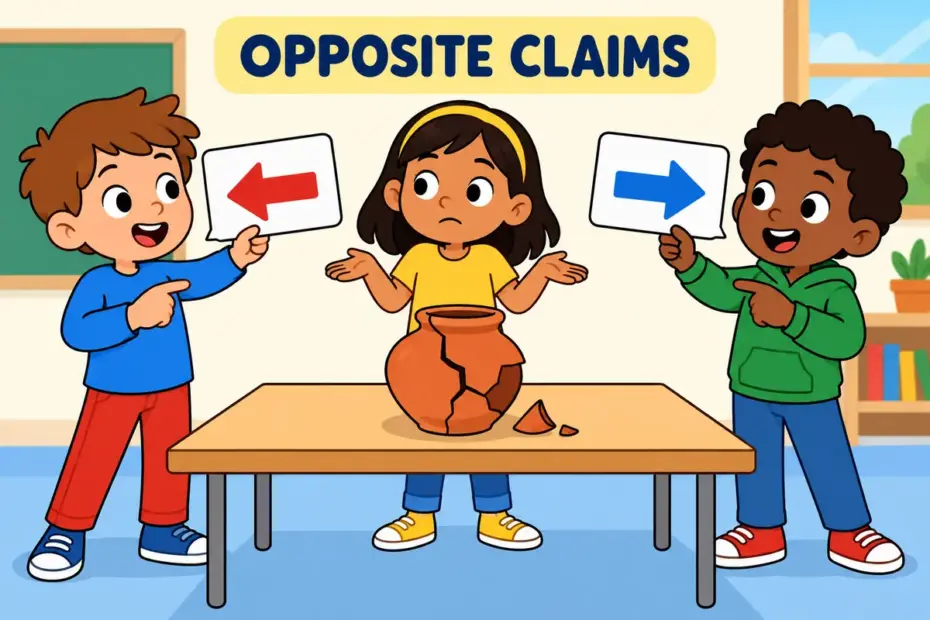
Contradict means to say the opposite of what someone has said, or to be so different that the two cannot both be true. To use contradict in a sentence, give the verb a person or a statement as its object: “The witness contradicted the earlier report.” The verb is transitive, so it never appears without something to contradict.
Contradict at a glance
- Contradict is a transitive verb; its forms are contradicts, contradicted and contradicting.
- The object is the person or statement that is being opposed.
- The reflexive pattern contradict yourself always means internal inconsistency.
- Contradict belongs to argument, reporting and logic rather than casual chat.
- The commonest error is using it for a flat denial, where deny is the more accurate verb.
What does contradict mean?
Contradict is a transitive verb meaning to state the opposite of a claim, or to be inconsistent with it. The Cambridge entry for contradict separates the two uses: a person contradicts someone, and a piece of evidence contradicts a statement. To confute a claim goes further and means to prove the other side wrong, which is more than merely opposing it.
| Sense | Plain meaning | Example sentence |
|---|---|---|
| Deny by opposing | Say the opposite of a claim | She contradicted his account of the meeting. |
| Be inconsistent with | Fail to agree with something | The dates contradict the invoice. |
| Oppose in argument | Speak against a person’s position | Two members contradicted the chair. |
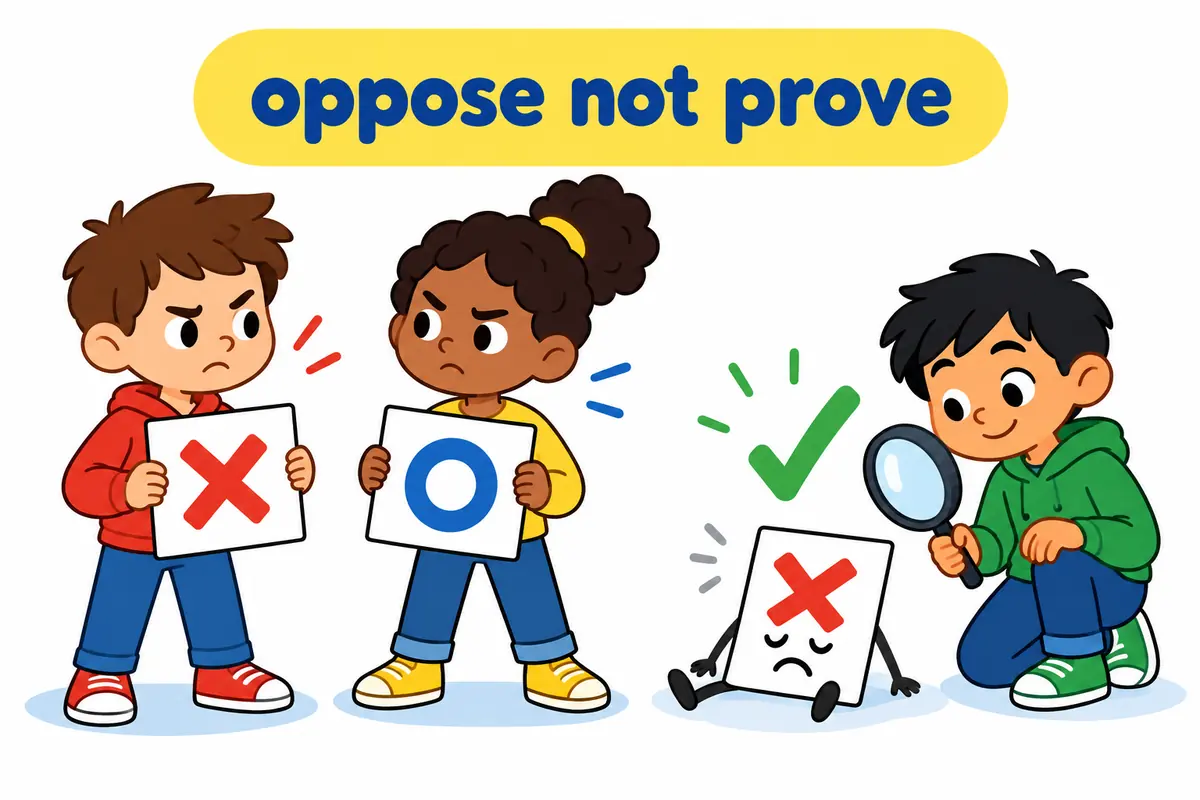
One limitation is worth stating plainly. Contradict is not deny and not refute: deny rejects a claim without offering the opposite, and refute proves it wrong. Contradict only sets a second claim against the first, and both claims may still be false.
How do you use contradict in a sentence?
The verb takes either a person or a thing as its object, and the reciprocal form handles two accounts that clash. These five patterns cover nearly every real sentence, and the passive is common in reporting.
| Pattern | Example | What it signals |
|---|---|---|
| subject + contradict + person | The apprentice contradicted her trainer. | One person opposes another person’s word. |
| subject + contradict + statement | The data contradict the forecast. | Evidence clashes with a claim. |
| contradict + yourself | He contradicted himself twice in one answer. | Marks internal inconsistency. |
| be contradicted by + source | The witness was contradicted by phone records. | Passive, used in neutral reporting. |
| contradict + each other | The two reports contradict each other. | Two things conflict; note the reciprocal form. |
A sentence sounds natural when the two sides are named, because contradiction always needs a first claim to oppose. Where two accounts clash without either being proved wrong, to dispute a figure is often the more usual verb in reporting.
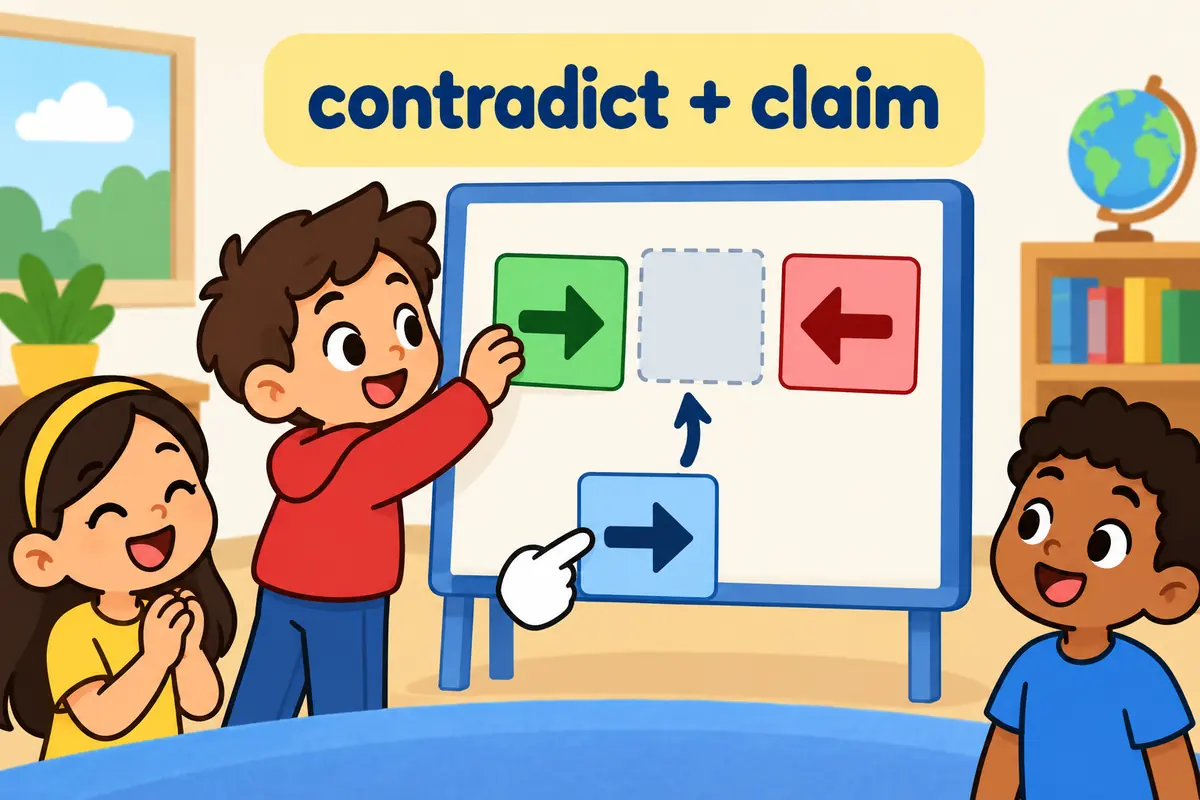
Contradict in a sentence: examples across contexts
Contradict holds the same meaning across registers, but the force changes with the subject. The eight sentences below move from a classroom to a research paper, naming the two sides in every case.
| Context | Example sentence | Why this works |
|---|---|---|
| Classroom | The pupil contradicted the textbook and was proved right. | Shows the verb can describe honest disagreement. |
| Workplace email | Please do not contradict the client in the meeting. | Uses the person as object in a polite instruction. |
| News report | The minister was contradicted by her own department. | The passive is standard when a source is the news. |
| Legal writing | The second statement contradicts the first on every material point. | Pairs the two documents as subject and object. |
| Science writing | The new measurements contradict the accepted value. | Data as subject keeps the claim impersonal. |
| Conversation | I hate to contradict you, but the shop closed at six. | The softening phrase is the polite spoken frame. |
| Academic prose | These findings contradict the model proposed in 1998. | A dated claim as object is normal in a review. |
| Debate | Each candidate contradicted the other on tax. | The reciprocal form signals mutual conflict. |
Contradict vs refute
Contradict and to refute a claim are close enough to be used wrongly in formal writing. To contradict is to assert the opposite; to refute is to prove that the opposite is true.
| Attribute | contradict | refute |
|---|---|---|
| Core act | Assert the opposite | Prove the opposite |
| Evidence needed | None | Strong evidence |
| What follows | Two conflicting claims | One claim defeated |
| Typical subject | A person, a report or the data | A study, an experiment or an audit |
| Register | Neutral to formal | Formal and academic |
| Implied outcome | Disagreement | Victory in argument |
Verdict: use contradict when two claims stand against each other, and refute only when you can show that one of them is false.
Word forms and grammar of contradict
The family is regular, and the adverb is the form learners are least likely to have met.
| Form | Part of speech | Example |
|---|---|---|
| contradict | verb, base form | Do not contradict the chair. |
| contradicts | verb, third person singular | The memo contradicts the policy. |
| contradicted | verb, past and past participle | Her claim was contradicted at once. |
| contradicting | verb, present participle | He kept contradicting himself. |
| contradiction | noun | The two figures stand in contradiction. |
| contradictory | adjective | They gave contradictory answers. |
| contradictorily | adverb | She spoke contradictorily about the date. |
Do not use contradict as an adjective: the answers were contradictory, never the answers were contradict. The noun contradiction takes an article, as in a plain contradiction.
Common mistakes with contradict
- Incorrect:
He contradicted to his boss.Correct: He contradicted his boss. Rule: Contradict is transitive, so it takes its object directly and needs no to. - Incorrect:
She contradicted that the plan was ready.Correct: She contradicted the claim that the plan was ready. Rule: The object is a noun phrase; a that-clause needs deny or dispute. - Incorrect:
His answer was contradict.Correct: His answer was contradictory. Rule: Contradict is a verb; the adjective is contradictory. - Incorrect:
He contradicted the accusation.Correct: He denied the accusation. Rule: A bare accusation is denied, not contradicted; contradict needs a prior statement to set against. - Incorrect:
The two reports contradict themselves.Correct: The two reports contradict each other. Rule: One thing contradicts itself; two things contradict each other.
Practice using contradict
Work through the six items, then read the answers for the reasoning, not only the key.
- Fill the gap: The new figures ______ the earlier estimate.
- Choose the better word: The scientist was able to (contradict / refute) the old theory with fresh data.
- Correct the error: She contradicted that the door was locked.
- Build a sentence: use contradict each other about two weather forecasts.
- Spot the register: which belongs in a report — the county figures contradict the state total, or the numbers just do not match up?
- Rewrite with the noun: His story contradicts the receipt. Use contradiction instead.
Answers
- contradict — the figures are the subject and the estimate is the object the verb needs.
- refute — fresh data proves the theory wrong, which is more than merely opposing it.
- She contradicted the claim that the door was locked — contradict takes a noun phrase, not a that-clause.
- Model answer: The two weather forecasts contradict each other about the weekend.
- The county figures contradict the state total — a report keeps the precise verb and avoids the vague phrase match up.
- His story stands in contradiction to the receipt — the noun takes the phrase in contradiction to.
The bottom line
Use contradict in a sentence to set one claim against another, and give the verb a clear object: a person, a report or a figure. Remember that contradict stops short of proof, so to deny a charge is the right verb when a claim is simply rejected. Reserve refute for the moment evidence settles the question.
Frequently asked questions about contradict
Is contradict a formal word?
Contradict is neutral in register and appears in ordinary argument as well as in reports. The set phrases do not contradict you and I hate to contradict you keep it polite in speech. In academic and legal writing it signals a direct clash between two claims.
What is the noun form of contradict?
The noun is contradiction, meaning a clash between two statements, and the adjective is contradictory. A person who contradicts constantly is called contradictory or, more informally, argumentative. The adverb contradictorily appears mainly in formal writing and is rare in speech.
Can contradict be used in the passive voice?
Yes, and the passive is common in reporting. The pattern is be contradicted by plus the source: the witness was contradicted by the phone records. The passive focuses on whose account was overturned rather than on who did the overturning, which suits a neutral news sentence.
What is the difference between contradict and deny?
To deny is to reject a claim; to contradict is to set an opposite claim against it. A person can deny an accusation without offering any counter-statement, but contradiction requires two things that cannot both be true. That is why a bare accusation is denied, not contradicted.
Ever encountered a sentence that seems to go against itself? That’s a contradiction – when a statement conflicts with itself, making it hard to believe both parts are true at the same time.
Words like “but,” “however,” or “yet” often signal a contradiction in a sentence, revealing an unexpected twist or new information that challenges what was previously stated. Contradictions can be subtle or glaring, adding complexity and intrigue to a text by presenting conflicting ideas within the same sentence.
7 Examples Of Contradict Used In a Sentence For Kids
- The sun is hot, but the ice is cold.
- I like apples, but my friend likes oranges.
- Birds can fly, but fish swim in water.
- The cat is small, but the elephant is big.
- I wear a red shirt, but my brother wears a blue shirt.
- My mom cooks dinner, but we eat breakfast in the morning.
- I have a toy car, but my sister has a doll.
14 Sentences with Contradict Examples
- Contradict the statement made by the professor if you have valid evidence to support your argument.
- It is important to contradict misinformation during academic discussions to maintain accuracy.
- Always be prepared to contradict peer opinions with logical reasoning and factual data.
- Do not hesitate to contradict outdated research findings with more recent and relevant studies.
- Contradict the stereotypical beliefs prevalent in society by presenting a different perspective.
- Use critical thinking skills to contradict faulty reasoning presented in academic essays and debates.
- It is essential to contradict biased viewpoints with impartial analysis and objective facts.
- Students should cultivate the courage to contradict authority figures respectfully in academic settings.
- Contradict baseless arguments with well-researched and credible sources of information.
- Engage in healthy debates and discussions where it is acceptable to contradict each other’s viewpoints to foster intellectual growth.
- It is acceptable to contradict your friend’s opinion if you have solid grounds to do so during academic debates.
- When presenting your research findings, be prepared to contradict previous studies that may have conflicting results.
- In academic research, contradict conflicting theories by conducting further experiments and analysis.
- Always be open to contradict your own beliefs and opinions if presented with compelling evidence or new information.
How To Use Contradict in Sentences?
Contradict is used when one statement or claim conflicts with another. To use Contradict in a sentence, first identify two statements that present opposing views or information. For example, “She said it was going to rain tomorrow, but the weather forecast contradicts her prediction.”
In this sentence, the word Contradict is used to highlight the conflict between what “she” said and what the weather forecast indicates. The key is to show that there is a contradiction between the two pieces of information.
When using Contradict in a sentence, ensure that both statements are clearly stated, and the contradiction between them is evident. This helps to provide context and clarity to the reader or listener.
Here is another example: “The witness’s testimony contradicted the defendant’s alibi, leading to further investigation by the police.”
In this sentence, the use of Contradict emphasizes the discrepancy between the witness’s testimony and the defendant’s alibi. This contradiction prompts the police to take further action.
Remember, using Contradict in a sentence helps to point out inconsistencies or conflicts between different statements or pieces of information. By clearly highlighting these contradictions, you can effectively communicate the conflicting viewpoints or information.
Conclusion
In conclusion, sentences with contradictory elements can create confusion and ambiguity in communication. These sentences consist of parts that clash or oppose each other, leading to a lack of clarity in the message being conveyed. It is essential to avoid contradictions in sentences to ensure clear and effective communication.
By being mindful of the language used and striving for consistency in writing, we can enhance the understanding and impact of our messages. Clear, coherent sentences help convey information effectively and prevent misunderstandings. Therefore, it is crucial to construct sentences that do not contain contradictory elements to maintain the clarity and coherence of our communication.


