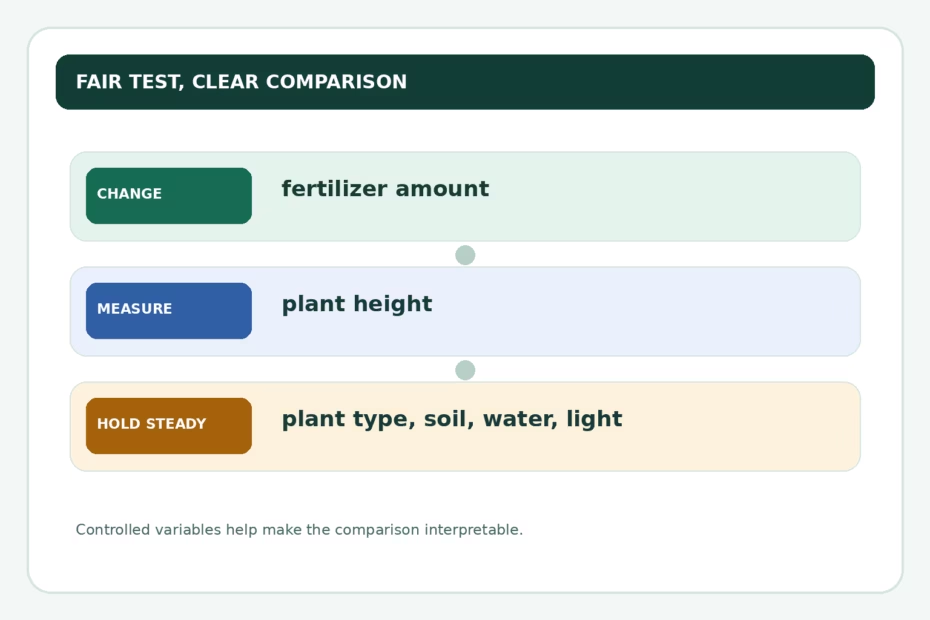
A controlled variable is a condition kept the same across the parts of an experiment being compared. For example, when testing whether fertilizer amount affects plant height, a student might use the same plant type, pot size, soil, water schedule, and light exposure for every plant. These controls help make the comparison clearer; they do not guarantee that every possible influence has disappeared.
Controlled variable: meaning and examples
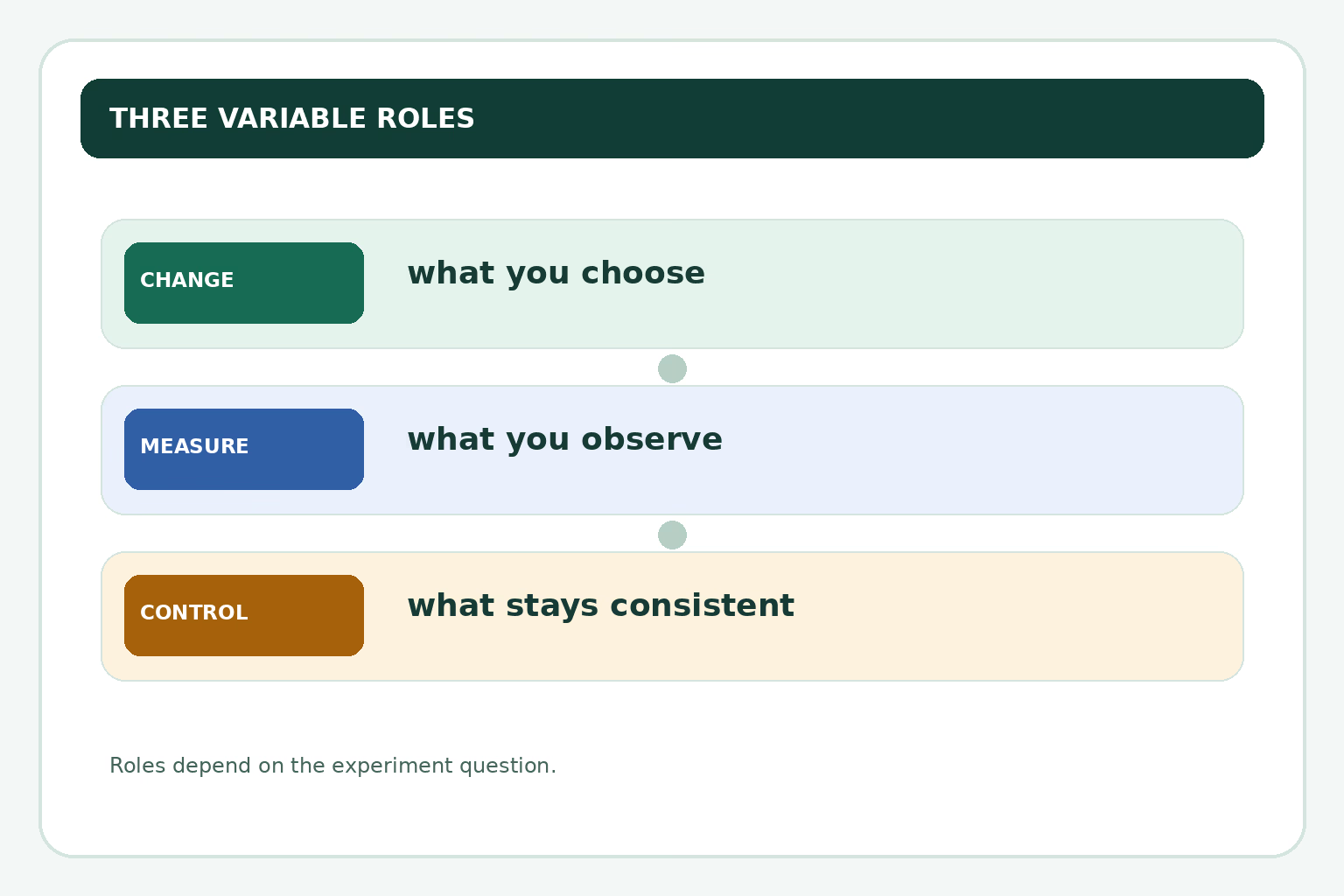
An experiment often identifies three roles for variables. The independent variable is what the investigator changes, the dependent variable is what they measure or observe, and controlled variables are relevant conditions they keep consistent or manage in a planned way. The names describe each factor’s role in a particular question: water amount can be a controlled variable in one plant study and the independent variable in another.
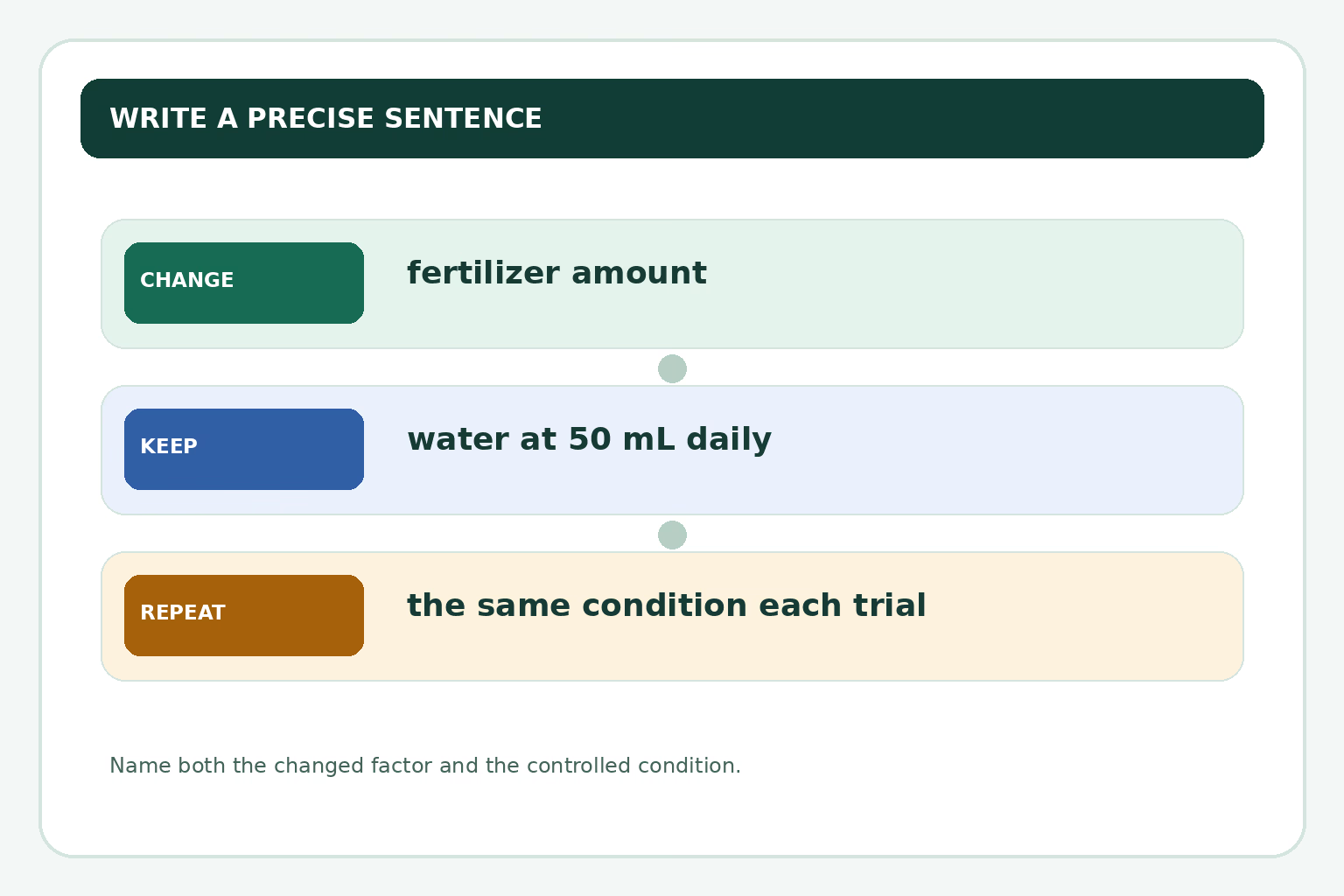
Controlled variables are also called control variables or constants in some classrooms. “Constant” is a useful shorthand, but real experiments may need to set a condition within an agreed range, measure it, or account for it rather than hold it perfectly fixed. Say what was actually done: for example, “Each pot received 50 mL of water daily,” rather than simply “water was controlled.”
How to identify the controlled variables
- Write the testable question. Name the factor you plan to change and the result you will measure. Example: “Does the amount of fertilizer affect bean-plant height after four weeks?”
- List other factors that could affect that result. For this plant comparison, relevant factors could include plant type, pot size, soil, water, light, and growing time.
- Choose how to handle each factor. Keep it the same when practical, define an acceptable range, or measure and account for it if it cannot be fixed.
- Describe the procedure precisely. Replace “same conditions” with observable details such as the same seed variety, equal soil mass, measured water volume, and equal growing period.
- Check the records. Note any differences or unexpected changes. A factor does not become controlled just because the plan says it should be.
There can be several controlled variables in one experiment. The aim is to reduce avoidable differences that could muddy the comparison, while recognizing that measurement error and uncontrolled influences can remain. A controlled experiment supports a more useful interpretation; the word “controlled” alone does not prove a cause-and-effect claim.
Controlled variable vs. independent variable vs. control group
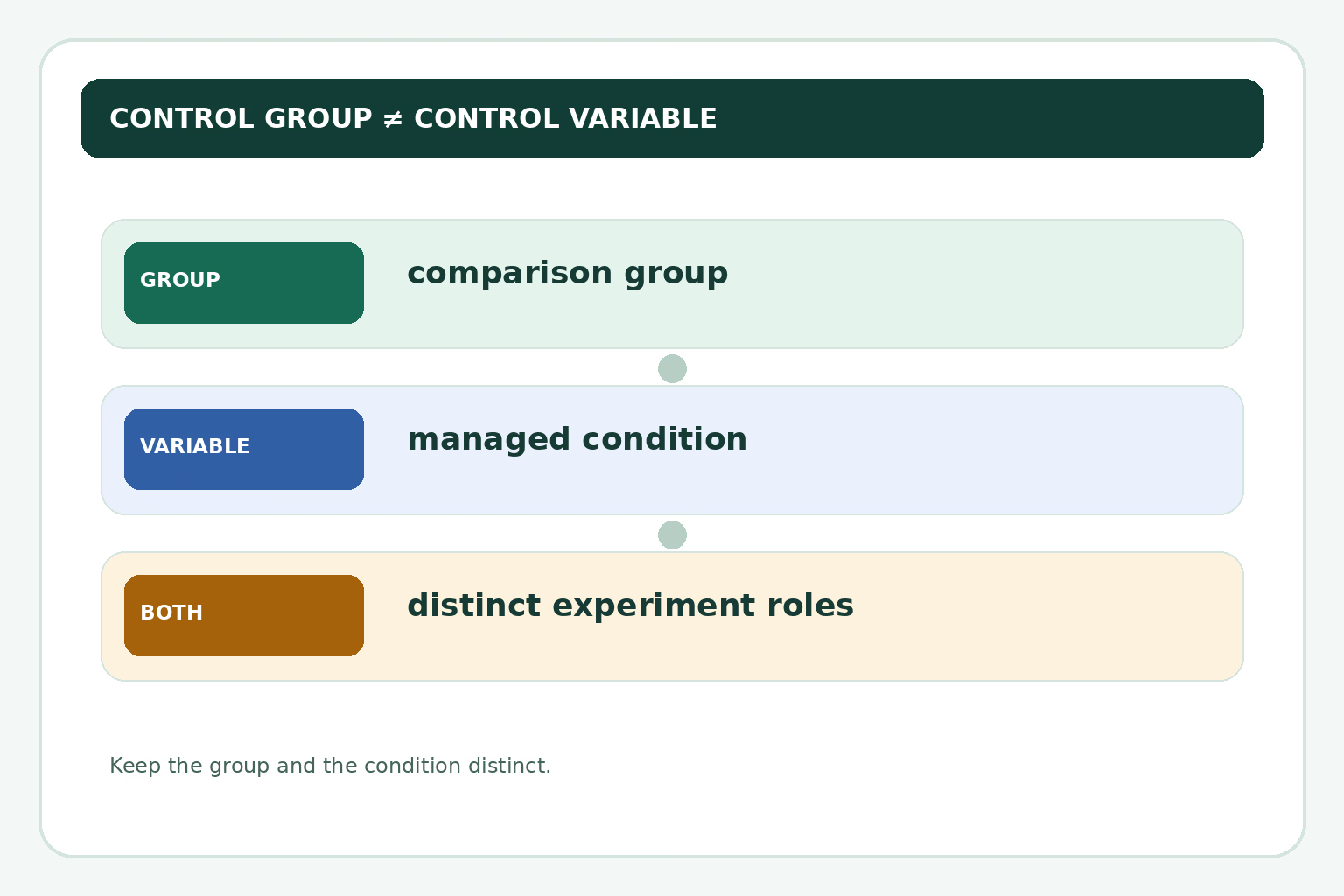
These terms are related but do different jobs. The independent variable is the planned difference between conditions. A controlled variable is a condition managed so the comparison stays interpretable. A control group is a comparison group that does not receive the tested treatment, or receives a specified comparison treatment. A control group is not itself a controlled variable.
| Question | Changed factor | Measured outcome | Example controlled conditions |
|---|---|---|---|
| Does fertilizer amount affect bean-plant height? | Fertilizer amount | Plant height after four weeks | Plant type, pot size, soil, water schedule, light, and growing time |
| Does water temperature affect how much sugar dissolves? | Water temperature | Amount of sugar dissolved under a stated procedure | Water volume, sugar type, stirring method and duration, and container |
| Does cart mass affect acceleration? | Cart mass | Acceleration measured with the same method | Track, starting position, applied force, and measurement procedure |
The table gives possible designs, not universal requirements. The researcher should identify conditions that matter for the specific question and explain how they were managed. In a complicated study, factors may be balanced across groups or included in the analysis instead of held identical.
Sentence patterns for “controlled variable”
- “While we changed [independent variable], we kept [controlled variable] at [value or condition] in every trial.”
- “To make the comparison fair, [condition] was kept the same for all groups.”
- “We controlled [factor] by [specific action or measurement].”
More example sentences
- “While we changed the fertilizer dose, we gave every bean plant 50 milliliters of water each day.”
- “The type of sugar was a controlled variable because we used granulated white sugar in every cup.”
- “To compare the detergents, we washed equal-sized fabric squares in the same volume and temperature of water.”
- “We kept the ramp angle and starting point constant while testing how wheel material affected the toy car’s travel distance.”
- “In our test of how mass affects acceleration, we applied the same measured force to each cart.”
- “The lab report lists light exposure as one of several controlled variables, not the only one.”
- “We measured room temperature during each trial because it could not be held at one exact value.”
- “The control group received no fertilizer; soil type and water volume were controlled variables in both groups.”
- “The experiment was easier to interpret because the team recorded which conditions stayed the same.”
Each factor’s role depends on the study. If the question is whether water affects plant growth, water amount is the independent variable, so it should not be described as controlled in that same comparison. If a sentence does not say what is being tested, readers may not know why a particular condition was kept the same.
Frequently asked questions
Can an experiment have more than one controlled variable?
Yes. Most comparisons manage several relevant conditions. A plant-growth test might standardize seed type, soil, water, light, container size, and duration.
Does a controlled variable always stay exactly the same?
Not necessarily. Researchers may hold a condition constant, define a range, monitor it, or account for it in the design or analysis. The sentence should match what actually happened.
Is the control group the controlled variable?
No. A control group is a comparison group; controlled variables are conditions handled consistently across the relevant groups or trials. A study may use both.
Why do controlled variables matter?
They reduce alternative explanations for observed differences and make the comparison easier to interpret. They cannot remove every source of uncertainty.
Sources for the science explanation
- Science Buddies, “What Are Variables?” explains independent, dependent, and controlled variables with experiment examples.
- Khan Academy, “Controlled experiments” uses experimental and control groups to explain comparison conditions.
Use the examples below as sentence models. For any real experiment, state the question and the exact procedure so readers can see which conditions were controlled.
Have you ever wondered what a controlled variable is in a scientific experiment? A controlled variable is a factor that is intentionally kept constant throughout the experiment to ensure that the only thing affecting the dependent variable is the independent variable being tested.
By isolating the effects of the independent variable through the use of controlled variables, researchers are able to draw accurate and reliable conclusions from their experiments. This practice helps to minimize external influences and make the experimental results more valid and credible.
7 Examples Of Controlled Variable Used In a Sentence For Kids
- The amount of water I use for my plant is a controlled variable.
- I make sure the temperature in my experiment stays the same as a controlled variable.
- When I play with my toy car, I keep the speed as a controlled variable.
- I always keep the time I sleep as a controlled variable every night.
- In class, we make sure the size of our paper is a controlled variable for our project.
- When I color my picture, I keep the type of crayons I use as a controlled variable.
- During our science experiment, we keep the type of plant the same as a controlled variable.
14 Sentences with Controlled Variable Examples
- In a biology experiment measuring the effect of temperature on enzyme activity, the amount of enzyme used would be the controlled variable.
- When analyzing the impact of caffeine on heart rate, the duration of exercise would need to be a controlled variable.
- In a physics lab exploring the relationship between mass and acceleration, the force applied would be the controlled variable.
- When conducting a psychology study on memory retention, the type of study material presented would serve as the controlled variable.
- In a chemistry experiment investigating the rate of reaction, the concentration of the reactants would be the controlled variable.
- When studying the effect of music on concentration, the volume of the music played should be a controlled variable.
- During a statistics project comparing different study methods, the duration of study time should be a controlled variable.
- In a nutrition study assessing the impact of diet on weight loss, the amount of exercise performed each week would be the controlled variable.
- When examining the influence of sleep on academic performance, the bedtime should be a controlled variable.
- In a sociology research project on social media usage, the specific platform used would be the controlled variable.
- When investigating the effect of stress on cognitive function, the duration of relaxation techniques practiced would be the controlled variable.
- In an engineering experiment on material strength, the thickness of the materials tested would be the controlled variable.
- When comparing different study environments, the level of noise present should be a controlled variable.
- In a economics study on consumer behavior, the price of the products being analyzed would be a controlled variable.
How To Use Controlled Variable in Sentences?
To use a Controlled Variable in a sentence, start by identifying the variable that you want to keep constant in an experiment. This variable is crucial for ensuring that any changes observed in the experiment are due to the manipulated variable and not other factors.
For example, in an experiment testing how different amounts of fertilizer affect plant growth, the amount of sunlight the plants receive can be a controlled variable. By keeping the sunlight constant for all groups of plants, you can accurately determine the impact of the varying amounts of fertilizer on plant growth.
When constructing your sentence, make sure to clearly state the controlled variable and its specific value or condition. For instance, “In the study, the controlled variable of temperature was set at 25°C throughout the experiment.”
Remember to use the term ” controlled variable” in your sentence to indicate to others that you have intentionally kept certain factors constant in your experimental setup. This helps to ensure the reliability and validity of your results.
By incorporating controlled variables into your experiments and writing about them in your results, you can demonstrate a sound understanding of experimental design and help others replicate your findings effectively.
Conclusion
In scientific experiments, a controlled variable is crucial for ensuring the accuracy and reliability of results. By keeping certain factors constant while manipulating others, researchers can isolate the effects of the independent variable and accurately assess its impact on the dependent variable. This helps to eliminate any potential confounding variables that could skew the results and allows for more valid conclusions to be drawn.
Overall, the use of controlled variables in experiments is essential for maintaining consistency and control, ultimately leading to more trustworthy and meaningful findings. By meticulously designing experiments with controlled variables in mind, scientists can confidently analyze the relationship between variables and make informed decisions based on reliable data.