
Conventional describes something that follows the usual, widely accepted way of doing things rather than a new or original one. To use conventional in a sentence, place it before the noun it judges: “a conventional design,” “conventional methods.” The word can mean simply customary or, less kindly, unoriginal.
Conventional at a glance
- Conventional is an adjective; its related forms are conventionally, convention, conventionality and unconventional.
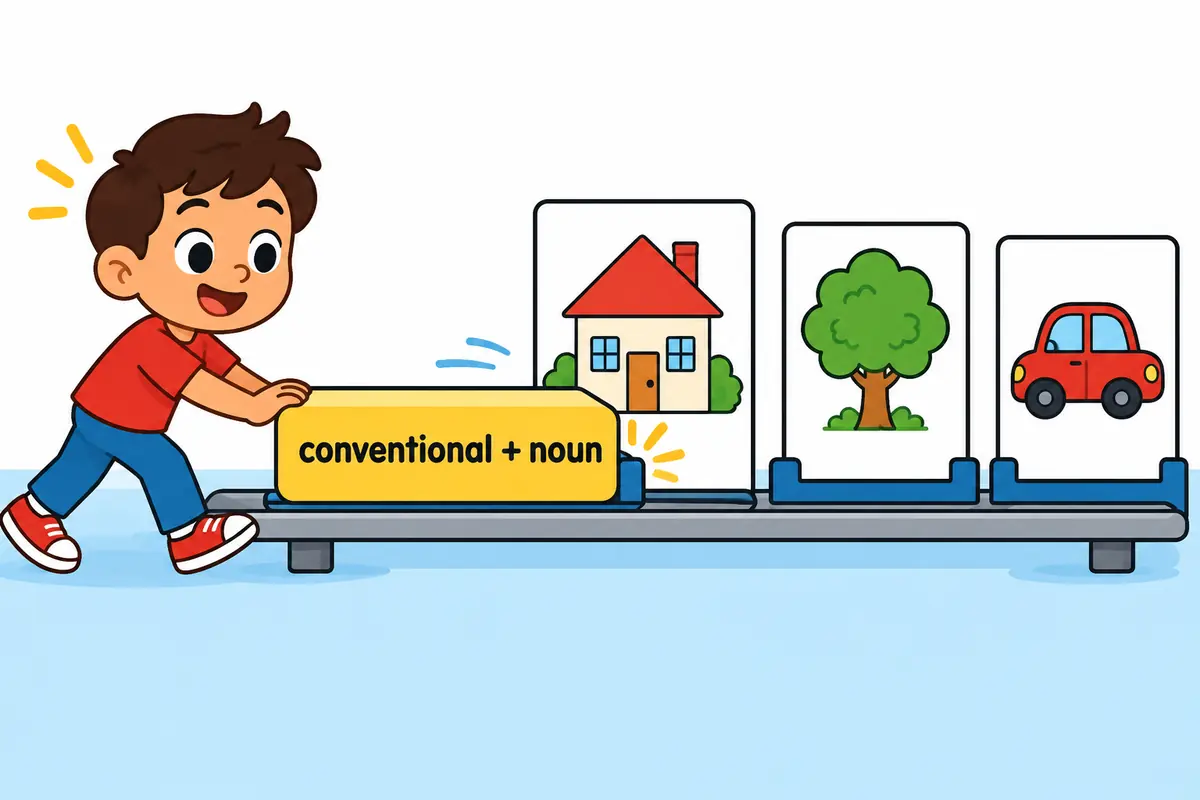
- The dominant pattern is conventional + noun.
- It describes choices that follow accepted custom rather than novelty.
- Conventional belongs to neutral, descriptive writing, though it can imply dullness.
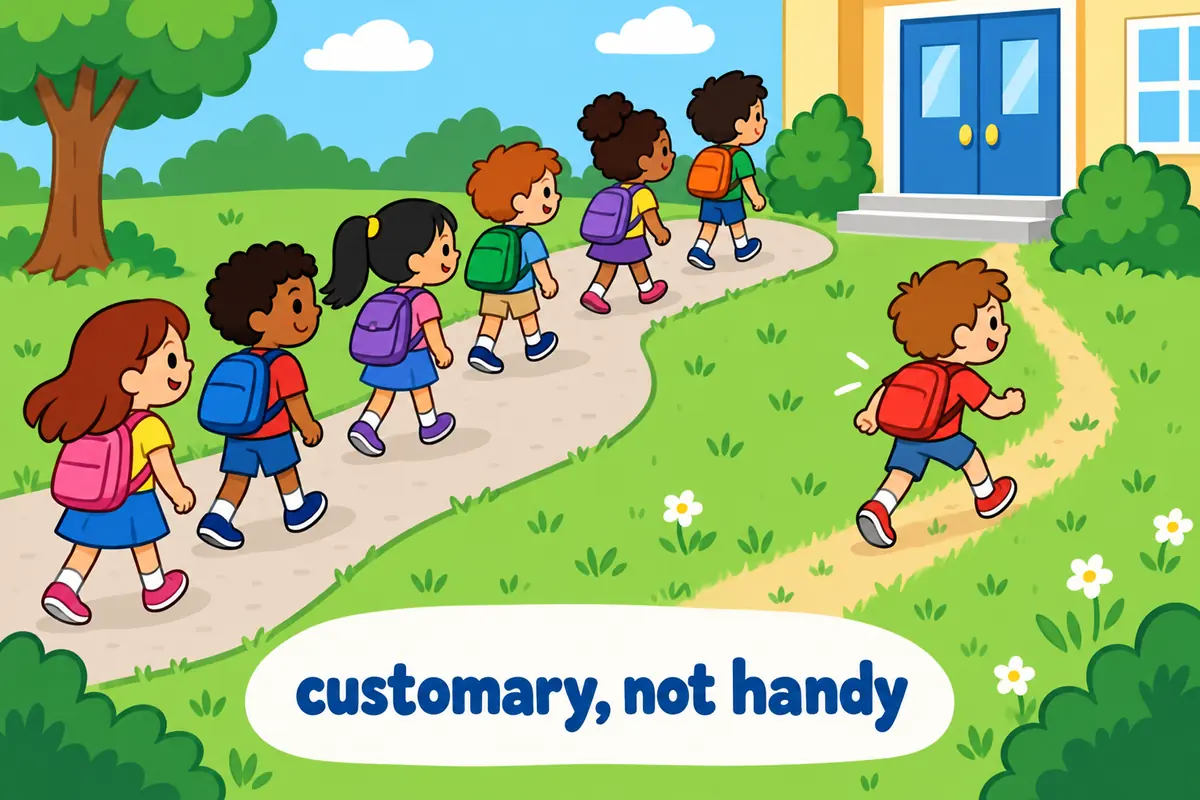
- The commonest error is confusing conventional with convenient.
What does conventional mean?
Conventional is an adjective meaning based on or following the customs and standards that most people accept. The Cambridge entry for conventional records both the customary and the ordinary senses, and the difference shows in tone: describing a method as conventional is neutral, while describing a plot as conventional quietly suggests it is unoriginal. The plainer word customary is the closest single-word gloss, though it sounds more formal.
| Sense | Plain meaning | Example sentence |
|---|---|---|
| Customary | Following what is usually done | A conventional handshake opened the meeting. |
| Ordinary, unoriginal | Not unusual or inventive | The plot is conventional, but the acting carries it. |
| Technical, non-nuclear | Describes weapons or power rather than nuclear forces | The treaty capped conventional forces in the region. |
One limitation is worth stating plainly. Conventional does not mean correct, and it does not mean good. Something can be widely done and still be wrong, and a conventional choice is not automatically less effective than a novel one. The word reports what is commonly accepted; the sentence decides whether that is praise or criticism.
How do you use conventional in a sentence?
Conventional is almost always an attributive adjective, sitting directly before the noun it classifies. Four patterns cover nearly every real sentence, and the last one lets you compare how far something departs from the norm.
| Pattern | Example | What it signals |
|---|---|---|
| conventional + noun | They chose a conventional route to the summit. | The adjective classifies the noun as accepted practice. |
| it is conventional to + verb | It is conventional to reply within a working day. | States an accepted custom as a general rule. |
| conventional wisdom | Conventional wisdom held that prices would fall. | Names the received view, often so it can be challenged. |
| more or less conventional than | Her second novel is less conventional than the first. | Compares how far something departs from custom. |
Conventional in a sentence: examples across contexts
Conventional holds its meaning while the setting changes. The nine sentences below move from a classroom to a technical report, and each one shows what is being called ordinary.
| Context | Example sentence | Why this works |
|---|---|---|
| Classroom | Our teacher prefers conventional spelling to text abbreviations. | Names the accepted standard against a newer habit. |
| Workplace email | A conventional subject line helps the message get read. | Ties the adjective to a small, practical choice. |
| News report | The party chose a conventional candidate for the safe seat. | Signals a safe, expected political decision. |
| Academic writing | Conventional accounts of the period overlook rural unrest. | Uses the word to name an accepted view being questioned. |
| Design review | The layout is conventional, but the typography is fresh. | Balances an ordinary choice against a novel one. |
| Scientific report | Conventional farming relies on synthetic fertiliser. | Marks the standard method against an alternative. |
| Conversation | We took the conventional tour rather than hiring a guide. | Everyday use, anchored in a concrete decision. |
| Sports column | His conventional tactics frustrated supporters who wanted risks. | Shows the word shading into a mild criticism. |
| Recipe blog | This is a conventional sponge, with no strange substitutions. | Reassures the reader that the method is familiar. |
Conventional vs traditional and orthodox
Conventional, traditional and orthodox all describe accepted practice, and learners often treat them as one word. Conventional points to what is common now, traditional points to what has been handed down, and orthodox points to what an authority officially approves. A related word is conservative, which stresses caution more than custom.
| Attribute | conventional | traditional | orthodox |
|---|---|---|---|
| Core meaning | Following current accepted practice | Inherited from earlier generations | Approved by an official authority |
| Direction of time | Points to the present | Points to the past | Points to established doctrine |
| Typical subject | A method, design or choice | A custom, dish or ceremony | A belief, teaching or treatment |
| Implied feeling | Neutral, sometimes unoriginal | Warm or respectful | Strict or rigid |
| Common pairing | conventional wisdom | traditional music | orthodox medicine |
Verdict: choose conventional for whatever is usual today, traditional for whatever is inherited, and orthodox for whatever an authority endorses.
Word forms and grammar of conventional
Conventional is an adjective built on the noun convention, and its adverb conventionally modifies a verb in the same way. The noun convention goes back to the idea of people coming together, a link still visible in the verb convene.
| Form | Part of speech | Example |
|---|---|---|
| conventional | adjective | A conventional answer satisfied the examiner. |
| more conventional, most conventional | comparative and superlative | The later design was more conventional. |
| conventionally | adverb | The room was conventionally furnished. |
| convention | noun | The convention of shaking hands is fading. |
| conventionality | noun | He distrusted the conventionality of the suburb. |
| unconventional | adjective, opposite | An unconventional plan saved the festival. |
Common mistakes with conventional
- Incorrect:
The shop is at a conventional location near the station.Correct: The shop is at a convenient location near the station. Rule: Conventional means customary; convenient means easy to reach or use. - Incorrect:
She dressed conventional for the interview.Correct: She dressed conventionally for the interview. Rule: Use the adverb conventionally to modify a verb. - Incorrect:
This is a convention method for baking bread.Correct: This is a conventional method for baking bread. Rule: Convention is the noun; conventional is the adjective. - Incorrect:
The design is conventional of most new offices.Correct: The design is conventional for most new offices. Rule: When the adjective needs a following preposition, use for, not of. - Incorrect:
Conventional is not always a bad thing.Correct: Being conventional is not always a bad thing. Rule: The adjective describes behaviour, so the sentence needs a noun or gerund to describe.
Practice using conventional
Work through the six items, then read the reasoning rather than only the answer.
- Fill the gap: The team chose a ______ approach and avoided any risky experiments.
- Choose the better word: The flat is small but very (conventional / convenient) for the station.
- Correct the error: He behaved very conventional at the dinner.
- Build a sentence: use conventional wisdom about a belief that people repeat without checking.
- Spot the register: which belongs in a formal report — the conventional method was used, or we just did the usual thing?
- Rewrite with the adverb: The engine was built in the standard way. Use conventionally instead.
Answers
- conventional — the team followed accepted practice and avoided novelty.
- convenient — the flat is easy to reach, which is convenience, not custom.
- He behaved very conventionally at the dinner — an adverb must modify the verb behaved.
- Model answer: Conventional wisdom says a cold makes you catch a chill, though the evidence is thin.
- The conventional method was used — a written report prefers precise vocabulary to the usual thing.
- The engine was conventionally built — the adverb describes the manner of building.
The bottom line
Use conventional in a sentence for a choice that follows the usual accepted practice rather than inventing a new one, and place it directly before the noun. Two nuances decide most sentences: the word can be neutral or faintly critical depending on the company it keeps, and it reports what is common rather than what is right. Where the emphasis is on something inherited, standard and traditional phrases often fit more exactly.
Frequently asked questions about conventional
Is conventional a negative word?
Conventional is mostly neutral, describing something that follows accepted practice. It turns negative only when newness is valued, as in a review calling a film conventional. Read the surrounding sentence: alongside wise or reliable it is praise, and alongside dull it becomes faint criticism.
What is the difference between conventional and traditional?
Traditional points to customs handed down over generations, while conventional points to whatever is common now. A traditional dance is inherited; a conventional greeting is simply the one most people use today. Traditional looks backward to inheritance, and conventional looks sideways to current practice.
Can a person be conventional?
Yes, a person can be conventional, meaning they prefer familiar choices and avoid novelty. You would say a conventional dresser or a conventional thinker. The word describes the pattern of someone’s choices rather than their ability, so it neither praises nor condemns unless the sentence adds that judgement.
Is conventional the opposite of unconventional?
Unconventional is the direct opposite, describing something that departs from accepted practice. One word is not better than the other: a conventional plot can comfort readers, and an unconventional one can surprise them. Choose according to whether the sentence stresses familiarity or departure.
When we talk about “conventional” in language, we are referring to a standard or traditional way of expressing ideas. In terms of grammar and writing, adhering to conventional usage can help maintain clarity and coherence in communication.
Using conventional grammar rules and structures is essential in conveying ideas effectively and ensuring smooth comprehension for readers. Sticking to traditional language norms can also help writers avoid confusion and misinterpretations in their written work.
7 Examples Of Conventional Used In a Sentence For Kids
- Conventional means following traditional ways.
- We use conventional methods for learning math.
- Our school has a conventional uniform.
- Let’s play a game using conventional rules.
- It’s important to respect conventional manners.
- The teacher used conventional teaching materials.
- In India, many weddings follow conventional customs.
14 Sentences with Conventional Examples
- The conventional route for most students is to pursue engineering or medicine after completing high school.
- Many college students opt for conventional part-time jobs like tutoring or working in a local coffee shop to earn some extra money.
- It is conventional for students to attend career fairs and networking events to explore job opportunities and internships.
- The conventional style of note-taking involves using pen and paper during lectures, although digital alternatives are becoming popular.
- Students often rely on conventional study methods like making flashcards or summarizing notes to prepare for exams.
- It is conventional for students to form study groups to collaborate and share knowledge on challenging subjects.
- One conventional strategy for managing time effectively is to create a daily schedule and prioritize tasks accordingly.
- When it comes to housing options, many college students prefer conventional dormitories or shared apartments near campus.
- Joining student clubs and organizations is a conventional way for students to socialize and build a network of like-minded peers.
- Attending lectures and taking notes in class are conventional practices to stay engaged and grasp the course material effectively.
- For writing assignments, students typically follow the conventional structure of introduction, body paragraphs, and conclusion.
- It is conventional for college students to seek guidance from academic advisors to plan their course schedules and graduation requirements.
- Utilizing libraries and study lounges for quiet study sessions is a conventional practice among college students.
- Following a conventional dress code for presentations and interviews, such as business casual attire, is often recommended for college students.
How To Use Conventional in Sentences?
To use the word Conventional in a sentence, you should consider its meaning and how it functions grammatically.
Conventional is an adjective that describes something that is based on or in accordance with what is generally done or believed. It can refer to traditions, customs, or practices that are widely accepted and followed by most people in a society.
When using Conventional in a sentence, you can follow these steps:
1. Identify the context in which you want to use the word Conventional. Is it describing a common practice, traditional belief, or typical behavior?
2. Determine the subject or object that you want to modify with the word Conventional.
3. Place Conventional before the noun it is describing to accurately convey that the subject or object adheres to established norms or standards.
4. Ensure that the sentence structure is clear and makes sense in conveying the intended meaning.
Here is an example sentence using Conventional:
* “In many conventional societies, it is conventional for couples to get married before starting a family.”
By following these guidelines, you can effectively incorporate the word Conventional into your sentences to convey the idea of something that is customary, typical, or accepted as the norm.
Conclusion
In conclusion, sentences with conventional language follow standard grammatical rules and commonly accepted wording. These sentences are structured in a traditional way that is familiar to most readers, making them easy to comprehend. By adhering to conventional language usage, writers can effectively convey their messages with clarity and efficiency.
Through the use of sentences with conventional language, authors can ensure that their writing is accessible to a wide audience and remains coherent. Following established conventions enables effective communication and helps readers easily navigate the text. Overall, incorporating conventional sentences in writing is essential for clear and effective communication.


