
Choose relationship adjectives by naming one dimension at a time: closeness, tone, reciprocity, or tension. Platonic means affectionate but nonsexual; mutual describes something shared; cordial means friendly but formal; supportive means giving help or encouragement; strained signals problems affecting the connection. These words describe a relationship; they do not diagnose the people in it.
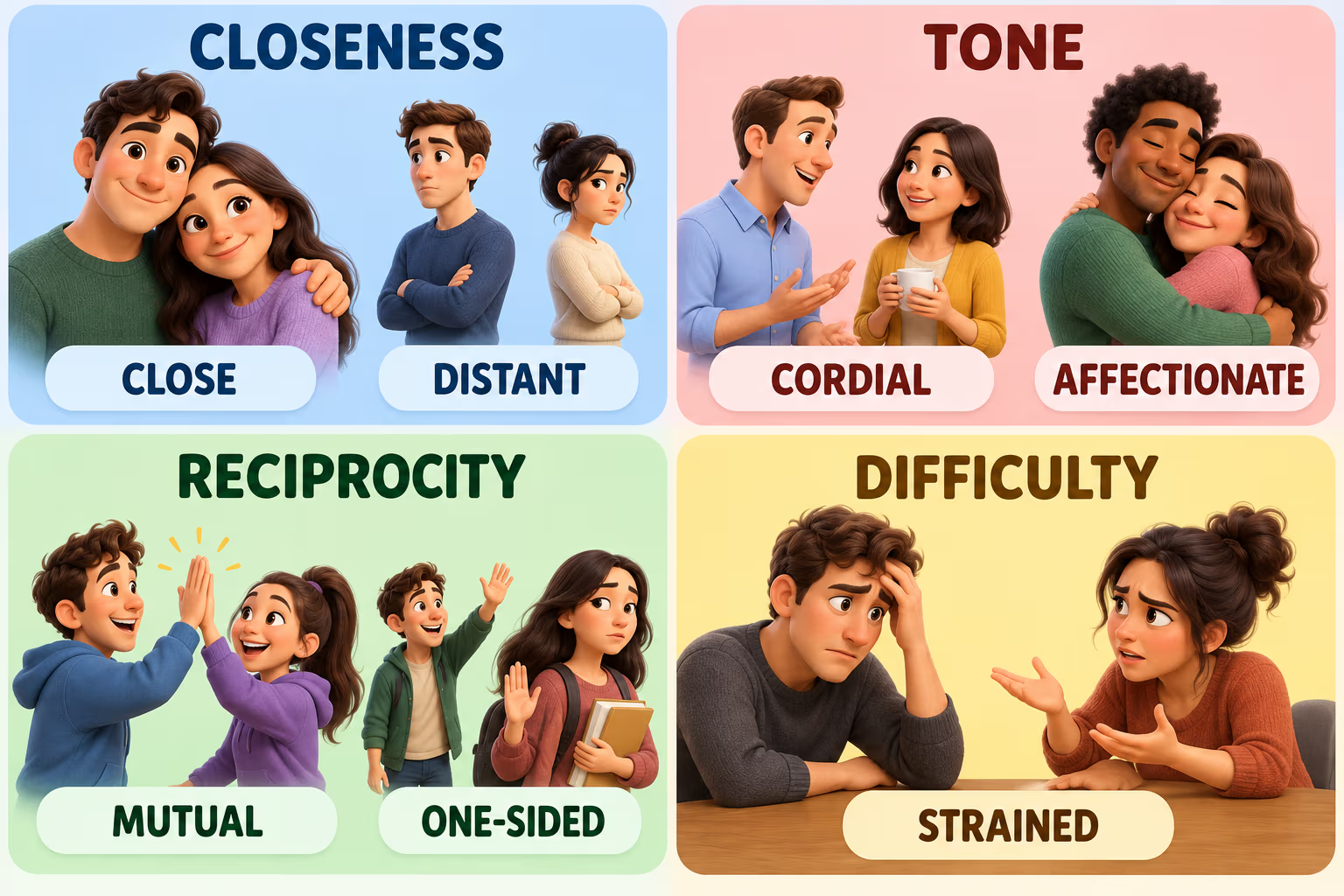
Quick selection guide
- Closeness: close or close-knit describes connection; platonic specifically distinguishes an affectionate relationship from a sexual one.
- Tone: cordial means friendly and polite, often in a formal way; it does not necessarily mean intimate.
- Support: supportive points to help or encouragement someone gives.
- Reciprocity: mutual means shared by both or all parties; reciprocal is a more formal word for two-way action or exchange.
- Unequal feelings: one-sided can describe a relationship where one person’s feelings are much stronger.
- Difficulty: strained describes a connection affected by problems; specify what happened when the evidence is limited.
A Relationship-Adjective Selection Guide
Start with the relationship itself, then select the adjective that fits the detail you can actually describe. A single connection can be close but strained, cordial but not intimate, or supportive in one situation while difficult in another. The table separates common dimensions so a word does not imply more than you intend.
| Dimension | Useful adjective | What it conveys | Example |
|---|---|---|---|
| Closeness | close, close-knit | A strong personal connection or a tightly connected group; context shows which. | “The cousins stayed close even after moving to different cities.” |
| Nonsexual affection | platonic | An affectionate or loving relationship that is not sexual. | “They described their friendship as platonic and deeply supportive.” |
| Polite tone | cordial | Friendly, formal, and polite; it need not imply personal closeness. | “Their cordial conversations stayed focused on work.” |
| Help and encouragement | supportive | Someone gives practical help, encouragement, or approval. | “Her teammates were supportive while she learned the new role.” |
| Shared feelings or actions | mutual, reciprocal | Mutual is shared; formal reciprocal emphasizes a two-way response or exchange. | “They reached the decision by mutual agreement.” |
| Imbalance or difficulty | one-sided, strained | One-sided can describe unequal feelings; strained signals problems affecting the relationship. | “After months of missed calls, their communication felt strained.” |
Closeness, Tone, and Reciprocity Are Different
Close describes connection, whereas cordial describes a friendly but formal or polite manner. Coworkers may be cordial without sharing private details; relatives may be close yet disagree often. Platonic answers a different question: Cambridge defines a platonic relationship as loving but not sexual. Because intimate can suggest emotional closeness or sexual intimacy depending on context, use platonic when the nonsexual distinction matters.
Mutual focuses on something felt or done by both parties, as in mutual respect or mutual agreement. Reciprocal is more formal and often emphasizes an action or benefit returned in kind. One-sided describes imbalance; Cambridge’s relationship entry specifically describes a case in which one person has much stronger feelings. Do not infer that a relationship is one-sided just because the people express themselves differently—describe the evidence you have.

Supportive and Strained: Describe What Happens
Supportive works when someone gives help or encouragement: “Her friends were supportive while she changed careers.” Name the support if it matters—listening, sharing childcare, offering feedback, or celebrating progress. That detail makes the description clearer than stacking several broad positive adjectives.
Strained is useful when problems are making a relationship difficult: “Their relationship became strained after they disagreed about the project.” It describes the connection’s condition, not either person’s character, and does not claim the difficulty is permanent. If all you know is that two people had one argument, say that rather than turning a moment into a lasting label.
Words such as healthy, unhealthy, and toxic can carry stronger judgments than a reader intends. In personal writing, explain the actions and their effects—such as repeated boundary violations, respectful disagreement, or reliable encouragement—before applying a broad label. An adjective alone cannot establish a clinical diagnosis or fully explain people’s circumstances.
Examples for Different Relationships
- Family: “The siblings have a close but occasionally competitive relationship.”
- Friends: “Their friendship is supportive: they check in and offer practical help.”
- Romance: “They describe their relationship as loving, committed, and mutually respectful.”
- Work: “The manager and designer maintain a cordial, professional relationship.”
- Distance: “They remain emotionally close despite living far apart.”
- Tension: “Communication has been strained since the unresolved disagreement.”
- Unequal interest: “The narrator sees the connection as one-sided because only one person expresses romantic feelings.”
For a focused word bank about a spouse, see adjectives for a husband; for language about emotional states, see adjectives for feelings. Dictionary references: platonic, mutual, reciprocal, cordial, supportive, strained, and one-sided relationship.
Frequently Asked Questions
What is a good adjective for a close relationship?
Close is a flexible choice for a strong personal connection; close-knit often describes a tightly connected family or group. Choose affectionate when warmth is the point and supportive when help or encouragement matters. Use platonic specifically when you mean affectionate but nonsexual.
Does cordial mean close friends?
No. Cordial means friendly but formal and polite, so a cordial relationship may be respectful without being intimate or personal. For example, former colleagues can remain cordial at meetings. If you mean a strong personal bond, use a word such as close, supported by the context.
What is the difference between mutual and reciprocal?
Mutual describes something shared by two or more people, such as mutual respect or agreement. Reciprocal is more formal and often emphasizes that people respond or give back to each other. The words overlap, but mutual is the more everyday choice for shared feelings or understanding.
What does strained relationship mean?
A strained relationship is one affected by problems that make the connection difficult. The adjective describes the relationship’s condition, not a person’s character and not necessarily a permanent state. For precise writing, identify the observable source of strain—such as unresolved conflict or limited communication—when you know it.
Is toxic a precise adjective for every difficult relationship?
No. Toxic is a strong, broad judgment and should not be used as a diagnosis or inferred from one disagreement. When possible, describe specific behavior and its effect, such as repeated insults or ignored boundaries. A narrower word like strained, distant, or controlling may communicate the point more precisely.
The English language is filled with a wide variety of adjectives that can be used to describe relationships. Whether you’re looking for a word to describe a close bond or a more negative association, there’s likely an adjective out there that will fit the bill. To help you choose the perfect word for your needs, here’s a list of adjectives for relationships:
- Close: intimate, close-knit, tight-knit, bonded, attached
- Strained: strained, tense, fraught, difficult, complicated
- Positive: healthy, supportive, positive, nurturing, gratifying
- Negative: unhealthy, toxic, destructive, harmful, negative
Adjective For Relationships
In relationships, adjectives are often used to describe the feeling between two people. However, there are many different adjectives that can be used to describe a relationship, and each one has its own connotations. For example, “loving” is often used to describe a warm and close relationship, while “cold” might be used to describe a more distant one. Below is a list of adjectives that can be used to describe relationships.
- Intimate: A close and personal relationship.
- Loving: A warm and caring relationship.
- Sexual: A relationship with a strong physical attraction.
- Platonic: A non-sexual relationship.
- Damaged: A relationship that has been hurt by trust issues or other problems.
- Strong: A relationship that is built on trust and communication.
- Weak: A relationship that is not built on a strong foundation.
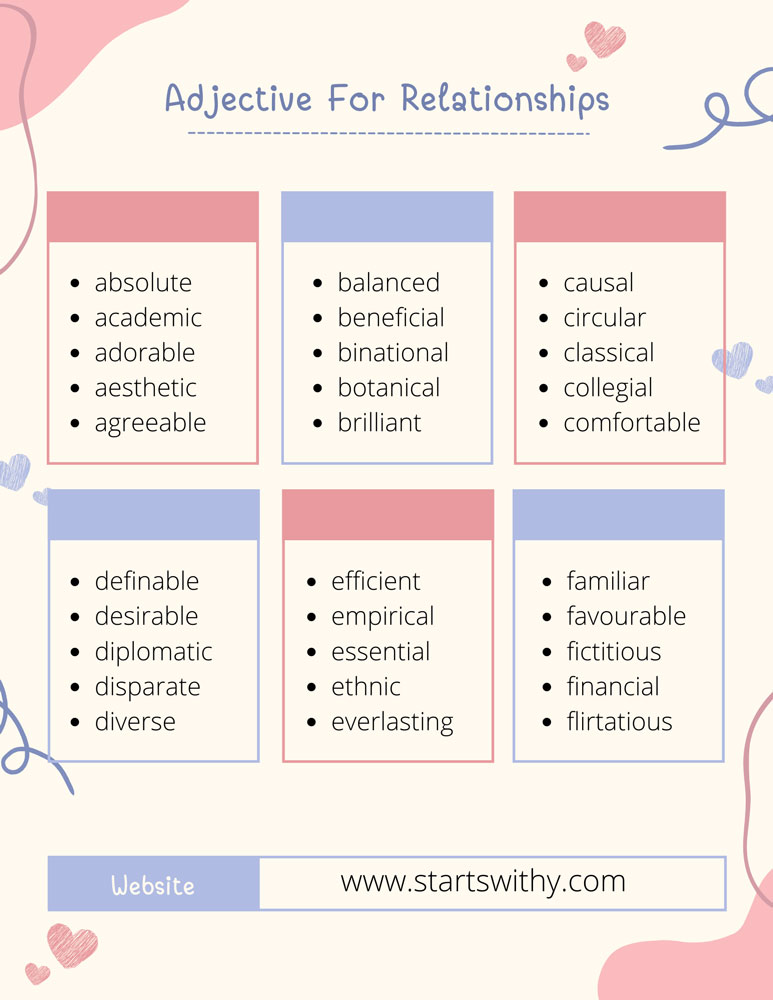
A
| Absolute | Abstract | Absurd |
| Abusive | Academic | Acrimonious |
| Active | Actual | Adaptive |
| Additive | Adorable | Adulterous |
| Advanced | Adversarial | Aesthetic |
| Affectionate | Affective | Aforementioned |
| Agreeable | Algebraic | Alive |
| Alternative | Amazing | Apparent |
| Aristocratic | Ascertainable | Associated |
| Asymmetrical | Australian | Authentic |
B
| Balanced | Basic | Beautiful |
| Beneficial | Bidirectional | Bilateral |
| Binary | Binational | Biologic |
| Bipartisan | Bitter | Blissful |
| Botanical | Branding | Brief |
| Brilliant | Broken |
C
| Canadian | Carnal | Casual |
| Causal | Central | Certain |
| Characteristic | Chinese | Christian |
| Circular | Civil | Clannish |
| Class | Classical | Clear |
| Closer | Collaborative | Collective |
| Collegial | Colonial | Combative |
| Comfortable | Comic | Commercial |
| Committed | Communal | Compatible |
| Competitive | Complex | Complicated |
| Conceptual | Conditional | Confidential |
| Conflicted | Conjugal | Consensual |
| Consistent | Constant | Constitutional |
| Constructive | Consultative | Contemporary |
| Contentious | Contiguous | Continued |
| Contractual | Controversial | Convenient |
| Conventional | Cooperative | Cordial |
| Corporate | Correlational | Covenant |
| Covid | Crazy | Creative |
| Credible | Creepy | Critical |
| Cross | Customary |
D
| Daily | Dangerous | Dating |
| Deadly | Dear | Decent |
| Deep | Deepen | Definable |
| Definite | Degrading | Desirable |
| Destructive | Developed | Dialectical |
| Difficult | Diplomatic | Direct |
| Disconnected | Disparate | Distant |
| Distinct | Diverse | Divine |
| Domestic | Dominant | Doomed |
| Dramatic | Dual | Dynamic |
| Dysfunctional |
E
| Eager | Earthly | Easy |
| Effective | Efficient | Elementa |
| Emotional | Empirical | Entire |
| Environmental | Equitable | Essential |
| Eternal | Ethiopian | Ethnic |
| Ethnical | Ethnological | Everlasting |
| Everyday | Evolutionary | Exact |
| Excellent | Exciting | Exclusive |
| Existing | Explicit | Exploitative |
| Expressible | Extended | Extensive |
| Extra | Extraordinary |
F
| Fabulous | Faceted | Facilitated |
| Faint | Fake | Familial |
| Familiar | Fantastic | Fatal |
| Favourable | Female | Feudal |
| Fictitious | Fide | Fiduciary |
| Filial | Financial | Fine |
| Fiscal | Flawed | Flirtatious |
| Foreign | Formal | Foster |
| Fractious | Fractured | Fraternal |
| Fraught | Friendly | Fruitful |
| Functional | Fundamental | Furtive |
| Future |
G
| Gay | Generational | Genetic |
| Genial | Genuine | Geographic |
| Geographical | Geopolitical | Global |
| Governmental | Grand | Graphical |
| Gratifying |
H
| Habitat | Happy | Hard |
| Harminious | Harmonious | Healthier |
| Heterosexual | Hidden | Hierarchical |
| Historic | Historical | Holy |
| Homoerotic | Homosexual | Honest |
| Hostile | Hot | Huge |
| Human | Hurtful | Hush |
| Hyponymic |
I
| Ichthyosaurian | Iffy | Illicit |
| Immaterial | Immediate | Immigrant |
| Immoral | Imperial | Implicit |
| Improper | Improved | Inappropriate |
| Incarnate | Incestuous | Inclusive |
| Indirect | Individual | Inevitable |
| Informal | Initial | Innocent |
| Institutional | Intense | Intentional |
| Inter | Interactive | Intercultural |
| Interdependent | Interesting | Intergenerational |
| Intergovernmental | Interior | Internal |
| International | Interordinal | Interpersonal |
| Interracial | Interreligious | Intersubjective |
| Intimate | Intra | Intricate |
| Intrinsic | Inverted | Iranian |
J | K | L
| Joint | Key | Kin |
| Korean | Larger | Lasting |
| Latest | Layered | Legal |
| Lengthy | Lesbian | Licensee |
| Lifelong | Light | Linear |
| Linguistic | Literary | Live |
| Logarithmic | Logical | Longitudinal |
| Longstanding | Longterm | Loose |
| Lopsided |
M
| Major | Male | Marital |
| Marked | Massive | Maternal |
| Mathematical | Mature | Meaningful |
| Mellow | Mental | Messy |
| Metaphysical | Military | Mimetic |
| Mixed | Modern | Modernized |
| Momentous | Monogamous | Monogamy |
| Moral | Multi | Multiple |
| Municipal | Musical | Mutual |
| Mysterious | Mystical |
N
| Narcissistic | Natural | Near |
| Needful | Negative | Newfound |
| Nice | Nondiplomatic | Normal |
| Notorious | Novel | Numerical |
| Numerous |
O
| Observed | Obsessive | Odd |
| Official | Open | Operative |
| Opposite | Orderly | Ordinary |
| Original | Outside | Overall |
P
| Paradoxical | Parasitic | Parental |
| Partial | Passionate | Past |
| Patient | Patientphysician | Patriarchal |
| Patrimonial | Peaceful | Peculiar |
| Perfect | Permanent | Personalized |
| Phylogenetic | Physical | Platonic |
| Poisonous | Polar | Polish |
| Poor | Positive | Post |
| Potential | Practical | Pre |
| Precise | Predictable | Preexisting |
| Present | Previous | Primal |
| Primary | Primate | Prior |
| Pro | Productive | Professional |
| Profitable | Prominent | Proper |
| Prospective | Protective | Provincial |
| Proxemic | Proximate | Psychical |
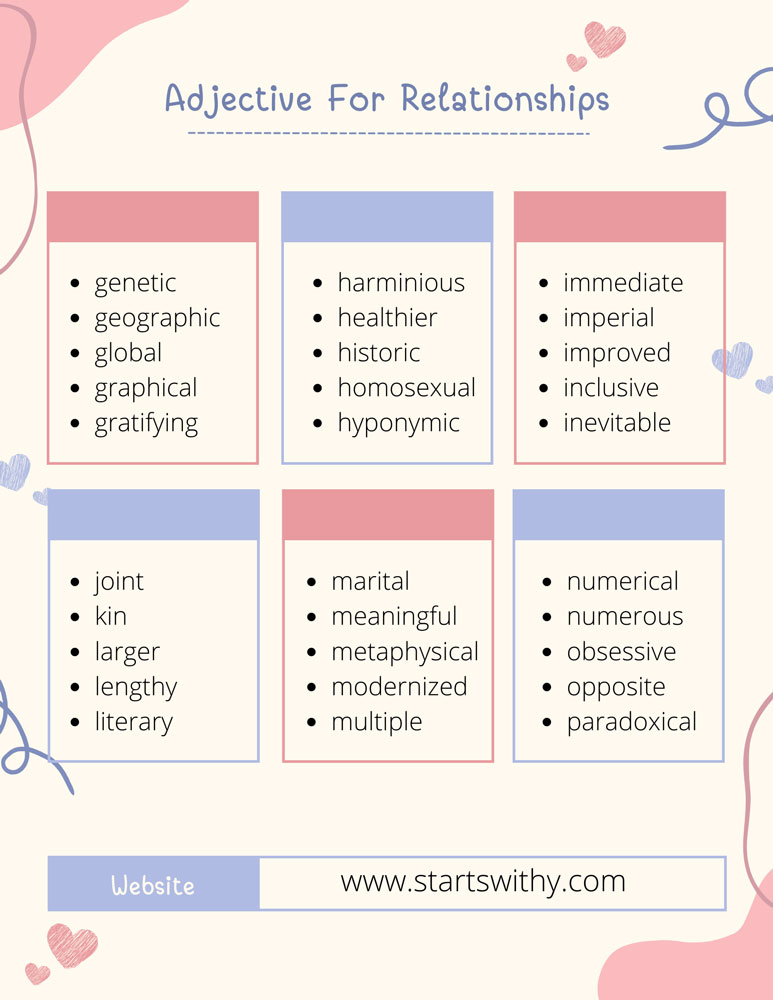
Q | R
| Queer | Questionable | Quirky |
| Racial | Rational | Real |
| Reciprocal | Recursive | Regional |
| Relationship | Relaxed | Remotest |
| Renaissance | Rental | Respectful |
| Respective | Respiratory | Responsible |
| Reverse | Rewarding | Rhythmic |
| Rich | Robosexual | Robust |
| Rocky | Romantic | Rural |
S
| Sacred | Safe | Sane |
| Satisfactory | Satisfying | Scary |
| Schizophrenic | Secret | Secular |
| Semi | Sensible | Sexual |
| Shambolic | Shameless | Short |
| Sibcestual | Sided | Significant |
| Simple | Single | Sixth |
| Slightest | Smooth | Solid |
| Sonic | Sophisticated | Soulful |
| Spatial | Spiritual | Stable |
| Standard | Statistical | Steady |
| Stellar | Straightforward | Strained |
| Strange | Strategic | Striking |
| Stringent | Strong | Structural |
| Submissive | Subsequent | Substantial |
| Subtle | Successful | Suitable |
| Super | Supervisory | Supportive |
| Supreme | Sustainable | Sustained |
| Sweet | Symbiotic | Sympathetic |
T
| Tactical | Tangible | Tarnished |
| Tempestuous | Temporal | Tense |
| Tenuous | Terrific | Testy |
| Theoretical | Therapeutic | Tight |
| Timeless | Tortuous | Touching |
| Toxic | Traditional | Transactional |
| Transatlantic | Transparent | Traumatic |
| Tremendous | Tribal | Troubled |
| Troubling | Trustworthy | Tumultuous |
| Turbulent | Typical |
U
| Unacknowledged | Unauthorized | Uncertain |
| Uncomfortable | Unconventional | Undefined |
| Undeniable | Undisputed | Uneasy |
| Unequal | Unethical | Unhappy |
| Unhealthy | Unique | Unitarian |
| Unlikely | Unmistakeable | Unparalleled |
| Unpredictable | Unrecognized | Unresolved |
| Unstable | Unsurmised | Unwelcome |
| Uptake | Usual |
| Valid | Valuable | Verbal |
| Vibrant | Violent | Viral |
| Virtual | Visual | Vital |
| Vulnerable |
W
| Warm | Weak | Weird |
| Wholesome | Wonderful | Worker |
When it comes to describing relationships, words have the power to paint a vivid picture. From the love between partners to the bond between friends, adjectives play a crucial role in capturing the essence of these connections. In this article, I’ll delve into a collection of adjectives that beautifully describe relationships, accompanied by examples that bring these words to life.
Whether you’re a writer looking to add depth to your characters or simply someone seeking to express the nuances of your own relationships, this guide will provide you with a treasure trove of descriptive words. From affectionate and supportive to tumultuous and complex, we’ll explore a wide range of adjectives that accurately depict the various dynamics that exist between people.
How to Describe relationships? – Different Scenarios

When it comes to describing relationships, there are many adjectives that can be used to paint a vivid picture of the dynamics between people. Each scenario carries its own unique set of emotions, connections, and interactions. In this section, I will explore several different scenarios and provide examples of adjectives that perfectly capture the essence of each relationship.
Family Relationships:
- Parent-Child Relationship:
- Sibling Relationship:
Romantic Relationships:
- Deep Love and Connection:
- Long-Distance Relationship:
Friendships:
- Best Friends:
- Acquaintances:
Remember, these examples are just the tip of the iceberg when it comes to describing relationships. There are countless adjectives that can be used to capture the intricacies and nuances of human connections. By using the right words, you can bring your characters to life or express the depths of your own relationships.
So whether you’re a writer looking to add depth to your characters or someone wanting to express the nuances of your own relationships, exploring different scenarios and using appropriate adjectives can help you accurately describe the dynamics that exist between people.
Describing Words for relationships in English
When it comes to describing relationships, words play a crucial role in capturing the essence of human connections. Here are some adjectives that can beautifully describe different types of relationships:
Read: Enhancing Descriptions: Adjectives for Opportunity [+Examples]
Parent-Child Relationships
- Loving: As a parent, I experience the joy of a loving relationship with my child every day.
- Nurturing: Parents provide a nurturing environment for their children to grow and thrive.
- Supportive: A strong parent-child relationship is built on support and encouragement.
- Guiding: Parents play a vital role in guiding their children through life’s challenges.
- Protective: Parents have an instinctual desire to protect their children from harm.
Sibling Relationships
- Close-knit: Siblings often share a close-knit bond that withstands the test of time.
- Playful: Sibling relationships can be filled with playful teasing and laughter.
- Competitive: Siblings may engage in healthy competition, pushing each other to succeed.
- Loyal: Siblings are often fiercely loyal and have each other’s backs in times of need.
- Unbreakable: The bond between siblings is unbreakable, built on a lifetime of shared experiences.
Romantic Relationships
- Passionate: In a passionate relationship, couples experience intense emotions and desire.
- Intimate: Intimacy is the foundation of a strong and connected romantic relationship.
- Trustworthy: Trust forms the core of a healthy and long-lasting romantic relationship.
- Devoted: Devotion and commitment are essential in a successful romantic relationship.
- Harmonious: A harmonious relationship is characterized by balance and understanding.
- Loyal: A loyal friend is someone you can always count on, no matter what.
- Supportive: Friends provide support and encouragement in both good times and bad.
- Reliable: A reliable friend is someone you can trust and depend on.
- Fun-loving: Friendships are often filled with laughter and a sense of shared enjoyment.
- Understanding: Friendships thrive on mutual understanding and acceptance.
These examples only scratch the surface of the many adjectives that can accurately describe the complexities of human relationships. By using the right words, we can bring our characters to life and convey the depth of our own connections.
Adjectives for relationships
When it comes to describing relationships, adjectives play a vital role in capturing the essence and depth of those connections. As an expert blogger with years of experience, I’ve come across various adjectives that beautifully depict different relationship scenarios. In this section, I’ll provide you with a range of positive and negative adjectives for relationships, along with example sentences.

Positive Adjectives for Relationships
- Loving: I remember the warm embrace of my parents, a loving and unconditional bond.
- Supportive: My best friend has always been there for me, offering supportive words of encouragement.
- Caring: In a nurturing relationship, both partners care deeply for each other’s well-being.
- Trustworthy: A trustworthy relationship is built on honesty, reliability, and mutual respect.
- Empathetic: A truly empathetic connection allows us to understand and share in the emotions of others.
- Respectful: A respectful relationship demonstrates admiration and consideration for one another’s opinions and boundaries.
- Nurturing: In a nurturing relationship, both individuals foster growth and support each other’s dreams.
- Affectionate: Expressing affection through touch, kind words, and gestures enhances the bond between partners.
- Understanding: An understanding relationship fosters open communication and empathy for each other’s perspectives.
- Compassionate: True compassion is shown through acts of kindness, empathy, and support for others.
- Patient: Patience is key in maintaining a healthy relationship, allowing for understanding and growth over time.
- Joyful: A joyful relationship is filled with laughter, shared experiences, and a deep sense of happiness.
- Distant: Sometimes, relationships can become distant if communication and connection are not nurtured.
- Controlling: A controlling relationship stifles individual freedom and autonomy.
- Toxic: Toxic relationships are characterized by constant negativity, manipulation, and emotional abuse.
- Dishonest: A dishonest relationship lacks trust due to deceitful behaviors and hidden truths.
- Unforgiving: In an unforgiving relationship, grudges are held onto instead of finding resolution.
Read: 450+ Adjectives That Start With V
Remember, these examples are just a starting point in understanding the power of adjectives in describing relationships. By using the right words, we can bring characters to life and express the depths of our own connections.
Synonyms and Antonyms with Example Sentences
Synonyms for Relationships
When it comes to describing relationships, using a variety of adjectives can help to paint a clearer picture and convey the nuances of different connections. Here are some synonyms that can be used to describe relationships:
- Loving – showing affection and care towards someone.
- Supportive – providing encouragement and assistance.
- Caring – demonstrating concern and kindness towards others.
- Trustworthy – reliable and deserving of trust.
- Empathetic – understanding and sharing the feelings of others.
- Respectful – treating others with esteem and consideration.
- Nurturing – fostering growth and development in a relationship.
- Affectionate – displaying warmth and tenderness.
- Understanding – comprehending and empathizing with others’ perspectives.
- Compassionate – showing sympathy and concern for others.
- Patient – being tolerant and understanding of others’ needs.
- Joyful – bringing happiness and delight in a relationship.
Using these synonyms can help to add depth and richness to your descriptions of relationships, allowing readers to truly understand the dynamics at play.
Antonyms for Relationships
On the flip side, it’s also important to acknowledge that not all relationships are positive and healthy. Here are some antonyms, or opposite words, that can be used to describe negative aspects of relationships:
- Distant – lacking emotional closeness or connection.
- Controlling – exerting power and dominance over others.
- Toxic – harmful and detrimental to one’s well-being.
- Dishonest – lacking truthfulness and integrity.
- Unforgiving – refusing to grant forgiveness or show mercy.
Read: Adjectives for Elephant: Describing Words + Examples
These antonyms help to highlight the negative qualities that can exist in relationships, serving as a reminder to avoid or address behaviors that can be damaging or unhealthy.
| Positive Adjectives | Negative Adjectives |
|---|---|
| Loving | Distant |
| Supportive | Controlling |
| Caring | Toxic |
| Trustworthy | Dishonest |
| Empathetic | Unforgiving |
Understanding and using the right adjectives can greatly enhance our ability to describe and communicate the complexities of relationships. By incorporating synonyms and antonyms into our vocabulary, we can provide a more accurate and nuanced portrayal of different types of connections. Whether positive or negative, these descriptive words play a crucial role in bringing characters to life and expressing the depths of our own personal relationships.
Remember, each relationship is unique, and it’s important to choose words that truly capture its essence. So next time you find yourself trying to explain a relationship, don’t be afraid to explore the range of adjectives at your disposal.
Describing relationships accurately is crucial in bringing characters to life and expressing the depths of our own connections. Throughout this article, we have explored the significance of using adjectives to capture the essence of different relationship scenarios. By employing positive adjectives such as loving, supportive, caring, trustworthy, empathetic, respectful, nurturing, affectionate, understanding, compassionate, patient, and joyful, we can paint a vivid picture of healthy and harmonious relationships.
Conversely, we have also touched upon negative adjectives like distant, controlling, toxic, dishonest, and unforgiving, which help us depict the challenges and complexities of unhealthy relationships. These adjectives allow us to create well-rounded characters and portray realistic dynamics.
Remember, the right words have the power to evoke emotions and engage readers. By carefully selecting adjectives that accurately describe relationships, we can create compelling narratives that resonate with our audience. So, whether you are a writer, a poet, or someone who simply wants to express their own experiences, harness the power of adjectives to convey the beauty and complexity of relationships.
Final verdict
In conclusion, adjectives are a necessary part of describing relationships. They help to provide context and understanding, and can be used to express both positive and negative feelings. While there are many different adjectives that can be used to describe relationships, some of the most commonly used include “close,” “distant,” “happy,” “sad,” “angry,” and “love.”
Ultimately, the adjectives that are used will depend on the specific relationship being described. However, by understanding the different adjectives that are available, it is possible to more accurately capture the unique dynamics of any relationship.


