Default means the choice that applies automatically when nobody selects another option, and in finance it means failing to pay what is owed. To use default in a sentence, name what is set or missed: “The app saves files to its default folder.” The noun covers settings, outcomes and unpaid debts, so context decides which sense is active.
Default at a glance
- Default is a noun and a verb, and the noun carries a computing sense and a finance sense.
- The dominant patterns are default plus a noun and the fixed phrases by default and in default.
- Usual collocations include default setting, default option, default folder and in default.
- The two noun senses are a pre-set choice and a failure to pay or appear.
- The commonest error is mixing default, a pre-set choice, with defect, a fault.
What does default mean?
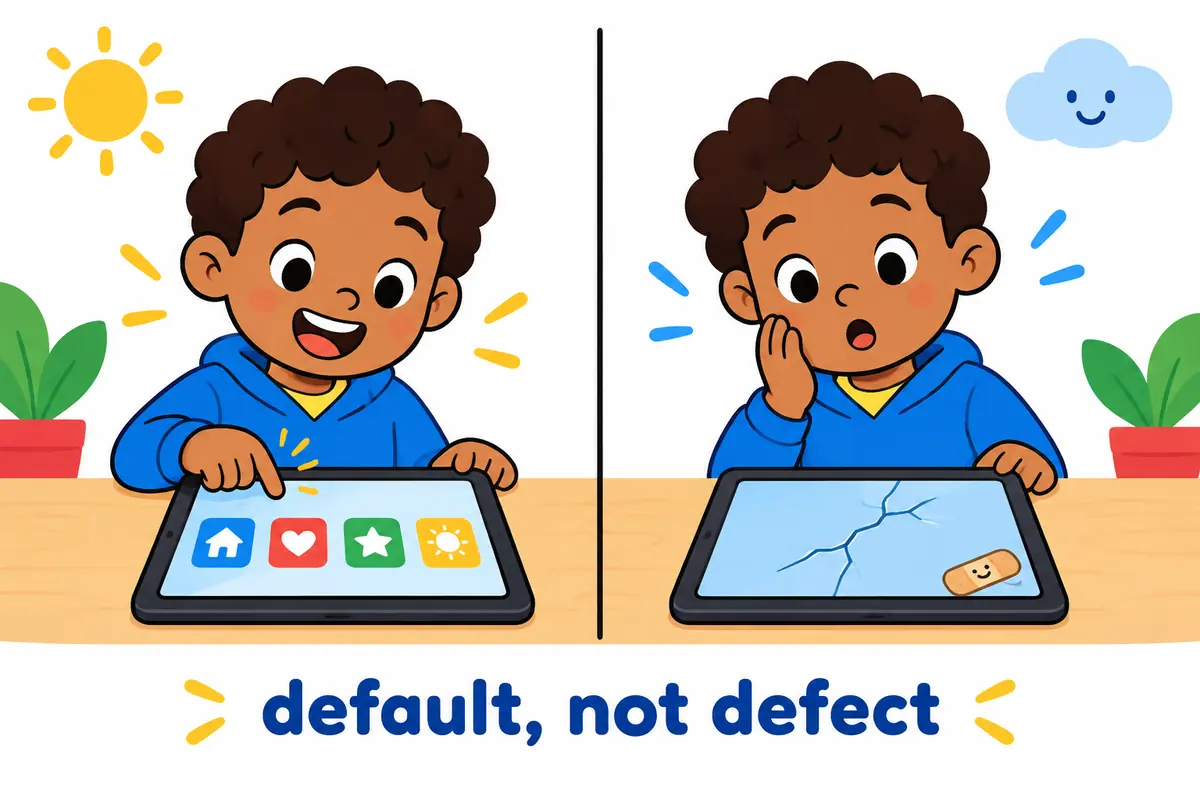
Default is a noun and a verb with two separate senses. The Cambridge entry for default covers both the pre-set choice that a device or process uses on its own and the failure to meet a payment or a legal duty. In computing the default is a convenience, because it is the answer supplied when the user does not choose. In finance it is a serious event, and it sits beyond delinquency, which is a payment that has merely arrived late. Default is not a fault, so a screen with a flaw has a defect, not a default.
| Sense | Plain meaning | Example sentence |
|---|---|---|
| Pre-set choice | The option used when no other is chosen | The default font is easy to read. |
| Standard outcome | The result that follows unless something intervenes | Silence is the default response to the survey. |
| Failure to pay | Not paying a debt on time | The borrower is in default on the loan. |
| Failure to appear | Not arriving or responding when required | The team lost by default when the other side withdrew. |
How do you use default in a sentence?
The noun pairs with a following noun or with the fixed phrases by default and in default, while the verb takes on before the obligation it names. The table shows what each pattern signals.
| Pattern | Example | What it signals |
|---|---|---|
| default + noun | The default language is English. | Names the pre-set option. |
| by default | The printer connects by default. | Means automatically, with no action taken. |
| default to + noun | The system defaults to the safer mode. | Names what happens when no choice is made. |
| in default | The account is in default. | Marks an unmet financial obligation. |
| default on + noun | The firm defaulted on the loan. | Names the obligation that was not met. |
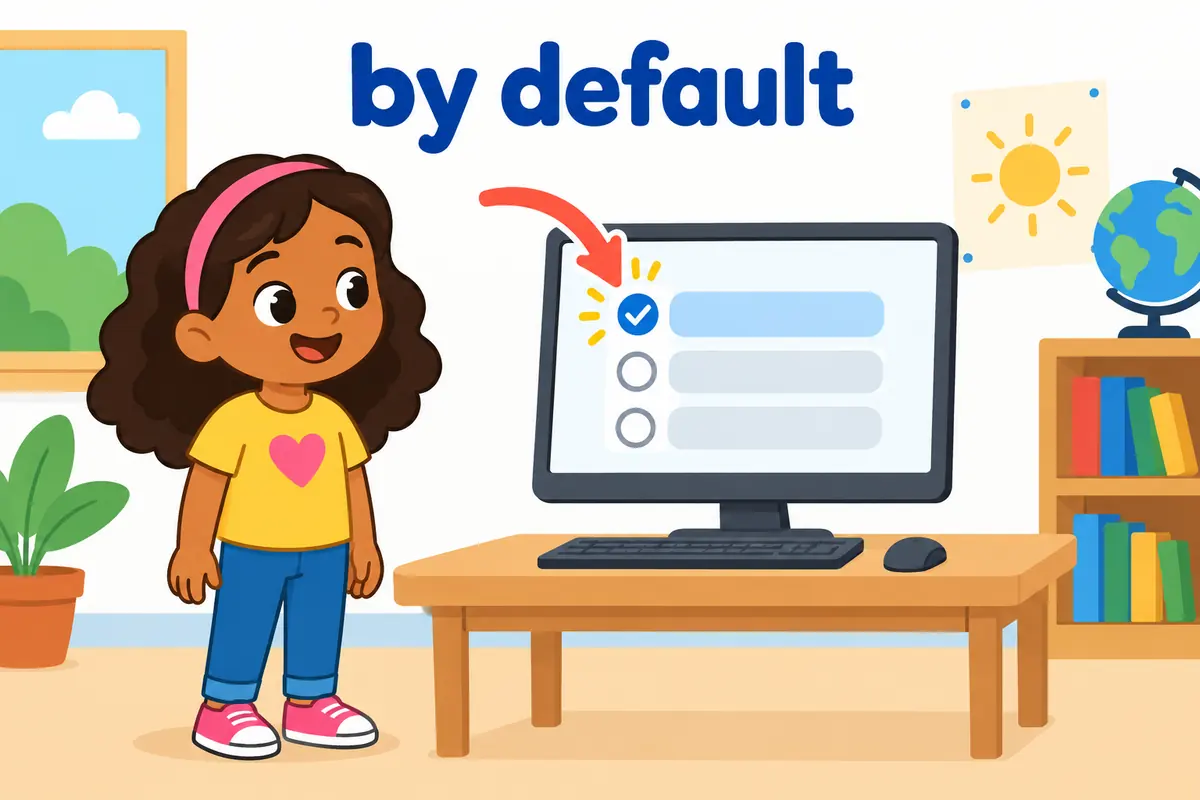
By default means automatically, so it describes the automatic setting that applies with no click. A choice stored in advance is a preset value, and the default is the one the system falls back on.
Default in a sentence: examples across contexts
Each row places the word in a different writing situation, because the sense shifts between technology, money and law.
| Context | Example sentence | Why this works |
|---|---|---|
| Computing | The app saves every file to its default folder. | Names the pre-set location. |
| Technical support | If the printer does not appear, reset the default settings. | Refers to the stored options. |
| Everyday conversation | The meeting link opens by default in the browser. | Uses the fixed phrase for automatic behaviour. |
| Finance | The borrower fell into default after three missed payments. | Marks a failure to meet a loan obligation. |
| News report | The country defaulted on its debt for the first time. | The verb form used in financial reporting. |
| Law | The defendant lost the case by default. | A legal failure to appear or respond. |
| Product design | Dark mode is the default on this screen. | Names the option that applies without a choice. |
| Business email | We ship the standard size unless the customer asks otherwise, so it is the default. | Explains a routine pre-set outcome. |
| Sport or competition | The team advanced by default when the other side withdrew. | A win granted because no opponent appeared. |
Outside computing, a missed deadline can make a person forfeit the place in a programme, which is a milder outcome than a full default.
Default vs standard
Both words describe a normal choice, so readers often swap them. The difference is who sets the expectation.
| Attribute | Default | Standard |
|---|---|---|
| Meaning | The option that applies when no choice is made | The usual or accepted version |
| Scope | Devices, software, finance and law | Sizes, procedures, measures and quality |
| Register | Technical, legal and everyday | General and formal |
| Typical partners | setting, option, folder, default on a loan | size, procedure, time, standard of quality |
| What it implies | A fallback that may not be the best choice | The expected or approved norm |
| Consequence | A user can change it at any time | Deviation usually needs a reason |
Verdict: use default for the fallback that applies until a choice is made, and the standard choice for the version most people are expected to accept; a default can be changed by a user, while a standard is changed by agreement.
Word forms and grammar of default
| Form | Part of speech | Example |
|---|---|---|
| default | Noun | The default is English. |
| defaults | Noun, plural | The defaults can be changed. |
| default | Verb | The system defaults to silent. |
| defaults | Verb, third-person singular | It defaults to the last setting. |
| defaulted | Past tense and past participle | The borrower defaulted last year. |
| defaulting | Present participle | Defaulting on a payment carries a penalty. |
| by default | Adverbial phrase | The page opens by default. |
| defaultly | Non-standard | Write by default, not defaultly. |
Common mistakes with default
- Incorrect:
There is a default on the screen.Correct: There is a defect on the screen. Rule: a default is a pre-set choice, while a defect is a fault. - Incorrect:
I changed the setting on default.Correct: I changed the setting by default. Rule: the fixed phrase is by default, not on default. - Incorrect:
The company defaulted the loan.Correct: The company defaulted on the loan. Rule: the verb takes on before the obligation. - Incorrect:
The payment is defaulted.Correct: The payment is in default. Rule: in default is the noun phrase for an unmet obligation. - Incorrect:
Leave the box empty to accept the standard.Correct: Leave the box empty to accept the default. Rule: the pre-set option is the default; standard names an accepted norm.
Practice using default
- Fill in the blank: If you do not choose a font, the app uses the ______.
- Fill in the blank: The company ______ on its loan after two missed payments.
- Choose the better word: This size is the (default / defect), so every order starts here.
- Correct the error: The printer connects on default when you switch it on.
- Build a sentence: Use by default about a phone setting.
- Spot the register: Which sentence belongs in a technical guide? (a) The app picks this unless you say otherwise. (b) The default language is English.
Answers
- default. The fallback option that applies with no choice is the default.
- defaulted. The past tense reports a completed failure to pay.
- default. The starting size is the pre-set option, not a fault.
- The printer connects by default when you switch it on. The fixed phrase uses by.
- Sample: The camera opens by default when I press the side button. The phrase describes automatic behaviour.
- (b) The default language is English. The technical term suits a guide.
The bottom line
Default in a sentence names either the option that applies automatically or a failure to meet an obligation, and the surrounding words show which sense is active. In computing and product writing the default is neutral and changeable, so a reader expects to be told how to alter it. In finance the same word is serious, and repeated default can lead a lender to foreclose on the property. Keep default apart from defect, because only one of them is a flaw.
Frequently asked questions about default
Is default a noun or a verb?
Default is both a noun and a verb. As a noun it names a pre-set choice or a failure to pay, as in the default font or a loan in default. As a verb it means to fail to meet an obligation, as in the firm defaulted on the loan.
What does by default mean?
By default means automatically, with no action taken by the user. If a phone opens its camera by default when you press a side button, that behaviour happens unless you change it. The phrase is fixed, so by default is correct and on default is not.
What is the difference between default and defect?
A default is the option that applies until someone chooses differently, so it is not a fault. A defect is an actual flaw in a product or a plan. The two words sound alike, which is why a screen with a fault has a defect rather than a default.
What happens when someone defaults on a loan?
To default on a loan is to miss the payments the agreement requires. The lender can then charge a penalty, demand the full balance or begin legal steps such as foreclosure. A single late payment is usually called delinquency, while default marks a more serious breach.
Have you ever wondered what the term “default” means in the context of computing? In simple terms, a default setting or value is one that is automatically used when no other alternative is specified or selected.
In computer programming or software applications, a default option is often pre-selected or predefined to provide a standard choice in the absence of user input. Understanding default settings is crucial in navigating digital interfaces and ensuring smooth user experiences.
7 Examples Of Default Used In a Sentence For Kids
- You can choose different colors for your drawings, but you can always go back to default if you want.
- The default setting on the computer will show you the basic options.
- If you don’t choose a specific font, it will automatically use the default one.
- The default cartoon character in this game is a friendly dragon.
- When you turn on the tablet, it will be on default mode.
- You can change the background of your picture, or keep it on default.
- The default language on this website is English.
14 Sentences with Default Examples
- Remember to always save your work to avoid losing it in case of a default.
- Make sure to pay your college fees on time to avoid being marked as a default.
- When setting up your computer, remember to select the appropriate language as the default.
- It’s important to have a backup plan in case your internet connection fails, causing a default in your online exam.
- Don’t forget to change the default font size and style in your assignments to make them more visually appealing.
- Double-check the default settings on your email account to ensure important messages are not overlooked.
- Set a reminder to renew library books to avoid any default fees.
- Always have a plan B in case your first-choice elective gets canceled by default.
- Check the default formatting for citations in your research paper to ensure compliance with academic guidelines.
- Remember to update your software regularly to avoid any default in compatibility with your college’s online platforms.
- Don’t forget to change the default password on your accounts to enhance security.
- Take note of the default requirements for group projects to ensure everyone is on the same page.
- Consider creating a study schedule to prevent the default of cramming before exams.
- Check the default options for printing to avoid unnecessary waste of paper and ink.
How To Use Default in Sentences?
To use the word “Default” correctly in a sentence, you can follow these simple steps:
-
Understand the meaning: The word “Default” is usually used as a noun and refers to a failure to fulfill an obligation, such as making a payment or performing a task.
-
Identify the context: Consider the situation in which you want to use the word. For example, if someone fails to pay their mortgage, they may be in default.
-
Write a sentence: Create a sentence that includes the word “Default” in the appropriate context. For example, “The borrower went into default after missing three consecutive loan payments.”
-
Check for accuracy: Make sure that the sentence makes sense and that “Default” is used correctly. It should indicate a failure to meet an obligation.
-
Practice: Try using the word “Default” in different sentences to become more comfortable with its usage. For example, “The computer’s settings were restored to default after a system update.”
By following these steps, you can effectively use the word “Default” in your sentences and improve your communication skills.
Conclusion
In conclusion, default settings are the predetermined configurations or values applied to software, devices, or systems when they are first installed or initialized. These settings are often chosen to provide a standard starting point that suits most users’ needs but can be customized as desired. Users can easily revert back to default settings if they make changes that they later want to undo.
It is important to be aware of default settings to ensure that devices and software operate as intended. Additionally, understanding how to change default settings can help users customize their experience to better suit their preferences and requirements. By familiarizing oneself with default settings and how to adjust them, users can optimize their systems for their specific needs.


