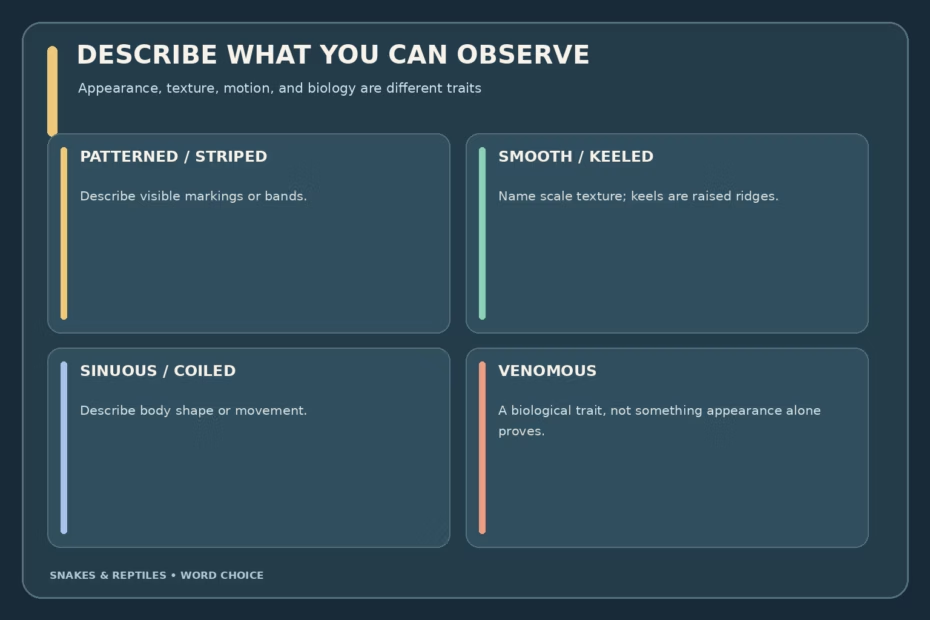
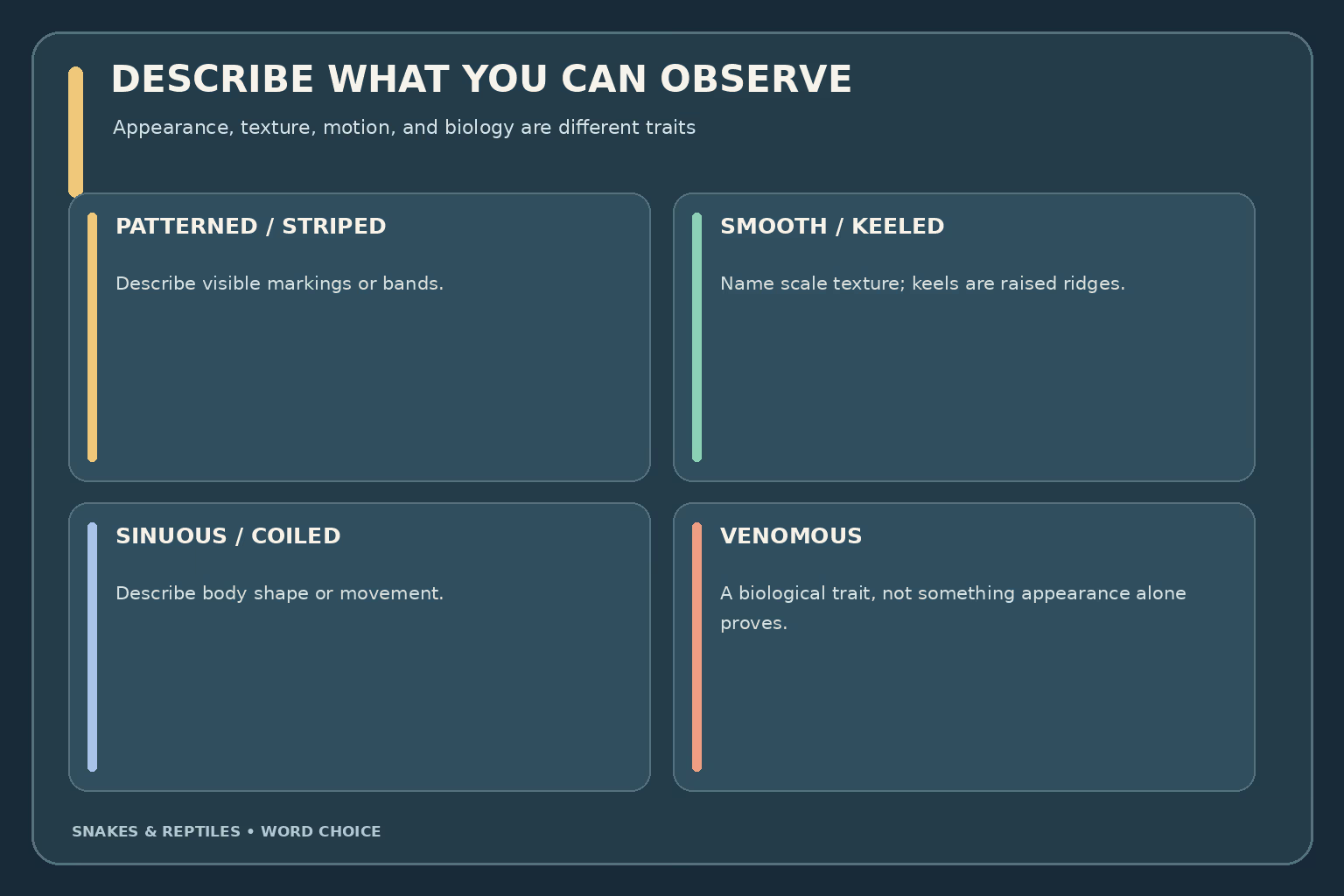
Choose an adjective that tells readers what you actually notice. A snake may be banded or speckled in appearance, keeled in scale texture, and sinuous in motion. These words describe different features; a color or pattern does not establish a snake’s species or whether it is venomous. “Reptile” is a broad group that includes snakes, lizards, turtles, crocodilians, and other animals, so a useful description should name the particular animal or feature when possible.
Many people picture snakes as slimy, but their scales are dry. Some feel smooth, while keeled scales have a raised ridge and may feel rougher. Use slimy only when something is actually slippery or covered in mucus; it is usually an inaccurate description of a snake.
Separate visible details from biological traits when choosing an adjective.
Adjectives for a Snake’s Appearance
Color words are most helpful when they are paired with a visible pattern, body shape, or scale detail. A snake might be olive-green and striped, dark with pale bands, or mottled with irregular patches. These terms describe what a viewer sees without implying that a particular color is always linked to one species.
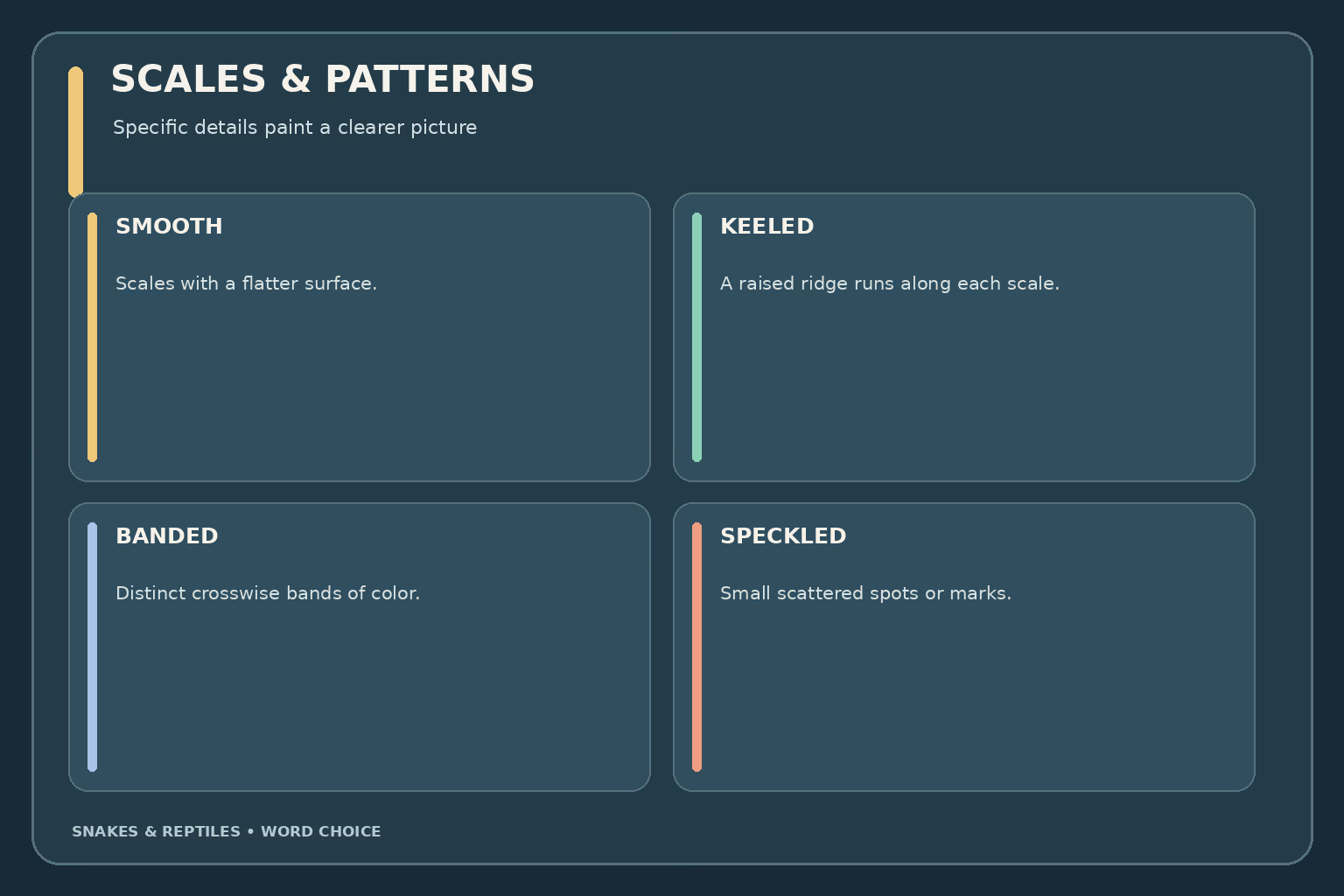
Snake scales and markings vary: name the observed texture or pattern precisely.
Banded: marked with distinct bands across the body. “The banded snake rested beneath a sun-warmed log.”
Striped: marked with long lines that run along the body. “A pale stripe followed the lizard’s back.”
Speckled: dotted with small marks. “Speckled scales helped break up the animal’s outline among dry leaves.”
Mottled: marked with irregular patches of different shades. “Its mottled brown pattern blended into the forest floor.”
Glossy: shiny or reflective. “The glossy scales caught the light.”
Matte: not shiny. “The lizard’s matte coloring looked subdued beside the bright flowers.”
Slender: narrow in body shape. “A slender garter snake slipped through the grass.”
Stout: thick or solidly built. “The stout python rested in a loose coil.”
Long-bodied: having an elongated body. “The long-bodied reptile crossed the path.”
Camouflaged: colored or patterned in a way that makes an animal difficult to see in a particular setting. “The camouflaged snake was hard to spot against the leaf litter.” Camouflage depends on the background and is not necessarily intentional concealment in every moment.
Words for Scales, Skin, and Body Features
Scaly is a broad word for an animal covered in scales. To be more precise about snakes, use smooth-scaled for scales with a flatter surface or keeled for scales with a raised lengthwise ridge. Not every species has the same scale texture, and the same animal may have different scale shapes on different parts of its body. For a reptile with a shell, shell-backed or domed may communicate more than “scaly.”
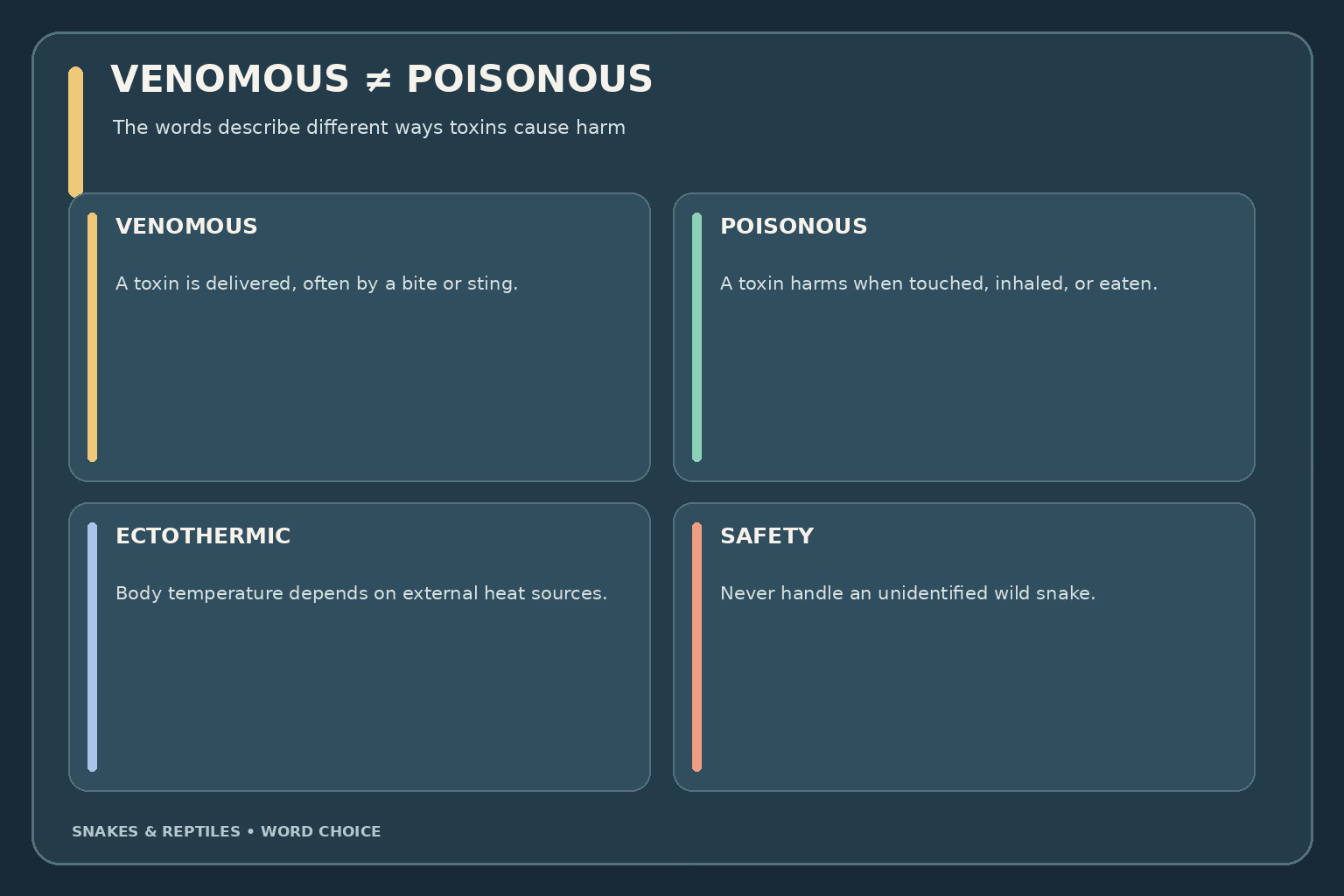
“Cold-blooded” is a familiar everyday term, but ectothermic is more accurate in scientific writing: an ectotherm relies largely on external sources of heat to regulate body temperature. This does not mean its blood is always cold. A sun-warmed lizard can be warm to the touch, and an ectothermic animal’s body temperature changes with its surroundings.
Adjectives for Movement and Posture
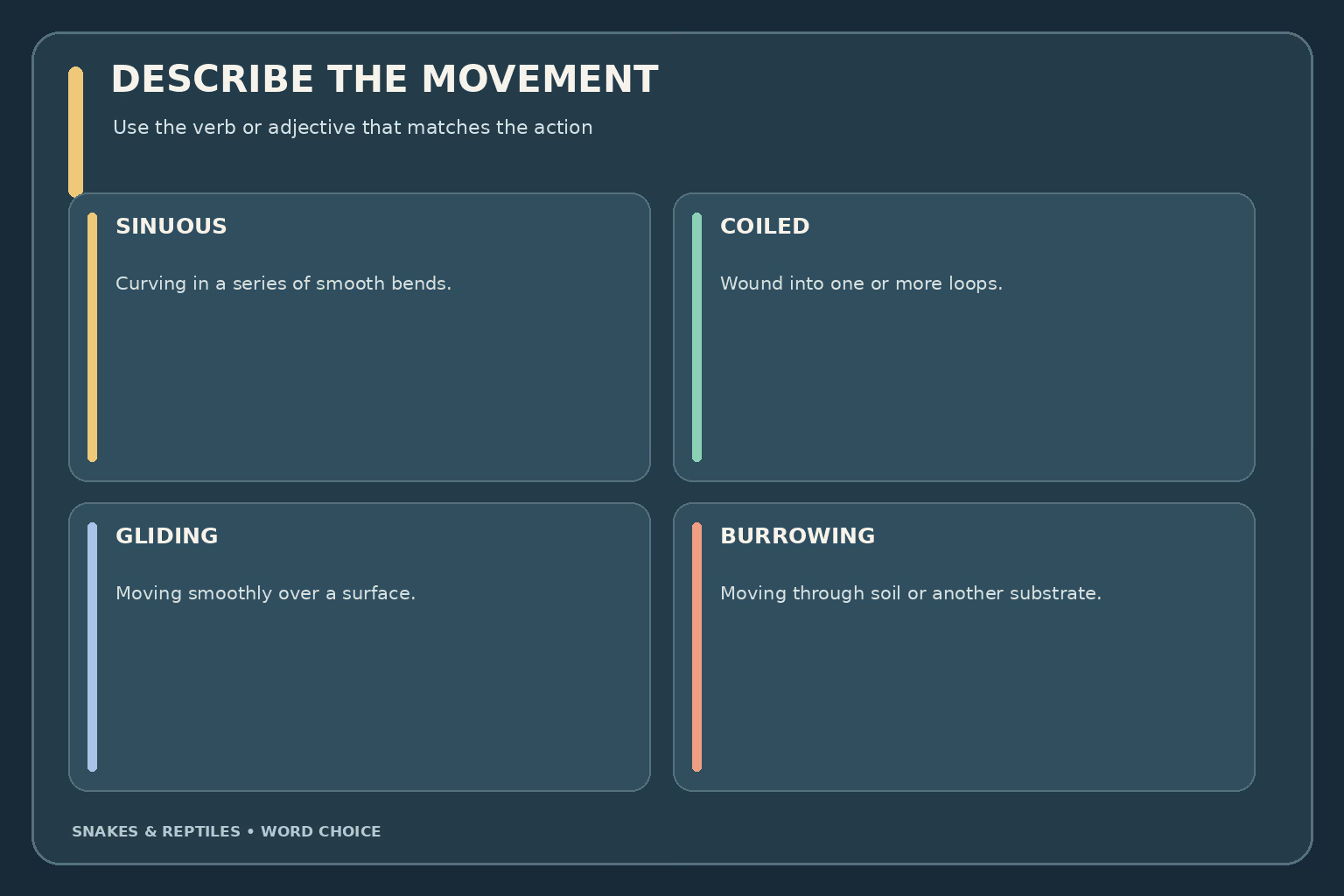
Movement words such as “sinuous” and “coiled” describe different actions and positions.
Sinuous: moving in a series of smooth curves. “The sinuous snake wound between the roots.”
Coiled: wound into a loop or series of loops. “The coiled snake rested quietly in its enclosure.”
Slithering: sliding or gliding along a surface, often with a side-to-side motion. “A snake was slithering through the grass.” This is a common descriptive word, though it can sound dramatic.
Burrowing: moving through or living in a tunnel in soil. “The burrowing reptile disappeared beneath the sand.”
Climbing: moving up a surface. “The climbing lizard reached a low branch.”
Basking: resting in warmth, often in sunlight. “The basking turtle stretched its neck toward the sun.”
Motionless: not moving. “The motionless lizard remained on the rock.” This describes what was observed at that moment; it does not prove the animal is tame or harmless.
Agile: able to move quickly and easily. “The agile gecko darted across the wall.” Use it when the movement supports the description.
Temperament and Behavior: Describe What Happened
Words such as aggressive, fierce, gentle, and tame can turn a brief observation into a broad claim about an animal. Prefer a specific behavior where you can: “the snake hissed and struck at the barrier” or “the turtle withdrew into its shell.” A reptile that stays still may be resting, stressed, cold, ill, or simply reacting to its surroundings; stillness alone does not show that it is tame.
For a story or poem, expressive words such as mysterious, eerie, majestic, or beautiful can set a mood. Make clear that these are the narrator’s impressions, not biological facts. For observation notes, choose neutral, visible details such as alert, resting, retreating, or basking.
Venomous, Poisonous, and Dangerous
Venomous and poisonous are not interchangeable. Venom is a toxin delivered into another animal, commonly through a bite or sting; poisonous animals or substances cause harm when touched, inhaled, or eaten. Some animals can be both, but the words describe different exposure routes. If a sentence means that a snake can inject venom, venomous is usually the intended adjective.
Use “venomous” for injected toxins and “poisonous” for toxins that harm by contact or ingestion.
Dangerous and deadly are high-stakes judgments, not visual descriptions. Risk depends on the species, circumstances, and contact with people. Color, head shape, or a photograph may not be enough for safe identification. Do not approach, pick up, or try to trap an unfamiliar snake. If someone has been bitten, seek urgent local medical or poison-control advice.
Quick Examples: Choose the More Specific Word
Instead of “a scary snake,” try “a dark, banded snake that raised its head,” if those are the observed details.
Instead of “a slimy lizard,” say “a smooth-scaled lizard” or describe the wet surface it was resting on.
Instead of “a cold-blooded turtle,” use “an ectothermic turtle” in a science report, or “a turtle warming itself in the sun” for a general audience.
Instead of “a poisonous snake,” write “a venomous snake” if the toxin is delivered through a bite, and only when that trait is confirmed.
Instead of “an aggressive reptile,” report the action: “The animal hissed and moved toward the observer.”
Frequently Asked Questions
What are good adjectives for a snake?
Useful choices include banded, striped, speckled, mottled, slender, coiled, sinuous, smooth-scaled, and keeled. Pick the word that matches the feature you can see or the movement you observed.
Are snakes slimy?
No. Snake scales are dry, though their texture varies: some are smooth and others have raised keels. “Slimy” is generally a misconception when used to describe a snake’s skin.
Is “cold-blooded” an accurate description?
It is a familiar common expression, but ectothermic is more precise. Ectotherms depend on external heat sources to regulate body temperature; their blood is not necessarily cold.
What is the difference between venomous and poisonous?
Venom is injected, often by a bite or sting. A poison causes harm when it is touched, inhaled, or eaten. Use the word that matches how the toxin enters the body.
Can you tell whether a snake is dangerous by its color?
Color and pattern alone are not a reliable basis for identifying an unfamiliar snake. Keep your distance and contact a qualified local wildlife professional if help is needed.
When it comes to adjectives for snake and reptiles, there are a few key things to keep in mind. First, snakes and reptiles are often seen as being dangerous or scary, so adjectives that convey these qualities can be useful. Second, snakes and reptiles can be very hard to spot, so adjectives that describe their colors and patterns can be helpful in getting someone’s attention.
Finally, snakes and reptiles come in a wide range of shapes and sizes, so adjectives that describe these features can also be useful. With all of this in mind, here are some adjectives for snake and reptiles that you might find useful.
Adjectives For Snake and Reptiles
Adjectives for snake and reptiles. adjectives for snake and reptiles. adjectives for snake and reptiles. adjectives for snake and reptiles. adjectives for snake and reptiles. adjectives for snake and reptiles. adjectives for snake and reptiles. adjectives for snake and reptiles. adjectives for snake and reptiles. adjectives for snake and reptiles.
Adjectives for snake and reptiles. adjectives for snake and reptiles. adjectives for snake and reptiles. adjectives for snake and reptiles. adjectives for snake and reptiles, including scaly, slimy, slithering, creepy, cold-blooded, venomous, dangerous, deadly, etc.
A
Active
Afraid
Aggressive
Alive
Analogy
Angry
Antelope
Attendant
Australian
Avoidance
B
Bald
Bearded
Beautiful
Bellied
Benumbed
Big
Biggest
Bird
Birds
Bit
Bite
Bites
Black
Blind
Blue
Bluish
Boats
Bodied
Bosom
Brazilian
Bright
Brilliant
Brown
Brownian
C
Catcher
Catching
Charmer
Charming
Coiled
Cold
Colored
Coloured
Colubrid
Colubrine
Columbia
Common
Copperhead
Coral
Country
Creek
Crested
Crooked
Cult
Curious
D
Dance
Dancing
Dangerous
Dark
Dead
Deadly
Dear
Deceitful
Deep
Delicate
Dem
Demon
Dirty
Doctor
Doctors
Dragon
E
Eastern
Eater
Eating
Elderly
Enormous
Evil
Eye
Eyed
Eyes
F
Faced
Fashion
Fat
Fatal
Favourite
Female
Fence
Ferocious
Fierce
Fiery
Fine
Fish
Flies
Foot
Formidable
Foul
French
G
Genuine
Giant
Gigantic
God
Goddess
Gods
Golden
Gorgeous
Gourd
Grass
Gray
Great
Greedy
Green
Guileful
H
Handling
Handsome
Happy
Harmless
Head
Headed
Heads
Heavy
Hideous
Hill
Holes
Holy
Hood
Hooded
Horned
Horrible
Horrid
Hot
Huge
Hunting
I
Illusion
Illusory
Immense
Indian
Innocent
Interesting
Invisible
Irritable
J | K
Jewelled
Jointed
Killer
Killing
King
Knotted
L
Languid
Large
Largest
Leaves
Legged
Light
Little
Live
Lively
Lizard
Locks
Long
Longest
Loose
M
Male
Meanest
Meat
Medicine
Metaphor
Mighty
Miraculous
Modern
Monstrous
Mythical
N | O
Native
Necked
Newly
Nonvenomous
Northern
Nosed
Numberless
Numerous
Occasional
Oil
Original
P
Parlour
Pernicious
Pet
Pink
Pit
Pits
Poison
Poisoning
Poisonous
Poor
Practical
Pretzel
Proteroglyphous
Proverbial
R
Rare
Rattle
Real
Red
Regular
Resistant
Ring
Ringed
Root
Rope
S
Sacred
Sacrifice
Scarlet
Sea
Secret
Serum
Shiny
Short
Silent
Silver
Silvery
Single
Sinister
Sized
Skin
Skinned
Skins
Slender
Slimy
Slithery
Small
Smooth
Soft
Southern
Speckled
Spirits
Spiritual
Splendid
Spotted
Startled
Stealthy
Stone
Stones
Story
Striking
Striped
Stuffed
Stylish
Subtle
T
Tame
Tattooed
Terrestrial
Terrible
Terrified
Thick
Thin
Thread
Tiny
Tortuous
Trodden
Tropic
Troublesome
Twisted
Typical
U
Unable
Uncommon
Uneasy
Unremarkable
Unseen
V
Vast
Vasty
Vengeful
Venom
Venomous
Vicious
Vile
Visible
W | Y
Whip
White
Wicked
Wild
Wily
Winding
Wise
Woman
Wood
Wooden
Worship
Wounded
Writhy
Yellow
Final verdict
In conclusion, adjectives for snake and reptiles are many and varied. While some may find these creatures to be repulsive, others find them to be fascinating and even beautiful. In any case, adjectives such as slimy, scaly, and slithering can help to paint a vivid picture of these creatures. With a little imagination, adjectives can bring snakes and reptiles to life in the minds of readers.
Robin founded StartsWithy in 2022 to make English words easier to understand and use. Robin oversees our 30,000+ guides, checks meanings and grammar against trusted dictionaries such as Cambridge, Oxford Learner’s and Collins, and is accountable for every correction we make.