Adjectives for Snow and Winter: Texture, Weather & Mood
As anyone who has experienced a winter knows, adjectives are essential for describing the coldest season of the year. From the light, fluffy flakes of a snowfall to the deep, unbroken silence of a winter night, there are countless ways to describe the unique beauty of winter. In this article, we will explore some of the most evocative adjectives for snow and winter.
Whether you’re looking for a way to describe a scene from your favorite childhood book or simply want to capture the magic of a snow-filled day, these adjectives will help you do just that. So grab a cup of hot cocoa and get ready to cozy up with this list of adjectives for snow and winter.
How to Choose the Right Adjective for Snow and Winter
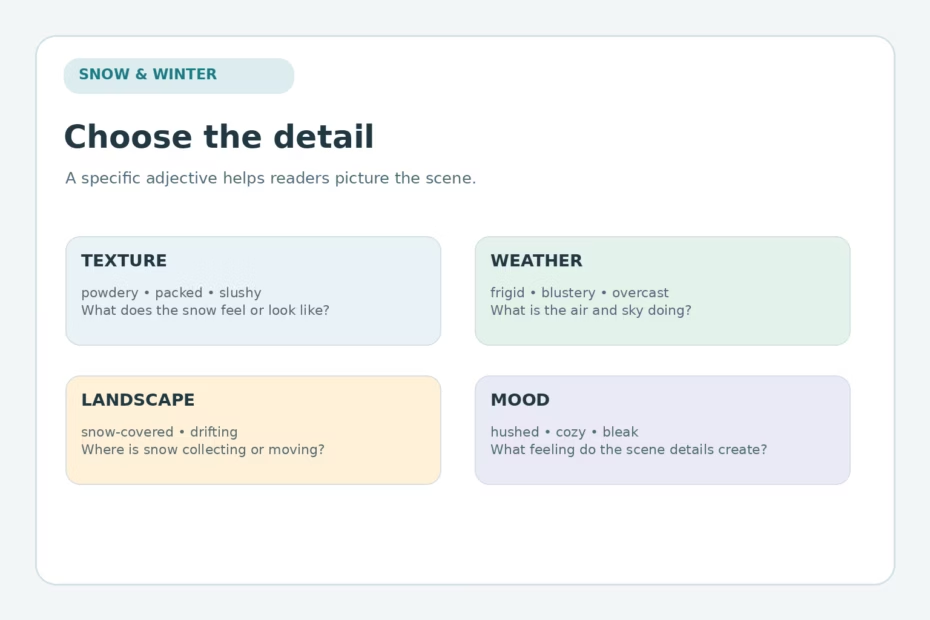
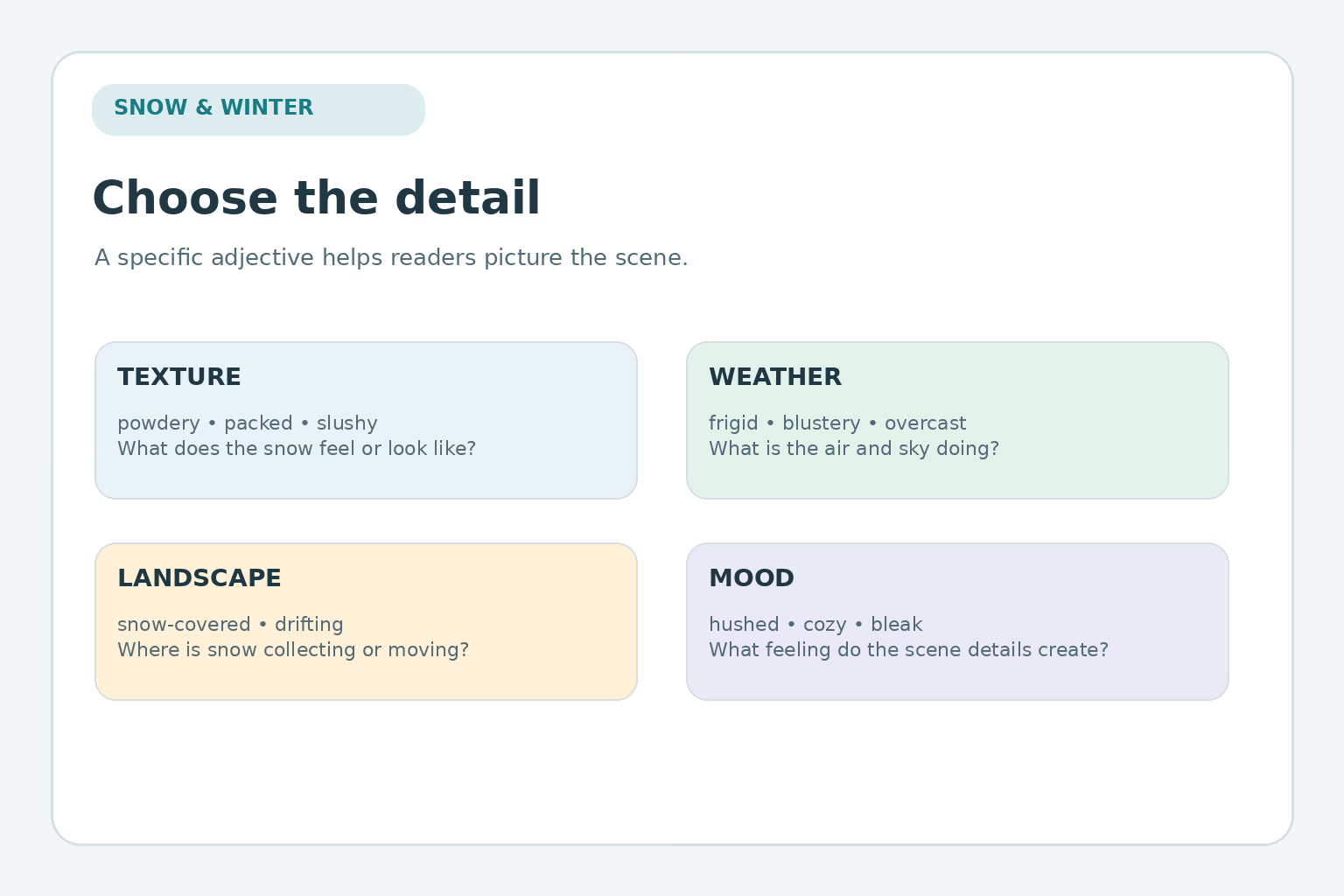
The best winter description tells readers what they could see, feel, hear, or experience. Instead of stacking several near-synonyms, decide whether you are describing the snow’s texture, the weather, the landscape, or the mood. A few precise words can make a scene clearer than a long string of adjectives.
Choose a descriptive angle first: texture, weather, landscape, or atmosphere.
Adjectives for snow texture and condition
These words describe snow on the ground or flakes as they fall. Conditions change as snow warms, melts, refreezes, or is compressed, so choose the word that fits the moment.
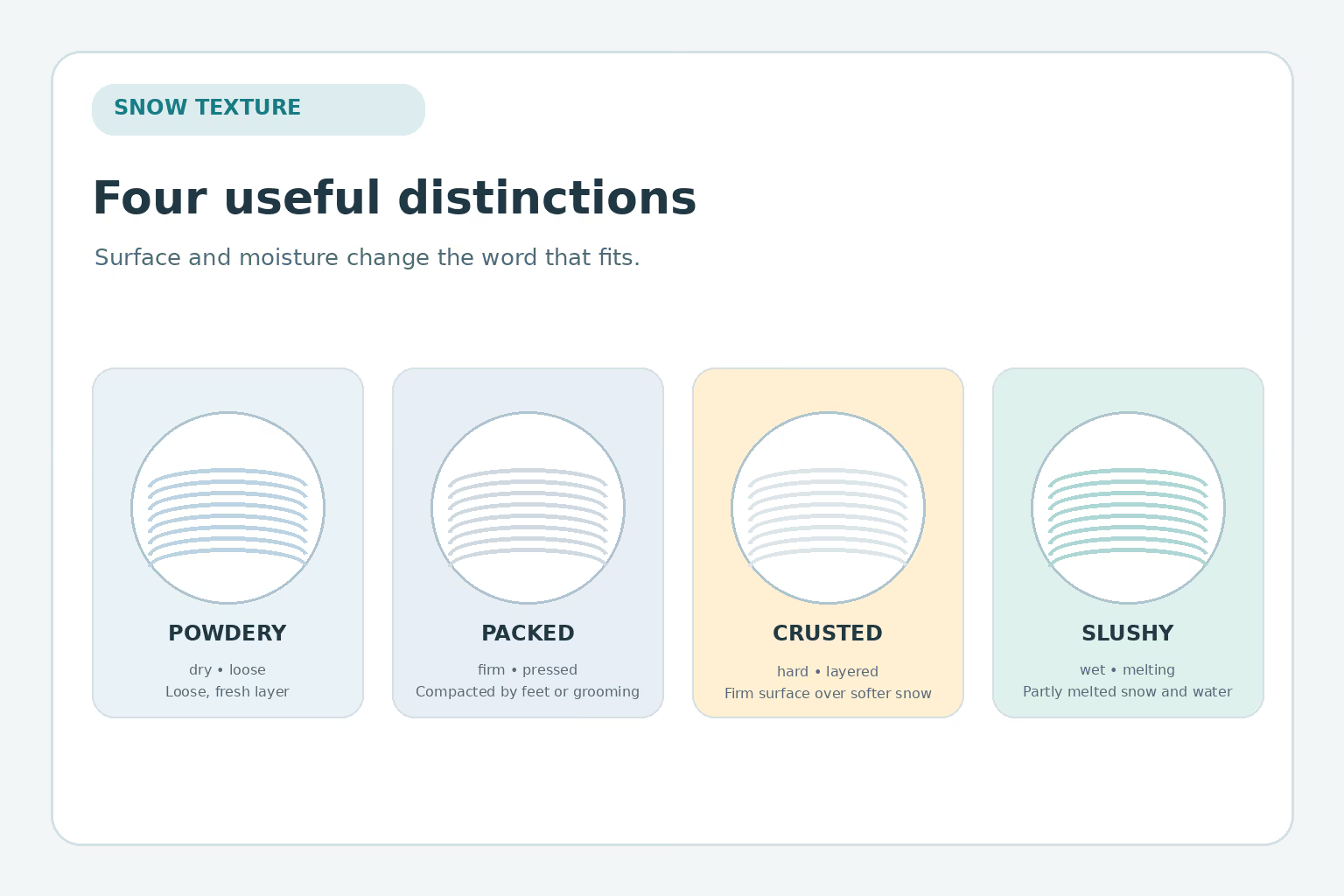
Powdery: dry, loose, and light snow that has not been packed down. “A powdery layer covered the trail.” The National Weather Service defines powder snow as dry, loose, unconsolidated snow.
Fluffy: soft-looking and airy, often used for newly fallen snow or large flakes. “Fluffy flakes gathered on the pine branches.”
Fresh: newly fallen or newly deposited. It does not by itself say whether the snow is wet or dry. “Fresh snow softened the footprints.”
Packed: pressed firmly together by footsteps, traffic, or grooming. “Packed snow made the path easier to walk on.”
Crusted: covered by a hardened surface layer, often after melting and refreezing. “A thin crust formed over the softer snow.”
Crystalline: sparkling or visibly made up of ice crystals. It sounds more technical or poetic than everyday “sparkly.”
Granular: made up of small grains or granular-looking pieces. Use it for texture, not as a synonym for every kind of snowflake.
Slushy: partly melted and wet, often mixed with water. “The curbside snow turned slushy by afternoon.”
Icy: coated with ice or containing ice; it often signals a slippery surface. Snow can be icy, but the words are not interchangeable.
Drifting: piled into shapes by wind. “Drifting snow partly covered the fence.”
Windblown: moved or scattered by wind. “Windblown snow swept across the open field.”
Untouched: not yet marked by people, animals, or vehicles. “Untouched snow stretched beyond the cabin.”
Texture words distinguish loose powder, compacted snow, a hard crust, and partly melted slush.
Adjectives for winter weather
Describe the air and conditions separately from the snow itself. “Snowy” means there is snow or snow is falling; it does not tell readers how cold the air feels. “Freezing,” “bitter,” and “brisk” describe cold, while “windy” and “blustery” describe moving air.
Wintry: characteristic of winter weather or scenery, including cold, bare trees, or snow.
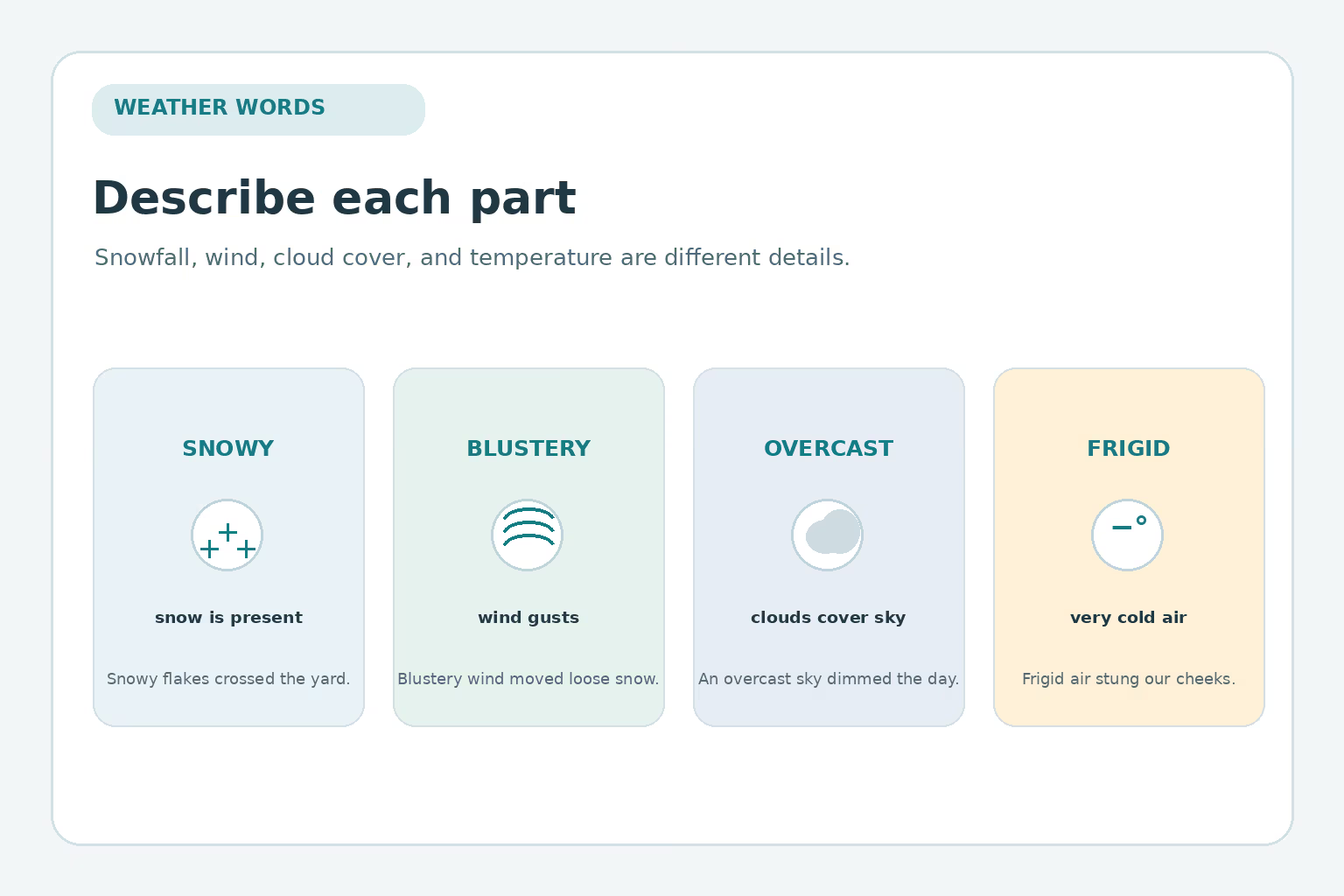
Frigid: extremely cold. “Frigid air stung our cheeks.”
Bitter: unpleasantly cold, often with an emphasis on how the cold feels. “A bitter wind cut across the lake.”
Brisk: pleasantly or sharply cool, usually with a sense of fresh movement. “We took a brisk walk before breakfast.”
Blustery: marked by strong, gusting wind. “A blustery afternoon sent loose snow across the road.”
Overcast: covered with clouds; it describes the sky, not snowfall. “An overcast sky dimmed the winter afternoon.”
Frosty: marked by frost or a cold, frost-like appearance. “Frosty grass glittered beside the path.”
Snowy: covered with snow or characterized by snowfall. “It was a snowy morning in the village.”
Stormy: affected by a storm. Add a more specific word if you know whether the storm brings snow, wind, or ice.
For weather reporting, keep terms distinct: a snow shower is a brief period of snowfall; sleet can refer to mixed rain and snow in some observation systems; freezing rain falls as liquid and freezes when it touches a cold surface. Those terms describe different conditions, not decorative synonyms.
Separate what falls from the sky from the wind, cloud cover, and temperature.
Adjectives for a winter landscape and mood
Landscape words help readers picture shape, light, and sound. Mood words describe the feeling a scene creates; they are subjective, so support them with a concrete detail.
Snow-covered: covered with a layer of snow. “Snow-covered roofs lined the quiet street.”
Snowbound: isolated or blocked in by heavy snow. “The snowbound village waited for the road to reopen.”
White: plain and direct, useful when color matters more than texture. “White fields surrounded the dark barn.”
Pristine: clean and apparently untouched. “The pristine slope had no tracks.”
Glistening: shining with reflected light. “Glistening icicles hung from the eaves.”
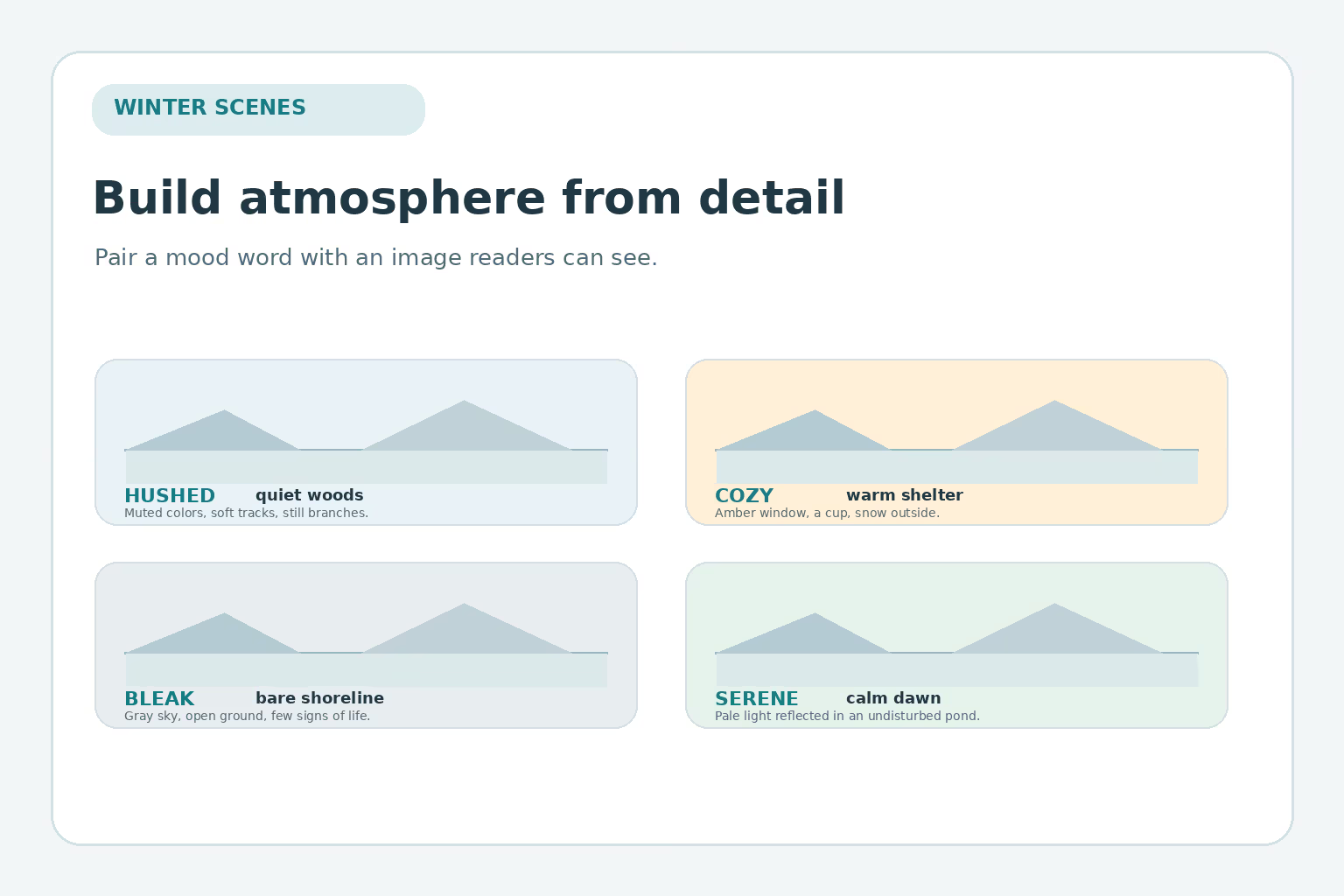
Hushed: unusually quiet. “A hushed wood held the sound of each step.”
Bleak: bare, exposed, or cheerless. “The bleak shoreline looked even wider in winter.”
Cozy: warm, comfortable, and sheltered. “We watched the snowfall from a cozy kitchen.”
Serene: calm and peaceful. “A serene dawn settled over the frozen pond.”
Gloomy: dim or low in mood. “Gloomy clouds gathered above the street.”
Treacherous: dangerously difficult to travel on or through. “Treacherous ice made the steps unsafe.”
Snow-laden: carrying a heavy layer of snow. “Snow-laden branches bent above the path.”
Pair a mood word with visible details so the scene earns the feeling you describe.
Quick adjective pairs: choose by meaning
Words
Difference
Example
Powdery / packed
Loose and dry / pressed together
Powdery snow fell beyond the packed trail.
Slushy / icy
Wet, partly melted snow / a surface with ice
Slushy snow gathered beside the icy crossing.
Brisk / frigid
Cool and refreshing / extremely cold
The brisk morning became frigid after sunset.
Snowy / frosty
Snow is falling or present / frost is present or suggested
A snowy field lay beside frosty grass.
Quiet / hushed
Simply low in sound / unusually still and subdued
The hushed woods seemed quiet after the storm.
How to use winter adjectives in a sentence
Place the adjective close to the noun it describes, and use details that match its meaning. “Powdery snow” describes texture; “powdery wind” is less natural unless you mean wind carrying fine snow. A compound adjective before a noun is usually hyphenated when needed for clarity: “a snow-covered path,” but “the path was covered with snow.”
Try this simple pattern: adjective + specific noun + action or detail. For example: “A bitter wind swept loose snow over the frozen pond.” The adjectives each add separate information: “bitter” describes the wind’s cold feel, “loose” describes the snow, and “frozen” describes the pond. Remove any word that repeats another or does not help readers imagine the scene.
For a calm scene, try soft, quiet, pale, still, or serene. For dangerous travel, use factual words such as icy, slick, deep, or treacherous only when the conditions support them. For a lively storm, blustery, swirling, heavy, and windblown can show movement. A short, accurate description is often stronger than calling every winter day “magical” or every patch of snow “crystalline.”
Adjectives For Snow and Winter
In the English language, there are a number of adjectives that can be used to describe snow and winter. For example, snow can be described as “fluffy,” “powdery,” or “crusty.” Winter, on the other hand, can be described as “cold,” “dark,” or ” bleak.” However, these are just a few of the many adjectives that can be used to describe snow and winter.
In order to fully appreciate the beauty of these seasons, it is worth taking the time to learn some of the other adjectives that can be used to describe them. After all, there is nothing quite like a crisp winter day or a gentle snowfall.
A
Absolute Zero
Accursed
Actual
Adequate
Adrian
African
Ageless
Aggressive
Alaskan
Antarctic
Anxious
Arctic
Armed
Artificial
Ascetic
Australian
Average
Awful
B
Banked
Bare
Barren
Beastly
Beautiful
Belgian
Below Zero
Bereft
Biting
Bitter
Bitter Cold
Black
Bleak
Blessed
Bloody
Blustery
Boisterous
Boreal
Bored
Boring
Brazilian
Bright
Brilliant
British
Broad
Broken
Busy
C
Calm
Canadian
Captive
Caspian
Celestial
Celtic
Certain
Challenging
Charming
Cheap
Chilling
Chilly
Clean
Clear
Close
Cloudy
Coarse
Coastal
Cold
Comfortable
Compact
Compressed
Confining
Congealed
Consecutive
Considerable
Consolidated
Contemporary
Continual
Continuous
Cool
Corrosive
Cozy
Crackling
Crimson
Crisp
Cruel
Cruellest
Crunchy
Crusty
Crystalline
Crystallized
Cursed
D
Damp
Dangerous
Dark
Dat
Dazzling
Decent
Deep
Deepest
Delicate
Delightful
Depressing
Desolate
Detestable
Difficult
Diligent
Dingy
Dirty
Disagreeable
Disastrous
Dismal
Disruptive
Distant
Distressing
Downy
Drab
Drafty
Dreaded
Dreadful
Dreariest
Dreary
Drenched
Drifted
Dropt
Druvven
Dry
Dull
Dumb
Dutch
E
Eastern
Easy
Ecumenical
Elaborate
Electric
Elementary
Enchanted
Endless
English
Entire
Epic
Eternal
Eurasian
European
Everlasting
Exaggerated
Expansive
Exquisite
Extensive
Extra
Extraordinary
Extreme
F
Fallen
Famine
Famous
Fatal
Fatiguing
Fearful
Fiercest
Fiery
Fine
Fireside
Firm
Flaky
Flannel
Fleecy
Flinty
Fluffy
Foggy
Following
Forlorn
Fourth
Fragmentary
Fragrant
Freezing
Fresh
Friendly
Frigid
Frostbitten
Frostless
Frosty
Frozen
Furious
G
Gayest
Gentle
German
Ghastly
Glacial
Glistening
Gloomy
Glorious
Granular
Gray
Grayest
Green
Grim
Gritty
Gusty
H
Happy
Hard
Hardened
Harsh
Hasty
Hazy
Heaped
Heartless
Hearty
Heated
Heavy
Hoarse
Hoary
Hollow
Honeyed
Horrid
Hull
Humid
Hungry
Hyperborean
Hypothermic
I
Ice Cold
Ice-Kissed
Icelandic
Iconic
Icy
Ideal
Immeasurable
Immemorial
Imminent
Incessant
Incipient
Inclement
Indian
Indoor
Infernal
Innocent
Insulated
Intensifying
Interminable
Intolerable
Irish
Irksome
Islamic
Isolated
Isolating
Isothermal
Italian
J | K | L
Jingling
Keen
Large
Late
Leafless
Lean
Lengthened
Lengthy
Lifeless
Light
Livid
Lone
Lonely
Lonesome
Long
Loose
Lovely
Lusty
M
Magical
Magnificent
Mantling
Marine
Martian
Matted
Measurable
Melancholy
Melted
Melting
Memorable
Mere
Meteorological
Mild
Minimal
Miserable
Misty
Modest
Moist
Molten
Monotonous
Mournful
Mournfullest
Muddy
Mushy
N
Nasty
Native
Natural
Nice
Nippy
Normal
Northeastern
Northern
Nuclear
Numb
Nuptial
O
Occasional
Odorous
Official
Oft
Oncoming
Opaline
Open
Ordinary
Outlive
Overall
Overcast
P
Packed
Pale
Pallid
Pandemic
Parisian
Past
Peaceful
Perfect
Permanent
Perpectual
Perpetual
Persistent
Peruvian
Piled
Pink
Plain
Pleasant
Plenty
Polar
Poor
Powdered
Powdery
Prairie
Premature
Present
Prevalent
Previous
Pristine
Productive
Prolonged
Promised
Proper
Protective
Punctual
Pure
Pure White
Q | R
Quick
Quiet
Radiant
Rainy
Real
Red
Regular
Relentless
Residential
Ribbed
Rigorous
Rotten
Rough
Rubbly
Rude
Russian
S
Sad
Sandy
Scanter
Scenic
Scottish
Seasonal
Secret
Sedentary
Semi
Seventh
Severe
Shallow
Shanty
Sharp
Shifty
Shivering
Short
Shoveled
Showy
Siberian
Sicilian
Sifting
Silent
Single
Sithonian
Sixteenth
Slight
Slippery
Slow
Slushy
Smooth
Snow Kissed
Snowbound
Snowed In
Snowiest
Snowthe
Snowy
Sodden
Soft
Softened
Solid
South
Southern
Sparkling
Spiced
Spiritual
Splendid
Spotless
Stained
Stainless
Stamped
Steep
Sterile
Stern
Sticky
Stormy
Strenuous
Stuck Inside
Sturdy
Sub
Subsequent
Successful
Successive
Sudden
Sunlit
Superficial
Surly
Swedish
Sweeping
Sweet
T
Tedious
Terrible
Terrific
Thawed
Thick
Thin
Thracian
Toasted
Toasting
Toasty
Topmost
Tough
Trackless
Traitorous
Transparent
Treacherous
Trodden
Tropical
Tuhble
Twentieth
Typical
U
Ultimate
Unadorned
Unbroken
Uncertain
Uncomfortable
Unending
Uneven
Unfortunate
Ungroomed
Universal
Unmelted
Unpacked
Unprecedented
Unprotected
Unsullied
Untarnished
Untouched
Untracked
Untrodden
Untroubled
Unwasted
Upcoming
Upland
Upper
Uppermost
Usual
V | W
Vicious
Virgin
Virtual
Wacky
Warm
Weak
Weary
Weird
Western
Wet
Wet Cold
Whelming
White
Wicked
Widespread
Wild
Windy
Wintertime
Wintry
Wise
Woeful
Wrathful
Wreathed
Wretched
Final verdict
In conclusion, the article provides a helpful list of adjectives for snow and winter. The adjectives are organized by category, making it easy to find the right word for the desired effect. In addition, the article includes example sentences for each adjective, demonstrating how the words can be used in context. Whether you’re writing a winter scene or simply describing the weather, these adjectives will be a valuable addition to your vocabulary.
Robin founded StartsWithy in 2022 to make English words easier to understand and use. Robin oversees our 30,000+ guides, checks meanings and grammar against trusted dictionaries such as Cambridge, Oxford Learner’s and Collins, and is accountable for every correction we make.