Adjectives for Technology: 80 Words and Examples
Useful adjectives for technology name a specific quality, such as how a system works, how easy it is to use, or how it handles data. This guide groups 80 technology adjectives by meaning, explains common distinctions, and gives sentence examples so writers can choose precise words instead of unsupported praise.
- Best practice: name one observable feature or outcome behind each adjective.
- Usability: accessible, intuitive and user-friendly describe different parts of the user experience.
- Reliability: durable concerns wear over time; reliable concerns consistent performance.
- Security: secure is a claim that should name the risk or protection when possible.
- Grammar: technological means related to technology; tech-savvy commonly describes a person.
How do you choose an adjective for technology?
Start with the quality you can describe or verify: performance, ease of use, reliability, privacy, connectivity, energy use or physical design. Then choose the adjective that names that quality and add a concrete example. “Energy-efficient” needs a comparison or measured use; “intuitive” should reflect how people actually navigate the system.
Avoid stacking praise words such as “innovative, powerful and revolutionary” when the sentence does not explain what changed. A useful pattern is: the [device, app or system] is [adjective] because [specific feature, test or outcome]. That turns a broad label into information a reader can assess.
80 adjectives for technology by meaning
Performance and capability
- advanced: developed beyond a basic or earlier version; use only when a meaningful improvement is clear.
- efficient: uses time, energy, money or materials with little waste.
- automated: performs a task with limited direct human input.
- high-performance: delivers strong speed, capacity or output for its intended task.
- powerful: can handle demanding workloads or functions.
- scalable: can expand to handle more users, data or work.
- sophisticated: uses complex, refined features or methods.
- versatile: works usefully across more than one task or setting.
- responsive: reacts quickly to commands, inputs or changing conditions.
- intelligent: uses programmed or learned methods to interpret information or choose actions.
Ease of use and access
- accessible: can be used by people with a range of abilities and access needs.
- intuitive: feels understandable with little explanation or trial-and-error.
- user-friendly: is simple for people to use, especially in its interface or instructions.
- ergonomic: is designed around comfortable and efficient human interaction.
- inclusive: accounts for different users and circumstances in its design.
- adaptive: adjusts to a user, environment or changing input.
- configurable: lets users change settings or functions.
- portable: is easy to carry or use in different locations.
- compact: takes up relatively little space.
- hands-free: can be operated without holding or touching it during use.
Reliability and upkeep
- reliable: works consistently under the stated conditions.
- durable: withstands wear or use over time.
- dependable: can be trusted to perform when needed.
- resilient: continues or recovers after disruption.
- stable: behaves consistently rather than changing unexpectedly.
- fault-tolerant: continues functioning when a component fails.
- maintainable: can be serviced or updated without disproportionate effort.
- repairable: can be fixed instead of replaced when a part fails.
- redundant: has backup components or paths if one fails.
- upgradable: can accept newer components, software or capabilities.
Security and accountability
- secure: uses safeguards that reduce specified security risks.
- encrypted: encodes data so it cannot be read without the required key.
- privacy-conscious: is designed with privacy risks and data minimization in mind.
- compliant: meets a named law, standard or policy; name the one.
- traceable: allows users to follow a process, item or data record.
- auditable: keeps evidence that can be reviewed against criteria.
- authenticated: checks that a user, device or message is genuine.
- monitored: is observed for activity, errors or performance.
- access-controlled: limits system or information access by permission.
- risk-aware: identifies or accounts for defined risks in its design or operation.
Novelty and development
- innovative: introduces a useful new idea or application.
- emerging: is developing or beginning to see wider use.
- experimental: is being tested and may not be proven for routine use.
- cutting-edge: uses very recent methods or capabilities.
- next-generation: is a newer generation designed to improve on an earlier one.
- novel: is new or unusual in a relevant context.
- transformative: substantially changes a process or result.
- state-of-the-art: uses the best available technology at a particular time.
- disruptive: changes an established market or way of working.
- pioneering: is among the first to develop or apply an approach.
Connection and data
- connected: links with other devices, systems or networks.
- networked: communicates through a network.
- wireless: transmits data without a physical cable connection.
- cloud-based: runs on or stores information through remote cloud services.
- data-driven: uses data to guide decisions or operation.
- interoperable: can exchange information or work with other systems.
- decentralized: distributes control, storage or processing across multiple points.
- real-time: processes or displays information with little delay after it is produced.
- synchronized: keeps information or actions aligned across devices or systems.
- sensor-enabled: uses sensors to collect information about conditions or activity.
Energy and environmental impact
- energy-efficient: uses less energy for a comparable task or output.
- low-power: requires relatively little electrical power to operate.
- sustainable: is designed to reduce environmental or resource impacts across its life cycle.
- recyclable: can be processed for reuse as material after use.
- resource-efficient: uses materials, water, energy or other resources sparingly.
- carbon-aware: accounts for carbon emissions in operation or decision-making.
- battery-powered: uses a battery as its power source.
- low-emission: produces relatively low emissions under specified conditions.
- energy-saving: reduces energy use compared with a stated baseline.
- lightweight: has low mass for its size or function.
Technical form and design
- digital: uses data represented electronically, often in binary form.
- electronic: uses electronic components to control or process signals.
- mechanical: uses physical moving parts or mechanisms.
- computational: involves computing or algorithmic processing.
- algorithmic: uses defined computational procedures to process inputs or produce results.
- AI-enabled: uses an artificial-intelligence system for a specified function.
- software-based: depends mainly on software for its operation or function.
- hardware-based: depends mainly on physical devices or components.
- miniaturized: made smaller while retaining a particular function.
- technologically advanced: uses relatively developed technology; state the feature that makes it advanced.
What is the difference between technological and tech-savvy?
Cambridge Dictionary defines technological as relating to or involving technology, so it describes a subject or connection: “technological change.” By contrast, tech-savvy is an informal adjective commonly used for a person who knows a lot about modern technology, especially computers. These adjectives do not mean the same thing.
Other terms make narrower claims. User-friendly describes a system that is simple for people to use; interoperable says systems can work together; fault-tolerant describes continued operation despite some component failures. Select the word that fits the feature you can actually support. Cambridge Dictionary: user-friendly; Cambridge Dictionary: tech-savvy.
Technology adjectives in example sentences
- The clinic chose a portable scanner because staff move it between rooms.
- The backup system is fault-tolerant: a second server keeps service running if the first one fails.
- The app is accessible because users can navigate it with a keyboard and screen reader.
- The sensor network is real-time, sending readings within seconds of collection.
- The new processor is energy-efficient compared with the previous model under the same workload.
- The prototype is experimental; its accuracy has not yet been validated for clinical decisions.
Frequently asked questions about technology adjectives
What are positive adjectives for technology?
Useful positive adjectives include reliable, accessible, efficient, secure and intuitive, but each makes a claim that should fit the evidence. Describe what the product does: “The accessible interface supports keyboard navigation” is more informative than calling a device simply “amazing” or “revolutionary.”
Is technological an adjective for technology?
Yes. Technological is an adjective meaning related to or involving technology, as in “technological change.” It usually identifies a relationship or subject area rather than evaluating quality. For praise, choose a specific term such as reliable or energy-efficient and support it with a concrete feature.
Should I write high tech or high-tech?
Use high-tech as a compound adjective before a noun, as in “high-tech equipment.” High tech can appear as a noun phrase, as in “the world of high tech.” Follow the style guide used in your publication, and avoid using high-tech as a substitute for a specific technical description.
Can I use tech-savvy to describe a device?
Usually, tech-savvy describes a person who knows a lot about modern technology, especially computers. For a device or system, use a more exact adjective such as intuitive, interoperable or high-performance. “Tech-savvy users” is natural; “a tech-savvy phone” can sound vague.
Choose precise adjectives for technology
An accurate adjective identifies the feature a reader needs to understand, whether that is performance, access, reliability, security or energy use. Treat words such as secure, sustainable and state-of-the-art as claims that need context. For a clear sentence, name the technology, the adjective and the evidence behind it.
Previously published article
The following article body is included exactly as fetched, with its original list retained as the source text for this update.
When it comes to adjectives for technology, there are a few key considerations to keep in mind. First, you want to choose adjectives that accurately describe the technology in question. Secondly, you want to avoid adjectives that are overly technical or difficult to understand. Thirdly, you want to select adjectives that will resonate with your audience. With these factors in mind, here are a few adjectives for technology that you may find useful.
- Advanced: Technology can be described as advanced if it is highly developed or sophisticated.
- Automated: Automated technology is designed to operate with minimal human intervention.
- Compact: Compact technology is small in size and easy to transport.
- Efficient: Efficient technology is designed to save time, money, or resources.
- Intuitive: Intuitive technology is easy to use and understand.
- Powerful: Powerful technology is capable of handling complex tasks or large workloads.
- Reliable: Reliable technology can be depended on to work properly and consistently.
- Secure: Secure technology is designed to protect data or information from unauthorized access or theft.
- User-friendly: User-friendly technology is easy to use and navigate.
Adjectives For Technology
When it comes to adjectives for technology, there are a few key terms that come to mind. To start, adjectives like “advanced” and “sophisticated” are often used to describe cutting-edge technology. Similarly, words like “powerful” and “effective” can be used to describe the benefits of new technology.
Additionally, adjectives like “innovative” and “revolutionary” are often used to describe groundbreaking new technology. Ultimately, the right adjective for technology will depend on the specific context in which it is being used.
A
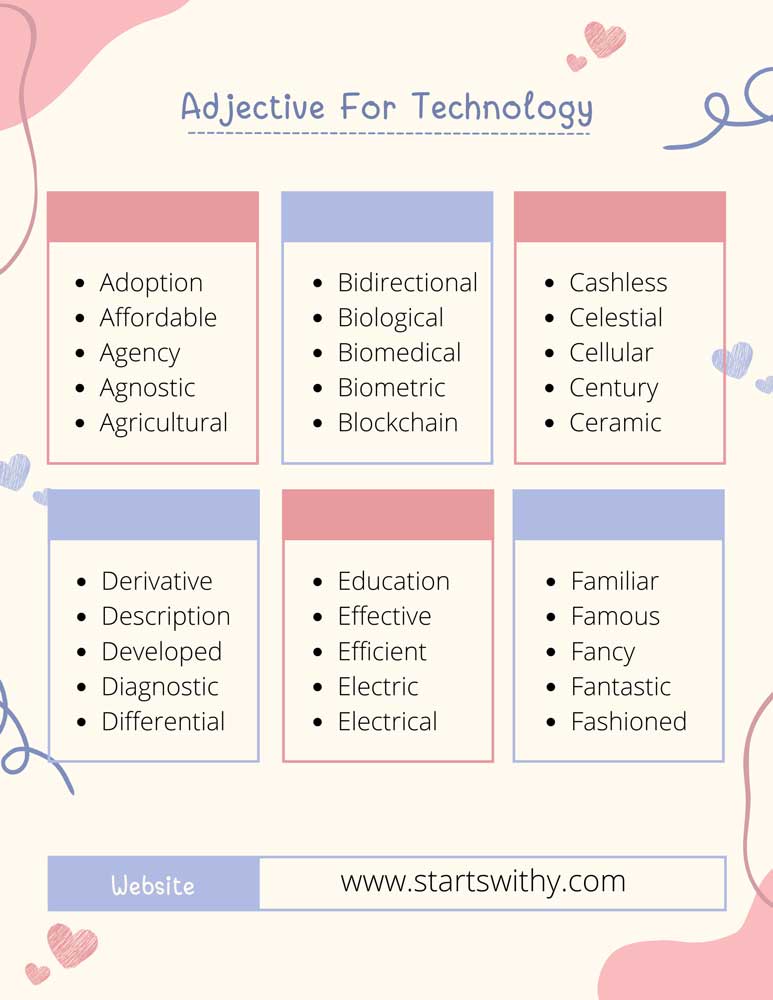
| Abstruse | Accessible | Acoustic |
| Acquisition | Active | Activities |
| Adaptable | Adaptive | Adhesive |
| Adjuvant | Adopted | Adoption |
| Advanced | Advances | Affordable |
| Agency | Agnostic | Agricultural |
| Agro | Allied | Alternative |
| Amazing | Analytic | Ancient |
| Annual | Anti | Antimicrobial |
| Application | Applied | Applying Science |
| Appropriate | Art | Artificial |
| Assessment | Assistive | Associated |
| Assumption | Astronomical | Audio |
| Australian | Authentic | Authorized |
| Automated | Automatic | Automotive |
| Autonomous | Available |
B
| Ballistic | Bandwidth | Base |
| Based | Basic | Beautiful |
| Bidirectional | Biological | Biomedical |
| Biometric | Blockchain | Breakthrough |
| Broader |
C
| Canadian | Capable | Care |
| Case | Cashierless | Cashless |
| Celestial | Cellular | Center |
| Century | Ceramic | Certain |
| Cheaper | Chemical | Chief |
| Chinese | Chiropractic | Cinematic |
| Civilian | Classical | Classified |
| Clean | Cognitive | Cold |
| Collaborative | Comfortable | Commercial |
| Community | Companies | Company |
| Complementary | Complex | Compliant |
| Complicated | Comprehensive | Computer |
| Computerized | Concerning Details | Concrete |
| Connected | Consistent | Constituent |
| Contactless | Contemporary | Continental |
| Contraceptive | Controversial | Conventional |
| Cool | Core | Corporate |
| Cosolvent | Costly | Counter |
| Countless | Course | Crazy |
| Creative | Credit Card | Critical |
| Crucial | Crypto | Culture |
| Current | Cyber |
D
| Dated | Deadly | Decent |
| Decentralized | Deep | Dental |
| Derivative | Description | Developed |
| Development | Devices | Diagnostic |
| Differential | Diffusion | Digital |
| Disadvantage | Disembodied | Disparate |
| Disruptive | Dominant | Downstream |
| Driven | Drm | Drone |
| Dynamic |
E
| Economy | Edge | Education |
| Educational | Effective | Efficient |
| Electric | Electrical | Electronic |
| Elite | Emerging | Empirical |
| Enabling | End | Energetic |
| Engineering | Enhanced | Entire |
| Entrepreneur | Environment | Environmental |
| Equipment | Equivalent | Established |
| Etheric | European | Excellent |
| Exceptional | Exciting | Exclusive |
| Expensive | Experiential | Experimental |
| Expert | Exports | Extensive |
| Extra | Extreme |
F
| Facial | Factual | Fake |
| Familiar | Famous | Fancy |
| Fantastic | Fascinating | Fashioned |
| Fast | Fatigue | Filterless |
| Financial | Firm | Firms |
| Fit | Flashy | Flexible |
| Focused | Fold | Foldable |
| Following | Forces | Foreign |
| Fourth | Friendly | Frontier |
| Frustrating | Functional | Fundamental |
| Future | Futuristic |
G
| Gap | Genetic | Genomic |
| Geospatial | Geovisual | Glare |
| Global | Goods | Governmental |
| Green | Groundbreaking |
H
| Handheld | Hard | Hardware |
| Harness | High | High-Tech |
| Hispanic | Holographic | Honeyclient |
| Hostile | Hottest | Human |
| Humane | Hybrid | Hypersonic |
I
| Image | Imaginative | Immersive |
| Impersonal | Implant | Impressive |
| Improved | Inclusive | Incredible |
| Independent | Indigenous | Inductive |
| Industrial | Industry | Inefficient |
| Informational | Infrared | Ingenious |
| Initial | Innovative | Instructional |
| Integrated | Intelligent | Intensive |
| Interactive | Interesting | Interior |
| Intermediate | Internal | International |
| Intuitive | Invasive | Investigative |
| Investment | Iot | Irish |
| Issues | Italian |
J | K
| Japanese | Joint | Key |
| Keyless | Kind | Knowledge-Based |
L
| Large | Laser | Latest |
| Leapfrog | Ledger | Legacy |
| Legal | Leveraged | Light |
| Lightweight | Link | Lost |
M
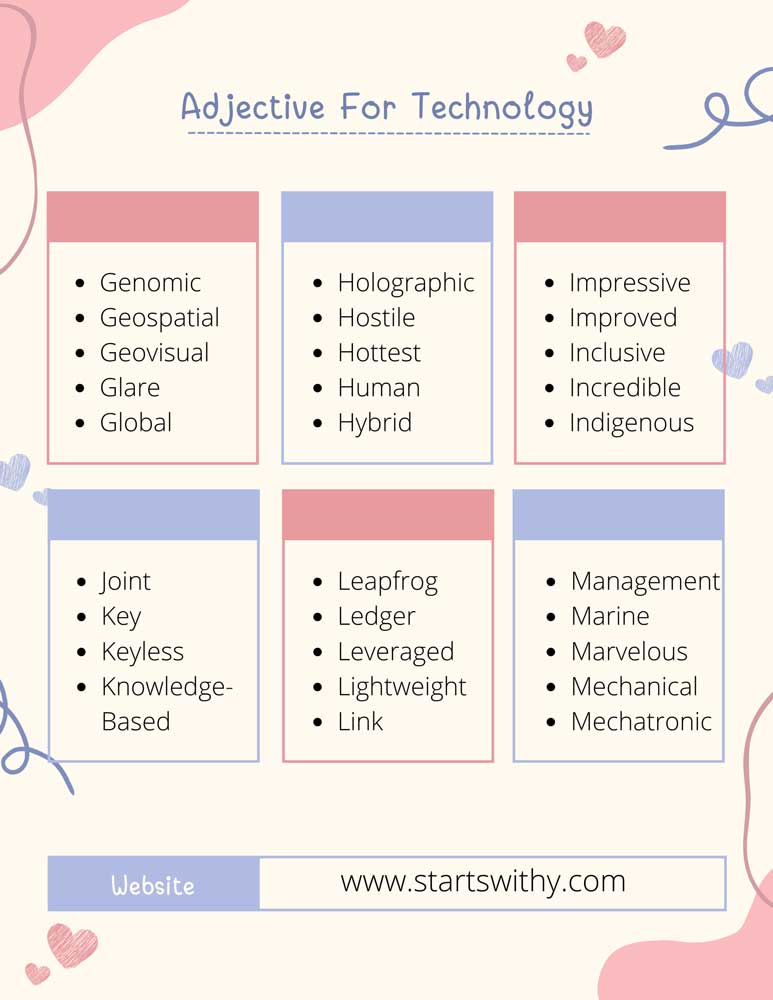
| Magnetic | Major | Malaysian |
| Management | Marine | Market |
| Marvelous | Mature | Mechanical |
| Mechanized | Mechatronic | Medical |
| Medicine | Mere | Metal |
| Methodical | Methodological | Micro |
| Microbial | Microbiological | Military |
| Miraculous | Mobile | Modem |
| Modern | Modernized | Modular |
| Molecular | Moral | Multi |
| Multimedia | Multinational | Multiple |
N
| Nanotube | Nascent | Naval |
| Navigational | Net | Netsweeper |
| Networked | Neural | New |
| Newfangled | Nifty | Nitrous |
| Non-Theoretical | Novel | Nuclear |
| Numerous |
O
| Obsolete | Occupational | Offshore |
| On The Net | On The Web | On-Screen |
| Online | Open | Operational |
| Optic | Optical | Oral |
| Organic | Oriented | Original |
| Outdated | Outsole | Overwrought |
P
| Park | Parks | Passive |
| Patented | Patient | Pavement |
| Perfect | Persuasive | Pet |
| Phosphorous | Photochromic | Photographic |
| Photovoltaic | Pioneering | Policy |
| Polymorphic | Popular | Portable |
| Portal | Positive | Post |
| Potential | Powerful | Practical |
| Practice | Precise | Predictive |
| Preeminent | Preferred | Present |
| Previous | Primitive | Prior |
| Procedural | Product | Production |
| Professional | Profitable | Programmatic |
| Programmed | Projects | Promising |
| Proper | Proprietary | Protective |
| Proven | Puncture | Push |
| Push-Button |
Q | R
| Qled | Quarterly | Radiologic |
| Radiological | Rainscreen | Rapid |
| Real | Realm | Rear |
| Recombinant | Refinish | Regional |
| Regular | Related | Relational |
| Relevant | Reliable | Remote |
| Remote-Control | Renewable | Renowned |
| Reproductive | Requisite | Research-Based |
| Residential | Respective | Responsible |
| Restorative | Restricted | Restrictive |
| Retail | Reversible | Review |
| Revolutionary | Rfid | Risky |
| Robotic | Robust | Ropeless |
| Rural |
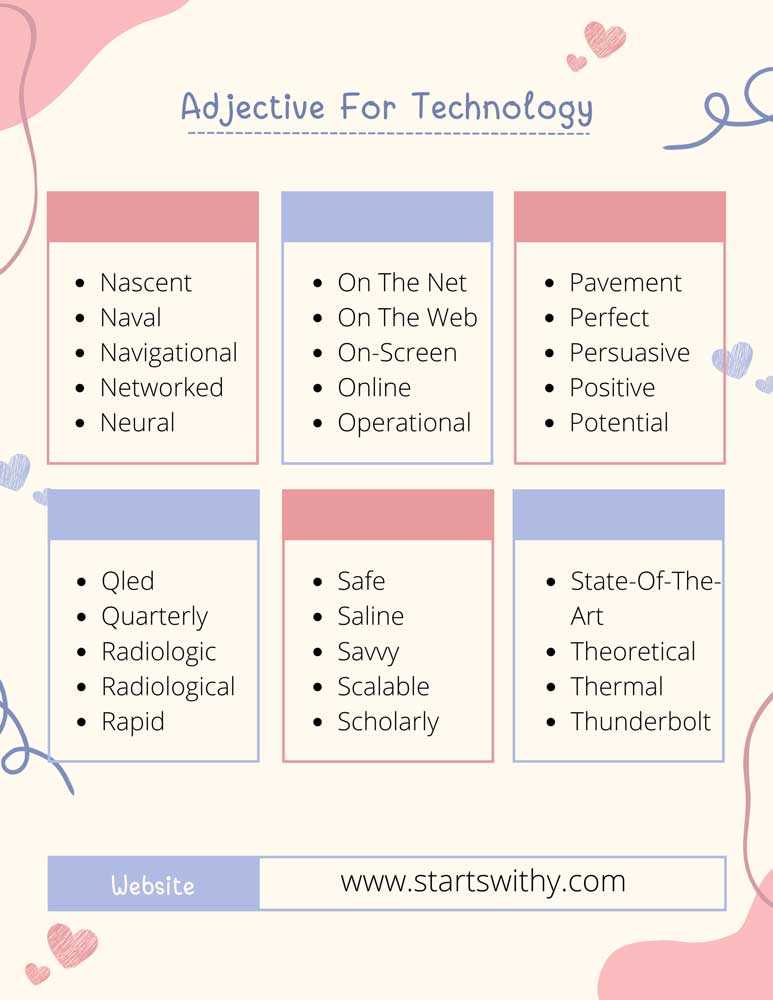
S
| Safe | Saline | Saving |
| Savvy | Scalable | Scholarly |
| Scientific | Secret | Secretive |
| Sector | Secure | Semantic |
| Sensitive | Sensory | Separate |
| Services | Shiny | Short |
| Silk | Single | Size |
| Skilled | Slip | Smart |
| Smartphone | Societies | Society |
| Soft | Solar | Solenoid |
| Solid | Soluble | Solution |
| Sophisticated | Soviet | Spatial |
| Special | Specialist | Specialized |
| Spectral | Spore | Stable |
| Standard | State-Of-The-Art | Static |
| Steady | Stealth | Strange |
| Strategic | Stream | Structure |
| Stylus | Submarine | Successful |
| Super | Superior | Surgical |
| Sustainable | Systems |
| Tamper | Technical | The |
| Theoretical | Thermal | Thick |
| Thin | Thunderbolt | Tidal |
| Tools | Touch | Tracking |
| Traditional | Transdermal | Transfer |
| Transformative | Transgenic | Trenchless |
| Tri | Trinomic | Trustworthy |
U
| Ubiquitous | Ultra | Ultrasonic |
| Underlying | Underwater | Unfamiliar |
| Unimaginable | Unique | Unknown |
| Unlicensed | Unmatched | Unproven |
| Unusual | Upper | Ups |
| Urban | Usable | Useful |
V
| Valuable | Versatile | Virtual |
| Visual | Vital | Vivo |
| Vocational |
W | Z
| Wars | Waterproof | Weapons |
| Wearable | Western | Whale |
| Wide | Wideband | Wired |
| Wireless | Wonderful | Worldwide |
| Zerog |
How to Describe technology? – Different Scenarios
When it comes to describing technology, there are various scenarios where different adjectives can be used to effectively convey the characteristics and functionalities of various technological devices. Let’s explore some of these scenarios and the descriptive words that can be employed in each case:
1. Describing the Appearance
When describing the appearance of technology, it’s important to focus on the visual aspects that define its design and overall look. Here are some adjectives that can be used in this scenario:
- Sleek
- Elegant
- Compact
- Stylish
- Modern
For example, when describing a smartphone, one can say, “The smartphone features a sleek and modern design, with a compact size that fits comfortably in your hand.”
2. Describing the Functionality
Describing the functionality of technology involves highlighting its features and capabilities. Here are some adjectives that can be used to describe the functionality of technological devices:
- Efficient
- Versatile
- Reliable
- User-friendly
- Innovative
For instance, when describing a smartwatch, one can mention, “The smartwatch offers efficient and innovative features, making it a versatile device for tracking your fitness, receiving notifications, and managing your daily tasks.”
3. Describing the Performance
When describing the performance of technology, the focus is on its speed, accuracy, and overall effectiveness. Here are some adjectives that can be used to describe the performance of technological devices:
- Fast
- Precise
- Powerful
- Seamless
- Responsive
For example, when describing a laptop, one can state, “The laptop delivers fast and seamless performance, allowing you to multitask effortlessly and complete your tasks with precision.”
4. Describing the Benefits
Describing the benefits of technology involves highlighting how it can positively impact our lives. Here are some adjectives that can be used in this scenario:
- Convenient
- Time-saving
- Enhancing
- Empowering
- Revolutionary
For instance, when describing a smart home system, one can mention, “The smart home system provides convenient and time-saving features, enhancing the way you control and automate your home, thus empowering you with a more comfortable and efficient living environment.”
Describing Words for technology in English
When it comes to describing technology, having a solid vocabulary of adjectives can help you effectively convey its characteristics and functionalities. In this section, I’ll provide you with a list of describing words that can be used to effectively describe technology. Let’s dive in
Read: Captivating Adjectives for Basketball Game – Examples Included
Appearance
When describing the appearance of a technological device, you can use adjectives that highlight its visual appeal, design, and aesthetics. Here are some examples:
- Sleek – A sleek device has a smooth and elegant appearance.
- Compact – A compact device is small and takes up minimal space.
- Stylish – A stylish device is fashionable and visually appealing.
- Modern – A modern device exhibits contemporary design and features.
- Minimalistic – A minimalistic device has a clean and simplistic design.
Functionality
Describing the functionality of a technological device involves focusing on its features and capabilities. Here are some adjectives that can help you effectively describe its functionality:
- Versatile – A versatile device is capable of performing multiple functions.
- Efficient – An efficient device performs tasks quickly and effectively.
- User-friendly – A user-friendly device is easy to use and navigate.
- Intuitive – An intuitive device is designed in a way that makes it easy for users to understand and operate.
- Innovative – An innovative device introduces new and advanced features.
Performance
When describing the performance of a technological device, you can use adjectives that highlight its speed, efficiency, and reliability. Here are some examples:
- Fast – A fast device performs tasks quickly and efficiently.
- Powerful – A powerful device has a high processing capability and can handle demanding tasks.
- Reliable – A reliable device consistently performs well without experiencing issues or malfunctions.
- Responsive – A responsive device reacts quickly to user commands.
- High-performance – A high-performance device delivers exceptional speed and efficiency.
- Convenient – A convenient device simplifies tasks and saves time for the user.
- Portable – A portable device can be easily carried and used on the go.
- Connected – A connected device allows seamless.
Adjectives for technology
In the world of technology, there are various ways to describe the characteristics and functionality of different devices. Whether you’re talking about the appearance, functionality, performance, or benefits of a technological device, utilizing the right adjectives can help paint a clear picture and effectively convey its features. Let’s explore some positive and negative adjectives that can be used to describe technology, along with example sentences showcasing their usage.
Positive Adjectives for Technology
- Innovative – The new smartphone features an innovative design that sets it apart from other models.
- User-friendly – The app interface is user-friendly, making it easy for people of all ages to navigate.
- Versatile – This tablet is highly versatile, allowing you to use it for work, entertainment, and more.
- Efficient – With its powerful processor, this laptop offers efficient performance for multitasking.
- Reliable – The security software provides reliable protection against online threats.
- Seamless – The wireless headphones provide a seamless listening experience without any connectivity issues.
- Compact – The new camera is compact, making it ideal for capturing moments on the go.
- Eco-friendly – The energy-saving feature of this device makes it an eco-friendly choice.
- Responsive – The touch screen on this tablet is highly responsive, providing a smooth user experience.
- Cutting-edge – This smartwatch is equipped with cutting-edge technology to track your fitness activities.
- Fast – The high-speed internet connection offers fast browsing and downloading.
- Secure – This password manager ensures secure storage of all your sensitive information.
- Outdated – The old desktop computer is outdated and struggles to run modern software.
- Confusing – The complex settings of this device can be confusing for new users.
- Bulky – The outdated printer is bulky and takes up a lot of space in the office.
- Slow – The old smartphone has a slow processor and lags while using apps.
- Fragile – This device is fragile and may break easily if not handled with care.
Read: Describing Chairs: Adjectives & Examples
Remember that these adjectives are just a starting point. Feel free to explore and experiment with different words to accurately capture the essence of various technological devices.
Without a conclusion paragraph or sentence, we’ll seamlessly transition to the next topic in the article.
Synonyms and Antonyms with Example Sentences
Synonyms for Technology
When it comes to describing technology, there are several synonyms that you can use to add variety and depth to your descriptions. Here are some alternative words you can use:
- Innovative: This word conveys the idea of cutting-edge technology that pushes the boundaries of what is possible.
- Advanced: When you want to emphasize that a technology is ahead of its time or has made significant progress, this word is a great choice.
- State-of-the-art: Use this term to describe technology that is at the forefront of its field, incorporating the latest advancements and features.
- Modern: This adjective is perfect for describing technology that is current, up-to-date, and in line with the latest trends.
- Sleek: Use this word to describe technology that has a smooth, stylish, and sophisticated design.
Using synonyms allows you to avoid repetitive language and keep your descriptions fresh and engaging. Here are a few example sentences incorporating these synonyms:
- The new smartphone features innovative technology that enhances the user experience.
- The advanced security system uses biometric authentication for maximum protection.
- This car is equipped with a state-of-the-art infotainment system that provides a seamless driving experience.
- The company prides itself on designing modern and user-friendly software solutions.
- The laptop has a sleek and lightweight design that makes it perfect for professionals on-the-go.
Read: Positive, Comparative, and Superlative Adjectives Guide
Antonyms for Technology
In addition to synonyms, using antonyms can help you convey different shades of meaning when describing technology. Here are some antonyms that you can use:
- Outdated: This term can be used to describe technology that is old-fashioned, obsolete, or no longer in use.
- Primitive: When you want to emphasize that a technology is basic or simplistic, this word is a good choice.
- Inefficient: Use this adjective to describe technology that is not effective, fails to perform well, or lags behind in its capabilities.
- Slow: This word is perfect for describing technology that operates at a slower pace or takes longer to complete tasks.
- Clunky: Use this term to convey the idea of technology that is heavy, awkward, or lacking in sleekness.
Again, using antonyms helps you add variety and nuance to your descriptions. Here are a few example sentences incorporating these antonyms:
- The software is outdated and lacks the advanced features available in the latest versions.
- Despite its primitive design, the device still manages to perform the required tasks efficiently.
- The old computer system is inefficient and often crashes, causing delays and frustration.
- The outdated smartphone feels slow compared to the newer models on the market.
- The clunky design of the device makes it less portable and harder to use on-the-go.
By incorporating synonyms and antonyms into your descriptions, you can paint a vivid picture of the characteristics and functionalities of different technological devices.
Describing technology accurately and effectively is essential in today’s fast-paced world. In this article, we explored the power of adjectives in bringing technology to life. We discussed how synonyms and antonyms can be used to add depth and variety to our descriptions, allowing us to paint a vivid picture of the characteristics and functionalities of different technological devices.
By using adjectives such as innovative, advanced, state-of-the-art, modern, sleek, outdated, primitive, inefficient, slow, and clunky, we can capture the essence of technology and convey its unique features to our readers. These words not only help us communicate the advancements and cutting-edge nature of technology but also highlight its limitations and drawbacks.
Remember, when describing technology, it’s important to choose the right adjectives that accurately reflect its attributes. Whether you’re writing a product review, a technology blog, or simply sharing your thoughts, incorporating descriptive adjectives can make your content more engaging and informative.
So, go ahead and experiment with different adjectives to describe technology. Let your words bring the world of technology to life for your readers.
Final verdict
As we can see, there are a variety of adjectives that can be used to describe technology. Some of the most common include innovative, cutting-edge, and state-of-the-art. However, there are also a number of more specific adjectives that can be used to describes different aspects of technology.
For example, we can use adjectives like user-friendly or resource-efficient to describe how easy or efficient a particular piece of technology is to use. Ultimately, the right adjective will depend on the specific context in which it is being used. With so many options to choose from, there is sure to be an adjective that perfectly describes any given piece of technology.