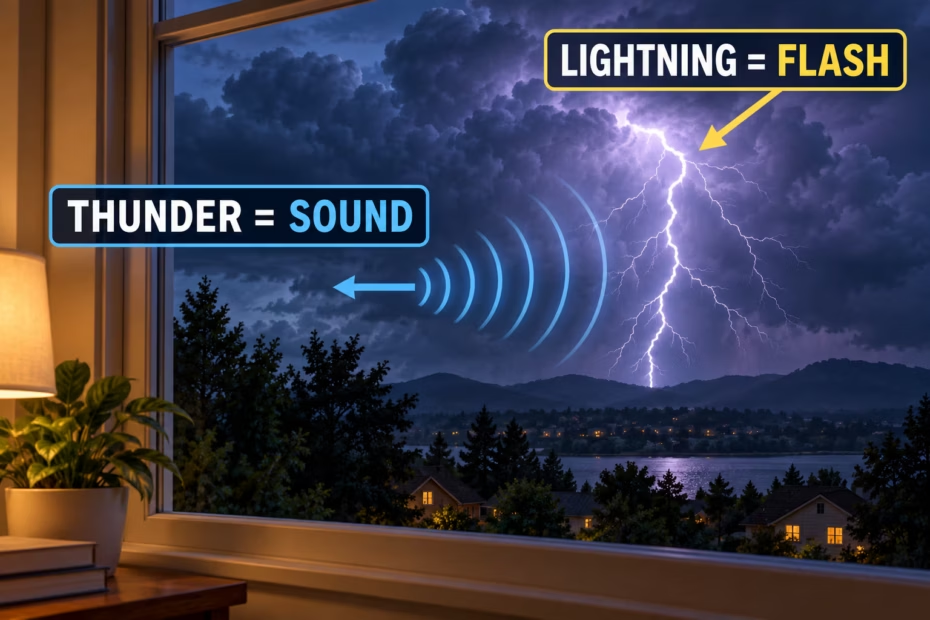
Adjectives For Thunder And Lightning refers to descriptive words for two different storm phenomena: thunder is heard, while lightning is seen. Words such as rolling and booming describe thunder’s sound; forked and jagged describe lightning’s shape. Mood words like ominous express a writer’s impression, not a forecast.
Adjectives for thunder and lightning at a glance
- Thunder is sound: try rolling, rumbling, booming, sharp, or distant.
- Lightning is a visible flash: try forked, jagged, branching, brief, or brilliant.
- Choose words by sense: describe what a character hears separately from what a character sees.
- Mood is interpretation: ominous or dramatic tells readers how the scene feels, not how dangerous the storm is.
- Writing vocabulary is not a safety test: if thunder is audible, follow official lightning-safety guidance and move indoors.
The National Weather Service explains that thunder is the sound produced when lightning rapidly heats the air and the air expands. Depending on the storm and the lightning channel, thunder may sound like a sharp crack or a longer rumble. Lightning, by contrast, is the flash you see; words for its brightness, duration, or branching shape describe the visual event.
| What you are describing | Useful adjectives | Example |
|---|---|---|
| Thunder’s sound | rolling, rumbling, booming, sharp, muffled | “A low rumbling thunder rolled beyond the hills.” |
| Lightning’s shape or look | forked, jagged, branching, bright, brief | “A brief, forked flash crossed the clouds.” |
| The storm’s effect on a scene | dark, sudden, dramatic, ominous | “An ominous sky darkened the afternoon.” |
Which adjectives describe the sound of thunder?
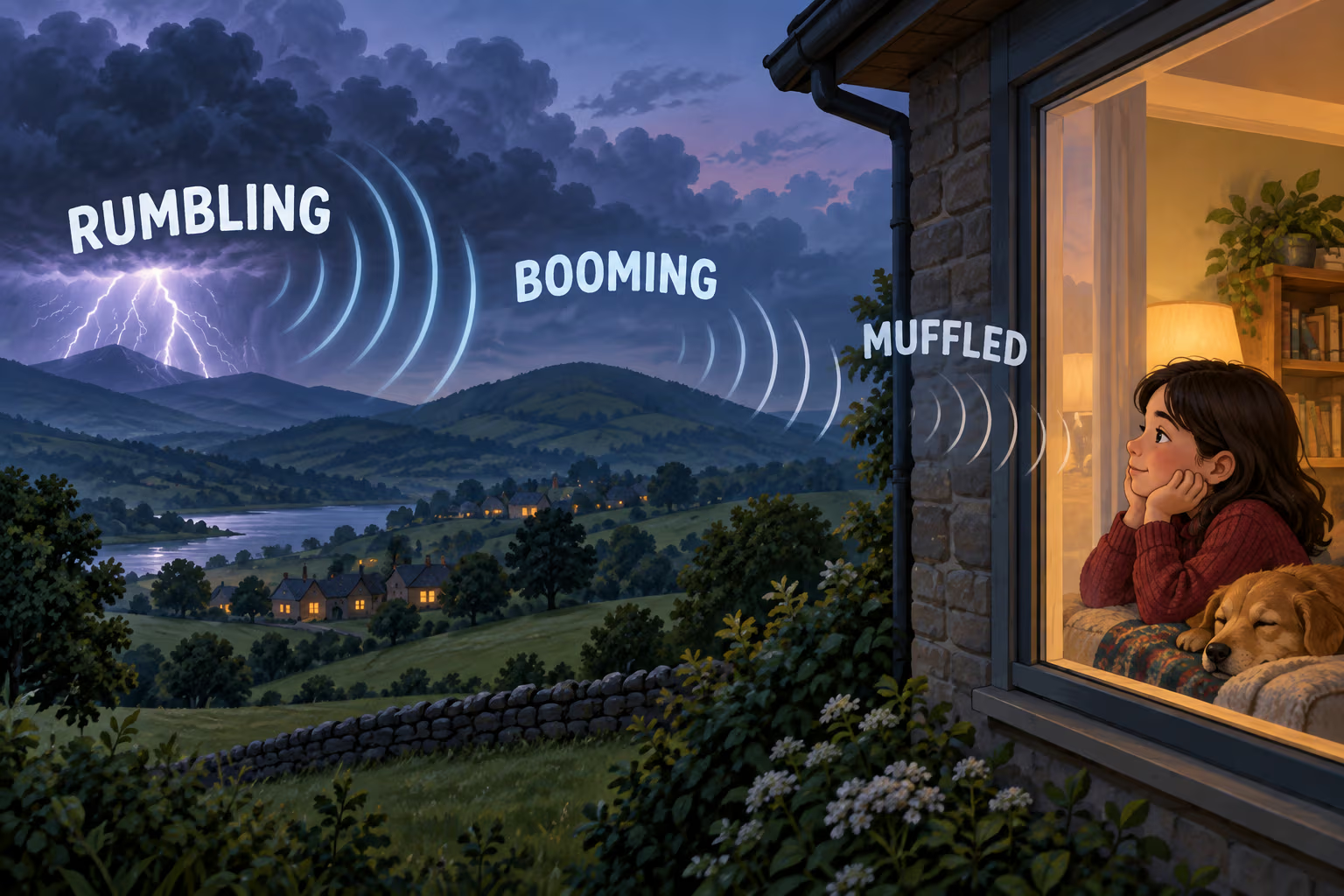
Use sound words for thunder because thunder is heard rather than seen. Rumbling suggests a low, extended sound; booming suggests a loud, full sound; and sharp or cracking suggests a sudden report.

Examples of thunder adjectives in sentences
- “A distant rumble of thunder followed the flash several seconds later.”
- “One sharp crack of thunder startled the hikers.”
- “Rolling thunder echoed across the valley.”
- “The storm sent a booming report through the open field.”
- “From inside the house, the thunder sounded muffled by the closed windows.”
Sound words depend on where the listener is and what happens in the storm. A long rumble does not by itself tell a reader the storm’s strength or the listener’s distance; use it as a description of the sound in the scene, not as a precise measurement.
Which adjectives describe the appearance of lightning?
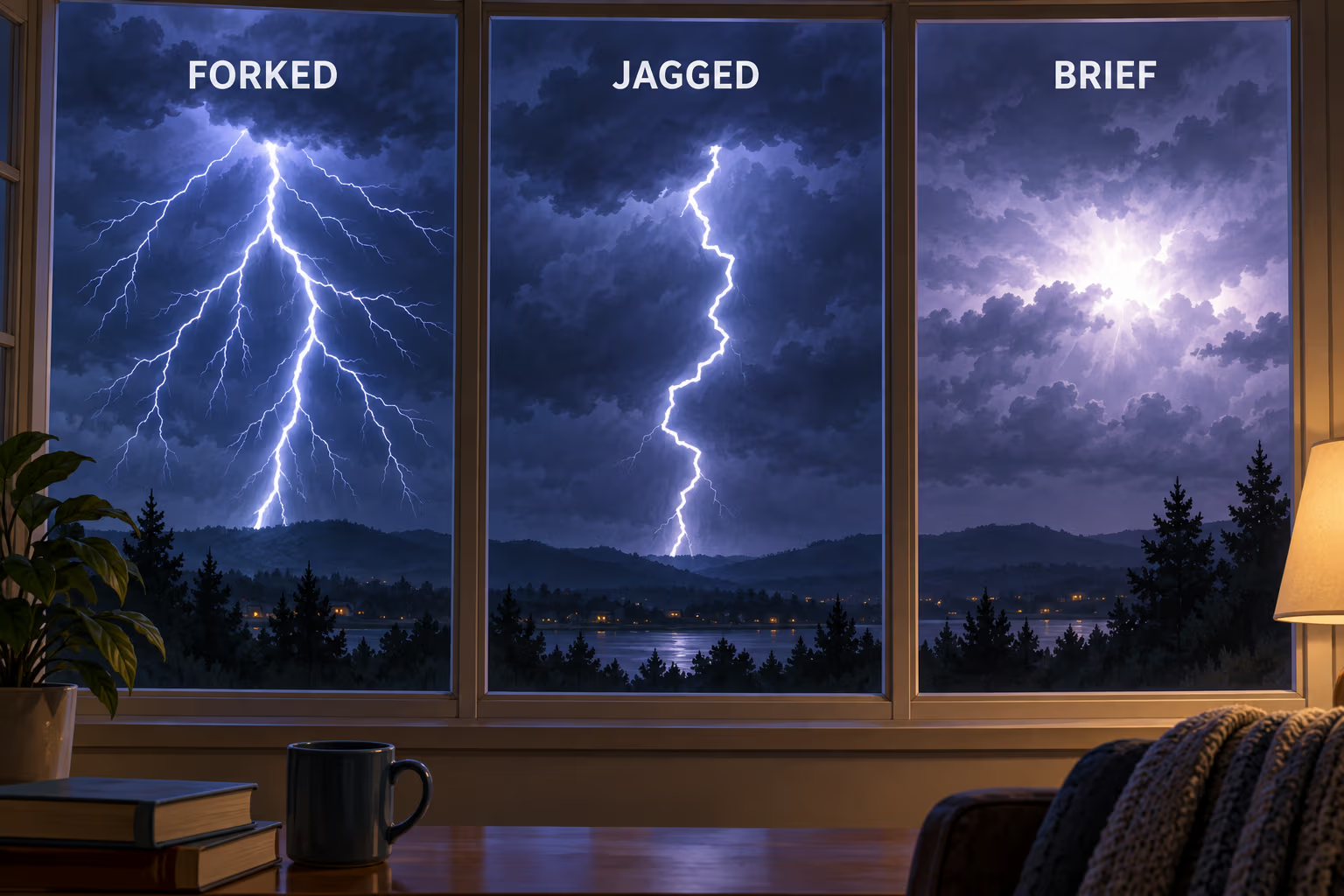
Use visual words for lightning’s shape, brightness, or duration. Forked, branching, and jagged describe a branching or angular path; brief describes how quickly a flash appears and fades; brilliant describes its intense brightness.
Examples of lightning adjectives in sentences
- “A forked bolt lit the clouds above the ridge.”
- “Jagged lightning flashed across the night sky.”
- “A brief flash revealed the outline of the trees.”
- “The brilliant bolt was visible through the rain.”
- “Branching lightning spread across the distant clouds.”
Lightning is the visible electrical discharge; a bolt or flash is a common way to describe one visible event. Avoid calling thunder “visible”: the sky may show a lightning flash while thunder is the sound associated with it.
How do you choose the right storm adjective?
Start by deciding whether the sentence describes sound, sight, or mood. Then choose one precise adjective that matches the detail you want readers to notice; stacking several near-synonyms can make a sentence less vivid.
- Name the subject. Is the sentence about thunder, lightning, clouds, rain, or a person’s reaction?
- Choose a sense. Use sound words such as rumbling for thunder, or visual words such as jagged for lightning.
- Add mood only if useful. Words like ominous describe an observer’s impression; they do not establish a storm’s risk.
- Read the sentence aloud. Keep the adjective that adds a clear image or sound and remove repetitions.

For example, “A loud, booming, thunderous thunder crashed” repeats the same idea. “A sharp crack of thunder followed the forked flash” gives readers one sound detail and one visual detail.
What does “thunderous” mean?
Thunderous usually means extremely loud and can also describe a strong or emphatic effect. “Thunderous applause” is figurative: it means very loud applause, not actual thunder. For a literal storm, booming thunder or rolling thunder is often more direct.
Some words can work in more than one way. Crackling can create a literary impression of repeated sharp sounds, but it is less exact than crack or rumble when describing thunder. Electrifying often describes excitement figuratively; use it for a character’s reaction rather than as a literal description of lightning.
Can adjectives tell you whether a storm is safe?
No. A vivid adjective does not measure lightning risk. The National Weather Service advises people to go indoors when they hear thunder, shelter in a substantial enclosed building or hard-topped vehicle, and wait at least 30 minutes after the last thunder before going back outside. This vocabulary guide is not a substitute for local weather alerts or safety instructions.
Sources: National Weather Service, “Thunder”; National Weather Service, “Lightning Safety Overview”; Cambridge Dictionary, “thunderous”.
Frequently asked questions
Is “crackling” a good adjective for thunder?
Crackling can work as an expressive, literary description, especially when a writer wants to suggest several sharp sounds. For a clear general description, cracking, sharp, booming, or rumbling is more direct. The best choice depends on the sound and the scene.
Can thunder be described as “forked”?
Forked describes a branching shape, so it normally modifies lightning rather than thunder. Thunder is sound; lightning is visible. A sentence may describe “forked lightning followed by rumbling thunder” to keep the two details distinct.
What is a figurative use of “thunderous”?
“The audience gave the speaker thunderous applause” uses thunderous figuratively to mean extremely loud. The word also works literally for a very loud sound, such as thunderous noise, but the sentence context tells readers which meaning is intended.
Which adjective should I use for a scary storm scene?
Choose the detail that creates the scene: ominous for an observer’s uneasy impression, booming for loud thunder, or jagged for a sharp-looking lightning path. Mood words are subjective descriptions and should not be treated as weather warnings.
A quick way to describe thunder and lightning
For clear writing, separate what is heard from what is seen: use sound adjectives for thunder and visual adjectives for lightning. Add a mood word only when it contributes to the scene. These distinctions make adjectives for thunder and lightning more precise, while official alerts—not descriptive words—should guide storm-safety decisions.
The original article below is preserved as published. Its alphabetized list is a legacy word bank, not a verified or carefully classified set of adjectives: it includes phrases, duplicates, misspellings, mixed parts of speech, and terms that may not describe thunder or lightning clearly. “Visible thunder” confuses sound with sight, and entries such as “harmless” or “innocuous” cannot establish that a storm or location is safe. Use the researched distinctions above when selecting words; follow official weather guidance for safety.
Adjectives are words that modify or describe other words. They can be used to describe the physical appearance of something, or to express feelings or emotions. When it comes to describing weather conditions, there are a few adjectives that are particularly useful for describing thunder and lightning.
For example, “crackling” is often used to describe the sound of thunder, while “forked” is often used to describe the appearance of lightning. In addition, “electrifying” is a good adjective to describe the feeling of being in the presence of thunder and lightning. Adjectives can be very helpful in making writing more vivid and expressive, so next time you’re trying to describe a storm, don’t forget to reach for your thesaurus.
Adjective For Thunder And Lightning
Adjectives play an important role in description, and this is especially true when it comes to weather phenomena like thunder and lightning. These words can help to paint a picture in the reader’s mind, making the experience more vivid and memorable.
In particular, adjectives can be used to convey the sound, sight, and feeling of thunder and lightning. For example, thunder can be described as “crashing,” “booming,” or “rumbling,” while lightning can be described as “brilliant,” ” blinding,” or “jagged.” By using these descriptive words, writers can give readers a better sense of what it’s like to experience these awe-inspiring natural phenomena.
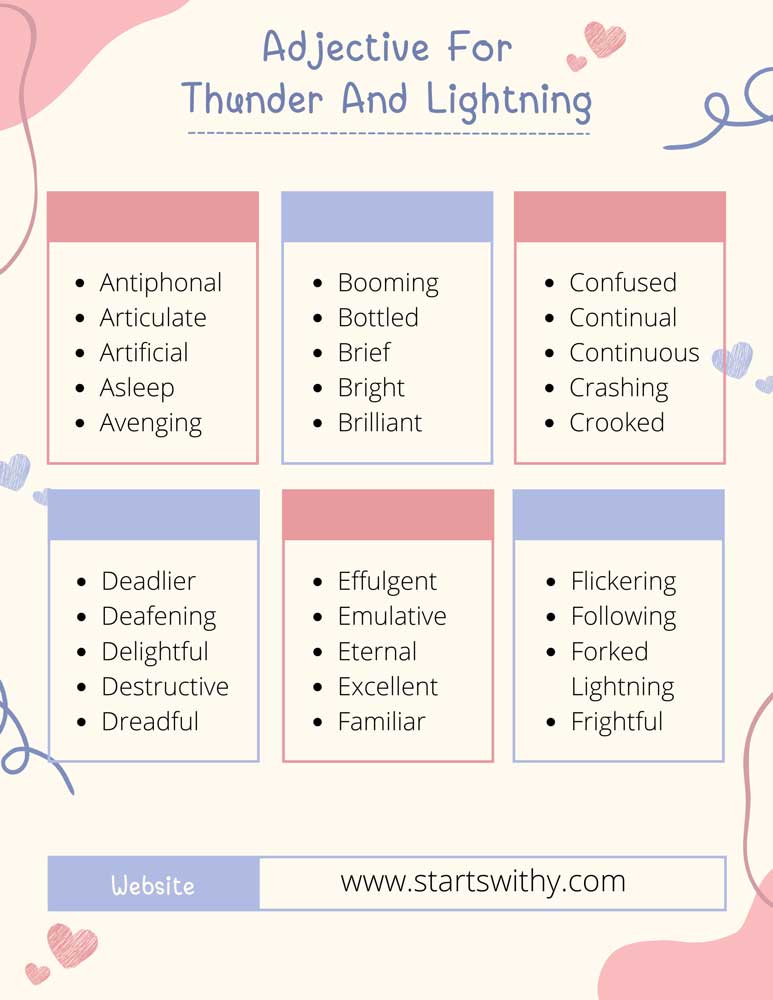
A
| Accustomed | African | Angry |
| Anotherbroken | Antiphonal | Approaching |
| Articulate | Artificial | Asleep |
| Avenging | Awful |
B
| Bare | Benignant | Black |
| Black Lightning | Blind | Blinding |
| Blue | Blue Lightning | Bold |
| Booming | Bottled | Brief |
| Bright | Bright Lightning | Brilliant |
| Brisk | British | Burning |
C
| Canst | Ceaseless | Cheery |
| Cloudy | Confused | Continual |
| Continuous | Crashing | Crimson |
| Crooked | Curious |
D
| Damp | Dark | Deadlier |
| Deafening | Deep | Delightful |
| Desolate | Destructive | Distant |
| Dormant | Double | Dread |
| Dreadful | Dreadful Thunder | Dreadfull |
| Dry | Dull |
E
| Earthly | Earthstupendous | Echoing |
| Eerie | Effulgent | Elusive |
| Emulative | Eternal | Excellent |
F
| Familiar | Farthest | Fateful |
| Fierce | Fiery | Fiery Lightning |
| Fine | Flaming | Flashed |
| Flashing Lightning | Flickering | Fold |
| Following | Forked | Forked Lightning |
| Forky | Frequent | Frightful |
G
| Gentle | Glimmering | Gloomy |
| Golden | Gorgeous | Grave |
| Gray | Greased | Great Thunder |
| Green | Guttural |
H
| Harmless | Harsh | Harsh Thunder |
| Heaventhe | Heavy | Heavy Thunder |
| Highest | Hoarse | Hollow |
| Hollow Thunder | Hooked | Horrible |
| Horrid | Hostile | Huge |
| Humble |
I
| Idle | Immediate | Imperial |
| Imprisoned | Incessant | Inexplicable |
| Innocuous | Intermittent | Inward |
J | K | L
| Jagged | Jarring | Keen |
| Large | Leaping | Leashed |
| Light Thunder | Live | Loudest |
| Luminous | Lurid |
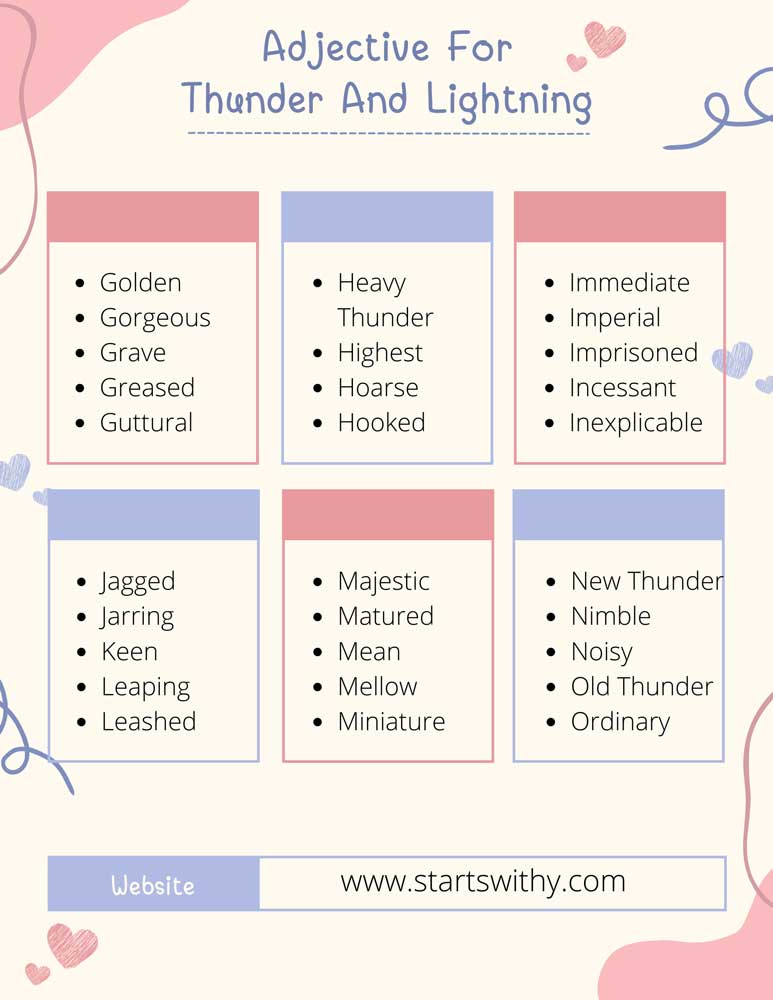
M
| Majestic | Maketh | Matured |
| Mean | Mellow | Mellowed |
| Melodious | Mental | Mere |
| Mighty | Mildest | Mimic |
| Miniature | Monotonous | Moral |
| Mortal | Muffled | Muffled Thunder |
| Murmurous | Musical | Mute |
| Mutter | Mysterious | Mysterious Thunder |
N | O
| Nearer | New Thunder | Nice |
| Nimble | Noisy | Old Thunder |
| Ominous | Ordinary |
P
| Pale | Parental | Paternal |
| Peremptory | Perpetual | Pointed |
| Popular | Powerful Thunder | Prodigious |
| Prolonged | Proverbial | Purple |
Q | R
| Quick | Quivering | Rapid |
| Real | Red | Regular |
| Retributive | Revolutionary | Rising |
| Rising Thunder | Roaring | Rocky |
| Rolling | Round |
S
| Savage | Scarlet | Scathing |
| Severe | Shaking | Sharp |
| Sheeted | Short | Sightless |
| Silent | Silver | Simultaneous |
| Sinister | Slumberous | Smothered |
| Soft | Solid | Sonorous |
| Sped Lightning | Spiritual | Steely |
| Stormful | Strange | Streaked |
| Stunning | Subterranean | Subterraneous |
| Subtle | Sudden | Sudden Lightning |
| Sullen | Sweet | Swift |
| Sworded Lightning |
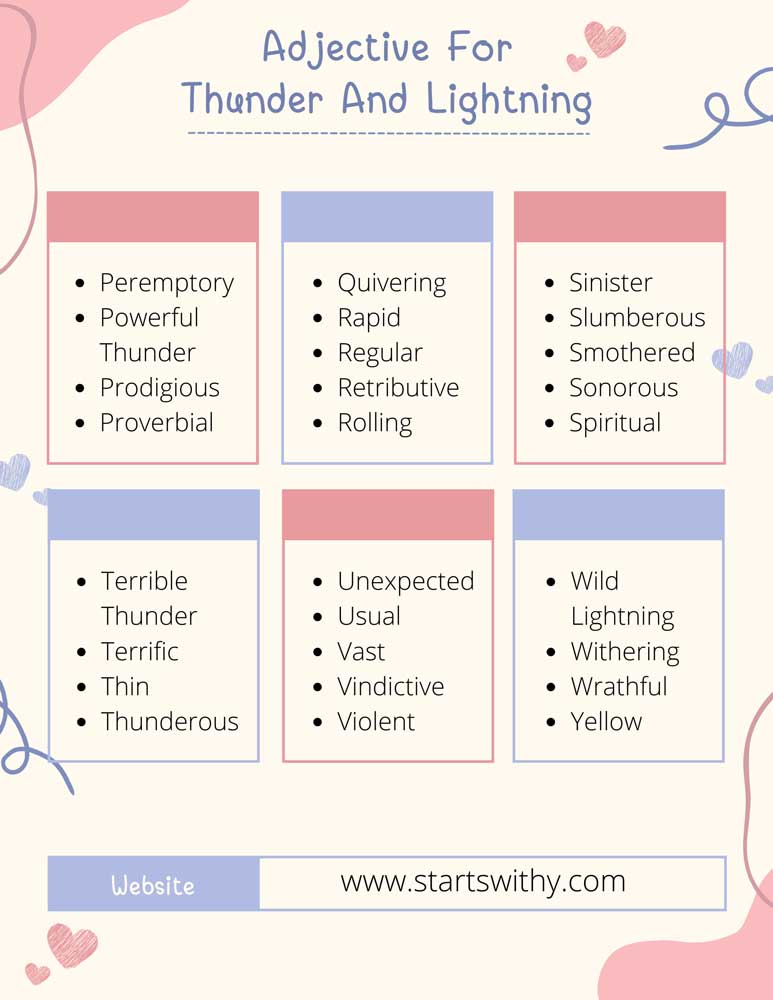
T
| Terrible | Terrible Thunder | Terrific |
| Terrifying | Thin | Thou |
| Thunderous | Titanic | Toned |
| Tongued | Tremendous | Tremulous |
| Tropick | Twisted |
U
| Ultimate | Unable | Unaccompanied |
| Unexpected | Uninterrupted | Unregarded |
| Usual |
V
| Vast | Vindictive | Violent |
| Violet | Visible | Visible Thunder |
| Visiblea | Vivid | Voiceless |
| Volcanic | Volleyed |
W | Y
| Watery | Weblike | Whirling |
| White Lightning | Wild | Wild Lightning |
| Wildering | Winged | Withering |
| Wonderful | Wrathful | Yellow |
Final verdict
Adjectives for thunder And lightning include adjectives such as “scary,” “loud,” “intense,” and ” impressive.” Adjectives can be used to describe the sound of thunder, the brightness of lightning, or both. They can also be used to convey the feelings that thunder And lightning evoke in people.
In general, Adjectives for thunder And lightning are positive, as they often indicate a sense of awe or wonder. However, some Adjectives (such as “scary”) may also convey a sense of fear or danger. Choose Adjectives for thunder And lightning based on the context in which they will be used.