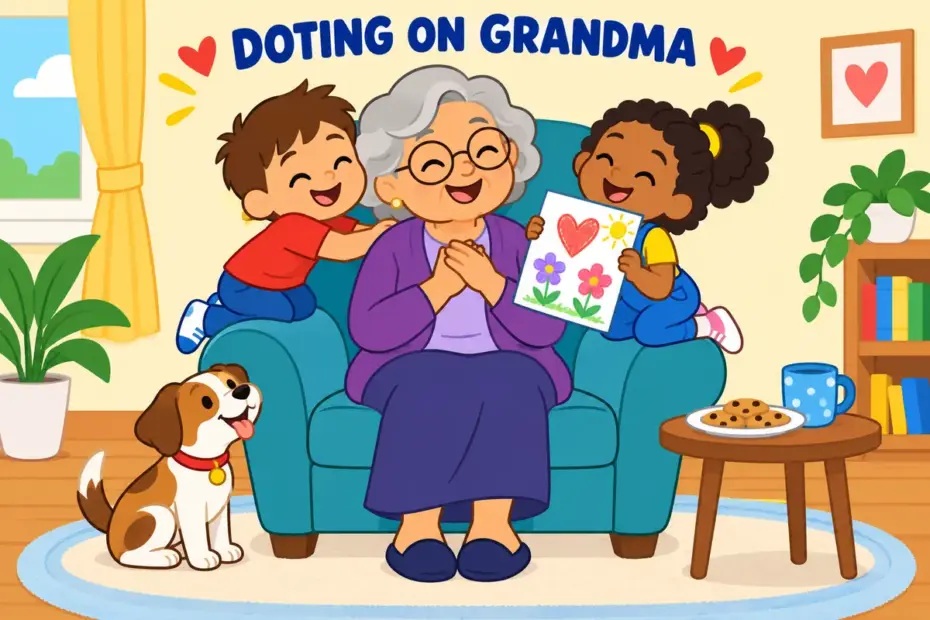
Dote means to love someone, usually a child or a partner, with more affection than good sense. To use dote in a sentence, add on or upon, as in “The grandparents dote on their youngest grandchild.” The verb is intransitive and almost never stands alone.
Dote at a glance
- Dote is an intransitive verb meaning to show excessive, indulgent affection.
- It is almost always followed by on or upon, never by a direct object.
- Its forms are dotes, doted and doting, with doting also used as an adjective.
- The fondness is usually directed at a child, a grandchild or a pet.
- Dote belongs to warm, slightly informal writing and speech.
- The commonest error is leaving out the preposition and writing dote someone.
What does dote mean?
Dote is a verb meaning to give someone far more affection and attention than is strictly sensible. The Cambridge entry for dote records the fixed pattern dote on someone, and its gentler near-synonym cherish keeps the warmth without the hint of overindulgence.
| Sense | Plain meaning | Example sentence |
|---|---|---|
| Dote on / upon | Love with excessive, indulgent affection | She dotes on her grandson. |
| Dote alone (older use) | Behave weakly or foolishly, mainly in older texts | The ageing king dotes and forgets his duties. |
One limitation is worth stating plainly. Dote carries a whisper of criticism, because the affection blinds the person showing it, so it is the wrong word for steady, balanced love. Say a parent loves a child, and save dote for the household where the youngest can do no wrong and the parents pamper every wish.
How do you use dote in a sentence?
Dote is intransitive, so a preposition must join it to the person who is loved. Four patterns cover almost every real sentence, and the participle doubles as an adjective.
| Pattern | Example | What it signals |
|---|---|---|
| dote on + person | My aunt dotes on her grandchildren. | The dominant pattern, with the preposition on. |
| dote upon + person | The old sailor doted upon his dog. | The same idea in a slightly older, more literary tone. |
| be doted on | The youngest was doted on by everyone. | Passive voice, with the loved person as subject. |
| doting + noun | Doting parents queued for the school play. | The participle used as an adjective before a noun. |
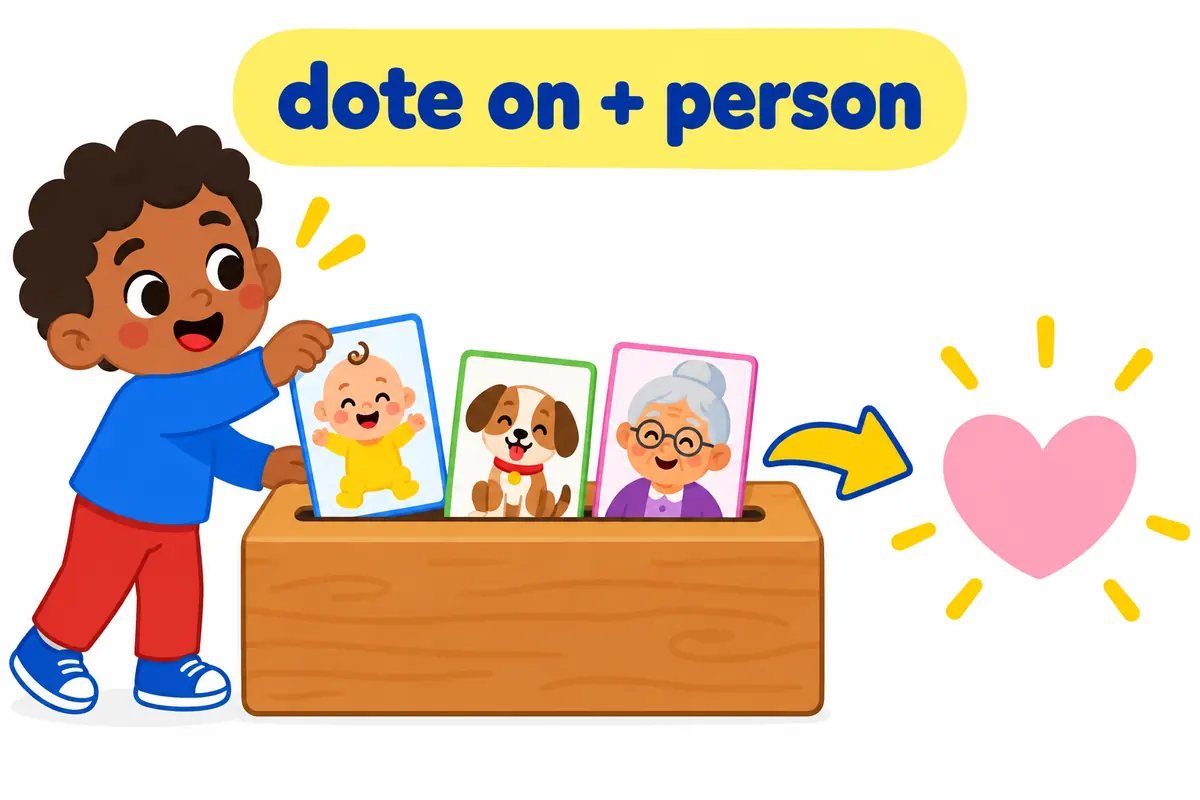
The practitioner rule is simple: if a direct object follows with no preposition, the sentence is wrong; dote always reaches its object through on or upon.
Dote in a sentence: examples across contexts
Dote barely shifts in meaning, but its tone moves with the context. The nine sentences below keep the same verb while moving from a family anecdote to a novel review, and each one names who is adored.
| Context | Example sentence | Why this works |
|---|---|---|
| Classroom | The story shows a queen who dotes on her only son. | A fairytale frame makes the overindulgence easy to see. |
| Family anecdote | Grandad dotes on the new puppy more than on us. | The comparison carries the humour and the mild criticism. |
| News report | Neighbours say the couple doted on the child they fostered. | Attributes the observation to witnesses, a common reporting move. |
| Biography | For all his severity in public, he doted on his daughters. | The contrast between public and private brings the sense alive. |
| Novel review | The author paints a mother who dotes on a son who will fail her. | Ties the affection to the plot, which is what a review needs. |
| Pet column | Owners who dote on their cats often overfeed them. | Shows the practical consequence of the overindulgence. |
| Academic prose | Letters show a father who doted upon an absent child. | Uses a source and the older preposition for a formal tone. |
| Sales copy | A gift for the grandparent who dotes on every photo you send. | The affectionate detail makes the product feel personal. |
| Conversation | You dote on that old car more than on your family. | The exaggeration is comic because dote is meant for people and pets. |
Only the last sentence stretches dote to an object, and the joke lands precisely because the usual target is a person or a pet.
Dote vs adore and spoil
Dote overlaps with two verbs and keeps a shade of its own. adore is warm and admiring without the hint of foolishness, while spoil stresses the harm that overindulgence does to the person loved.
| Attribute | dote | adore | spoil |
|---|---|---|---|
| Core meaning | Love with blind indulgence | Love and admire deeply | Overindulge until harm is done |
| Grammar | dote on / upon | adore + direct object | spoil + direct object |
| Typical object | A child, grandchild or pet | Anyone or anything | A child or animal |
| Register | Warm, slightly informal | Neutral to warm | Informal, often critical |
| Implies excess | Yes | No | Yes, with visible damage |
Verdict: use adore for straightforward love, spoil when the overindulgence has consequences, and dote when the affection is so fond it makes the adorer slightly blind.
Word forms and grammar of dote
Dote inflects regularly and its participle is common as an adjective. The table lists the real forms and the invented one learners reach for by mistake.
| Form | Part of speech | Example |
|---|---|---|
| dote | verb, base form | They dote on the baby next door. |
| dotes | verb, third person singular | He dotes on his garden. |
| doted | verb, past and past participle | Her mother doted on her as a child. |
| doting | verb participle or adjective | A doting uncle bought every toy. |
| dotingly | adverb, rare | He spoke dotingly of his old dog. |
| dote over | non-standard | Write dote on, not dote over, in standard English. |
The participle indulge is a useful check on tone: if the sentence suggests giving in to every wish, dote and indulge sit close together.
Common mistakes with dote
- Incorrect:
She dotes her grandson.Correct: She dotes on her grandson. Rule: Dote is intransitive, so it needs on or upon before the person loved. - Incorrect:
They dote over the new puppy.Correct: They dote on the new puppy. Rule: The standard preposition is on, not over. - Incorrect:
I dote that film.Correct: I love that film. Rule: Dote describes fond overindulgence in a person, so it does not fit a casual liking. - Incorrect:
He dotts on his cat.Correct: He dotes on his cat. Rule: The verb has one t and ends in e, unlike the word dots. - Incorrect:
I doubt on my niece.Correct: I dote on my niece. Rule: Dote and doubt sound close but mean affection and uncertainty, so check the spelling.
Practice using dote
Work through the six items, then check the reasoning rather than only the answer.
- Fill the gap: My grandfather has always ______ on his old radio.
- Choose the better word: The child is never told no because the parents (dote on / adore) him.
- Correct the error: She dotes her little brother.
- Build a sentence: use doted on about a singer and a loyal fan.
- Spot the register: which belongs in a family story — the aunts dote on the baby, or the aunts exhibit excessive affection?
- Rewrite with the participle: The uncle dotes on his nephew. Use doting as an adjective.
Answers
- doted — the past participle follows has and the preposition on.
- dote on — the excess and the blindness make dote the better fit than adore.
- She dotes on her little brother — the intransitive verb needs on.
- Model answer: The singer was doted on by one loyal fan for forty years.
- The aunts dote on the baby — a family story prefers the warm everyday verb.
- The doting uncle bought a gift every week — the participle works as an adjective.
The bottom line
Use dote in a sentence when the affection is so fond it borders on blind, and always join the verb to its person with on or upon. The two nuances that decide most sentences are these: dote is intransitive, so it never takes a direct object, and it carries a faint note of criticism that plain love does not. The phrase to test is doting fond, which only sounds right when the fondness has gone slightly too far.
Frequently asked questions about dote
What does dote mean?
Dote means to love someone with excessive, indulgent affection, far more than good sense would allow. It is most often used of parents, grandparents and pet owners. The verb implies that the person showing the affection is a little blind to the loved one’s faults, which is why it can carry a gentle hint of criticism.
Is it dote on or dote over?
The standard form is dote on, with dote upon as an older variant. Dote over appears in casual writing but is not standard, and the verb never takes a direct object. So you write she dotes on her grandson, not she dotes her grandson and not she dotes over her grandson.
What is the difference between dote and adore?
Adore means to love and admire deeply, while dote means to love with a fondness that spoils good judgement. You can adore a place or an idea, but dote is reserved for a person or a pet you overindulge. Adore carries no criticism, whereas dote quietly suggests the affection has gone too far.
Can you dote on things as well as people?
The verb is normally reserved for people and pets, but writers stretch it to treasured objects for humour, as in he dotes on that old car. The joke works because dote implies real affection. In ordinary writing, keep dote for living creatures and use love or be fond of for possessions.
Have you ever found yourself so infatuated with someone or something that you couldn’t help but shower them with adoration and affection? This intense fondness is what we refer to as “dote.” Doting on someone or something often involves expressing overwhelming love, admiration, and attention towards them.
When you dote on a person, pet, or even an object, you may find yourself constantly thinking about them, praising their qualities, and going out of your way to make them feel special. This behavior is driven by a deep emotional attachment and a desire to show your affection openly.
7 Examples Of Dote Used In a Sentence For Kids
- I dote on my cute little puppy.
- My grandma loves to dote on me with sweets.
- The teacher will dote on the best drawings in class.
- Parents often dote on their children with hugs and kisses.
- She will dote on her plants by watering them every day.
- The cat will dote on its favorite toy.
- The baby’s family will dote on the new arrival with gifts and cuddles.
14 Sentences with Dote Examples
- Dote on your studies to achieve academic success.
- Make sure to dote on your health by getting enough sleep and eating well.
- It’s important to dote on your mental well-being by practicing self-care activities.
- Don’t forget to dote on your hobbies and interests outside of academics.
- Remember to dote on your relationships with friends and family for a balanced college life.
- Take time to dote on your personal growth and development during your college years.
- Don’t hesitate to dote on seeking help from teachers or counselors when needed.
- Always dote on staying organized with your schedule and assignments to avoid last-minute stress.
- It’s crucial to dote on networking with professionals in your field for future opportunities.
- Make it a habit to dote on setting realistic goals and working towards them consistently.
- Don’t forget to dote on budgeting your expenses to manage your finances effectively in college.
- Remember to dote on exploring new extracurricular activities to broaden your skill set.
- Take the time to dote on learning new things outside of your academic curriculum for personal growth.
- Don’t hesitate to dote on participating in community service activities to give back during your college years.
How To Use Dote in Sentences?
Dote is a verb that means to show excessive love or fondness towards someone. When using dote in a sentence, it is important to ensure that it fits the context appropriately.
To use dote in a sentence, start by identifying the subject of the sentence – the person who is showing the affection. For example, “I dote on my little sister” or “She dotes on her pet cat.”
Next, identify the object of the affection – the person or thing that is being showered with love. For instance, “I dote on my little sister” or “He dotes on his grandchildren.”
Ensure that the sentence conveys the sentiment of excessive love or fondness. This can be done by using adjectives or adverbs that emphasize the intensity of the affection. For example, “She dotes tirelessly on her aging parents” or “They dote overwhelmingly on their newborn baby.”
Finally, make sure to place dote in the appropriate tense to match the rest of the sentence. For example, “I have always doted on my best friend” or “They will continue to dote on their grandchildren.”
By following these steps, beginners can effectively use the word dote in a sentence to express extreme love and affection towards someone or something.
Conclusion
In conclusion, “sentences with dote” refer to statements that express deep affection, admiration, or infatuation towards someone or something. These sentences often highlight a strong emotional attachment or fondness, showcasing the speaker’s adoration and love for the subject being discussed. Whether doting on a beloved pet, a cherished family member, or a favorite possession, these sentences convey a sense of tender care and devotion.
Through sentences with dote, individuals convey their deep feelings of love and admiration, expressing their emotional connections in a heartfelt manner. These expressions of affection can range from simple compliments to more elaborate declarations of adoration, making them a powerful way to communicate feelings of love and appreciation in a clear and straightforward manner.


