
Enable means to make an action possible, usually by giving someone the means or the opportunity to act. To use enable in a sentence, name the agent and follow the pattern enable someone to do something: “The grant enabled the team to finish the study.” The verb is transitive, so it always takes an object.
Enable at a glance
- Enable is a transitive verb; its forms are enable, enables, enabled and enabling.
- It means to make something possible, not merely to allow it.
- The dominant pattern is enable + object + to + base verb.
- In technology, enable a setting means switch it on.
- The commonest error is writing enable doing instead of enable to do.
What does enable mean?
Enable is a transitive verb meaning to make an action possible, or to give someone the power, means or authority to do it. The first sense supplies a route, the second supplies permission, and the third supplies a switch. The Cambridge entry for enable records the make-possible sense, and the word always needs something that is enabled.
| Sense | Plain meaning | Example sentence |
|---|---|---|
| Make possible | Supply the means for an outcome | The new bridge enabled the village to reach the clinic. |
| Give authority | Grant the power or right to act | The charter enabled the council to levy a fee. |
| Switch on | Activate a setting or feature | Enable two-factor login in the security menu. |
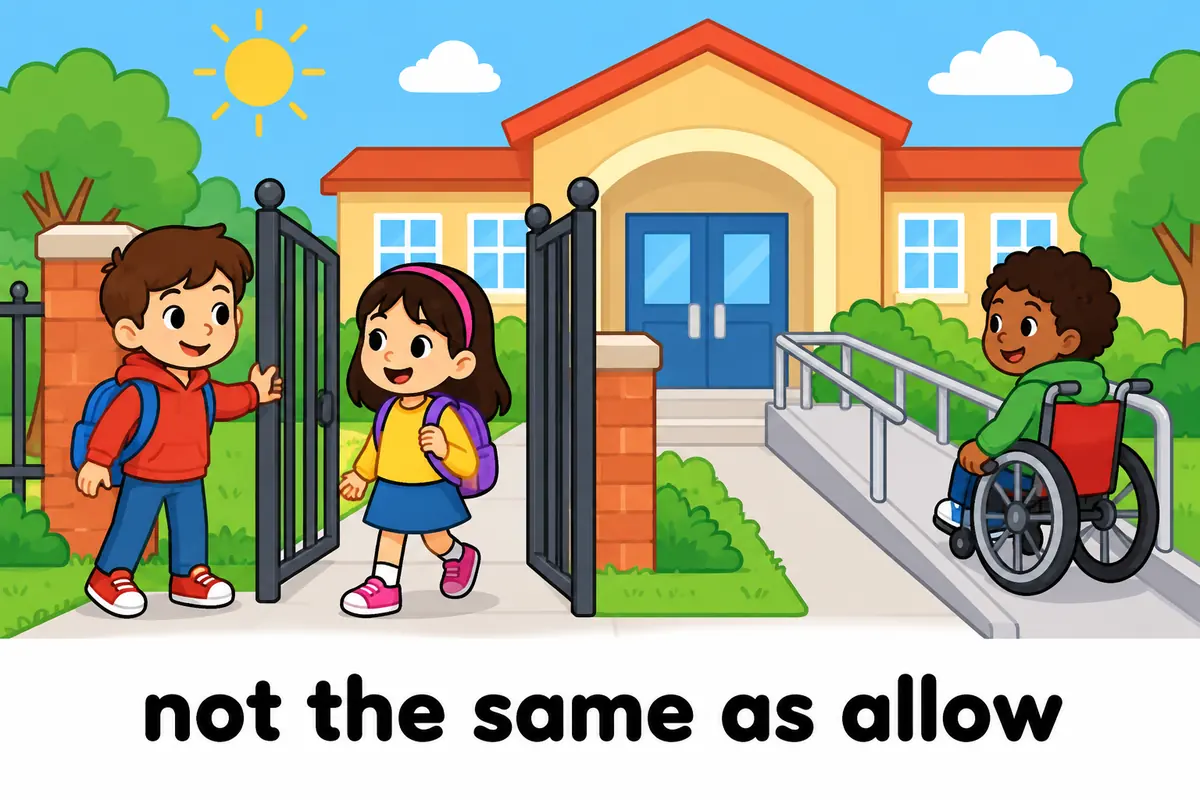
One limitation is worth stating plainly. Enable is not a synonym for allow. To allow something is only to remove a block; to enable it is to provide the means, so a rule can allow an action without enabling it. Where nothing is supplied, allowing a request is the accurate verb.
How do you use enable in a sentence?
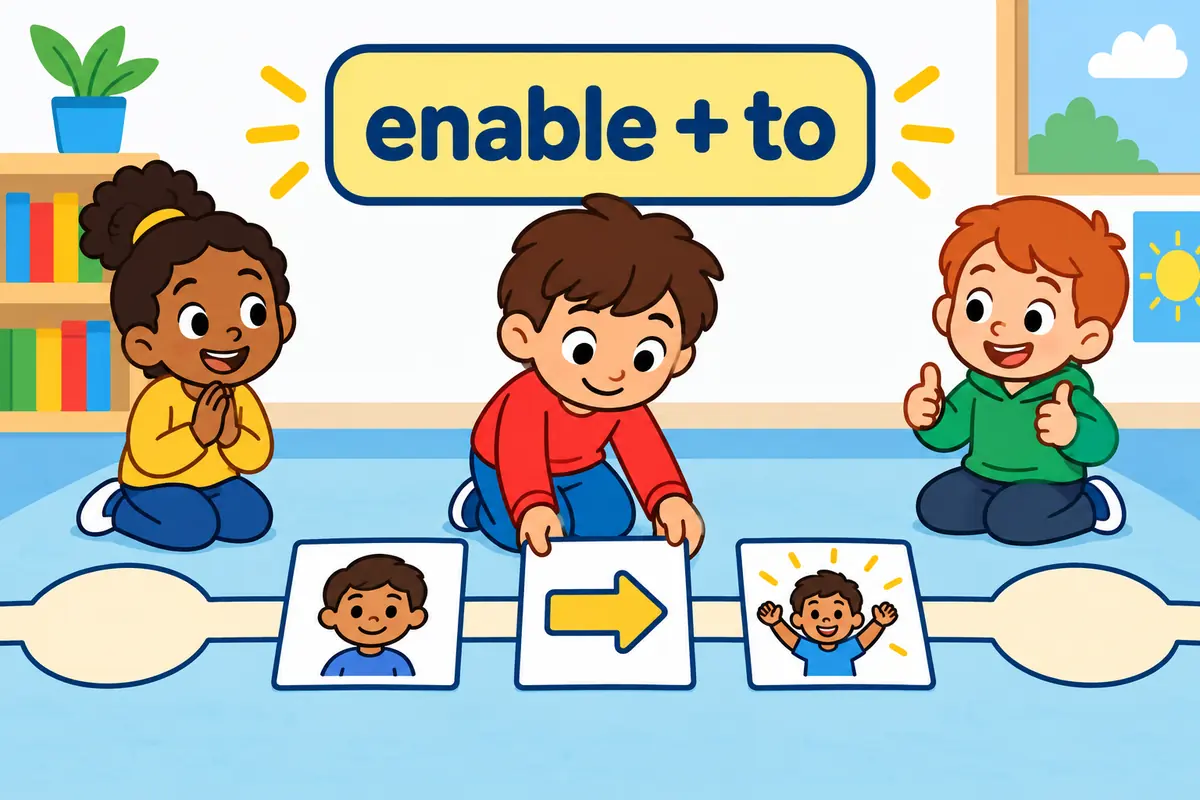
Enable works with an object and a to-infinitive: enable plus whoever receives the ability, plus to, plus the base verb. The object can be a person, a thing or an action, and the meaning shifts with each one.
| Pattern | Example | What it signals |
|---|---|---|
| enable + person + to + verb | The scholarship enabled Maya to study abroad. | A person gains the means or opportunity. |
| enable + thing + to + verb | The filter enables the pump to run on less power. | A thing makes an outcome possible. |
| enable + noun | The pass enables entry after six. | The object is an action or result, not a person. |
| be enabled by + noun | The launch was enabled by weeks of testing. | Passive voice keeps attention on the cause. |
| enabling + noun | Enabling legislation cleared the way. | An attributive use common in law and policy. |
Enable in a sentence: examples across contexts
Enable keeps the same grammar while the register moves. These sentences run from a classroom to a policy document, and each one names what is made possible and by what.
| Context | Example sentence | Why this works |
|---|---|---|
| Classroom | The reading app enabled the class to hear every word aloud. | A tool is the agent and the benefit is concrete. |
| Workplace email | Extra staffing enabled us to answer every ticket within a day. | Names the resource and the measurable result. |
| Technology | Enable dark mode to reduce glare in the evening. | The imperative uses the switch-on sense. |
| News report | The ceasefire enabled aid trucks to enter the region. | An event supplies the opportunity for action. |
| Legal writing | The statute enables the minister to set a cap. | Uses the grant-authority sense precisely. |
| Science writing | The lens enabled observers to resolve the two stars. | A device makes a measurement possible. |
| Sports report | The early goal enabled the side to defend its lead. | Ties a cause to a later tactic. |
| Academic prose | Better sampling enabled the team to test the theory. | A method makes a claim testable. |
| Conversation | The ramp enabled my grandmother to get inside. | The plainest use survives in speech unchanged. |
Across every row the same shape holds: something supplies the means, and the infinitive names the action that becomes reachable.
Enable vs empower and facilitate
Enable is close to empower and facilitate but not interchangeable with either. Empower a community adds confidence and control, facilitate a discussion means smooth the process rather than supply the means, and enable simply makes the action possible.
| Attribute | enable | empower | facilitate |
|---|---|---|---|
| Core meaning | Make possible by supplying means | Give power or confidence | Make a process smoother |
| Usual object | Person, device or action | A person or group | An event or discussion |
| Implies authority | Sometimes | Always | No |
| Common in technology | Yes, for settings | No | No |
| Register | Neutral to formal | Formal and political | Formal and professional |
Verdict: choose enable when something supplies the means, empower when the change is about control or confidence, and facilitate when the goal is to make a process run more smoothly.
Word forms and grammar of enable
Enable inflects regularly, and its past participle doubles as an adjective. Two derived forms appear in professional writing, and one word that looks like a relative is not one.
| Form | Part of speech | Example |
|---|---|---|
| enable | verb, base form | The key will enable access to the archive. |
| enabled | verb, past and past participle | The tutor enabled her to retake the test. |
| enabled | adjective | Press the enabled button on the panel. |
| enabling | present participle and adjective | Enabling laws made the scheme lawful. |
| enablement | noun, business jargon | The team runs sales enablement for the region. |
| amenable | adjective, different word | She was amenable to a later meeting. |
The adjective an enabled device is common in technology writing, and it is the past participle used as a description rather than a new word.
Common mistakes with enable
- Incorrect:
The ramp enabled Maya entering the hall.Correct: The ramp enabled Maya to enter the hall. Rule: Enable takes a to-infinitive, never a gerund. - Incorrect:
The rules enable to book a room.Correct: The rules enable staff to book a room. Rule: Enable needs an object between the verb and to. - Incorrect:
The manager was very enable after lunch.Correct: The manager was very amenable after lunch. Rule: An amenable person is willing; enable is a verb, not an adjective. - Incorrect:
The pass allows and enables entry at any hour.Correct: The pass allows entry at any hour, and a later rule enabled the evening opening. Rule: Allow removes a block; enable supplies the means, so they are not a pair.
Practice using enable
Work through the six items, then read the reason beside each answer rather than only the key.
- Fill the gap: The new lift ______ wheelchair users to reach the top floor.
- Choose the better word: The tutor (enabled / empowered) the class to keep control of its own project.
- Correct the error: The grant enabled starting the repairs early.
- Build a sentence: use enable + to about a library card and borrowing books.
- Spot the register: which belongs in a software guide — Enable notifications in Settings, or Turn the notifications thing on?
- Rewrite with the noun: The training enabled the staff to use the till. Use enablement instead.
Answers
- enabled — the lift supplies the means, and the pattern is enable someone to do.
- empowered — the class gained control, which is more than being made able.
- The grant enabled the team to start the repairs early — enable needs an object and a to-infinitive.
- Model answer: The library card enables students to borrow books.
- Enable notifications in Settings — a guide uses the imperative and the technical sense.
- The training provided enablement for the staff using the till — the noun names the process.
The bottom line
Use enable in a sentence when something supplies the means for an action, and follow the pattern enable someone or something to do something. The two nuances that decide most sentences are these: enable is stronger than allow, because it provides rather than merely permits, and it never takes a gerund after the object. Where the change is about control or confidence, empower is the better verb.
Frequently asked questions about enable
Is enable a formal word?
Enable is neutral, so it fits a software guide, a policy document and an ordinary conversation alike. It sounds slightly technical in casual talk, where people often say let or help instead. A sentence such as the ramp enabled her to get inside sounds natural anywhere.
What is the noun form of enable?
The straight noun is enablement, though it is business jargon and rare outside corporate writing. Most writers turn the verb around instead, as in the new ramp gave her access. For everyday prose, a plain noun such as access or opportunity keeps the sentence clear.
Can you say enable doing something?
No. Enable takes an object and then a to-infinitive, never a gerund, so the tutor enabled her to retake the test is correct and enable her retaking is not. The only exception is the attributive enabling, as in enabling laws, where it describes rather than governs.
Does enable always need an object?
Yes, because enable is transitive. Every sentence needs something that is enabled, whether a person, a device or an action, as in the setting enables two-factor login. The object can sit in the passive, as in two-factor login is enabled, but it is still there in meaning.
Enable in a Sentence: Meaning and Quick Examples
To enable means to make an action possible, give someone the means or opportunity to act, or grant permission; in a sentence, it commonly follows the pattern enable + person or thing + to + verb. For example, “The ramp enabled Maya to enter the building” names the ramp as the means and Maya as the person able to act.


- Part of speech: transitive verb; it normally takes an object.
- Common pattern: enable someone or something to do something.
- Core meaning: make an action possible by providing a means, opportunity, ability, or authority.
- Technology: enable a setting or feature means activate it.
- Verb forms: enable, enables, enabled, enabling.
How Do You Use Enable Correctly?
In the most common construction, put the person or thing that receives the ability immediately after enable, then use to before the base form of the next verb. Cambridge English Grammar Today describes the pattern as a direct object followed by a to-infinitive; Collins also labels this use “verb + noun + to-infinitive.”

| Pattern | Example | What it shows |
|---|---|---|
| enable + person + to + verb | The grant enabled Noor to finish her training. | A person receives the opportunity or means. |
| enable + thing + to + verb | The new filter enables the machine to use less water. | A thing makes an outcome possible. |
| enable + noun | The pass enables entry after 6 p.m. | The object is an action or result, not a person. |
| enable + feature or device | Enable location access only while using the map. | In technology, enable means switch on or activate. |
Do not leave out the object when the sentence needs one: “The guide enabled us to find the trail” is standard; “The guide enabled to find the trail” is not. The object may be a noun, pronoun, or noun phrase, such as the new schedule, them, or the team.
Eight Examples of Enable in a Sentence
- The handrail enabled Mr. Chen to climb the steps safely.
- A shared calendar enables the team to see schedule changes.
- Her scholarship enabled her to study engineering without taking an extra job.
- The adapter enables the older monitor to connect to a newer laptop.
- Clear labels enabled volunteers to sort the supplies quickly.
- The city’s new permit allows food carts to operate in the plaza.
- Enable two-factor authentication to add a second sign-in check.
- The study’s larger sample enabled researchers to compare the groups.
In the first five examples, enable names a means that makes an action possible. Example six shows the related authority sense, while example seven uses the common settings-menu instruction. In the final example, the research design makes a comparison possible; it does not mean that the sample performs the comparison by itself.
Can Enable Mean Give Permission?
Yes. Enable can mean authorize or give someone the right to do something, especially when a law, rule, pass, or official decision grants that authority. Collins distinguishes this permission sense from enabling someone by giving them a practical opportunity or means.
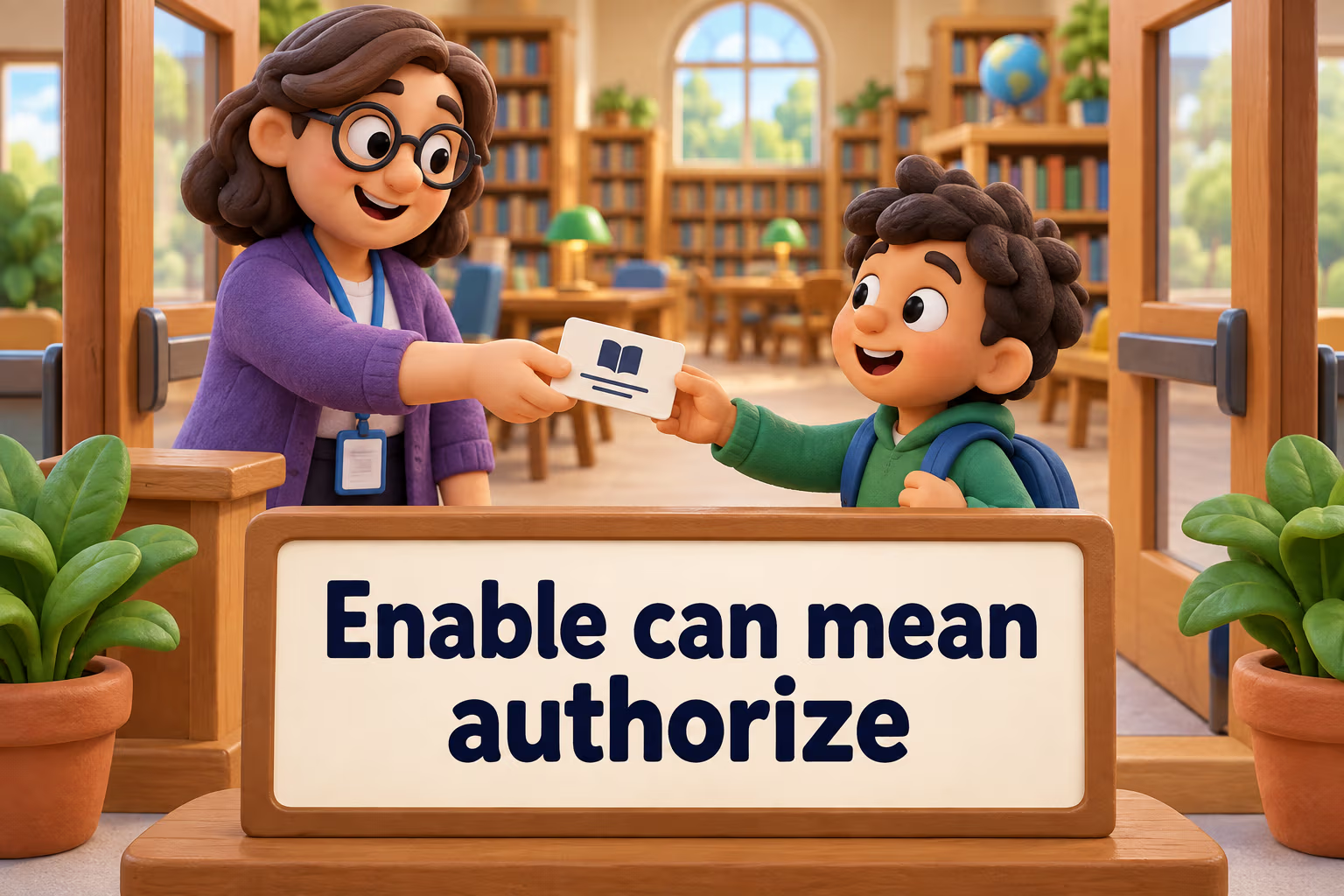
- Permission: The new policy enables tenants to request a review.
- Practical means: A ramp enables wheelchair users to reach the entrance.
- Cause or condition: Warm weather enables the seeds to germinate.
These meanings overlap because each describes a condition that makes an action possible. Choose a more exact verb when the distinction matters: authorize for official permission, equip for providing tools or skills, and cause when one event directly produces another.
What Does Enable Mean in Technology?
In a device or software interface, enable usually means activate a control, setting, connection, or feature so it can operate. “Enable notifications” means turn notifications on; “disable notifications” means turn them off. This use can take a direct object without a person-and-to-infinitive phrase.

Use the exact name of the control in instructions: “Enable Bluetooth in Settings” is more useful than “Enable the phone,” which could mean several different things. If an instruction changes privacy or security settings, name the effect and let readers decide whether it suits their needs.
Enable, Allow, Let, and Help
Enable, allow, let, and help can all describe conditions for an action, but their grammar and emphasis differ.
| Word | Usual pattern | Example |
|---|---|---|
| enable | enable + object + to + verb | The map enables us to compare routes. |
| allow | allow + object + to + verb | The rules allow visitors to take photos. |
| let | let + object + base verb | The host let us take photos. |
| help | help + object + (to) + verb | The map helped us (to) compare routes. |
Enable often highlights the means or condition that makes an outcome possible. Allow emphasizes permission or absence of a restriction, while let is more conversational and takes a bare verb, without to. Help means contribute to an action; the help may be partial rather than sufficient on its own.
Verb Forms and Common Grammar Mistakes
Enable is a regular verb: its past tense and past participle are both enabled; its present participle is enabling. Add -s for a third-person singular present subject: “The key enables access.”
- Present: This shortcut enables screen magnification.
- Past: The bus route enabled more residents to reach the clinic.
- Present perfect: The update has enabled users to save drafts.
- Passive: Visitors are enabled to reserve a seat online.
- With a gerund phrase: The new schedule enables working from home on Fridays.
Common errors come from mixing the patterns for nearby verbs. Use enable someone to do, not enable someone do. By contrast, let someone do normally has no to. Also check that the subject actually provides a means, permission, or condition: “The button enabled me to save the file” works if clicking it made saving possible; if you personally performed the action, “I saved the file” is clearer.
Frequently Asked Questions
Is enable followed by “to”?
When a person or thing is followed by an action, yes: write enable + object + to + base verb, as in “The course enabled Luis to apply.” In technology instructions, enable can take a noun directly—“Enable captions”—with no infinitive needed.
Is “enable me to” correct?
Yes. Me is the object that receives the opportunity or ability, and to introduces the action: “The extra practice enabled me to improve.” Do not write “enabled to me” or “enabled me improve.”
Can enable be used for a person?
Yes. A person can enable another person by providing tools, access, support, or permission: “The librarian enabled the class to use the research database.” The sentence describes what the action made possible; context determines whether that support is beneficial.
What is the difference between enable and allow?
Enable often emphasizes providing a means or condition; allow often emphasizes permission or lack of a barrier. Their meanings overlap, so the best choice depends on context. For a formal right, authorize may be more precise than either.
What is the opposite of enable?
Disable is the direct opposite when enable means activate a device or feature. In other contexts, the opposite depends on the meaning: prevent or hinder can describe stopping an action, while prohibit means officially forbidding it.
Sources and Further Reading
- Cambridge English Grammar Today: “Enable” — object + to-infinitive pattern and passive use.
- Collins COBUILD Advanced Learner’s Dictionary: “enable” — means/opportunity, possibility, permission, and grammatical examples.
Have you ever wondered what it means to “enable” something? In simple terms, to enable is to provide the necessary means or opportunity for something to happen or exist.
Enabling can range from empowering someone to achieve their goals to allowing a device or system to function in a certain way. Let’s explore various contexts where enabling plays a significant role.
7 Examples Of Enable Used In a Sentence For Kids
- Enable the light to see in the dark.
- Can you enable the fan for me, please?
- Enable me to count from 1 to 10.
- Enable the music to play on the phone.
- Enable the toy car to move forward.
- I will enable the TV to watch cartoons.
- Enable the computer to start up.
14 Sentences with Enable Examples
- Enable time management skills by creating a study schedule and sticking to it.
- Joining study groups can enable better understanding of complex concepts through peer discussion.
- Setting small goals can enable a sense of achievement and motivation in academics.
- Utilizing online resources can enable access to a variety of study materials for exam preparation.
- Seeking help from professors or tutors can enable clarification on doubts and improve academic performance.
- Enable a productive study environment by minimizing distractions and creating a designated study space.
- Utilizing digital tools and apps can enable better organization of study materials and notes.
- Participating in extracurricular activities can enable holistic development and provide a break from academic stress.
- Attending workshops and seminars can enable exposure to new ideas and concepts outside of the curriculum.
- Taking care of physical and mental well-being can enable better focus and concentration during study sessions.
- Enable collaboration with classmates for group projects to enhance team-building and communication skills.
- Seeking internships and practical training opportunities can enable hands-on experience in the chosen field of study.
- Participating in college events and competitions can enable networking and building connections with peers and professionals.
- Developing a growth mindset can enable resilience in the face of challenges and setbacks in academics.
How To Use Enable in Sentences?
To use the word Enable correctly in a sentence, you should understand its meaning and function in a sentence.
Enable is a verb that means to make something possible or to give someone the ability to do something. When incorporating Enable into a sentence, you are indicating that you are providing the means for something to happen.
Here are a few examples of how to correctly use Enable in a sentence:
- “Regular exercise can enable you to lead a healthier lifestyle.”
- “Completing this course will enable you to enhance your skills and knowledge.”
- “Using the latest technology will enable the company to streamline its operations.”
When constructing a sentence with Enable, it is important to ensure that the subject of the sentence is the entity being granted the ability to do something. The word Enable typically comes before the action that is made possible.
In summary, when using Enable in a sentence, you are conveying the idea of providing the necessary means or ability for something to happen. By understanding the meaning and context in which Enable is used, you can effectively incorporate it into your writing to express the concept of making something possible.
Conclusion
In conclusion, incorporating sentences with the keyword “enable” in your writing can enhance clarity, understanding, and effectiveness. By using such sentences, you can illustrate how certain actions or tools empower individuals to accomplish tasks or achieve goals. This word can serve as a powerful tool in highlighting capabilities, opportunities, and potential solutions within your content.
Furthermore, incorporating sentences with “enable” can aid in conveying the concept of providing support, facilitating processes, and promoting growth. These sentences can effectively demonstrate how various factors work together to make something possible or to improve a situation. By utilizing sentences with “enable,” you can convey information in a straightforward and accessible manner, ultimately improving the overall communication and impact of your writing.


