
Fruition is the point at which a plan, hope or effort finally becomes real. To use fruition in a sentence, put a plan as the subject and pair it with come to, bring to or reach: “The garden project came to fruition last spring.” The noun is uncountable, so it takes no plural and rarely an article.
Fruition at a glance
- Fruition is an uncountable noun; it has no plural form in standard use.
- It means the point at which a plan, hope or effort becomes real or successful.
- It appears almost always in the fixed patterns come to fruition and bring to fruition.
- The usual subjects are plans, projects, hopes, ideas and reforms.
- The commonest error is writing come into fruition, where the established form uses come to fruition.
What does fruition mean?
Fruition is a noun meaning the point at which a plan, hope or effort is achieved or begins to succeed. The Cambridge entry for fruition records the sense of a plan or idea beginning to happen or be successful, and the word keeps a sense of long effort finally rewarded. A project can still be imperfect when it reaches fruition, and the related achievement names the finished feat that follows.
| Sense | Plain meaning | Example sentence |
|---|---|---|
| Realization of a plan | The point at which a long effort pays off | The merger came to fruition after two years. |
| Bearing fruit, literary | The literal producing of fruit | The orchard reached fruition in late summer. |
One limitation is worth stating plainly. Fruition is not a synonym for any ending, and it does not mean mere completion. A failure cannot come to fruition, and a routine task that finishes on time has reached completion, not fruition, because nothing was hoped for and then rewarded.
How do you use fruition in a sentence?
Put the plan in the subject position, then choose the verb that says who makes it real. The patterns below cover almost every real sentence, and each keeps the plan as the thing being realized.
| Pattern | Example | What it signals |
|---|---|---|
| come to fruition | The reforms came to fruition last year. | The plan realizes itself over time. |
| bring + object + to fruition | She brought the scheme to fruition. | Someone deliberately makes it happen. |
| reach fruition | The book reached fruition after a decade. | Stresses arrival at the endpoint. |
| the fruition of + noun | The bridge was the fruition of years of planning. | Names the completed plan behind a thing. |
| be far from fruition | The idea was still far from fruition. | Marks how much remains to be done. |
The established phrase is come to fruition. Writers often produce come into fruition, which many editors regularize to the to form, and the formal verb behind the image of fruit is fructify.
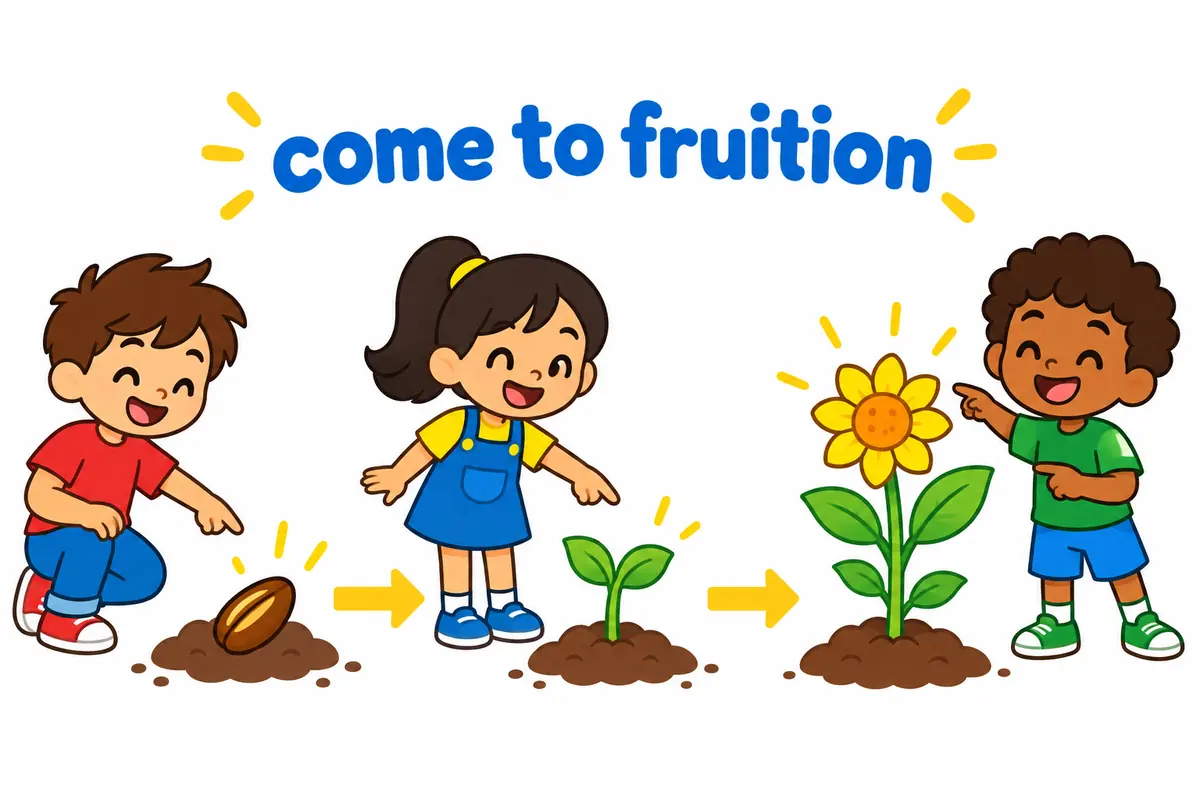
Fruition in a sentence: examples across contexts
Fruition keeps its meaning while the setting changes. The nine sentences below move from a classroom to an orchard, and each one shows a plan that finally became real.
| Context | Example sentence | Why this works |
|---|---|---|
| Classroom | The class play came to fruition on the last day of term. | A concrete event marks the plan becoming real. |
| Workplace email | The training plan will come to fruition in the spring. | A future date shows the effort is still maturing. |
| News report | Years of negotiation brought the treaty to fruition. | Names the agents and the long build-up. |
| Project update | The new library is close to fruition. | Careful phrasing for a plan nearly complete. |
| Academic writing | The fieldwork reached fruition in a single clear result. | Ends a long process in a definite outcome. |
| Agriculture | The apple trees brought their first fruition in the fifth year. | Uses the literal fruit-bearing sense. |
| Conversation | Her idea finally came to fruition. | The fixed phrase works in everyday speech. |
| Charity report | The appeal came to fruition with a new shelter. | Links the effort to a visible achievement. |
| Historical account | The reforms were the fruition of a long campaign. | Uses the fruition of pattern to name a legacy. |
Each sentence names a real outcome rather than a vague hope, which is what keeps the word from sounding inflated.
Fruition vs completion
Fruition and completion both mark a kind of ending, and they are not interchangeable. Completion says the work is finished; fruition says the plan has become real and, usually, successful. success is the closest everyday idea, though it is broader.
| Attribute | fruition | completion |
|---|---|---|
| Core idea | A plan becoming real and rewarding | The act of finishing something |
| Needs effort over time | Usually yes | Not necessarily |
| Applies to | Plans, hopes, projects and ideas | Tasks, forms, courses and buildings |
| Feeling | Positive; implies success | Neutral; states an end |
| Failure possible | A plan may never reach it | A task can be completed badly |
Verdict: choose completion for a neutral finish and fruition when a plan finally becomes real and rewarding.
Word forms and grammar of fruition
Fruition has no verb of its own, and its noun stays uncountable, which is where most learner errors start. The table also names a plural that writers invent and should avoid.
| Form | Part of speech | Example |
|---|---|---|
| fruition | noun, uncountable | The plan reached fruition at last. |
| fructify | verb, formal | Good soil helps the vines fructify. |
| fruitful | adjective | It was a fruitful meeting. |
| fruitfully | adverb | The day passed fruitfully for everyone. |
| fruitions | noun, non-standard | Keep fruition uncountable; do not add an s. |
Common mistakes with fruition
- Incorrect:
The plan came into fruition.Correct: The plan came to fruition. Rule: The established phrase uses to; many editors regularize the into variant back to it. - Incorrect:
We marked a fruition of the project.Correct: We brought the project to fruition. Rule: Fruition is uncountable and lives in fixed phrases, never with a or an. - Incorrect:
Her failed attempt finally came to fruition.Correct: Her attempt finally succeeded. Rule: A failure cannot reach fruition; the word implies success. - Incorrect:
The form came to fruition at five o’clock.Correct: The form was completed at five o’clock. Rule: Routine completion wants completion, not the reward-laden fruition. - Incorrect:
We need to fruition the plan.Correct: We need to bring the plan to fruition. Rule: Fruition is a noun; there is no verb to fruition.
Practice using fruition
Work through the six items, then check the reasoning rather than only the answer.
- Fill the gap: After five years of fundraising, the new hall finally came to ______.
- Choose the better word: The routine paperwork reached (completion / fruition) on Friday.
- Correct the error: The scheme came into fruition last month.
- Build a sentence: use bring to fruition about a teacher’s plan for a school garden.
- Spot the register: which suits a project report — the plan came to fruition, or the plan totally worked out?
- Rewrite with a countable noun: The merger came to fruition. Use achievement instead.
Answers
- fruition — the long effort ending in a real result is the fixed phrase come to fruition.
- completion — routine paperwork is finished, not a hoped-for plan rewarded.
- The scheme came to fruition last month — the established phrase uses to, not into.
- Model answer: The teacher brought her plan for a school garden to fruition.
- The plan came to fruition — a report avoids slang and keeps the formal noun.
- The merger was a real achievement — the countable noun takes an article and fits the sense.
The bottom line
Use fruition in a sentence when a plan, hope or effort finally becomes real, and keep the fixed patterns come to and bring to. The two facts that decide most sentences are these: the noun is uncountable, so it never takes a or an, and it implies success in a way that completion does not. If the ending is merely an outcome, choose accomplishment or completion instead.
Frequently asked questions about fruition
What does it mean for a plan to come to fruition?
When a plan comes to fruition it stops being only an intention and becomes real or successful. The phrase always points to the end of a long effort, so it suits a project, a reform or a hope that has taken time. A plan can come to fruition gradually, and the result need not be perfect.
Is fruition a countable noun?
No, fruition is uncountable in standard use. You write the fruition of a long campaign, not a fruition, and you never add an s. When you need a countable word, use result, achievement or outcome instead, all of which take a or an and can be made plural without any awkwardness.
Does fruition always mean success?
It leans that way. Fruition marks the moment a plan becomes real, and the word carries a positive charge that completion lacks. A routine task can be completed late or badly, but a plan that reaches fruition has usually rewarded the effort behind it. A failed attempt simply never reaches fruition at all.
What is another word for fruition?
The closest single words are realization, achievement and completion, though none matches exactly. Realization keeps the sense of something becoming real, achievement adds the reward, and completion stays neutral about value. The fixed phrase come true is the everyday equivalent, but it is too informal for a report or an essay.
Have you ever heard the phrase “bring something to fruition” and wondered what it really means? In simple terms, bringing something to fruition refers to successfully achieving or completing a goal, idea, or project.
When an idea, plan, or project comes to fruition, it means that it has been successfully realized or accomplished. It signifies the moment when something that was once just a concept or a dream becomes a reality, often after effort and hard work have been put into it.
7 Examples Of Fruition Used In a Sentence For Kids
- The plant grew tall and bore delicious fruits, finally coming to fruition.
- With hard work and determination, our project came to fruition.
- The little seed we planted in the soil eventually grew into a tree with ripe fruits, reaching fruition.
- After months of practice, our dance performance finally came to fruition on stage.
- The caterpillar spun a cocoon and transformed into a beautiful butterfly, its growth reaching fruition.
- We worked together as a team to build a sandcastle, seeing our creation come to fruition.
- The farmer watered his crops daily, watching them grow and eventually reach fruition.
14 Sentences with Fruition Examples
- Fruition of a well-structured study plan can lead to better academic performance.
- College students should strive to bring their innovative ideas to fruition through various projects and initiatives.
- It is important for students to set realistic goals and work towards their fruition.
- Collaboration with classmates can help in bringing group projects to fruition more efficiently.
- Effective time management skills are crucial for achieving fruition in all academic endeavors.
- Attending workshops and seminars can help students gain insights that can assist in the fruition of their career aspirations.
- Seeking guidance from mentors can accelerate the fruition of personal and professional goals.
- Students should focus on continuous improvement to ensure the ongoing fruition of their ambitions.
- Adhering to deadlines is essential for the timely fruition of academic assignments.
- Overcoming obstacles with determination is key to experiencing the fruition of hard work.
- Engaging in extracurricular activities can lead to the fruition of a well-rounded college experience.
- Networking with industry professionals can open doors to opportunities that can bring one’s career goals to fruition.
- Receiving positive feedback from professors can be a motivating factor in the fruition of academic success.
- Acknowledging the importance of mental health and self-care can contribute to the fruition of overall well-being as a college student.
How To Use Fruition in Sentences?
To use the word Fruition in a sentence, first, identify a situation where something is being realized or accomplished. For example, “After months of hard work, the project finally came to fruition.”
When using Fruition in a sentence, remember that it refers to the point at which a plan or project is successfully completed, or a desired outcome is achieved. You can replace words like “realization” or “accomplishment” with Fruition to add variety and depth to your writing.
Here are a few more examples of how to use Fruition in a sentence:
- The idea she had been nurturing for years finally came to fruition when she launched her own business.
- The long-awaited reunion with her family came to fruition as they embraced each other with tears of joy.
- Years of saving and planning came to fruition when they were finally able to buy their dream home.
By using Fruition in your writing, you can convey the sense of accomplishment, success, and fulfillment in a more sophisticated and nuanced way. Practice incorporating Fruition into your sentences to become more comfortable with this word and expand your vocabulary.
Conclusion
In conclusion, the examples of sentences with the keyword “fruition” showcase the concept of realization or achievement of a goal. Whether referring to a plan coming to fruition, a dream being realized, or a project reaching its culmination, the word “fruition” signifies the successful conclusion of efforts. These sentences illustrate the satisfaction and fulfillment that comes with seeing something through to its intended outcome.
By examining these sentences with “fruition,” we can understand the sense of accomplishment and joy associated with the completion of tasks or the attainment of aspirations. It serves as a reminder that persistence and dedication can lead to the fruition of our endeavors, reinforcing the idea that hard work pays off in the end.


