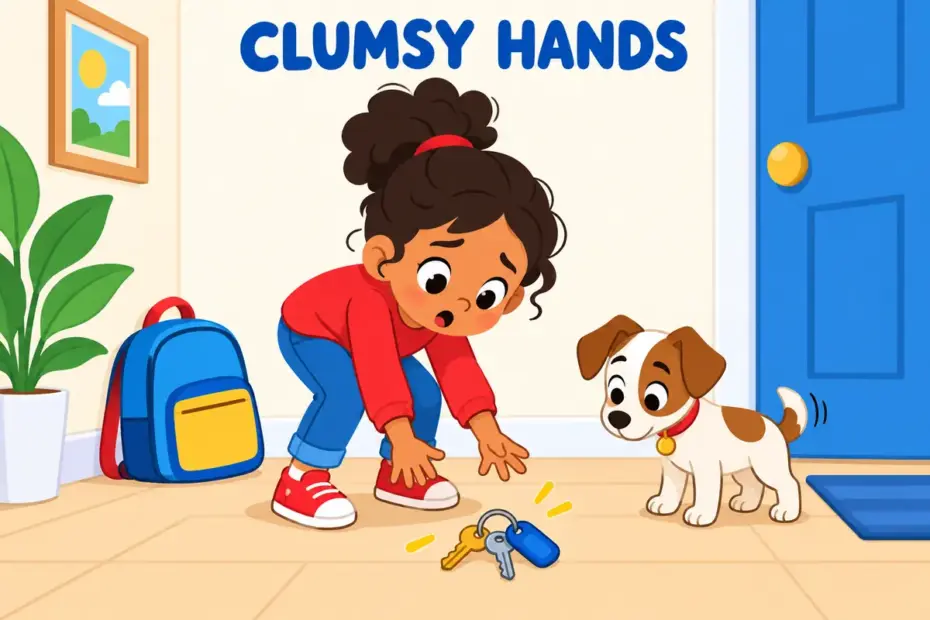
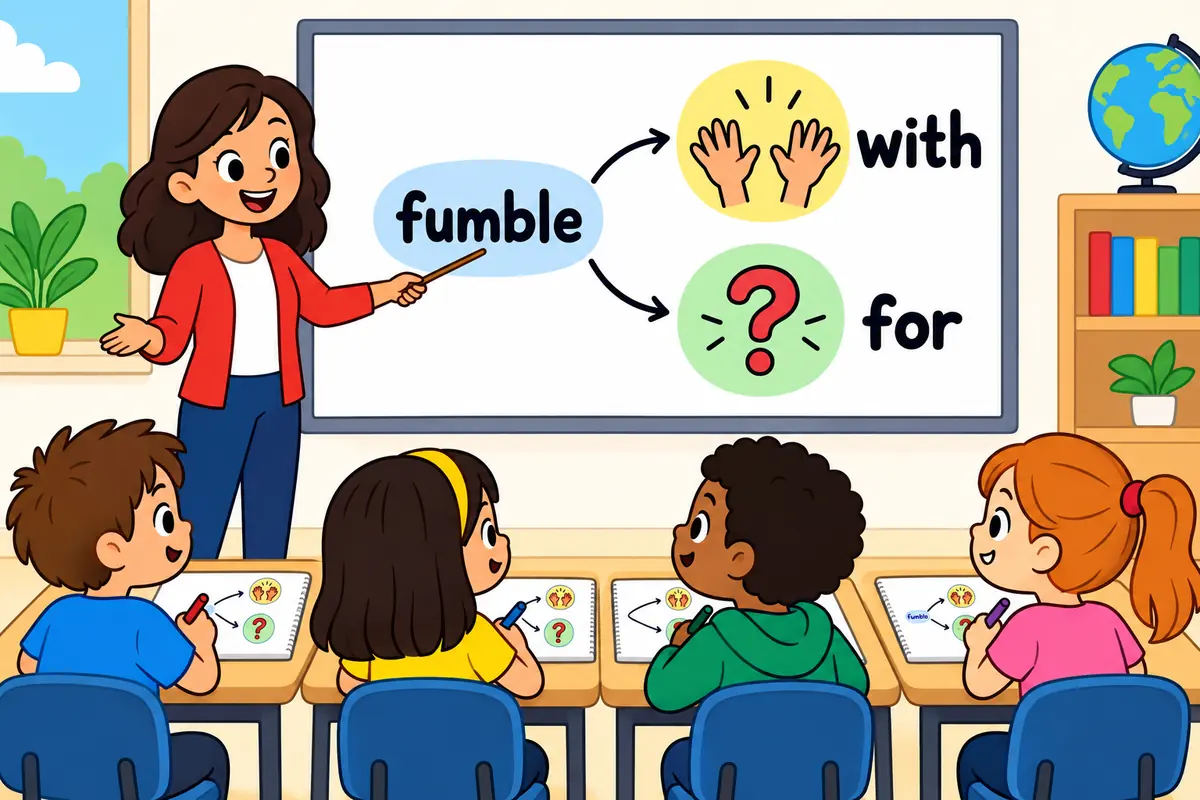
Fumble is a verb meaning to handle something clumsily or to search for words with difficulty. To use fumble in a sentence, pair it with a concrete object or a preposition: fumble with the keys, fumble for an answer. In sport the word also names dropping the ball.
Fumble at a glance
- Fumble is both a verb and a noun; its verb forms are fumbles, fumbled and fumbling.
- The two verbs senses are clumsy handling and searching with difficulty.
- The preposition decides the sense: fumble with something, fumble for something.
- The noun fumble is common in sport for a dropped ball.
- The commonest error is dropping the preposition and writing fumble the keys for handling them.
What does fumble mean?
Fumble is a verb meaning to use the hands awkwardly, to search for words or an object with difficulty, or, in sport, to drop a ball one should have held. The Cambridge entry for fumble records these senses, and the grammar points to which one is meant: fumble with takes a thing being handled, and fumble for takes a thing being sought.
| Sense | Plain meaning | Example sentence |
|---|---|---|
| Handle clumsily | Use the hands awkwardly | She fumbled with the keys at the door. |
| Search with difficulty | Grope for words or an object | He fumbled for the right word. |
| Sporting drop | Drop or lose control of a ball | The receiver fumbled the pass. |
| Noun | An act of dropping the ball | The fumble cost them the game. |
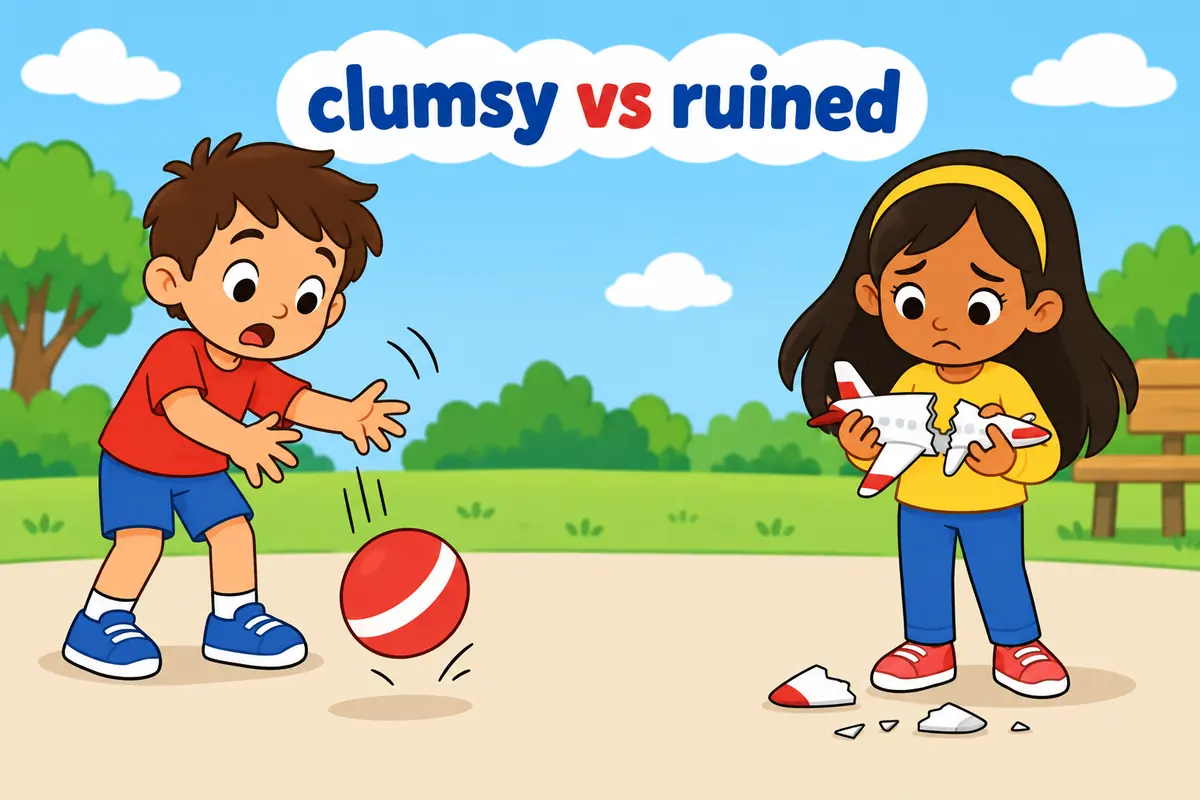
Fumble is too soft for a ruined outcome. If a repair leaves the machine broken, the verb is botch, not fumble, because fumble reports awkwardness rather than failure. It is also the wrong word for steady, deliberate groping in complete darkness, where grope is the plainer choice.
How do you use fumble in a sentence?
The preposition you choose fixes the meaning. When the hand is searching rather than mishandling, grope is more precise than fumble, because you grope for a switch in the dark but fumble with a zip you can already feel.
| Pattern | Example | What it signals |
|---|---|---|
| fumble with + noun | She fumbled with the zip. | Awkward handling of a known object. |
| fumble for + noun | He fumbled for the light switch. | Searching for something. |
| fumble + noun | The keeper fumbled the catch. | Losing control of a ball. |
| fumble one’s way | We fumbled our way through the dark. | Moving by touch through difficulty. |
| a fumble | That fumble changed the match. | Noun for a single dropped ball. |
Fumble in a sentence: examples across contexts
| Context | Example sentence | Why this works |
|---|---|---|
| Everyday speech | She fumbled with the keys at the door. | with marks clumsy handling of a known object. |
| Speaking | He fumbled for the right word in the meeting. | for marks a mental search under pressure. |
| Sport | The receiver fumbled the pass near the goal line. | Direct object shows a dropped ball. |
| News report | The minister blundered through the question. | A stronger synonym suits a public failure. |
| Academic writing | Beginners fumble the method before they master it. | Clumsiness as a stage on the way to skill. |
| Cooking | She fumbled the plate and dropped the ball of dough. | Two linked actions show a slip of the hands. |
| Apology | I fumbled my way through the apology. | one’s way shows managing despite awkwardness. |
| Workplace | Do not fumble the handover with a colleague waiting. | An instruction with a concrete object. |
| Sport report | A late fumble ended their hopes. | The noun compresses a whole incident. |
Fumble vs botch
Both words describe doing something badly, but they punish different things. To botch a job is to spoil the result, while to fumble is only to handle it clumsily, and the outcome may still be fine. To bungle a task also suggests a ruined outcome, which is stronger than a fumble.
| Attribute | Fumble | Botch |
|---|---|---|
| Core meaning | Handle something clumsily | Ruin a task by doing it badly |
| Strength | Mild and often recoverable | Strong; the result is spoiled |
| Register | Everyday speech and sport | Informal but blunt |
| Typical object | Keys, words, a ball | A repair, a job, a meal |
| What it implies | Awkwardness | A failure of skill |
Reach for fumble when the hands or words trip but the task survives, and for botch when the whole job has been ruined.
Word forms and grammar of fumble
| Form | Part of speech | Example |
|---|---|---|
| fumble | base verb | Do not fumble the catch. |
| fumbles | third-person singular | He fumbles his words when nervous. |
| fumbled | past tense | She fumbled the keys. |
| fumbled | past participle | The ball was fumbled at the line. |
| fumbling | gerund or participle | Fumbling with the lock wasted a minute. |
| fumbler | noun | The young fumbler needed practice. |
| fumble | noun | He forced the fumble on defence. |
Common mistakes with fumble
Incorrect: She fumbled the keys at the door. Correct: She fumbled with the keys at the door. Rule: handling a known object takes the preposition with.
Incorrect: He fumbled the light switch in the dark. Correct: He fumbled for the light switch in the dark. Rule: searching for something takes for.
Incorrect: He has one fumble: he talks too much. Correct: He has one foible: he talks too much. Rule: a minor weakness in a person is a foible, not a fumble.
Incorrect: The team fumbled by a goal. Correct: The team lost by a goal after a fumble. Rule: the verb needs an object; the noun names the incident.
Incorrect: She was fumbling with to open the box. Correct: She was fumbling to open the box. Rule: use a bare infinitive or a noun, never with to.
Practice using fumble
- Fill the gap: He ___ ___ his pocket for the ticket. (past tense + preposition)
- Fill the gap: The goalkeeper ___ the ball under pressure.
- Choose the better word: She (fumbled / botched) with the door handle, then opened it.
- Correct the error: I fumbled the remote in the dark.
- Build a sentence about a nervous speaker using fumble for.
- Pick the noun or verb: The ___ cost the team the match. (fumble)
Answers
- He fumbled in his pocket for the ticket, using the past tense and for to show a search.
- The goalkeeper fumbled the ball under pressure, with the ball as the direct object.
- She fumbled with the door handle, because the task was survived and only handling was clumsy.
- I fumbled for the remote in the dark, because searching takes for, not a direct object.
- The nervous speaker fumbled for words at the start, using for to show the mental search.
- The fumble cost the team the match, using the noun for a single dropped ball.
The bottom line
Fumble is a gentle word for clumsy hands or a struggling memory, and it never has to mean the task was ruined. The preposition does the deciding: fumble with an object, fumble for something out of reach. In sport the noun simply names a dropped ball. When you write fumble in a sentence, keep the object concrete and the blame light.
Frequently asked questions about fumble
Is fumble a verb or a noun?
Fumble is both. As a verb it means to handle something clumsily or search with difficulty, as in fumble with the keys. As a noun it names a single such act, especially a dropped ball in sport, as in a costly fumble.
What does fumble mean in sports?
In sport, to fumble is to drop or lose control of the ball while carrying it or catching it. The noun fumble names that single error. It appears most in American football, where a fumble can hand possession to the other team.
Can you fumble your words?
Yes. To fumble your words, or fumble for words, is to speak hesitantly because the right phrase will not come. The preposition for is the usual one, as in he fumbled for an answer, and the image is a mental search rather than a physical slip.
Is fumble always about the hands?
No. The word began with clumsy hands, but it extends to speech, memory and decisions. A speaker can fumble a question, and a team can fumble a plan. The thread is awkward, uncertain movement, whether of fingers or of thought.
Have you ever fumbled for the right words to express yourself in a situation? The verb “fumble” means to handle or manipulate something clumsily or uncertainly, typically resulting in mistakes or mishaps.
When we fumble, we often struggle to find the right way to accomplish a task or convey a message, leading to confusion or errors. Join me as we explore how to avoid fumbling in our interactions and become more confident in our expressions.
7 Examples Of Fumble Used In a Sentence For Kids
- Don’t fumble when you are tying your shoe laces.
- I saw him fumble while trying to catch the ball.
- Fumble and bumble, then try again!
- She tends to fumble when she’s nervous.
- It’s okay to fumble as long as you keep trying.
- Fumble not, dear child, for mistakes are part of learning.
- Let’s practice so we don’t fumble during the dance performance.
14 Sentences with Fumble Examples
- Fumble with the mic during a presentation.
- In the rush to get to class, she fumbled with her books and dropped them all.
- Trying to impress the professor, he fumbled through his answer during the exam.
- She fumbled with her phone trying to silence it in the middle of a lecture.
- Fumble while playing a game of cricket with friends on the college grounds.
- Fumble with the keys while trying to open the hostel room door late at night.
- Realizing he forgot to study for the test, he started to fumble through his notes in a panic.
- Fumble while trying to explain a complex concept to a peer during group study.
- During a debate competition, she fumbled over her words in front of the judges.
- Fumble with the projector controls during a group presentation.
- Trying to impress a crush, he fumbled while trying to ask them out on a date.
- She fumbled with her bag, searching for a pen during an important lecture.
- Fumble while trying to catch a frisbee during a friendly game on the campus lawn.
- Fumble while trying to demonstrate a chemistry experiment in the lab.
How To Use Fumble in Sentences?
To use the word Fumble in a sentence, follow these steps for beginners:
-
Understand the meaning behind the word Fumble. It refers to clumsily handling something, dropping or mishandling an object, or making a mistake in an action.
-
Identify the context in which you want to use the word Fumble. It could be in a sports setting, such as dropping a football during a game, or in everyday situations like dropping your phone.
-
Construct a sentence using the word Fumble appropriately. For example, “During the crucial play, the quarterback unfortunately fumbled the ball, leading to a turnover.”
-
Make sure the sentence makes sense and accurately conveys the idea of clumsiness or making an error.
-
Practice using the word Fumble in different contexts to become more comfortable with its usage.
Remember that Fumble can be used as both a noun and a verb. As a noun, it refers to the act of mishandling something, while as a verb, it describes the action of clumsily handling an object. Be mindful of the context in which you are using the word Fumble to ensure it fits appropriately within the sentence.
Conclusion
In conclusion, the examples of sentences with “fumble” highlighted instances of clumsiness, mistakes, or hesitations in various contexts. Whether describing a literal mishandling of an object, a metaphorical stumble in communication or decision-making, or a fumbled attempt at a task, the word “fumble” conveys an image of awkwardness and error. These illustrations demonstrate how the term can be used to portray a range of human errors and imperfections, capturing moments of vulnerability and struggle in everyday life.
Overall, the diverse sentences featuring the word “fumble” showcase its versatility in depicting blunders, mishaps, and uncertainties. By encapsulating moments of fumbling and missteps, these examples provide a glimpse into the common struggles and imperfections that people encounter, emphasizing the universal nature of mistakes and the importance of perseverance in overcoming challenges.


