
Furnish means to supply something, or to put furniture into a room, and both senses are current. To use furnish in a sentence, decide which one you need: a witness furnishes evidence, while a landlord furnishes a flat. The formal supply sense usually takes with.
Furnish at a glance
- Furnish is a transitive verb with the forms furnishes, furnished and furnishing.
- The formal sense is to supply or provide something, usually with the pattern furnish with.
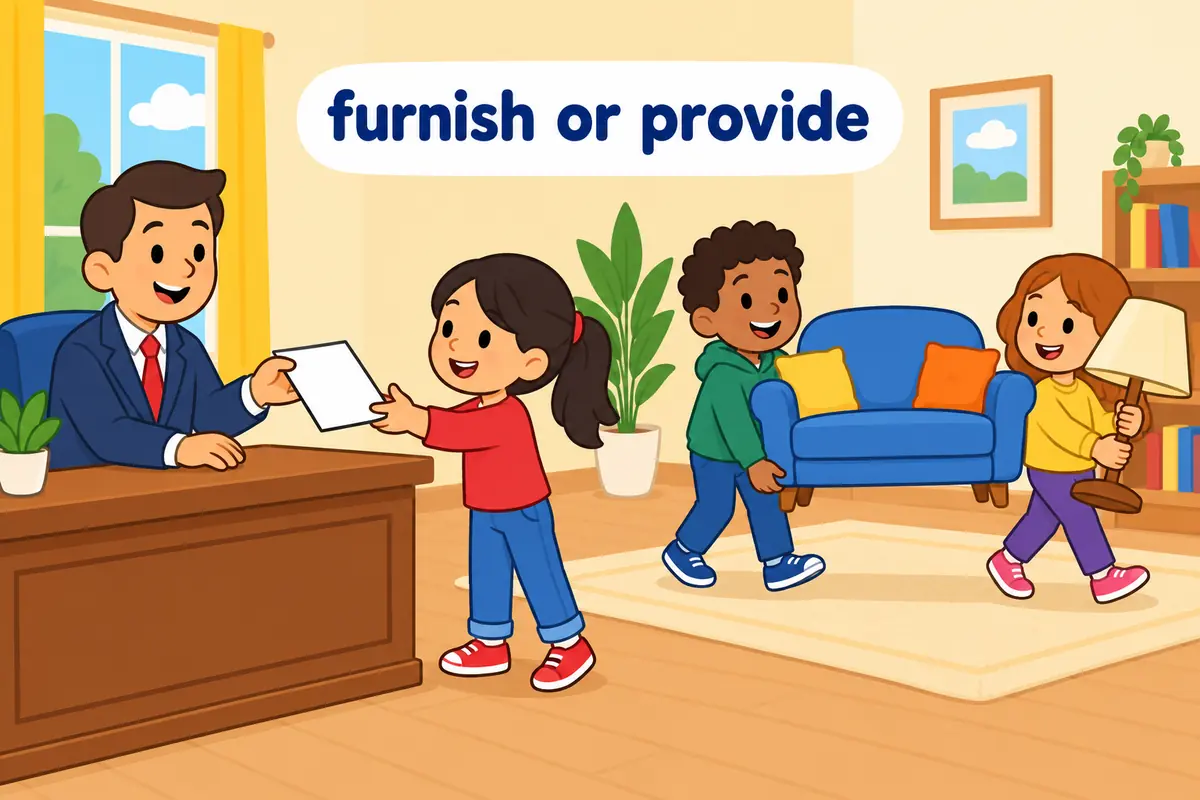
- The everyday sense is to put furniture into a room, house or flat.
- Its noun forms are furnishings and the participle furnishing; the object in the supply sense is a thing.
- The commonest error is treating afford as a synonym, although it means to have enough money.
What does furnish mean?
Furnish is a verb meaning to supply or provide something, and, in a second sense, to fit a room out with furniture. The Cambridge entry for furnish records both the supply sense and the furniture sense. The supply sense is formal and belongs to legal, official and academic writing, while the furniture sense is everyday.
| Sense | Plain meaning | Example sentence |
|---|---|---|
| Supply information | Give what is asked for | The bank furnished the figures to the auditor. |
| Provide an object | Give something needed | They furnished us with maps and lanterns. |
| Equip a building | Put furniture into a room | They furnished the flat in a week. |
| Fit with equipment | Supply a thing with a part | Each machine is furnished with a guard. |
One limitation is worth stating. Furnish is more formal than give and provider, and its furniture sense takes a room as its object, not the furniture itself. Where the register is casual, the plainer give evidence does the same work without any stiffness.
How do you use furnish in a sentence?
The verb is transitive, so it needs an object: something is furnished to someone, or someone is furnished with something, or a room is furnished. The with pattern is the standard one for the supply sense. The table sets out the working patterns.
| Pattern | Example | What it signals |
|---|---|---|
| furnish + object (supply) | The report furnishes no figures. | The formal supply sense with a bare object. |
| furnish + object + with + thing | They furnished us with maps. | The standard double pattern for supplying. |
| furnish + thing + to + object | The bank furnished the details to the auditor. | Moves the thing forward and the receiver after to. |
| furnish + a room or house | They furnished the flat in a week. | The furniture sense; the object is the place. |
| be furnished with | Each desk is furnished with a lamp. | Passive, common in estate listings and manuals. |
The practitioner rule is simple: a thing is furnished to a person, a person is furnished with a thing, and a place is furnished with furniture. To deliver results is the plainer choice when the tone is commercial rather than official.

Furnish in a sentence: examples across contexts
Furnish changes register more than it changes meaning. The nine sentences below move from a courtroom to an estate agent’s listing, and each one names exactly what is supplied or what the room receives.
| Context | Example sentence | Why this works |
|---|---|---|
| Legal writing | The witness furnished evidence that the door had been open. | Uses the formal supply sense with a noun object. |
| Estate agency | The flat is furnished with a desk and two beds. | Passive furniture sense, standard in listings. |
| Academic writing | Later scholars furnished references for every claim. | Shows the supply sense in a research context. |
| Business email | Please furnish the figures to the finance team. | Uses the to pattern in a polite request. |
| Technical manual | Every station is furnished with an emergency light. | Perfunctory passive, common in specifications. |
| News report | Officials furnished a list of sites to the committee. | Names the supplied document and its receiver. |
| History essay | The garrison was furnished with stores for the winter. | Uses the older equip sense in a description of a siege. |
| Everyday speech | We furnished the nursery with a cot and a rug. | The furniture sense with an ordinary subject. |
| Public notice | Applicants must furnish proof of address. | A fixed official phrase for supplying documents. |
Only the nursery sentence is conversational. The other eight keep the word in the supply or passive furniture patterns that official writing prefers.
Furnish vs provide and supply
Furnish overlaps with two commoner verbs and is interchangeable with neither. provide the details is the neutral everyday choice; supply the missing pages stresses quantity; furnish carries a formal, documentary tone.
| Attribute | furnish | provide | supply |
|---|---|---|---|
| Register | Formal and official | Neutral | Neutral to commercial |
| Typical object | Evidence, details, references | Help, support, information | Goods, pages, power |
| With pattern | Furnish somebody with something | Provide somebody with something | Supply something to somebody |
| Furniture sense | Yes, a room is furnished | No | No |
| Best for | Legal and official requests | Everyday statements | Quantities and logistics |
Verdict: choose furnish for formal supply and for fitting a room out, provide for the plain everyday statement, and supply when the amount or the flow of goods matters. To offer a receipt suggests willingness rather than obligation, which is a different move again.
Word forms and grammar of furnish
Furnish inflects regularly, and its family spreads into interior design as well as official prose. The table also separates furniture, which learners wrongly treat as the verb’s noun.
| Form | Part of speech | Example |
|---|---|---|
| furnish | verb, base form | Records furnish the dates of each sale. |
| furnishes | verb, third person | The office furnishes a handbook. |
| furnished | verb past | They furnished the room in a week. |
| furnished | adjective | They rented a furnished flat. |
| furnishing | verb participle | He is furnishing the study. |
| furnishings | noun, plural | The soft furnishings are new. |
| furniture | noun, different word | The furniture arrived late. |
| furnishment | non-standard | Avoid it; use the noun furnishings instead. |
The related adjective a furnished flat is the form estate agents use most, while furnishing a room names the activity itself.
Common mistakes with furnish
- Incorrect:
The witness furnished that the door was open.Correct: The witness furnished evidence that the door was open. Rule: Furnish needs a noun object, not a that-clause. - Incorrect:
They furnished furniture to the flat.Correct: They furnished the flat. Rule: In the furniture sense the object is the room, not the furniture. - Incorrect:
The room was furnished by a sofa and two chairs.Correct: The room was furnished with a sofa and two chairs. Rule: Use with for contents, not by. - Incorrect:
I cannot furnish a new car this year.Correct: I cannot afford a new car this year. Rule: Afford means to have enough money; furnish means to supply. - Incorrect:
Please furnish me the report by Friday.Correct: Please furnish me with the report by Friday. Rule: Careful use keeps with before the thing supplied.
Practice using furnish
Work through the six items, then check the reasoning rather than only the answer.
- Fill the gap: The company ______ the inspectors with all the requested files.
- Choose the better word: The landlord will (furnish / afford) the flat before the tenants move in.
- Correct the error: The report furnished that costs had risen.
- Build a sentence: use furnish + thing + to about a bank sending statements.
- Spot the register: which belongs in a legal letter — please furnish proof of address, or please send us some proof of where you live?
- Rewrite with the noun: They fitted the room with new curtains. Use furnishings instead.
Answers
- furnished — the past tense adds -ed and the with pattern supplies the receiver.
- furnish — afford concerns money, not fitting out a flat.
- The report provided evidence that costs had risen — furnish cannot take a that-clause on its own.
- Model answer: The bank furnished the statements to the auditor.
- Please furnish proof of address — a legal letter keeps the formal verb and the fixed phrase.
- The room had new soft furnishings — the plural noun names the items fitted into the room.
The bottom line
Use furnish in a sentence when something is formally supplied or when a room is fitted with furniture, and let the with pattern carry the thing supplied. The two details that decide most sentences are object and register: the supply sense takes a thing as its object, while the furniture sense takes a place, and the word stays more formal than provide. Where the tone is ordinary, provide or give is the honest replacement.
Frequently asked questions about furnish
Is furnish a formal word?
Furnish is more formal than give or provide, which is why it survives in legal, official and academic writing. A court asks a party to furnish evidence, and a notice asks applicants to furnish proof. In casual conversation the same idea is usually stated with give or send instead.
Does furnish always mean furniture?
No. The furniture sense is only one of its two main uses. The older and more formal sense is to supply information or goods, as in furnish the figures to the auditor. Context decides which meaning is active, and the with pattern almost always signals the supply sense.
Can you say furnish someone with something?
Yes, and that is the standard pattern for the supply sense: they furnished us with maps. You can also put the receiver last with to, as in furnish the details to the auditor. What careful writers avoid is the bare double object, so please furnish me the report is better written as please furnish me with the report.
What is the noun form of furnish?
The noun is usually furnishings, always plural, which names the items fitted into a room. The participle furnishing can also work as a noun for the activity, as in furnishing the hall took weeks. The invented form furnishment is not standard, so keep to furnishings in careful writing.
Have you ever found yourself struggling to come up with the perfect example sentence using the word “furnish”? “Furnish” means to provide or supply something, whether physical items or information. It is often used to describe the act of equipping a space with furniture or decorating it.
Constructing a sentence with “furnish” can enhance your writing by demonstrating how something is supplied or adorned. Using this word effectively can paint a clearer picture for the reader and add depth to your writing. Let’s explore some creative ways to incorporate “furnish” into your sentences!
7 Examples Of Furnish Used In a Sentence For Kids
- Furnish your room with bright colors and cozy pillows.
- We can furnish the dollhouse with tiny furniture and curtains.
- Let’s furnish the classroom with new books and colorful posters.
- You can furnish your desk with pens, markers, and stickers.
- Our garden will look beautiful once we furnish it with flowers and plants.
- Help me furnish the play area with fun toys and games.
- Remember to furnish your lunchbox with healthy snacks and fruits.
14 Sentences with Furnish Examples
- Furnish your dorm room with comfortable furniture and colorful accents to make it feel like home.
- Take a trip to the nearest market to furnish your kitchen with utensils and appliances for convenient cooking.
- Visit a thrift store to find budget-friendly items to furnish your living space with unique and eclectic pieces.
- Use online shopping platforms to conveniently furnish your study area with a desk, chair, and bookshelves.
- Furnish your wardrobe with trendy clothes and accessories that reflect your personal style.
- Attend local flea markets to find affordable decor items to furnish your walls and shelves.
- Collaborate with roommates to furnish common areas like the living room and dining room with shared furniture and decorations.
- Consider upcycling old furniture to furnish your space sustainably and creatively.
- Browse through interior design magazines for inspiration on how to furnish your room in a stylish and functional manner.
- Ask for recommendations from seniors on where to furnish your room with cost-effective yet durable items.
- Check out DIY tutorials online to learn how to furnish your space with handmade decorations and furniture.
- Visit a second-hand furniture store to furnish your room with pre-loved items at affordable prices.
- Plan a weekend shopping trip with friends to furnish your entire apartment with matching decor and furniture.
- Attend a furniture sale event in your city to furnish your space with high-quality items at discounted prices.
How To Use Furnish in Sentences?
To properly use Furnish in a sentence, follow these simple steps:
-
Understand the meaning: Furnish means to provide or supply something. It is often used in the context of providing furniture or other items to a space.
-
Choose the context: Determine in what way you want to use Furnish in your sentence. For example, you can talk about furnishing a room, furnishing information, or furnishing a service.
-
Construct the sentence: When using Furnish in a sentence, make sure to place it in a position that makes sense and conveys your message clearly. Here are a few examples:
- “The interior designer will furnish the new apartment with modern furniture.”
- “Could you please furnish us with the latest sales report?”
- “The company will furnish customers with a free trial of their software.”
-
Check for correctness: After forming your sentence, review it to ensure that Furnish is used correctly and fits the context. Make sure the sentence is grammatically sound.
By following these steps, you can effectively use Furnish in a sentence to communicate your message clearly and accurately. Remember to practice using Furnish in different contexts to become more comfortable incorporating it into your writing and speech.
Conclusion
In conclusion, examples of sentences with the keyword “furnish” illustrate how it is used to describe the act of providing or supplying something, particularly in the context of furniture or information. Whether it is furnishing a room with new chairs and tables or furnishing a report with relevant data and insights, the word “furnish” conveys the idea of equipping or adorning something with what is needed.
By examining sentences with “furnish,” we see how this versatile term can be applied in a variety of situations to convey the action of outfitting or supplying. It serves as a clear and concise way to express the act of providing what is necessary to complete a task or enhance a space, making it a valuable word in communication and writing.


